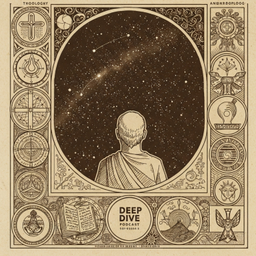
Forget the platitudes. 'Of Dust and Divinity' engages the dialectic between scriptural hermeneutics, philosophical inquiry, and anthropological theory. We're not just pondering; we're critically analyzing the inherent tensions and resonant harmonies between the terrestrial and the transcendent, the finite and the infinite.
The Hermeneutics of Derision in Augustinian Angelology (Part 2)
In this episode, we deconstruct Saint Augustine’s assertion in De civitate Dei 11.33 that holy angels "make sport of" or deride (illudunt) fallen demons whose persecutions inadvertently advance divine ends. While Augustine presents this celestial mockery as a triumphant theological certainty, we interrogate this cosmic comedy through Asymmetric Ludic Theory, Roman gender rhetoric, and biblical covenantal theology to demonstrate that it relies on a highly fragile set of structural assumptions.
We explore how angelic derision inherently requires casting the demon as a pedantic, task-oriented laborer whose earnest efforts providence continuously subverts. However, if the demonic adversary operates instead as a chaotic trickster or a malicious homo ludens seeking gratuitous destruction indifferent to systemic triumph, this angelic derision collapses into strategic misdirection. The traditional privatio boni defense fails to rescue Augustine's premise here, as privative evil requires no positive ontological substance to act as gleeful, non-teleological vandalism.
Furthermore, we trace how Augustine projects elite Roman rhetorical codes onto cosmology to protect this fragile framework. He pathologizes demonic possessive envy (invidia) as effeminate (muliebris) emotional volatility, while characterizing celestial dispassion (apatheia) as hyper-rational masculine virtue (virilitas). To preserve this Neoplatonic ideal of divine impassibility, Augustine suppresses the biblical archetype of God’s covenantal jealousy (El Kanna, Exod 34:14), re-interpreting divine passion into static justice and exiling exclusive relational desire to hell as demonic hysteria. Ultimately, we reveal how angelic mockery operates as a patriarchal reaction formation designed to insulate the City of God from relational vulnerability and existential tragedy.
10 Oct 2026
The Hermeneutics of Derision in Augustinian Angelology (Part 1)
In this episode, we deconstruct Saint Augustine’s assertion in De civitate Dei 11.33 that holy angels "make sport of" or deride (illudunt) fallen demons whose persecutions inadvertently advance divine ends. While Augustine presents this celestial mockery as a triumphant theological certainty, we interrogate this cosmic comedy through Asymmetric Ludic Theory, Roman gender rhetoric, and biblical covenantal theology to demonstrate that it relies on a highly fragile set of structural assumptions.
We explore how angelic derision inherently requires casting the demon as a pedantic, task-oriented laborer whose earnest efforts providence continuously subverts. However, if the demonic adversary operates instead as a chaotic trickster or a malicious homo ludens seeking gratuitous destruction indifferent to systemic triumph, this angelic derision collapses into strategic misdirection. The traditional privatio boni defense fails to rescue Augustine's premise here, as privative evil requires no positive ontological substance to act as gleeful, non-teleological vandalism.
Furthermore, we trace how Augustine projects elite Roman rhetorical codes onto cosmology to protect this fragile framework. He pathologizes demonic possessive envy (invidia) as effeminate (muliebris) emotional volatility, while characterizing celestial dispassion (apatheia) as hyper-rational masculine virtue (virilitas). To preserve this Neoplatonic ideal of divine impassibility, Augustine suppresses the biblical archetype of God’s covenantal jealousy (El Kanna, Exod 34:14), re-interpreting divine passion into static justice and exiling exclusive relational desire to hell as demonic hysteria. Ultimately, we reveal how angelic mockery operates as a patriarchal reaction formation designed to insulate the City of God from relational vulnerability and existential tragedy.
3 Oct 2026
Blinded by Glory: Divine Hiddenness and the Kenotic Flood (Part 2)
This episode explores whether we are living in the shadow of a hidden God, or if we are simply blinded by an excess of divine light. We challenge the long-standing theological consensus surrounding divine hiddenness by taking a critical look at Eberhard Jüngel’s famous concept of the Deus absconditus and the "ontological reserve" used to protect divine freedom. By unpacking these ideas, we show how any lingering insistence on divine concealment ultimately undermines the radical, absolute reality of the Incarnation.
Instead of accepting a divine mystery defined by distance and secrecy, we propose a bold alternative: a saturated Christology of "light in light." Drawing on the ancient patristic wisdom of Gregory of Nazianzus and the modern phenomenology of Jean-Luc Marion, we show how divine mystery is not a dark veil of withheld truth, but an overwhelming, unshielded torrent of self-giving love. This paradigm shift demonstrates that God holds nothing back from creation, revealing the cross as the exhaustive, fully given nucleus of divine life.
By reframing our understanding of the divine nature, we journey together into a theology of radical kenotic outpouring where divine freedom is expressed not in aloof self-preservation, but in total self-gift. We invite our listeners into this deep dive as we dismantle artificial boundaries, re-examine the profound silence of Holy Saturday, and encounter a glory that is simply too radiant to be hidden.
Reach and audience
Public platform figures. Ratings count people who left a rating, not total listeners.
Spotify
5.0 / 5
2 ratings
Contact Of Dust and Divinity
Guest appearances
Does not typically book guests
Based on episode analysis; this does not confirm that the show is currently accepting guests.
Host of Of Dust and Divinity?
Claim your podcast to manage its listing and keep your show details accurate.
Pod Engine is an independent podcast discovery and analytics service and is not affiliated with or endorsed by this podcast. Artwork and show content belong to their owners. Full legal notice.
Explore this show Podcast research with Pod Engine