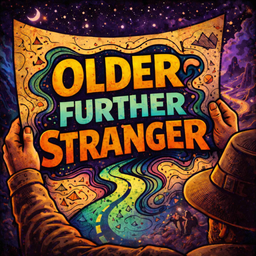
About Older, Further, Stranger: A Podcast of the Possible Past
Older Further Stranger applies the Copernican Principle to the reimagining of the human past. The problem is not that we know too little, but that a narrow, settled set of stories has been allowed to stand in for a history that was vastly more inventive, daring, and strange. Hosted by Jacob Gold, the podcast moves through deep time and across forgotten landscapes, following the traces of people who built, experimented, adapted, and imagined their worlds in ways that still surprise us. Archaeology and anthropology become instruments of revelation rather than correction, uncovering coastlines now underwater, social worlds that flourished without kings or borders, and human ingenuity that appeared early, vanished, and reappeared in unexpected forms. Older Further Stranger treats the past not as a prelude to the present, but as a reservoir of possibility—rich, unresolved, and alive—inviting listeners into a deeper, more astonished sense of what it has meant, and might still mean, to be human.
Water Under Ground
Sixty thousand years ago, on the Western Cape of South Africa, someone punched a hole in an ostrich egg, drained it, engraved it and filled it with water. The oldest wells yet found were cut on Cyprus around 8400 BC, by farmers who had just crossed the sea and knew exactly how deep to dig. The oldest wooden structures dated to the year are oak boxes lowered into wells in Central Europe seven thousand years ago.
This episode follows people who watched where water went on its own and followed it further. They cut shafts down to the clay, broke river banks to lead floods across the plain, and dammed gaps between hills with grass-wrapped clay. They tunnelled through mountains from both ends at once, and chased springs kilometres back into the desert. The trail runs from Mesopotamia, where irrigation is older than Sumer and buried under its own silt, through Mohenjo-daro's seven hundred brick wells and the hidden cisterns of the Nabataeans, to Hezekiah's Tunnel and Eupalinos on Samos. From there it takes in the qanats of Iran, the spiral wells of Nazca, the Hohokam canals beneath Phoenix, Li Bing's bamboo baskets on the Min River, a volcanic-mineral filter at Tikal, and the Garamantes, a Saharan kingdom that drank an Ice Age aquifer dry.
Much of what they built is still under the rivers. What survives comes back through tree rings, carbon in burnt grain, spy-satellite photographs, and the shells of tiny crustaceans in canal mud.
11 Sept 2026
Episode 14 - Holiday Fiction Special: Apples & Honey
in honor of the sweet fruit and honey eaten in the hopes of a sweet new year to come, I present to you, a tale… of two young musicians, a summer on the road, and a strange journey through the farms and forests of the Hudson Valley. There are songs, bees, apples, old records, unexpected friends, and a few things beneath the surface that are better left undiscovered. A story about music, memory, friendship, and the places a song can take you.
28 Aug 2026
Episode 13: Mixed Company
Who moved when they married? Who inherited the house? Who did the grinding, weaving, trading, ruling, and writing? In Mixed Company, archaeology, ancient DNA, isotopes, bones, houses, laws, letters, and forgotten archives let us ask what life between men and women actually looked like across deep time. From Neanderthal caves to Bronze Age farms, Babylonian merchants, Egyptian villages, and ancient royal courts, the evidence keeps overturning the stories we thought we knew.
19 Aug 2026
Episode 11: Salt of the Earth
Episode 11: Salt of the Earth
Salt is everywhere, but the ways humans have hunted, mined, boiled, traded, taxed, and worshipped it are anything but ordinary. From elephants digging for minerals in the darkness of Mount Elgon to prehistoric salt factories, desert caravans, submerged Maya kitchens, ancient fish sauce, and miners preserved for millennia inside salt itself, this is a global history of the substance that quietly built economies, technologies, and states. And the strangest part? Much of the story was hiding in plain sight.
12 Aug 2026
Older, Further, Stranger, Episode 10: The Zen of Erectus
The Zen of Erectus
Homo erectus emerged in East Africa around two million years ago and was still alive at least a hundred and ten thousand years ago in Java — a run about six times longer than our own species has managed. From the neck down they were built much as we are. They walked exactly the way we walk, threw with a shoulder configured for it, spread from South Africa to the Norfolk coast to central China, and reached islands across water that has never closed at any sea level.
They also made a family of stone tools that changed slowly and stayed recognizable for a million and a half years across three continents. That rate has been read, for most of the last century, as a verdict on the minds behind it.
This episode tests that verdict against the places where more than stone survived: the tilted beds at ‘Ubeidiya, the drowned lakeshore at Gesher Benot Ya’aqov, Kalambo Falls, Schöningen, Boxgrove, Zhoukoudian, and six teeth pulled from a Beijing museum drawer this year that still had readable protein in them.
What you’ll come away with: what a handaxe actually is, and why “they never improved it” is the wrong sentence. Why the famous ash layers at Zhoukoudian aren’t ash. How a lakeshore in Israel proves people were cooking, using the fish that aren’t there. Why sophisticated toolkits sometimes vanish in modern humans too, with nobody able to say why. And a pattern worth knowing about the field itself — every time the instruments improve, past people turn out to have been more capable than the previous generation of scholars believed. Not once has it gone the other way.
24 Jul 2026
OLDER FURTHER STRANGER, EPISODE 9: WE CAN BE FERALS
Fifty thousand years. Six continents. One vast and varied yearning for transformation, made again and again in materials as different as ivory, ochre, gold, and human skin.
They painted it in total darkness, four hundred meters into the earth. They carved it into a throne so that to rule was to sit inside an animal’s mouth. They buried it with their dead, wore it into battle, danced it until they died, and swore afterward that dying was exactly what it felt like. Lion, bear, jaguar, serpent, crocodile — the species changes with the coastline. The impulse doesn’t.
This is the story of what happens when a species keeps trying, for fifty thousand years running, to stop being only itself.
9 Jul 2026
Episode 8: Go Ask Lattice
Farms, cities, temples, and rivers were never really separate things — for most of human history they were one tangled system, and power ran sideways through it instead of stacking up into a single throne. This episode follows that pattern from a lake in the Sahara that hasn’t existed in nine thousand years, through a city in Mali built without a king, and into the last place anyone would expect to find it — underneath the pyramids of Egypt themselves. It’s the episode where that pattern finally gets a name: heterarchy.
8 Jun 2026
Older, Further, Stranger, Episode 7: Technologies of Freedom
Technologies of Freedom: Nine cases. Nine thousand years. Five continents.
The Cossacks building a steppe assembly with no hereditary rulers. The Maroons synthesizing African, indigenous Caribbean, and European knowledge in the mountains of Jamaica and Suriname. The pastoralists of East Africa developing a mobile sovereignty around cattle. The sea nomads of Southeast Asia choosing water as a zone beyond state control. The Zomians engineering societies to stay outside the reach of lowland kingdoms. The camel nomads transforming the Arabian desert into a protected highway. The Comanche expanding from a Great Basin people to an empire across the southern plains. The wōkōu—embargoed merchants turned raiders—of the Ming coast. And the Roma, whose thousand-year diaspora toolkit became, in the twentieth century, a catastrophic vulnerability.
These are people who looked at the organizing systems around them—empires, dynasties, plantation economies, sea bans, enclosures, caste hierarchies—and assembled from whatever was available a completely different way of living. Not freedom as an abstraction. Freedom as a set of practical tools: specific animals, specific landscapes, specific bodies of knowledge, specific social structures woven together into working alternatives.
The archaeology is central. Bone measurements, seed assemblages, isotope ratios, ancient DNA, and language branching points keep producing evidence of something real, something sophisticated, something worth understanding on its own terms.
These were not morality plays. The raids were real. The violence fell on real people. But they built something. And for a while, sometimes for centuries, it worked.
24 May 2026
OLDER FURTHER STRANGER, EPISODE 6: SOFT MACHINE
While conventional archaeology leaves us with an inorganic skeleton of cold stone and broken pottery, taphonomic miracles across the ancient world have frozen the intimate, organic tissue of daily life in stunning detail. From a mother’s handwritten birthday invitation on the Roman frontier to a Siberian shaman’s elaborate tattoos and imported silk, these rare glimpses into the past reveal a world that is both touchingly familiar and profoundly uncanny.
15 Apr 2026
EPISODE 5: INVENT HORIZON
Civilizations seem to rise, fall, and vanish in clean, dramatic strokes—until the timeline begins to shift. Across sites from Angkor to the Late Bronze Age collapse, what once looked like sudden catastrophe or steady decline dissolves into something far less certain: centuries mistaken for moments, sequences collapsed into a single cause.
This episode explores the edge of temporal knowability in archaeology—where better dating doesn’t just refine the past, it rearranges it. Events fragment, causes reverse, and whole histories lose their shape. At the Invent Horizon, time itself becomes unstable, and the stories we thought we understood begin to come apart.
11 Feb 2026
Episode 4: The Few, The Proud
How do small-scale societies organize the labor, knowledge, and coordination required to build things that seem to belong to empires?
In this episode, we travel across continents and millennia to examine monuments that challenge our assumptions about hierarchy, population, and power. From the earliest ritual architecture to island societies shaping stone and reef, from desert landscapes engineered through repetition to bridges rebuilt generation after generation, we explore how communities achieved feats of construction without the centralized states we often assume are necessary.
Rather than telling a simple story of progress toward civilization, these sites reveal a world full of experiments in how people chose to live, gather, build, and remember.
11 Jan 2026
Episode 3: Terraformers
Episode 3: Terraformers. The first planet we humans terraformed was earth. This episode explores some of the ways and means.
2 Jan 2026
Blood Ochre Cave Magic: Cave Art and the Human Spirit
Blood Ochre Cave Magic plunges into the Paleolithic dark where firelight animates painted beasts. This episode explores how early humans used caves as ritual theaters—mixing pigment, breath, and shadow to make megafauna move across stone. The walls become living skin; art becomes spell; creation itself, a communal act of power and memory,
26 Dec 2025
Episode I: The Aquatic Ape
Are humans more like dolphins or chimpanzees? This episode of Older, Further, Stranger explores the Aquatic Ape Hypothesis, tracing human evolution along shorelines through swimming, anatomy, and Ice Age coastlines. This episode reframes familiar human traits and explores a far stranger origin story than the land-only one we’re used to hearing.
Reach and audience
Public platform figures. Ratings count people who left a rating, not total listeners.
Apple Podcasts (US)
5.0 / 5
2 ratings
Spotify
5.0 / 5
1 ratings
Contact Older, Further, Stranger: A Podcast of the Possible Past
Guest appearances
Does not typically book guests
Based on episode analysis; this does not confirm that the show is currently accepting guests.
Host of Older, Further, Stranger: A Podcast of the Possible Past?
Claim your podcast to manage its listing and keep your show details accurate.
Pod Engine is an independent podcast discovery and analytics service and is not affiliated with or endorsed by this podcast. Artwork and show content belong to their owners. Full legal notice.
Explore this show Podcast research with Pod Engine