- 13
- Episodes
- 1
- Ratings
- Monthly
- Cadence
- 2025
- First episode
About One Great Case
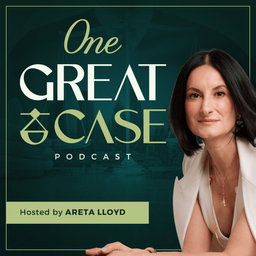
A podcast about law to learn more about people. Every episode goes behind the scenes of a case with the lawyer who argued it, and sometimes the judge who decided it. You may ask, what makes for a great case? It might be novel, it might move the needle on a point of law, it might be shocking, or frivolous, or high profile. Maybe you’ve heard of it, maybe you haven’t. But behind each case are the people who drive it. And that’s who we find continually fascinating, because at the end of the day, what are lawyers except well paid managers of human relations. Join us for each episode, as we do a deep dive into one great case. Hosted by Areta Lloyd, a litigation lawyer in Toronto, Canada.
- Publisher
- Areta Lloyd
- Category
- news · society & culture · true crime
- Language
- en
- Explicit
- No
- First episode
- 4 Sept 2025
- Latest episode
- 24 Sept 2026
Latest episodes
13 episodes in the feed.
24 Sept 2026
The Prolific Decision on Privacy in Sexual Assault Cases w/Anna Matas
How much privacy is too much? The Court of Appeal recently granted a motion, in part, that will be the standard for sexual assault cases, using the Sherman Estate framework. The implications are especially critical in sexual violence cases, where litigation itself can be re-traumatizing for the victim. The case is B.E. v. O.R., 2026 ONCA 501 (https://www.canlii.org/en/on/onca/doc/2026/2026onca501/2026onca501.html?resultId=b20670b3b08747b6a962b622d6e926d6&searchId=2026-09-22T19:15:43:655/538abdbed9bd434ea5be15e500f9f376) and to dive into this decision, I reached out to Anna Matas, the lawyer who brought the motion on behalf of her client, B.E. The issue is, what factors go to the core of ‘individual dignity’, and how the result affects the litigation process for victims. As Anna pointed out, “ I don't think we ever actually succeed in making litigation easy for survivors of sexual assault.” What You’ll Discover In This Episode The information breach that triggered the first motion for anonymization The sequence of pretrial orders that sealed B.E.'s medical records How the Court’s experience with criminal appeals informed Justice Dawe's decision The appeal that may make it safer to report sexual violence and abuse Why Anna moved away from big ‘crusader’ type cases A disturbing new trend of abusers using litigation to re-traumatize victims How Anna prevents burnout in sexual violence cases For more case details, visit CanLII (https://www.canlii.org/en/on/onca/doc/2026/2026onca501/2026onca501.html?resultId=b20670b3b08747b6a962b622d6e926d6&searchId=2026-09-22T19:15:43:655/538abdbed9bd434ea5be15e500f9f376) Other cases mentioned: Sherman Estate v Donovan (https://decisions.scc-csc.ca/scc-csc/scc-csc/en/item/18914/index.do) Law Society of Ontario v AA (https://www.canlii.org/en/on/onca/doc/2026/2026onca47/2026onca47.html?resultId=5dbe7282e93841b1a5282e57ee39374c&searchId=2026-09-22T19:28:49:860/1aa1a80808b14397a44cf37ce8334286) About the Guest Anna Matas is the founder and principal lawyer of Matas Legal, and a passionate advocate for survivors of sexual violence. She is a Director of the Women's Legal Education and Action Fund (LEAF) and previously served as Chair of the Board of Directors of the Barbra Schlifer Commemorative Clinic, which supports survivors of gender-based violence. In 2024, she received the Women's Law Association of Ontario President's Award. Matas holds an LL.B./B.C.L. (2006) and was an editor of the McGill Law Journal. About Your Host Areta Lloyd practices estate and trusts litigation, with a particular focus on capacity litigation. She participates in public speaking, mentoring junior lawyers, and presenting courses on the topics of estates law, health law, and law practice management. Areta has written for several publications and wrote a column for the Alzheimer caregiver website ALZlive.com (https://alzlive.com/category/editorial/legal-series/). Resources Have a suggestion for a great case to feature on the show? Email me at hello@onegreatcase.com Looking for support in your legal career? The Toronto Lawyers Association offers resources, networking, and legal research at no cost. Visit (http://tla.org)https://www.tlaonline.ca/ (https://www.tlaonline.ca/) Follow One Great Case on Apple Podcasts (https://podcasts.apple.com/ca/podcast/one-great-case/id1837712731), YouTube (https://www.youtube.com/@onegreatcase), or your preferred app to stay up to date with the latest cases and conversations. If you’ve found the show valuable, please leave us a review on Apple Podcasts or share it with a colleague. Each time you do, you help another professional discover insights that can shape their practice.
3 Sept 2026
Can Historic Family Law Obligations Continue to Have Consequences After Death?
Can historic family law obligations continue to have consequences after death through Part V of the Succession Law Reform Act? A recent case touched on that question, causing a stir in the estates litigation community. The lawyer at the center of the issue is fielding calls from fellow lawyers, who themselves are fielding calls from people seeking to use this decision. But did this decision create new law? To find out more, I reached out to Jenny Bogod, who shared the unique circumstances of the case, as well as her perspective on losing a motion for summary dismissal under Rule 2.1.01. What You’ll Discover In This Episode The strategy behind filing the motion Why a summary dismissal in this case was ‘ deceptively difficult’ How a previously-unknown child support order came to light The related threshold motion still awaiting decision How Jenny recovers from losses The implications of an influx of similar cases in the next few years About the Guest Jenny Bogod is a partner at Rosen Sack LLP, and a passionate litigator whose practice focuses on estate, trusts and capacity litigation as well as professional negligence. Jenny represents dependants, estates, beneficiaries and persons whose capacity is being questioned by others in matters related to will challenges, will interpretation applications, power of attorney disputes, dependant support claims and guardianship applications. For more information or to connect directly with Jenny, visit https://www.rosensack.com/jenny-bogod (https://www.rosensack.com/jenny-bogod) About Your Host Areta Lloyd practices estate and trusts litigation, with a particular focus on capacity litigation. She participates in public speaking, mentoring junior lawyers, and presenting courses on the topics of estates law, health law, and law practice management. Areta has written for several publications and wrote a column for the Alzheimer caregiver website ALZlive.com (https://alzlive.com/category/editorial/legal-series/). Resources Have a suggestion for a great case to feature on the show? Email me at hello@onegreatcase.com Looking for support in your legal career? The Toronto Lawyers Association offers resources, networking, and legal research at no cost. Visit (http://tla.org)https://www.tlaonline.ca/ (https://www.tlaonline.ca/)
30 Jul 2026
The Dog Walker Who Was Attacked and Legally Treated as the Owner w/ Shane Katz
What happens when the law defines a dog owner more broadly than most people realize? Under Ontario’s Dog Owners’ Liability Act, a person may be treated as a dog’s owner simply because they have temporary possession or control of the animal. That can include a professional dog walker, a friend taking someone else’s dog for a walk, or a neighbour asked to care for it while the actual owner is away. But the surprising definition is only part of the legal problem. In this episode, I’m joined by Toronto personal injury lawyer Shane Katz, who represented a dog walker severely injured while following the owners’ instructions inside their home. The result? A law intended to hold dog owners accountable may now prevent injured caregivers from recovering against the people who actually own the animal, while also exposing those caregivers to liability themselves. Things You’ll Learn in This Episode; Why Ontario’s Dog Owners’ Liability Act ordinarily allows an injured person to establish liability without proving that the owner knew the dog was dangerous. How temporary possession and control of a dog can cause a dog walker or caregiver to be treated as an “owner” under the current interpretation of the law. Why being classified as an owner may prevent an injured person from suing the dog’s actual owner under the statute. How the precedent discussed in the episode shaped both the summary judgment decision and the unsuccessful appeal. Why Shane believes legislative reform may now be the only practical way to restore accountability and protect people temporarily caring for someone else’s dog. About the Guest Shane Katz is a personal injury lawyer at Singer Kwinter, where he has been a member of the legal team since 2001. His practice is dedicated exclusively to representing plaintiffs in personal injury, insurance claims, and medical malpractice matters. Shane has advocated for clients before the Ontario Superior Court of Justice, Divisional Court, and Court of Appeal. He has been involved in several significant cases, including Bonaiuto v. Pilot Insurance Company and Hazan v. ING Insurance Company. He has successfully resolved many matters in which defendants had previously been unwilling to compensate his clients. Known for his honest, approachable, and compassionate manner, Shane is committed to achieving the strongest possible outcomes while treating every client with dignity and respect. He is a member of the Ontario Trial Lawyers Association, the Ontario Bar Association, and The Advocates’ Society. His peers have recognized Shane as a leading personal injury litigation lawyer in Best Lawyers in Canada. He also regularly contributes to the profession through continuing legal education, mentorship of articling students and junior lawyers, and involvement with organizations supporting injured and disabled people. Connect with Shane on LinkedIn (https://www.linkedin.com/in/shane-katz-4948b638/). About Your Host Areta Lloyd practices estate and trusts litigation, with a particular focus on capacity litigation. She participates in public speaking, mentoring junior lawyers, and presenting courses on the topics of estates law, health law, and law practice management. Areta has written for several publications and wrote a column for the Alzheimer caregiver website ALZlive.com (https://alzlive.com/category/editorial/legal-series/). Resources Have a suggestion for a great case to feature on the show? Email me at hello@onegreatcase.com Looking for support in your legal career? The Toronto Lawyers Association offers resources, networking, and legal research at no cost. Visit (http://tla.org)https://www.tlaonline.ca/ (https://www.tlaonline.ca/)
25 Jun 2026
The Groundbreaking Tort That Recognized Intimate Partner Violence w/ Joanna Radbord
For decades, family lawyers have represented clients whose abuse was not defined by one isolated incident, but by a pattern of control: financial abuse, isolation, humiliation, threats, physical violence, and the slow erosion of autonomy inside the home. The problem was that tort law did not always know how to capture that kind of harm. Claims like assault, battery, and intentional infliction of mental distress could address pieces of the abuse, but they often miss the cumulative reality of intimate partner violence: the breach of trust, the coercive control, and the loss of dignity, equality, safety, and freedom within what should have been a safe relationship. That is what makes Ahluwalia v. Ahluwalia so significant. In recognizing the new tort of intimate partner violence, the Supreme Court of Canada gave family lawyers a framework for harm many clients had been describing for years, but the law had not fully named. The case confirms that intimate partner violence is not merely a series of discrete acts. It can be a pattern of coercive and controlling conduct that causes its own compensable harm. In this episode, Areta is joined by Joanna Radbord, a partner at McCarthy Hansen & Company, who worked on Ahluwalia v. Ahluwalia as co-counsel for the appellant before the Supreme Court of Canada. Joanna brings both direct involvement in the case and deep experience in novel family law litigation, constitutional challenges, and research on intimate partner violence. She unpacks why the existing torts were not enough, what this new tort changes for family lawyers and their clients, and why Ahluwalia marks a major shift in how the law recognizes intimate partner violence. What you’ll discover in this episode; How Ahluwalia v. Ahluwalia created a new tort of intimate partner violence and why that recognition is significant for family law. Why existing torts like assault, battery, and intentional infliction of mental distress often failed to capture the cumulative harm of coercive control. The three-part test family lawyers now need to understand when assessing intimate partner violence claims. What the new tort changes in practice, from screening and pleadings to damages, settlement strategy, and client safety. Why this case matters for survivors whose harm has often been minimized, fragmented, or treated as incidental to the “real” family law issues. About the Guest Joanna Radbord is a partner at McCarthy Hansen & Company LLP. Joanna has practiced for over a quarter-century, seeking to advance access to family justice through litigation, intervention, law reform, and education. Joanna was awarded the Law Society Medal for exceptional career achievements and contributions to her community in the areas of LGBTQ2+ rights, family law, constitutional, and human rights. She received the Lexpert Zenith Award: Celebrating Women in Law and the Canadian Bar Association Sexual Orientation and CBA Gender Identity Conference Hero Award. Joanna has done ground-breaking work on substantive equality and access to justice, including litigation to achieve spousal status for same-sex couples (M v H), equal marriage (Halpern), trans parenting (Forrester), birth registration (Rutherford), three-parent recognition (AA v BB), and defining parentage (Grand). In relation to Indigenous families, Joanna’s work has addressed jurisdiction over Haudenosaunee family law disputes (Beaver v Hill) and the best interests of Indigenous children in parenting cases (E.Y. v B.A.). She is currently co-counsel in litigation seeking recognition of the tort of family violence before the Supreme Court of Canada (Ahluwalia). Connect with Joanna on LinkedIn. About Your Host Areta Lloyd practices estate and trusts litigation, with a particular focus on capacity litigation. She participates in public speaking, mentors junior lawyers, and presents courses on estates law, health law, and law practice management. Areta has written for several publications and wrote a column for the Alzheimer caregiver website ALZlive.com. Resources Have a suggestion for a great case to feature on the show? Email me at hello@onegreatcase.com Looking for support in your legal career? The Toronto Lawyers Association offers resources, networking, and legal research at no cost. Visit https://www.tlaonline.ca/
26 Mar 2026
When Online Trolls Target a Community: How the Law Responds w/ Doug Judson
On paper, defamation law looks simple: a false statement is published, a reputation is harmed, and the courts step in to address the damage. The internet has changed that equation. Today, some of the most damaging allegations spread through social media, where accusations can move faster than facts, especially when misinformation about LGBTQ+ people and organizations begins circulating online. Two Ontario defamation cases, Rainbow Alliance Dryden et al. v. Webster and Canadian AIDS Treatment Information Exchange et al. v. Blackwell, exemplify how quickly online accusations can escalate into serious legal battles. Both cases arose after social media posts accused LGBTQ+ organizations and individuals of “grooming” children. What makes these cases especially interesting is how the litigation unfolded. It’s the limits of online speech, the risks of turning cultural narratives into accusations of crime, and how courts determine the real meaning behind words posted on the internet. The result was significant damage awards and an important reminder that anti-SLAPP protections and “public interest” defenses are not a license to publish harmful falsehoods online. To unpack how these cases developed and what they mean for defamation law in the digital age, I sat down with Doug Judson, a lawyer in Northwestern Ontario who represented the plaintiffs and has been involved in a growing number of online defamation cases. Doug shares how a case that started with a single social media post ended up producing one of the largest defamation awards of its kind in Canada. Things you’ll learn; How online accusations of “grooming” against LGBTQ+ organizations turned into major defamation lawsuits Why the court rejected the argument that these posts were protected “public interest” commentary How anti-SLAPP motions work and why the defendant’s motion failed The role of expert evidence in explaining the social meaning of defamatory language Why summary judgment was the right strategy in these cases How courts assess malice in online defamation disputes The challenges of identifying and serving anonymous online defendants Why large defamation awards may matter, even when collecting the money is uncertain Guest Bio Doug Judson practices law with Judson Howie LLP, a firm based in Northwestern Ontario that works with clients across the province. Doug began his practice with a leading Canadian law firm. He has worked with the in-house legal teams of two financial institutions, has held posts in the federal public service in Ottawa, has served as a contract Crown Attorney, and has worked in economic development, health, and justice programming for Treaty #3 First Nations. Doug started his professional career on Parliament Hill as an aide to two former MPs, and has since been involved with federal, provincial, and municipal election campaigns. From 2018-2022, he served on the council of the Town of Fort Frances. Doug maintains a busy volunteer presence in the community. He currently serves on the boards of the Northwest Community Legal Clinic and Borderland Pride. Doug is also currently the President of the Rainy River District Law Association and Past Chair of the Federation of Ontario Law Associations. He has previously served on the executive of the Ontario Bar Association's sexual orientation and gender identity section, on the Law Society of Ontario’s Equity Advisory Group, as President of the Law Students’ Society of Ontario, and on the boards of the Thunder Bay Regional Health Sciences Centre and Start Proud, a non-profit serving 2SLGBTQIA+ students and young professionals. https://www.douglasjudson.ca/ (https://www.douglasjudson.ca/). About Your Host Areta Lloyd practices estate and trusts litigation, with a particular focus on capacity litigation. She participates in public speaking, mentoring junior lawyers, and presenting courses on the topics of estates law, health law, and law practice management. Areta has written for several publications and wrote a column for the Alzheimer caregiver website ALZlive.com (https://alzlive.com/category/editorial/legal-series/).
5 Feb 2026
Chiang (Trustee of) v. Chiang: The Dark Side of Civil Contempt w/ Tom Curry
We like to believe that contempt of court is simple: you break the rules, face the consequences, and if you comply, you earn your way back out. The law, we tell ourselves, is precise, structured, and fair. But what happens when the very order meant to restore accountability becomes the trap itself? This case, Chiang (Trustee of) v. Chiang, forces us to confront a deeply uncomfortable reality: that even systems designed to enforce justice can spiral into something coercive, endless, and structurally impossible to escape. What began as a routine commercial debt dispute in California evolved into one of the most complex and punishing contempt proceedings in Canadian legal history. A family chased across borders. A consent order that functioned more like a contract with no exit. A process where the “keys to the cell” were no longer in the hands of the people being punished, but in the hands of their creditors. A use of contempt that was alarming and structurally unsound. And a long odyssey of litigation that took over eight years to resolve. At the center of this story is a haunting paradox. The court wanted answers, but the mechanism it created to extract those answers required cooperation from third parties in another jurisdiction. The result was a legal maze where effort was never enough, compliance was never complete, and the definition of “purging contempt” remained perpetually out of reach. The result was a system that punished without a clear path to redemption, where time, effort, and even compliance could not guarantee release. The lesson for litigators is that precision is not a technical detail; it is a safeguard against harm. To unpack how this happened (and why it still matters), I sat down with Tom Curry, a veteran litigation lawyer in Toronto who was brought into the case at its darkest point. Together, we explored how a single consent order reshaped the trajectory of an entire family’s life, why the Court of Appeal eventually intervened, and what this case teaches us about power, perseverance, and the limits of coercive justice. You’ll also learn: How a routine business dispute turned into a decade-long legal odyssey How a consent order became the most powerful lever in the case What happens when the keys to freedom are held by creditor/plaintiff instead of the contemnor Why “best efforts” can become an impossible legal standard How coercive sentences cross the line into punishment What this case reveals about power, persistence, and human resilience Why structure, not pressure, is the real engine of accountability Guest Bio Tom Curry is a litigation lawyer in Toronto, a partner at Lenczner Slaght, and a speaker. He is recognized as one of the most experienced trial and appellate advocates of his generation in Canada. Tom has a long record of success in high-profile commercial litigation, class actions, arbitrations, business disputes, administrative law, judicial review, intellectual property, competition, and professional liability cases. Tom is a Fellow of the American College of Trial Lawyers and the International Academy of Trial Lawyers and is certified as a specialist in civil litigation by the Law Society of Ontario. He is a regular speaker on a wide variety of subjects relating to trial practice and substantive law. He has been recognized with the prestigious Law Society Medal, the Catzman Award, the Advocates’ Society Award for Excellence in Teaching, and, most recently, the OBA Award for Excellence in Civil Litigation. Connect with him on LinkedIn (http://linkedin.com/in/tom-curry-7268b8b5?originalSubdomain=ca/). About Your Host Areta Lloyd practices estate and trusts litigation, with a particular focus on capacity litigation. She participates in public speaking, mentoring junior lawyers, and presenting courses on estates law, health law, and law practice management. Areta has written for several publications and wrote a column for the Alzheimer caregiver website ALZlive.com (https://alzlive.com/category/editorial/legal-series/). Have a suggestion for a great case to feature on the show? Email me at hello@onegreatcase.com Looking for support in your legal career? The Toronto Lawyers Association offers resources, networking, and legal research at no cost. Visit (http://tla.org)https://www.tlaonline.ca/ (https://www.tlaonline.ca/).
22 Jan 2026
Nuremberg Revisited: When Evil Was Obvious but the Law Wasn’t w/ David Parry
We tend to think of history’s great atrocities as moral failures that are obvious in hindsight. Evil acts, evil people, and clear lines between right and wrong. But the harder question (which still haunts legal systems today) is this: how do you turn moral certainty into legal accountability when the law itself doesn’t yet exist? That question has been back in public conversation recently with the release of the film Nuremberg. But it was never theoretical for the Allies in the wake of World War II. They weren’t just confronting the scale of the crimes; they were operating in an almost impossible legal position. No established crime for what we now call crimes against humanity. No clear roadmap for holding individuals responsible for actions carried out under the color of domestic law. And nowhere was that tension more visible than in the trial of Hermann Göring. What looks, at first glance, like a straightforward prosecution unravels into something far more complex. A courtroom filled with politics, ego, performance, and legal improvisation. A defendant who understood power, optics, and narrative better than many of the people questioning him. And a cross-examination that’s now infamous. This case forces us to confront an uncomfortable truth: accountability doesn’t come from outrage alone. It comes from systems, structure, and the discipline to resist fighting on the wrong terrain. Nuremberg wasn’t just a legal milestone. It was a test of whether law could rise to meet morality without collapsing into vengeance or theater. To unpack all of this, I sat down with criminal lawyer and Crown prosecutor David Parry. He has spent years studying the Nuremberg trials and their legacy. Together, we explored what Göring’s testimony reveals about human nature, why Robert Jackson’s cross-examination still matters, and how the innovations born at Nuremberg continue to shape international law today. You’ll Also Learn Why Nuremberg wasn’t inevitable, and how close the Allies came to abandoning trials altogether How retroactive justice became one of the most controversial but necessary legal innovations of the 20th century Why Göring’s charisma and ego made him such a dangerous witness on the stand What not to do in cross-examination when facing a powerful, combative defendant How “arguing with the witness” quietly hands them control of the courtroom Why structure (not emotion) is the prosecutor’s most powerful tool How film evidence changed the trial when words failed What Nuremberg teaches us about accountability, power, and the fragility of democratic systems Why law is ultimately an attempt to discipline our moral instincts, not replace them About the Guest David Parry is a criminal lawyer and Crown prosecutor who began his career in private practice before moving into public prosecution. He has a long-standing interest in international law, legal ethics, and the history of the Nuremberg Trials—particularly how the International Military Tribunal grappled with accountability, morality, and the limits of law in the aftermath of World War II. His work sits at the intersection of legal theory and real-world courtroom practice, which makes him especially well-placed to unpack what actually happened inside the courtroom at Nuremberg. About Your Host Areta Lloyd practices estate and trusts litigation, with a particular focus on capacity litigation. She participates in public speaking, mentoring junior lawyers, and presenting courses on the topics of estates law, health law, and law practice management. Areta has written for several publications and has written a column for the Alzheimer's caregiver website ALZlive.com (https://alzlive.com/category/editorial/legal-series/). Have a suggestion for a great case to feature on the show? Email me at hello@onegreatcase.com Looking for support in your legal career? The Toronto Lawyers Association offers resources, networking, and legal research at no cost. Visit (http://tla.org)https://www.tlaonline.ca/ (https://www.tlaonline.ca/).
11 Dec 2025
Ritualistic Repetition or Genuine Intent? Inside a Stunning Undue Influence Case w/ David Delagran & Justice Gilmore
Most people imagine undue influence as overt manipulation: a domineering child, a vulnerable parent, and a will that suddenly changes. But the reality, undue influence often looks like routine caregiving. That’s what made Abbruzzese v Tucci so striking. At first glance, it looked like a typical estate dispute. Instead, what emerged was a rare, almost textbook convergence of every factor litigators usually struggle to prove: isolation, dependency, capacity concerns, and a sudden transfer of the family home for no consideration. Then, everything changed when a single piece of evidence emerged; something you rarely see in these files. Civil litigator David Delagran walked me through the moment the entire case took a sharp turn. A moment that revealed just how different this file was from the usual “she said / she said” estate dispute. What he uncovered suggested something more deliberate, more structured, and far more difficult to dismiss. Then I sat with Justice Gilmore, the judge who ultimately had to make sense of it all. From her vantage point, this case wasn’t just unusual; it presented a combination of factors she rarely sees align so neatly in one file. It all pointed to something beneath the surface that only became visible once she started asking the right questions. Why do some cases that look “clean” on paper unravel the moment you peel back a single layer? What happens when the usual tools for assessing capacity and intent collide with the messy realities of family relationships? In this episode, we explore all of it, from the litigation strategy to the judicial reasoning. We also talk about the deeper lessons this case offers for anyone navigating influence, vulnerability, and the fragile line between care and control. You’ll Also Learn; How dependence, isolation, and family conflict quietly lay the groundwork for influence Why repeated phrases and “too-consistent” explanations can be a red flag in capacity cases How a drafting solicitor’s clean notes can mask deeper dynamics the lawyer never saw Why contemporaneous medical assessments often reveal what retrospective reports can’t How judges test whether a testator’s words were their own or shaped by someone else What credibility looks like when family stories, expert opinions, and documents all clash Why this case is becoming a reference point for spotting influence that hides in plain sight Guest Bios David Delagran is a civil litigator and partner at Beard Winter LLP in Toronto, with over 25 years of litigation experience across commercial, estates, and employment disputes. In contentious trusts and estates disputes, David represents personal and institutional estate trustees, as well as beneficiaries, in all matters arising out of the administration of trusts and estates, including administration, will challenges, dependent support claims, interpretation issues, and breaches of trust. David works together with the firm’s Estates and Trusts solicitors to form an effective multidisciplinary litigation team. Connect with David on LinkedIn (https://www.linkedin.com/in/david-delagran-4731496a/). Justice Gilmore is an Estates List judge and a specialist in estates litigation. She sits in Toronto and has presided over a large variety of civil, criminal, and family cases since her appointment. She was the President of the Ontario Superior Court Judges’ Association from December 2014 to June 2017 and sitting Past President until June 2019. Justice Gilmore has passed the Level C civil servant French exam, which permits her to hear trials in French, and has been a regular educational panel member on evidentiary and advocacy issues. Connect with her on LinkedIn (http://linkedin.com/in/madam-justice-cory-gilmore-740a5525?originalSubdomain=ca/). About Your Host Areta Lloyd practices estate and trusts litigation, with a particular focus on capacity litigation. She participates in public speaking, mentoring junior lawyers, and presenting courses on the topics of estates law, health law, and law practice management. Areta has written for several publications and wrote a column for the Alzheimer caregiver website ALZlive.com (https://alzlive.com/category/editorial/legal-series/).
13 Nov 2025
Exploitation at the Ballet: The Case That Redefined Justice in Canada w/ Gillian Hnatiw
When we think of ballet, we think of grace, discipline, and the pursuit of perfection, not precedent-setting litigation. But within the walls of elite ballet institutions, the pursuit of perfection can blur into something darker: a culture of hierarchy, obedience, and silence. That silence is what made this case possible. Behind the curtain of one of Canada’s most prestigious ballet schools, a story unfolded that had nothing to do with art and everything to do with power. When the truth finally surfaced, the women seeking justice faced an even greater challenge…a justice system unequipped to name their harm. This wasn’t just a story about a predator hiding in plain sight. It was a reckoning with how the legal system lags behind the realities of digital-age exploitation and gender-based harm. What happens when centuries-old torts can’t capture the trauma of having your body and trust violated on camera? That’s where lawyer Gillian Hnatiw stepped in. As a leading advocate for victims of gender-based violence, she was able to recognize the deeper systemic failure beneath the case, a legal framework unprepared to address modern forms of harm. In this episode, Gillian unpacks the complexities of the case and the creative lawyering it demanded. She also reflects on how the case reshaped the legal understanding of gender-based harm, and why its lessons remain urgent in an era where technology keeps outpacing the law. Things You’ll Learn in This Episode; How the Royal Winnipeg Ballet class action broke new ground in recognizing psychological and gender-based harm from non-consensual image taking and sharing. Why arts institutions can enable abuse through culture, not just conduct, and how silence becomes complicity. The creative legal strategy behind a case with no clear precedent, from using privacy torts to invoking occupiers’ liability and breach of confidence. Why this case signals the next frontier of justice — as the law races to catch up to digital realities like voyeurism, deepfakes, and AI-generated abuse. Guest Bio Gillian is one of Canada's leading advocates for victims of gender-based violence. Although that is not her only area of practice, she maintains a diverse litigation practice at her eponymous law firm located in Toronto, with a national reach. Gillian is talented, fearless, hugely empathetic, and a huge risk-taker. You can learn all about her work on her website, gillianandco.ca (http://gillianandco.ca). About Your Host Areta Lloyd practices estate and trust litigation, with a particular focus on capacity litigation. She participates in public speaking, mentoring junior lawyers and presenting courses on the topics of estates law, health law, and law practice management. Areta has written for several publications and wrote a column for the Alzheimer caregiver website ALZlive.com (https://alzlive.com/category/editorial/legal-series/). Resources Have a suggestion for a great case to feature on the show? Email me at onegreatcasepodcast@yahoo.com Looking for support in your legal career? The Toronto Lawyers Association offers resources, networking, and legal research at no cost. Visit TLA.org (http://tla.org) Follow One Great Case on Apple Podcasts, Spotify, or your preferred app to stay up to date with the latest cases and conversations. If you’ve found the show valuable, please leave us a review on Apple Podcasts or share it with a colleague. Each time you do, you help another professional discover insights that can shape their practice.
16 Oct 2025
The Strategy That Turned Two Lost Properties into a Mortgage-Free Victory w/ Neil Colville-Reeves
On paper, SEPUSAC v. 9706151 Canada Limited seemed like a routine mortgage enforcement dispute. A borrower defaulted, the lender sold the properties, and the matter looked destined for the standard path of foreclosure. But the case quickly revealed itself to be anything but ordinary. What unfolded over the next seven years exposed how vulnerable Ontario’s mortgage enforcement framework can be to abuse. Procedural stonewalling, shameless delay tactics, chaos, havoc, opaque numbered companies, and even the suing of a judge. This was the weaponization of the rules, deployed to exhaust a borrower, delay accountability, and deprive someone of their day in court. Along the way, the litigation raised hard questions about how far bad actors can push the system. To help unpack it, I’m joined by the lawyer on the side of the borrower, Neil Colville-Reeves. After diving into what he first thought was a straightforward enforcement matter, Neil found himself navigating the uncharted territory of predatory lending and fraud. What made this case anything but the typical foreclosure litigation? And how did Neil secure an outcome no one would have predicted: a client who entered homeless but emerged with title to his properties, mortgage-free? In this episode, you’ll learn; How SEPUSAC v. 9706151 Canada Limited illustrates systemic vulnerabilities in Ontario’s mortgage enforcement regime Why rapid, improvident sales to numbered corporations signal potential fraud The strategic use of CPLs, Rule 45 motions, and Mareva injunctions in exposing fraud and preserving assets How defendants weaponized adjournments, discovery delays, and shell companies to obstruct proceedings Why the civil justice system, premised on good faith, struggles when faced with shameless actors The outcome: how a borrower who lost two properties in a predatory lending scheme ultimately recovered both, free of encumbrances Guest Bio Neil Colville-Reeves is the Managing Partner of Reeves Richarz LLP. Neil has a general commercial, estates, and insurance litigation practice and has handled a broad range of matters before the Ontario Superior Court of Justice, Ontario Court of Appeal, Financial Services Commission of Ontario, License Appeal Tribunal as well as advocating on behalf of his clients in private arbitrations. Neil manages a large and diverse subrogation practice and has experience in a range of matters, including construction/engineer liability, oil spills, fire and flooding losses, product failures, municipal infrastructure failures, first responder cases, and class actions. He also defends his insurer clients and policies in first-party and liability claims involving a broad range of property-related claims, including fire and flood loss cases. Neil has acted for clients in partnership and shareholder disputes, private road associations in negotiating member agreements, as well as litigating breach of contract, estates, and construction-related matters. Neil also practices injury law. He has represented the interests of a wide range of insurers, defending policy-holders and insurers in bodily injury claims as well as defending first-party accident benefits claims. His clients also seek out his advice and representation in priority and loss transfer disputes between insurers. In recent years, Neil has taken a particular interest in assisting clients facing mortgage enforcement proceedings who can be particularly vulnerable to unscrupulous lenders. In addition to practicing law, Neil spent two years in the securities industry working in corporate finance for an investment management/merchant banking firm. In that role, he dealt extensively with the community of investment advisors and financial planners and was involved in issues relating to corporate governance in publicly-listed companies. Connect with Neil on LinkedIn (https://www.linkedin.com/in/neil-colville-reeves-5592971a?originalSubdomain=ca/). About Your Host Areta Lloyd practices estate and trust litigation, with a particular focus on capacity litigation. She participates in public speaking, mentoring junior lawyers, and presenting courses on the topics of estates law, health law, and law practice management. Areta has written for several publications and wrote a column for the Alzheimer caregiver website ALZlive.com (https://alzlive.com/category/editorial/legal-series/). She is on the Board of Directors of the Toronto Lawyers Association. Follow One Great Case on Apple Podcasts, Spotify, or your preferred app to stay up to date with the latest cases and conversations. If you’ve found the show valuable, please leave us a review on Apple Podcasts or share it with a colleague. Each time you do, you help another professional discover insights that can shape their practice.
11 Sept 2025
Inside John Campion's Winning Strategy for the Biggest Mining Case in History
Long before the lawsuits, there was the story that captivated the world. Bre-X Minerals, a penny stock based in Calgary, claimed to have discovered the largest gold deposit in history deep in the jungles of Indonesia. Almost overnight, its market value soared into the billions, drawing in banks, governments, and some of the biggest players in mining. The frenzy was intoxicating. Ordinary investors saw life-changing fortunes appear on paper. Analysts assured the public they had “seen the gold.” Politicians and corporations scrambled for a stake in what looked like a once-in-a-lifetime discovery. Yet beneath the euphoria lay a series of red flags, signals that something was terribly wrong. Why were drill samples handled in secrecy? Why did results grow more spectacular with every announcement? And why did so many seasoned professionals suspend their disbelief? In this episode, John Campion, one of Canada’s most respected litigators, reconstructs the rise and collapse of Bre-X before it ever reached the courtroom. From its basement beginnings and improbable ascent, to the mysterious fall of its chief geologist, John lays out how the world’s biggest gold rush unraveled into one of the greatest financial scandals of modern times. In this episode, you’ll learn: How Bre-X transformed from an obscure penny stock into a $6B global sensation Why governments, banks, and investors ignored glaring warning signs How Busang’s remote and treacherous setting made independent verification nearly impossible The role of key figures, Walsh, Felderhof, and de Guzman, in building the illusion The unanswered questions and enduring mysteries that still surround Bre-X today Guest Bio John Campion is a senior litigator and partner at Gardiner Roberts LLP with more than 45 years of experience across Canada and internationally. Over his career, he has acted in more than 300 trials, appeals, and arbitrations, representing prime ministers, heads of state, leading global corporations, and families in some of the most high-stakes disputes of the last half-century. John has appeared before the courts of ten provinces, the Federal Court, the Supreme Court of Canada, and in arbitrations and tribunals around the world. His work spans corporate and commercial law, estates, regulation, and government, giving him a rare perspective at the intersection of business, policy, and justice. Beyond the courtroom, John has served as President of the Federation of Law Societies of Canada, an Emeritus Bencher of the Law Society of Ontario, and President of the Empire Club of Canada. He has also advised the CBC, acted as counsel to prime ministers, written extensively on professional liability, and taught as an adjunct professor of law. John Campion is known not only as one of Canada’s leading senior counsel but also as a mentor, teacher, and advocate who has devoted his career to advancing both the law and the people it serves. Learn more about John here (https://www.grllp.com/profile/John-A-Campion/). About Your Host Areta Lloyd practices estate and trusts litigation, with a particular focus on capacity litigation. She participates in public speaking, mentoring junior lawyers, and presenting courses on the topics of estates law, health law, and law practice management. Areta has written for several publications and wrote a column for the Alzheimer caregiver website ALZlive.com (https://alzlive.com/category/editorial/legal-series/). Follow the One Great Case on Apple Podcasts, Spotify, or your favorite podcast app so you get the latest episodes! If the show has been helpful, leave us a review on Apple Podcasts —or simply tell a friend about the show. Each time you share the show, you are potentially changing someone’s life!
11 Sept 2025
Red Flags Everywhere…Even as Investors Poured Billions into Bre-X
A gold discovery that never was. Billions in market value wiped out. Investors are demanding answers, and banks are facing claims that could shake confidence in the entire financial system. The Bre-X scandal didn’t end when the gold vanished. In many ways, that’s when the real battle began. With billions lost and reputations in ruins, the courts became the new arena. The question was no longer whether the gold existed, but who would be held accountable for its disappearance. John Campion, senior litigator and partner at Gardiner Roberts LLP, was at the center of it all. As lead counsel for Nesbitt Burns, he was charged with defending one of Canada’s largest brokerages against claims that could have reshaped the financial industry. Billions of dollars, institutional credibility, and investor trust all hung in the balance. In this episode, John takes us inside the strategy: how he built a defense in a case with global attention, why the concept of reliance became the decisive factor, and how Bre-X ultimately triggered reforms that continue to define Canadian securities law today. How John structured a defense against billions in claims across multiple jurisdictions Why the legal principle of reliance became the turning point in the class action What U.S. jury research revealed about investor psychology and risk-taking How to manage media scrutiny when clients’ reputations are under siege The reforms Bre-X triggered in Canadian securities law and why they matter today For the full picture, listen to our bonus episode, where John lays out the background of the Bre-X scandal, the key players, and the overlooked red flags that led to the courtroom battles. Guest Bio John Campion is a senior litigator and partner at Gardiner Roberts LLP with more than 45 years of experience across Canada and internationally. Over his career, he has acted in more than 300 trials, appeals, and arbitrations, representing prime ministers, heads of state, leading global corporations, and families in some of the most high-stakes disputes of the last half-century. John has appeared before the courts of ten provinces, the Federal Court, the Supreme Court of Canada, and in arbitrations and tribunals around the world. His work spans corporate and commercial law, estates, regulation, and government, giving him a rare perspective at the intersection of business, policy, and justice. Beyond the courtroom, John has served as President of the Federation of Law Societies of Canada, an Emeritus Bencher of the Law Society of Ontario, and President of the Empire Club of Canada. He has also advised the CBC, acted as counsel to prime ministers, written extensively on professional liability, and taught as an adjunct professor of law. John Campion is known not only as one of Canada’s leading senior counsel but also as a mentor, teacher, and advocate who has devoted his career to advancing both the law and the people it serves. Learn more about John here (https://www.grllp.com/profile/John-A-Campion/). About Your Host Areta Lloyd practices estate and trusts litigation, with a particular focus on capacity litigation. She participates in public speaking, mentoring junior lawyers, and presenting courses on the topics of estates law, health law, and law practice management. Areta has written for several publications and wrote a column for the Alzheimer caregiver website ALZlive.com (https://alzlive.com/category/editorial/legal-series/). Follow the One Great Case on Apple Podcasts, Spotify, or your favorite podcast app so you get the latest episodes! If the show has been helpful, leave us a review on Apple Podcasts —or simply tell a friend about the show. Each time you share the show, you are potentially changing someone’s life!
4 Sept 2025
One Great Case Podcast Trailer
A podcast about law to learn more about people. Every episode goes behind the scenes of a case with the lawyer who argued it, and sometimes the judge who decided it. You may ask, what makes for a great case? It might be novel, it might move the needle on a point of law, it might be shocking, or frivolous, or high profile. Maybe you’ve heard of it, maybe you haven’t. But behind each case are the people who drive it. And that’s who we find continually fascinating, because at the end of the day, what are lawyers except well-paid managers of human relations. Join us for each episode, as we do a deep dive into one great case. Hosted by Areta Lloyd, a litigation lawyer in Toronto, Canada.
Reach and audience
Public platform figures. Ratings count people who left a rating, not total listeners.
- Spotify
- 5.0 / 5
- 1 ratings
Contact One Great Case
- Guest appearances
- Books guests
Based on episode analysis; this does not confirm that the show is currently accepting guests.
Shows with a similar audience


Host of One Great Case?
Claim your podcast to manage its listing and keep your show details accurate.
Pod Engine is an independent podcast discovery and analytics service and is not affiliated with or endorsed by this podcast. Artwork and show content belong to their owners. Full legal notice.
Explore this show
Podcast research with Pod Engine