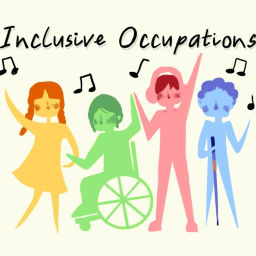
This podcast is for school-based occupational therapists and other educators who are invested in creating a more inclusive world for their students.

OT for Inclusive Occupations: Stories of Not Just Being Invited to the Party but Dancing
Claim This Podcastby Savitha Sundar
Podcast Authority
Beta
Podcast Overview
This podcast is for school-based occupational therapists and other educators who are invested in creating a more inclusive world for their students.
Language
🇺🇲
Publishing Since
11/12/2020
Unlock The Full Podcast Authority Score Report
See how your podcast performs across key metrics
Podcast Authority
Beta
Recommendations available
Unlock the full report to see detailed tips
Unlock comprehensive insights including:
- • YouTube presence analysis
- • Social media reach metrics
- • RSS compliance scoring
- • Podcast 2.0 features
- • Technical standards
Detailed Analytics
- Complete breakdown of all 19 authority metrics
- Personalized recommendations for each metric
- Industry benchmarks and comparisons
- Technical RSS feed analysis and compliance scoring
Growth Strategies
- Step-by-step action plans for improvement
- Quick wins to boost your score immediately
- Pro tips from successful podcasters
See how your show performs across every key metric
High authority scores make your podcast more attractive to industry leaders and influencers who want to appear on credible shows.
Sponsors look for podcasts with proven authority and engagement. Your score demonstrates your podcast's value to potential partners.
Understanding your strengths and weaknesses helps you make data-driven decisions to expand your listener base effectively.
9 verified contact emails on file for OT for Inclusive Occupations: Stories of Not Just Being Invited to the Party but Dancing
Pitch yourself as a guest, propose sponsorships, or reach out directly to the host.
Recent Episodes

June 3, 2026
Season 5, Episode 6: Partnering for Change (P4C Model): Reimagining School-Based Occupational Therapy Service Delivery — Dr. Wenonah Campbell
Host Savitha Sundar interviews Dr. Wenonah Campbell about reimagining school-based occupational therapy through the collaborative Partnering for Change model to enhance student participation and inclusion.

March 17, 2026
Season 5, Episode 5: The EMPOWER Model for Neurodivergence Affirming Occupational Therapy Practice- Bryden Carlson-Giving
<p>In this episode of <strong>Inclusive Occupations</strong>, host <strong>Savitha Sundar</strong> speaks with <strong>Bryden Carlson-Giving</strong>—a multiply disabled, multiply neurodivergent, queer occupational therapist, artist, and creator of the Empower Model, a neurodiversity-affirming framework for occupational therapy.</p><p>Bryden shares his professional journey—from working in an <strong>ABA clinic</strong>, recognizing practices that felt harmful, and intentionally seeking out autistic perspectives—to ultimately leaving that setting and developing a model that centers <strong>neurodivergent participation, lived experience, and disability justice</strong> within occupational therapy practice.</p><p>Together, Savitha and Bryden explore how occupational therapists can rethink traditional approaches and move toward practices that support <strong>authentic neurodivergent development, identity, and belonging in school and community environments.</strong></p><p>In this conversation, Savitha and Bryden explore:</p><p>🌱 Neurodiversity & Neurodivergence</p><p>⚖️ Ableism in OT and Education</p><ul><li>How ableism can show up in <strong>IEPs, evaluations, “functional” goals, and behavior expectations</strong></li><li>Why saying “we’re not ABA” is not enough if occupational therapy continues to rely on <strong>compliance-based, neuronormative practices</strong></li></ul><p>🌟 <strong>The Empower Model</strong></p><p>Bryden introduces the <strong>Empower Model</strong>, a neurodiversity-affirming framework grounded in four foundations:</p><ul><li>Strengths-based practice</li><li>Trauma-informed care</li><li>Anti-racism</li><li>Disability justice</li></ul><p>At the center of the model is <strong>lived experience</strong>, which serves as the connective thread guiding meaningful and ethical occupational therapy practice. Bryden describes the anti-ableist process that includes:</p><ul><li>Critical reflexivity</li><li>Inclusive evaluations</li><li>Affirming services and supports</li><li>Neurodivergent outcomes<br>Advocacy</li></ul><p><strong>🏫 Belonging and Educational Placement</strong></p><ul><li>Bryden challenges listeners to rethink segregation in education and emphasizes the idea that: (a) <strong>“All students are general education students first.” (b) </strong>The conversation explores how we can reimagine <strong>special day classes, segregation by disability, and what true belonging in general education could look like.</strong></li></ul><p>🤝<strong> From Compliance to Collaboration</strong></p><ul><li>Bryden encourages occupational therapists to rethink how they respond to behaviors often labeled as <strong>“non-compliance.”</strong></li><li>Instead of focusing on control, practitioners can approach these moments through:</li></ul><ol><li>Co-regulation</li><li>Curiosity</li><li>Meaningful participation goals</li></ol><ul><li>This shift invites therapists to ask deeper questions:</li></ul><ol><li>Is this skill meaningful to the student?</li><li>Is the environment supportive?</li><li>What expectations or systems might need to change?<br></li></ol><p>🧭 <strong>Working Within Ableist Systems</strong></p><p>Bryden also discusses the realities of practicing within imperfect systems and how therapists can sustain themselves through:</p><ul><li>Avoiding burnout from trying to <strong>fix the entire system alone</strong></li><li>Valuing <strong>micro-advocacy</strong>—small but meaningful shifts in conversations and practice</li><li>Giving ourselves <strong>grace when we cannot challenge everything, all the time</strong></li></ul><p><strong>Resources & Links Mentioned in the Episode</strong></p><p><strong>Bryden’s Website:</strong><a href="https://neurodivergentnexus.com" target="_blank" rel="ugc noopener noreferrer"><strong>https://neurodivergentnexus.com</strong></a></p><p> Resources, tools, and updates on the <strong>Empower Model</strong> and Bryden’s upcoming book.</p><p><strong>The Empower Model</strong> A neurodiversity-affirming occupational therapy framework centered on strengths-based practice, trauma-informed care, anti-racism, disability justice, and lived experience</p><p><strong>Upcoming Open-Access Article (OJOT)</strong> A forthcoming article detailing the Empower Model and practical examples for occupational therapy practice. (Link will be added once published.)</p><p><strong>Empower Model Action Template</strong> A planning and reflection tool designed to help practitioners apply the model with real students. (Link will be added once the resource is published.)</p><p>Podcast transcripts available at <a href="http://otter.ai" target="_blank" rel="ugc noopener noreferrer"><strong>Otter.ai</strong></a>- <a href="https://otter.ai/u/MfPnD7hB-fR0ihps8f1q1SrZQAg?utm_source=copy_url" target="_blank" rel="ugc noopener noreferrer">https://otter.ai/u/MfPnD7hB-fR0ihps8f1q1SrZQAg?utm_source=copy_url</a></p>

February 9, 2026
Season 5, Episode 4: The 9-Step Inclusive IEP Process- Dr. Jessica Apgar
<p>In this episode of <strong>Inclusive Occupations</strong>, host <strong>Dr.</strong> <strong>Savitha Sundar</strong> welcomes <strong>Dr. Jessica Apgar, </strong>educator, scholar, and researcher for <strong>16 years</strong>. Dr. Apgar spent <strong>8 years</strong> as a dual-certified inclusive educator in public schools and has worked with <strong>pre- and in-service teachers</strong> for the past <strong>11 years.</strong> Her professional interests include <strong>inclusive education, systems change, literacy, and curricular alignment</strong>—all in service of <strong>social justice</strong> through high-quality, rigorous instruction, particularly for students with the most <strong>extensive support needs</strong>.</p><p>In this conversation, Savitha and Dr. Apgar spotlight a powerful tool created by a team of educators-turned-researchers- <strong>Jessica Apgar , Kate MacLeod, and Michael McSheehan : </strong>The <strong>9-Step Inclusive IEP Process.</strong>Together, they unpack how inclusive education truly begins with an inclusive IEP—one that moves beyond compliance to intentionally design for <strong>access, participation, and belonging</strong> across the school day.</p><p>Together, Savitha and Dr. Apgar explore:🌟 <strong>Why inclusive education begins with an inclusive IEP</strong>—and the common traps that keep IEPs from translating into real participation.🧭 <strong>The 9-step process, step-by-step</strong>—how each step builds clarity, shared responsibility, and actionable supports.🧑🏫 <strong>Team collaboration that works</strong>—how to bring general educators, special educators, related service providers, and families into a unified plan.📚 <strong>Literacy and curricular alignment</strong>—strengthening rigor and access for students with extensive support needs.🏫 <strong>Designing for real school routines</strong>—how IEPs can support inclusion across classroom instruction, specials, lunch, recess, transitions, and extracurriculars.✅ <strong>Making it sustainable</strong>—turning inclusive intent into consistent implementation through repeatable team structures.</p><p>Inclusive IEPs are not paperwork—they are <strong>blueprints for belonging</strong>. When we plan intentionally for access and participation, we reduce “invisible barriers” and create clear supports that teachers can actually implement. Dr. Apgar offers a roadmap for systems change that is both values-driven and practical for real schools.</p><ul><li>Inclusion doesn’t happen after the IEP—it is <strong>designed in the IEP</strong>.</li><li>Strong IEPs translate into <strong>clear supports in real contexts</strong>, not just goals on paper.</li><li>Shared processes and shared language make inclusive planning <strong>more efficient and more consistent</strong>.</li><li>Rigor, literacy, and curricular alignment are essential for meaningful inclusion—especially for students with the most extensive support needs.</li><li><strong>Key Takeaways, Resources & Links:</strong></li><li><strong>1. The 9-Step Inclusive IEP Process Template</strong> by Jessica Apgar, Kate MacLeod and Michael McSheehan. - <a href="https://docs.google.com/document/d/1conn6_Dy7qkX9g8IEvVgi3XjSwIZe-n0/edit?usp=sharing&ouid=113473970588582202532&rtpof=true&sd=true">Click Here </a><a href="https://drive.google.com/file/d/1VuRvvtjx3_AhotskAV0zO0zmBVcJuPX_/view?usp=sharing">(https://docs.google.com/document/d/1conn6_Dy7qkX9g8IEvVgi3XjSwIZe-n0/edit?usp=sharing&ouid=113473970588582202532&rtpof=true&sd=true)</a> </li><li>2. <strong>The Continuum of Supports (NOT Placements) by.Michael McSheehan, Jessica Apgar, Debbie Taub,</strong><strong> </strong><strong>Mary </strong><strong>Schumer </strong><strong>andKate MacLeod</strong><strong>) </strong><a href="https://courses.evolveandeffect.com/products/digital_downloads/Continuum-of-Supports">https://courses.evolveandeffect.com/products/digital_downloads/Continuum-of-Supports</a> </li><li><strong>3. Creating Inclusive Individualized Education Program- Microcredentials</strong><a href="https://farmington.edu/academics/graduate-continuing-education/graduate-academics/creating-inclusive-individualized-education-programs-micro-credential/">: https://farmington.edu/academics/graduate-continuing-education/graduate-academics/creating-inclusive-individualized-education-programs-micro-credential</a>/</li><li><strong>Podcast transcripts available at Otter.ai:</strong> <a href="https://otter.ai/u/QgDqitCxJ9Kb9M--WcQXTvYUDfI?utm_source=copy_url">https://otter.ai/u/QgDqitCxJ9Kb9M--WcQXTvYUDfI?utm_source=copy_url</a></li></ul>
36 total episodes available with 1 transcripts
Deep-dive analytics for OT for Inclusive Occupations: Stories of Not Just Being Invited to the Party but Dancing
Frequently asked questions
Have a different question and can't find the answer you're looking for? Reach out to our support team by sending us an email and we'll get back to you as soon as we can.
- What is OT for Inclusive Occupations: Stories of Not Just Being Invited to the Party but Dancing?
- How often does this podcast release new episodes?
This podcast updates bi-weekly.
- Where can I listen to this podcast?
This podcast is available on 8 platforms including Apple Podcasts, Spotify, and more. You can also use the RSS feed directly.
- Does this podcast accept guests?
No, this podcast does not typically feature guests.
Legal Disclaimer
Pod Engine is not affiliated with, endorsed by, or officially connected with any of the podcasts displayed on this platform. We operate independently as a podcast discovery and analytics service.
All podcast artwork, thumbnails, and content displayed on this page are the property of their respective owners and are protected by applicable copyright laws. This includes, but is not limited to, podcast cover art, episode artwork, show descriptions, episode titles, transcripts, audio snippets, and any other content originating from the podcast creators or their licensors.
We display this content under fair use principles and/or implied license for the purpose of podcast discovery, information, and commentary. We make no claim of ownership over any podcast content, artwork, or related materials shown on this platform. All trademarks, service marks, and trade names are the property of their respective owners.
While we strive to ensure all content usage is properly authorized, if you are a rights holder and believe your content is being used inappropriately or without proper authorization, please contact us immediately at hey@podengine.ai for prompt review and appropriate action, which may include content removal or proper attribution.
By accessing and using this platform, you acknowledge and agree to respect all applicable copyright laws and intellectual property rights of content owners. Any unauthorized reproduction, distribution, or commercial use of the content displayed on this platform is strictly prohibited.