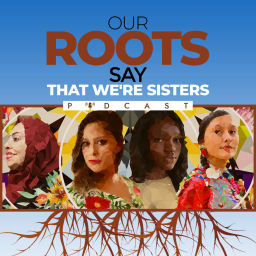
Podcast thumbnail for Our Roots Say That We're Sisters

Our Roots Say That We're Sisters

Claim This Podcast

by Marquette University

5.0(1 reviews)
35 episodes
Updated Bi-weekly
Accepts GuestsHas SponsorsLocation 🇺🇸
23

Podcast Authority

Beta
PoorBased on show quality, social media presence, reviews, charts, and more
Pod Engine
Quality35
Social0
YouTube0
Engagement27

Podcast Overview

Welcome to Our Roots Say That We're Sisters podcast. This podcast series is sponsored by the Marquette Forum with support from Marquette University's Office of Institutional Diversity and Inclusion and the Haggerty Museum of Art. It's an extension of a Marquette University mural project to highlight and uplift diverse women associated with Marquette whose images and contributions have been systematically made invisible.

Language

🇺🇲

Publishing Since

2/24/2021

Unlock The Full Podcast Authority Score Report

See how your podcast performs across key metrics

23

Podcast Authority

Beta
PoorBased on show quality, social media presence, reviews, charts, and more
Pod Engine
Quality35
Social0
YouTube0
Engagement27
7
Excellent Areas
1
Good Performance
11
Growth Opportunities
excellent
Episode Length
11 minutes
Performing excellently!
good
iTunes Tags
6.2/10

Recommendations available

Unlock the full report to see detailed tips

poor
Publishing Consistency
Every 44 days

Recommendations available

Unlock the full report to see detailed tips

+16 More Metrics

Unlock comprehensive insights including:

  • • YouTube presence analysis
  • • Social media reach metrics
  • • RSS compliance scoring
  • • Podcast 2.0 features
  • • Technical standards
What's Included in Your Full Report

Detailed Analytics

  • Complete breakdown of all 19 authority metrics
  • Personalized recommendations for each metric
  • Industry benchmarks and comparisons
  • Technical RSS feed analysis and compliance scoring

Growth Strategies

  • Step-by-step action plans for improvement
  • Quick wins to boost your score immediately
  • Pro tips from successful podcasters
Get your free podcast insights report

See how your show performs across every key metric

Instant delivery
No spam
Attract Better Guests

High authority scores make your podcast more attractive to industry leaders and influencers who want to appear on credible shows.

Secure Sponsorships

Sponsors look for podcasts with proven authority and engagement. Your score demonstrates your podcast's value to potential partners.

Grow Your Audience

Understanding your strengths and weaknesses helps you make data-driven decisions to expand your listener base effectively.

Reach the team behind Our Roots Say That We're Sisters

Verified contact details for this show aren't on file yet — sign up to get notified when they land.

Recent Episodes

Episode thumbnail for Mission, Mentorship & Community with Makda Fessahaye

May 14, 2025

Mission, Mentorship & Community with Makda Fessahaye

<p>Makda Fessahaye, a Marquette Law grad who now works as the Associate Vice Chancellor and head of HR at the University of Wisconsin Milwaukee, talks about growing up in Milwaukee as a Black woman with Eritrean roots and how her parents’ focus on faith, education, and community helped shape who she is today.</p><p>She talks about the ups and downs of being a woman of color in school and at work, and how mentors and strong community ties have helped her along the way. She also shares how important it is to support others as you move forward in life.</p><p>Through honest and personal stories, Makda shows how her background and experiences have guided her—and how she hopes to help others on their own paths. If you're looking for a thoughtful, down-to-earth conversation about resilience, sisterhood, and making a difference, this episode is for you.</p><p><strong>Episode Highlights:</strong></p><p><strong>3:21 - </strong>I went to many different schools—parochial, inner city, and then in Whitefish Bay. As a child of African immigrants, it was hard to navigate being in African-American and then predominantly white spaces. As a kid, I didn’t fully understand what I was experiencing. Looking back, I see how resilient children are. Later in life, being a young Black woman in leadership brought challenges—imposter syndrome, figuring out how to stay authentic while navigating workplace politics. It hasn’t been easy, but I’ve learned a lot along the way.</p><p><strong>09:06 -</strong> I just love that mural. It is beautiful. I think it is so reflective of the diversity of Milwaukee. It reminds me of the value of community, of being in community, to be of community, to be of sisterhood, I think is very important. And I think that that mural is so beautiful and so reflective of that.</p><p><strong>13:59 - </strong>I hope to have the same impact others had on me—to be there when needed, to inspire, and to help others navigate challenges through my own experiences. I want to be someone who lifts others up and connects them to the resources they need.</p><p><strong>Interview:</strong></p><p><strong>What is the story you’d like to share with us today and how do you identify? </strong></p><p><strong>[01:31]</strong> We could go anywhere with this story. I identify as a Black woman of Eritrean descent, and my journey has been shaped by my immigrant family’s devotion to faith and education, as well as my upbringing in Milwaukee’s Lincoln Park neighborhood."</p><p><strong>How did you get onto the path that you're on? </strong></p><p><strong>[01:54]</strong> So my family, as I mentioned, is from Eritrea in East Africa. My parents immigrated here prior to me being born. They are a family that is rooted in faith, specifically the Catholic faith, and also have a major value and appreciation for education. So I grew up in a household where my summers were spent in the library and doing brain exercises and doing different workbooks and making sure that I just kept on track. I really look to my upbringing and what my parents valued as part of why I'm here today.</p><p><strong>What kind of challenges, if any, did you face as you've sort of gone on your journey? </strong></p><p><strong>[03:21]</strong> I went to many different schools—parochial, inner city, and then in Whitefish Bay. As a child of African immigrants, it was hard to navigate being in African-American and then predominantly white spaces. As a kid, I didn’t fully understand what I was experiencing. Looking back, I see how resilient children are. Later in life, being a young Black woman in leadership brought challenges—imposter syndrome, figuring out how to stay authentic while navigating workplace politics. It hasn’t been easy, but I’ve learned a lot along the way.</p><p><strong>What’s been the role of women of color in your journey, especially in navigating some of those challenges? </strong></p><p><strong>[05:55]</strong> They’ve been incredible. One of my earliest mentors was Dee Dee...
Episode thumbnail for Speaking Up & Standing Out with Amyah Brooks

March 4, 2025

Speaking Up & Standing Out with Amyah Brooks

<p>Did you know that women of color in leadership are often labeled as “disruptive” simply for asserting their voice? In this episode, we explore what it means to lead unapologetically, despite the barriers that seek to silence strong voices. </p><p>Listen to Amyah Brooks, a biracial Black woman, who is majoring in Political Science and Social Welfare and Justice at Marquette University. She talks about her journey on navigating identity, leadership, and advocacy. From confronting institutional challenges to carving out spaces of belonging, Amyah shares her insights on using her voice, embracing activism, and redefining leadership on her own terms. </p><p>How do you stand your ground and lead boldly when the very qualities that make you a great leader—passion, resilience, and a drive for justice—are the ones that make others uncomfortable? What does it mean to truly belong in spaces that weren’t designed with you in mind, and how can we learn from those who refuse to be silent?</p><p>If you’ve ever felt the tension between fitting in and standing out, this conversation will challenge you to rethink what it means to lead boldly and create change from within.</p><p><strong>Episode Highlights:</strong>&nbsp;&nbsp;</p><p><strong>03:44 - </strong>I've heard from certain administrators telling me about my own leadership, saying that sometimes it's better if I step away from my identity in order to lead. That comment has always stuck with me because I was questioning—what does it mean to step out of my identity to lead others? It felt like they wanted me to remove myself. </p><p><strong>08:15 -</strong> The impact I want to have is helping people discover what they’re passionate about, find their voice, and know that they can do anything they set their mind to.</p><p><strong>10:16 - </strong>My hope for my own future is to graduate from Marquette University. Then, I hope to continue a commitment to service while helping people. That’s been my main motivation for getting involved in politics—to change the culture of politics while keeping humanity at the center of it. I also hope to do more work within immigration law. A big goal of mine is to work at the U.S.-Mexico border directly. I’ve been fortunate to visit twice with Marquette and will be going again this spring break.</p><p><strong>Interview:</strong></p><p><strong>What's the story you want to share with us today?</strong>&nbsp;&nbsp;</p><p><strong>[01:18]</strong> Today, I just wanted to talk about a little bit of my time at Marquette.</p><p><strong>How do you identify?</strong>&nbsp;&nbsp;</p><p><strong>[01:37]</strong> I identify as a biracial Black woman.</p><p><strong>Are you from Wisconsin?</strong>&nbsp;&nbsp;</p><p><strong>[01:43]</strong> I'm from Appleton, Wisconsin.</p><p><strong>What's it like growing up there?</strong>&nbsp;&nbsp;</p><p><strong>[01:48]</strong> Growing up there, there's really not much to do. I kind of describe it as a quaint town, kind of like Gilmore Girls-esque.</p><p><strong>So you're the Rory in this scenario?</strong>&nbsp;&nbsp;</p><p><strong>[01:57]</strong> Yes.</p><p><strong>Tell us about some of your adventures. What’s the journey? Share a bit of your journey to and through Marquette.</strong>&nbsp;&nbsp;</p><p><strong>[02:10]</strong> Well, coming to Marquette, I was always really interested in going for political science. I had a big interest in high school with forensics, debate team, and civics. So I always thought I was going to major in political science and then be right on track for law school. But then I developed a big interest in education, which then shaped into social welfare and justice because I'm really passionate about learning about different social inequalities and how I can help solve them.</p><p><strong>And you plan to do that as a lawyer? Are you still thinking about law school?</strong>&nbsp;&nbsp;</p><p><strong>[02:47]</strong> I am still thinking about law school. I want to do a dual program for law...

Episode thumbnail for Intergenerational Health and Community-Centered Research with Dr. Kimberly D'Anna Hernandez

February 5, 2025

Intergenerational Health and Community-Centered Research with Dr. Kimberly D'Anna Hernandez

<p>In this inspiring episode of Our Roots Say That We’re Sisters, Dr. Kimberly D'Anna Hernandez, Associate Professor of Psychology at Marquette University, shares her remarkable journey navigating academia as a Chicana, a single student-parent, and a trailblazer in stress biology research. </p><p>Dr. Hernandez reflects on the intersection of her identity, life challenges, and professional aspirations, highlighting how her lived experiences have shaped her research into social and cultural stressors, intergenerational health disparities, and community-based mental health initiatives.</p><p>From her roots in zoology and behavioral neuroscience to her current work addressing medical violence and systemic inequities in Milwaukee’s perinatal care systems, Dr. Hernandez emphasizes the importance of community-engaged research and the power of cultural representation in higher education spaces. She also offers an honest look into her personal journey, balancing her roles as a mother, researcher, and mentor.</p><p><strong>Episode Highlights:</strong>&nbsp;&nbsp;</p><p><strong>04:36 -</strong>&nbsp;I was trying to merge my identities because the whole time I was in graduate school, I was actually trying to leave. I couldn’t figure out where I fit. My people weren’t the people in my cohort. I was part of a single-parent group that was mainly women of color.</p><p><strong>07:10 - </strong>Community-engaged research is about equity. You meet with community partners, talk about their needs, and design a project together that you both own and have voice in. It takes real time to build those relationships.</p><p><strong>15:50 - </strong>I always want to show gratitude to those who came before me, whose shoulders we stand on, and whose legacy we’re lucky to be a part of. But I also want to keep DEI initiatives alive despite the fear-mongering against them. It’s dangerous not to name that we’re striving for diversity, equity, and inclusion.</p><p><strong>Interview:</strong></p><p><strong>What’s the story you'd like to share with us today?</strong></p><p><strong>01:23</strong> - I'd like to talk a little bit about how I started out and got here because in some ways the path is traditional, and in some ways it's not. I was a zoology major. I always liked animals, and that's what I thought I was going to do. But I was also a Chicano activist when I was in undergrad. It was a real duality of identities and bringing those together. How were they going to play out? Was I going to have to choose one or the other to go forward? Along the way, something else happened to me—I was a student parent. I had my son when I was a junior in college. Unlike many of my peers who were going out and doing things, I was a single parent taking care of a kid in a one-bedroom apartment, going to class. I remember eating to stay awake, those types of things. I had a professor at the time. My son was born in April, so I wasn’t done with finals yet. I had to tell most of my professors that I was pregnant and how I was going to plan to finish the semester. One professor told me, "If you're not in class, there's nothing I can do for you." So I gave birth on Sunday, and I was back in class on Thursday. Now I know more, but at the time, I was young, I didn’t have much mentorship, and I didn’t know what to do. Putting all of those things together shaped what I do now. I had basic training in stress biology in my PhD and combined it with my roots as a Chicana and my activism to look particularly at sociocultural stressors—things like racism and discrimination—and their effects on the Latinx population and pregnant women, and how those things change and program stress responsivity and biology. This has consequences for the intergenerational transmission of health disparities and mental health risk. I think finding that has really pushed my journey forward in a way that I’m not sure would have happened without all those things coming together.</p><p><strong>Are you...

35 total episodes available

Deep-dive analytics for Our Roots Say That We're Sisters

Frequently asked questions

Have a different question and can't find the answer you're looking for? Reach out to our support team by sending us an email and we'll get back to you as soon as we can.

What is Our Roots Say That We're Sisters?

Welcome to Our Roots Say That We're Sisters podcast. This podcast series is sponsored by the Marquette Forum with support from Marquette University's Office of Institutional Diversity and Inclusion and the Haggerty Museum of Art. It's an extension of a Marquette University mural project to highlight and uplift diverse women associated with Marquette whose images and contributions have been systematically made invisible.

How often does this podcast release new episodes?

This podcast updates bi-weekly.

Where can I listen to this podcast?

This podcast is available on 10 platforms including Apple Podcasts, Spotify, and more. You can also use the RSS feed directly.

Does this podcast accept guests?

Yes, this podcast regularly features guests.

Legal Disclaimer

Pod Engine is not affiliated with, endorsed by, or officially connected with any of the podcasts displayed on this platform. We operate independently as a podcast discovery and analytics service.

All podcast artwork, thumbnails, and content displayed on this page are the property of their respective owners and are protected by applicable copyright laws. This includes, but is not limited to, podcast cover art, episode artwork, show descriptions, episode titles, transcripts, audio snippets, and any other content originating from the podcast creators or their licensors.

We display this content under fair use principles and/or implied license for the purpose of podcast discovery, information, and commentary. We make no claim of ownership over any podcast content, artwork, or related materials shown on this platform. All trademarks, service marks, and trade names are the property of their respective owners.

While we strive to ensure all content usage is properly authorized, if you are a rights holder and believe your content is being used inappropriately or without proper authorization, please contact us immediately at hey@podengine.ai for prompt review and appropriate action, which may include content removal or proper attribution.

By accessing and using this platform, you acknowledge and agree to respect all applicable copyright laws and intellectual property rights of content owners. Any unauthorized reproduction, distribution, or commercial use of the content displayed on this platform is strictly prohibited.