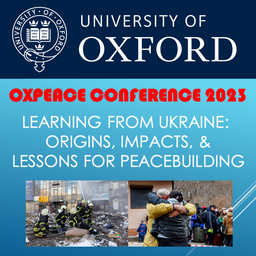
Podcast thumbnail for OxPeace Conference 2023: Learning from Ukraine

OxPeace Conference 2023: Learning from Ukraine

Claim This Podcast

by Oxford University

10 episodes
Updated Daily
Accepts GuestsHas SponsorsLocation 🇬🇧

Podcast Overview

How can the war in Ukraine inform our understanding of peace? Experts from the Oxford Network of Peace Studies -- from University of Oxford, United Nations, World Economic Forum and more -- explore the origins, impacts and lessons of the conflict for peacebuilding. 'OxPeace', the Oxford Network of Peace Studies, is a multidisciplinary network to promote the study of peace, peacemaking, peacekeeping and peacebuilding in Oxford University and beyond. Through conferences, seminars and practical training workshops, OxPeace showcases the study of peace across a wide variety of disciplines, networks with practitioners and policy-makers. Previous OxPeace conferences are available via the 'Department of Politics and International Relations (DPIR)' page linked below.

Language

🇺🇲

Publishing Since

5/4/2023

1 verified contact email on file for OxPeace Conference 2023: Learning from Ukraine

Pitch yourself as a guest, propose sponsorships, or reach out directly to the host.

Recent Episodes

Episode thumbnail for Russia and Christian nationalism: the background of a conflict

May 12, 2023

Russia and Christian nationalism: the background of a conflict

How the global resurgence of traditionalist, religion-based nationalism relates to the specifics of the present conflict between Russia and Ukraine. The aggression in Ukraine is rooted in a long history of mythologised versions of Russian identity, which need to be better understood. But it is also an instance of a wider resurgence of nationalism allied to a traditionalist religious and moral agenda. Rt Revd & Rt Hon. Dr Rowan Williams DD, FBA was born in 1950 into a Welsh-speaking family in Swansea. He read Theology at Cambridge, and gained his doctorate in Oxford on the work of the Russian émigré theologian Vladimir Lossky. Ordained priest in 1978, he taught at Mirfield and in Cambridge, moving to Oxford as Lady Margaret Professor of Divinity 1986-1991. He became Bishop of Monmouth 1991-1999, Archbishop of Wales 1999-2002, Archbishop of Canterbury 2002-2012. He received a life peerage in 2012 and was Master of Magdalen College, Cambridge, 2013-2020, also serving as a member of the House of Lords 2002-2020. Author of a number of theological works and sermon collections, Rowan is also an accomplished poet. Creative Commons Attribution-Non-Commercial-Share Alike 2.0 UK: England & Wales; http://creativecommons.org/licenses/by-nc-sa/2.0/uk/

Episode thumbnail for Exiting Russia: the effects of multinational withdrawal

May 12, 2023

Exiting Russia: the effects of multinational withdrawal

Can corporate action contribute to human rights, peace, and conflict prevention? Russia’s invasion of Ukraine triggered not only massive economic and financial sanctions imposed on Russia, but also a significant but incomplete exit of multinational corporations from Russia. This exit has been driven by varying degrees of ethical as well as reputational considerations but has stalled as companies cite operational and legal dilemmas. Nonetheless important precedents have been set that may make companies—and their investors—more conscious and responsible actors in conflict situations. Companies and investors alike may integrate longstanding political risk analysis with emerging human rights due diligence to inform decisions whether to remain in certain countries. They may also consider human rights and humanitarian factors both to ensure a responsible exit and to determine possible post-conflict re-entry in ways that can contribute to peace and prevent further conflict. Such commitments and actions can encourage a new geopolitical corporate responsibility to support the rules-based order that defines the international community and underpins the global economy—and in turn enables the cooperation critical to alleviating inequality and diminishing the climate crisis. An innovative leader and standard-setter for responsible business and investment, Bennett Freeman has co-founded multi-stakeholder initiatives and coalitions focused on the extractives, technology and apparel sectors. Bennett holds degrees in History from the University of California at Berkeley (1979) and Oxford (1981; English-Speaking Union Scholar, Balliol). He served as a Clinton presidential appointee in three positions at the US Department of State, including as deputy assistant secretary of state for democracy, human rights and labour from 1999-2001. He was senior VP for sustainability research and policy at Calvert Investments, 2006-15. As principal of Bennett Freeman Associates LLC, he currently advises multinational corporations, international institutions and NGOs on policy and strategy related to human rights and labour rights. He was the lead author of Shared Space Under Pressure: Business Support for Civic Freedoms and Human Rights Defenders (2018) and is an Associate Fellow of the International Law Programme at Chatham House. Bennett is a co-founder and Steering Committee member of Business for Ukraine (B4Ukraine), a coalition that seeks to complete the exit of foreign companies from Russia and to set higher standards for human rights due on the part of companies and investors in conflict situations—and in turn to contribute to a new ethic of geopolitical corporate responsibility to support the international rules-based order. Creative Commons Attribution-Non-Commercial-Share Alike 2.0 UK: England & Wales; http://creativecommons.org/licenses/by-nc-sa/2.0/uk/

Episode thumbnail for The Global Food Crisis and the Ukraine War

May 12, 2023

The Global Food Crisis and the Ukraine War

Exploring the three elements that intersect and contribute to the global food crisis. There is a global food crisis. It is connected with the Russian invasion of Ukraine in several ways. The aspect that gained publicity is the interruption of wheat supplies from Black Sea ports to international food markets. This has been addressed by the ‘Black Sea Grain Initiative’ led by the UN and Turkey. A second aspect is the ripple effects from the emergent war economies and the Atlantic and eastern blocs. A third is that principled multilateral engagement in crises in the Global South has been supplanted by rivalrous transactional diplomacy. All three elements intersect in food-vulnerable regions of the world such as the Horn of Africa to calamitous effect. Professor Alex de Waal is executive director of the World Peace Foundation and Research Professor at the Fletcher School, Tufts University. He has worked on the Horn of Africa, and on conflict, food security and related issues since the 1980s as a researcher and practitioner. He served as a senior advisor to the African Union High Level Panel on Sudan and South Sudan. He was listed among Foreign Policy’s 100 most influential international intellectuals in 2008 and Atlantic’s 29 ‘brave thinkers’ in 2009. De Waal’s recent books include: The Real Politics of the Horn of Africa: Money, War and the Business of Power (Polity 2015), Mass Starvation: The history and future of famine (Polity 2018), and New Pandemics, Old Politics: 200 years of the war on disease and its alternatives (Polity 2021). Creative Commons Attribution-Non-Commercial-Share Alike 2.0 UK: England & Wales; http://creativecommons.org/licenses/by-nc-sa/2.0/uk/

10 total episodes available

Deep-dive analytics for OxPeace Conference 2023: Learning from Ukraine

Frequently asked questions

Have a different question and can't find the answer you're looking for? Reach out to our support team by sending us an email and we'll get back to you as soon as we can.

What is OxPeace Conference 2023: Learning from Ukraine?

How can the war in Ukraine inform our understanding of peace? Experts from the Oxford Network of Peace Studies -- from University of Oxford, United Nations, World Economic Forum and more -- explore the origins, impacts and lessons of the conflict for peacebuilding.

'OxPeace', the Oxford Network of Peace Studies, is a multidisciplinary network to promote the study of peace, peacemaking, peacekeeping and peacebuilding in Oxford University and beyond. Through conferences, seminars and practical training workshops, OxPeace showcases the study of peace across a wide variety of disciplines, networks with practitioners and policy-makers.

Previous OxPeace conferences are available via the 'Department of Politics and International Relations (DPIR)' page linked below.

How often does this podcast release new episodes?

This podcast updates daily.

Where can I listen to this podcast?

This podcast is available on 4 platforms including Apple Podcasts, Spotify, and more. You can also use the RSS feed directly.

Does this podcast accept guests?

Yes, this podcast regularly features guests.

Legal Disclaimer

Pod Engine is not affiliated with, endorsed by, or officially connected with any of the podcasts displayed on this platform. We operate independently as a podcast discovery and analytics service.

All podcast artwork, thumbnails, and content displayed on this page are the property of their respective owners and are protected by applicable copyright laws. This includes, but is not limited to, podcast cover art, episode artwork, show descriptions, episode titles, transcripts, audio snippets, and any other content originating from the podcast creators or their licensors.

We display this content under fair use principles and/or implied license for the purpose of podcast discovery, information, and commentary. We make no claim of ownership over any podcast content, artwork, or related materials shown on this platform. All trademarks, service marks, and trade names are the property of their respective owners.

While we strive to ensure all content usage is properly authorized, if you are a rights holder and believe your content is being used inappropriately or without proper authorization, please contact us immediately at hey@podengine.ai for prompt review and appropriate action, which may include content removal or proper attribution.

By accessing and using this platform, you acknowledge and agree to respect all applicable copyright laws and intellectual property rights of content owners. Any unauthorized reproduction, distribution, or commercial use of the content displayed on this platform is strictly prohibited.