
Panglot World Languages
Claim This Podcastby Stanisław Pstrokoński
Podcast Overview
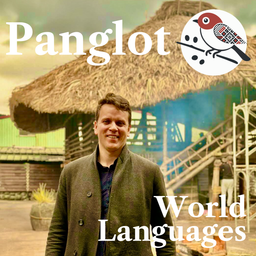
<p><b>There are 7,000 languages on planet Earth. Come and explore this hidden world with us.</b></p><p>Welcome to Panglot World Languages, a show about all the languages you've never heard of, and the speakers who call these languages their home.</p><p>Linguists see languages as beautiful abstract structures; speakers see them as an expression of identity, heritage, and soul. Both are right. On this podcast, we nerd out (respectfully) about their unique modes of expression, while also listening to the human stories of those who speak, study, and preserve them.</p><p><b>Subscribe to hear the world differently.</b></p><p><i>Cover art: Stanisław Pstrokoński in front of the Temple of the War God in the village of Dabang in central Taiwan, home of the Tsou people.</i></p>
Language
🇺🇲
Publishing Since
3/25/2026
2 verified contact emails on file for Panglot World Languages
Pitch yourself as a guest, propose sponsorships, or reach out directly to the host.
Recent Episodes
May 4, 2026
8. Raising children in Penang Hokkien (Malaysia) with Dr Guy Karavengleman
<p>Guy Karavengleman (a.k.a. Guy Emerson) is a computational linguist at Cambridge University's Computer Laboratory. His mother is a Penang Hokkien speaker but brought him up speaking English. In his twenties, Guy decided to reclaim his linguistic heritage, and embarked on a many-year-long project to learn Penang Hokkien, depsite a dearth of resources for this language and an absence of speakers to practice with. Since then he has had two children and is raising them in this language also. His wife, who does not share his heritage, has also been gradually learning Penang Hokkien and working together with Guy to raise their children in this language.</p><p>Guy's story is touching and somewhat miraculous. Being a good friend of mine and an academic linguist, there is plenty of room to nerd out here. But I am especially excited to share his personal journey and his deep feeling towards his heritage, as well as his bold actions, since many in the audience may be inspired by his story.</p><p>Guy had every reason to ignore his feelings or to make excuses, but he chose a more difficult and altogether more meaningful path. In the end this goes beyond language; this is about choosing the person that you want to be and the life that you want to live.</p><p>Enjoy the episode.</p><p></p><hr /><p></p><p>Find out more about our work at <a rel="noopener noreferrer nofollow" href="http://panglotlanguages.com" target="_blank">panglotlanguages.com</a> .</p>
April 27, 2026
7. Documenting Kol (Bangladesh) from scratch with Dr Mashrur Imtiaz
<p>Dr Mashrur Imtiaz of Dhaka University is the first person to document the Kol language of Bangladesh.</p><p>I am excited to meet somebody that has documented a language from scratch - this is a rare find indeed! While many of the world's 7,000 languages remain to be documented (i.e. we literally know almost nothing about them), each such attempt is a real expedition and adventure into the unknown, both socially and linguistically; and a lot of documentation work is a continuation of previous groundwork, whereas in this case we are speaking with somebody who started from the name of a village and a blank sheet of paper.</p><p>Mashrur's sense of gratitude and warmth towards the Kol people is palpable, and his sense of mission in supporting minority languages in Bangladesh is clearly on display. He maintains a strong link with the Kol people and continues to work with them to this day. The story he shares is both intrepid and hopeful. I hope his story can inspire others in Bangladesh and around the world to continue this meaningful work.</p><p>Enjoy the episode.</p><p></p><hr /><p></p><p>You can read Mashrur's article about Kol in The Daily Star here: <a rel="noopener noreferrer nofollow" href="https://www.thedailystar.net/slow-reads/slow-reads-special/news/language-power-and-the-erasure-kol-4110676" target="_blank">https://www.thedailystar.net/slow-reads/slow-reads-special/news/language-power-and-the-erasure-kol-4110676</a> .</p><p>Find out more about our work at <a rel="noopener noreferrer nofollow" href="http://panglotlanguages.com" target="_blank">panglotlanguages.com</a> .</p>
April 20, 2026
6. Self-help in ancient constructed languages: Sanskrit, Prakrit, and Pali with Dr Alexander O'Neill
<p>Dr Alexander O'Neill of Musashino University in Tokyo returns to the podcast to explain to us the history, significance, cultural output, and current-day relevance of Sanskrit and its relatives Prakrit and Pali.</p><p>There was a time when Sanskrit speakers could be found all the way from Central Asia to Indonesia. It was a unifying lingua franca that was the centre of education, that books were written in, and that intellectuals would debate each other in on demand (in verse!). It was like Latin was to Europe, except even more important.</p><p>Literature in Classical Sanskrit covers a huge range, from religious texts and royal decrees to mathematics, astronomy, so-called mirrors for princes (i.e. self-help books for kings) and, famously, the Kama Sutra. And Vedic Sanskrit is the language of the Vedas, passed down through oral tradition over literally thousands of years. It's the only example I've heard of of a language preserved not through writing, but through generations of memorising ritual speech.</p><p>Classical Sanskrit also had what we might call "daughter languages" Prakrit and Pali. All of these were constructed languages in the sense that they seem not to have been codifications of a language that was spoken, but a codified adaptation from spoken language (the work "Sanskrit" itself means "constructed" or "perfect"). Each of these has had their own role to play in the culture of Central, South and Southeast Asia, and in particular in the religious traditions, literature, and drama of these regions. There is even a modern movement to revive Sanskrit as a spoken language!</p><p>Dr O'Neill also shares how reading the original Buddhist texts differs from reading them in translation, and the value of understanding the languages themselves.</p><p>Enjoy the episode.</p><p></p><hr /><p></p><p>Find out more about our work at <a rel="noopener noreferrer nofollow" href="http://panglotlanguages.com" target="_blank">panglotlanguages.com</a> .</p>
9 total episodes available
Deep-dive analytics for Panglot World Languages
Frequently asked questions
Have a different question and can't find the answer you're looking for? Reach out to our support team by sending us an email and we'll get back to you as soon as we can.
- What is Panglot World Languages?
<p><b>There are 7,000 languages on planet Earth. Come and explore this hidden world with us.</b></p><p>Welcome to Panglot World Languages, a show about all the languages you've never heard of, and the speakers who call these languages their home.</p><p>Linguists see languages as beautiful abstract structures; speakers see them as an expression of identity, heritage, and soul. Both are right. On this podcast, we nerd out (respectfully) about their unique modes of expression, while also listening to the human stories of those who speak, study, and preserve them.</p><p><b>Subscribe to hear the world differently.</b></p><p><i>Cover art: Stanisław Pstrokoński in front of the Temple of the War God in the village of Dabang in central Taiwan, home of the Tsou people.</i></p> - How often does this podcast release new episodes?
This podcast updates daily.
- Where can I listen to this podcast?
This podcast is available on 4 platforms including Apple Podcasts, Spotify, and more. You can also use the RSS feed directly.
- Does this podcast accept guests?
Yes, this podcast regularly features guests.
Legal Disclaimer
Pod Engine is not affiliated with, endorsed by, or officially connected with any of the podcasts displayed on this platform. We operate independently as a podcast discovery and analytics service.
All podcast artwork, thumbnails, and content displayed on this page are the property of their respective owners and are protected by applicable copyright laws. This includes, but is not limited to, podcast cover art, episode artwork, show descriptions, episode titles, transcripts, audio snippets, and any other content originating from the podcast creators or their licensors.
We display this content under fair use principles and/or implied license for the purpose of podcast discovery, information, and commentary. We make no claim of ownership over any podcast content, artwork, or related materials shown on this platform. All trademarks, service marks, and trade names are the property of their respective owners.
While we strive to ensure all content usage is properly authorized, if you are a rights holder and believe your content is being used inappropriately or without proper authorization, please contact us immediately at hey@podengine.ai for prompt review and appropriate action, which may include content removal or proper attribution.
By accessing and using this platform, you acknowledge and agree to respect all applicable copyright laws and intellectual property rights of content owners. Any unauthorized reproduction, distribution, or commercial use of the content displayed on this platform is strictly prohibited.