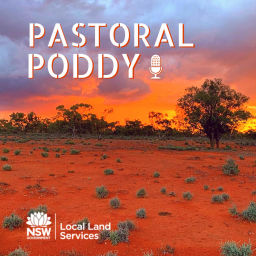
Pastoral Poddy – your go-to podcast for managing the rangelands of Western NSW.
Real-world stories, expert insights and the latest research from farmers and grazing specialists, covering sheep, goats and extensive pastoral systems in arid and semi-arid country.
Whether you're tackling grazing pressure, rangeland rehabilitation or livestock productivity, each episode brings practical takeaways tailored for the pastoral industry.
Listen to 'Pastoral Poddy' on your usual podcast platform, hit subscribe and share with a mate
Produced by the Grow Love Project for NSW Western LLS Australia
The story beneath our feet: understanding rangeland soils
What can your soil tell you about how your country is functioning?
In this episode of the Pastoral Poddy, host Edgars Greste speaks with soil scientist Karl Anderson about what makes rangeland soils unique and how rainfall, landscape position and soil type influence productivity.
Karl explores the role of carbon and organic matter, explains common constraints such as salinity and sodicity, and shares practical insights into groundcover, water infiltration and managing highly variable country.
It’s a conversation about looking beneath the surface, understanding how soil systems function, and recognising what happens across the landscape when the rain finally arrives.
EPISODE TIMESTAMPS
● (00:00) Why rangeland soils are different
● (02:40) Why organic matter matters
● (08:35) The soil tells a story of time and place
● (10:50) Reading the landscape after rain
● (13:40) Salinity and sodicity explained
● (16:55) Practical tools to rebuild productive country
● (19:00) Managing for variability and climate extremes
Resource links
https://www.dpird.nsw.gov.au/dpi/about-us/research-and-development/projects/soil-and-water-research/rangelands-living-skin
The Pastoral Poddy is proudly brought to you by Western Local Land Services in partnership with the New South Wales Department of Climate Change, Energy, the Environment and Water under the Primary Industries Productivity and Abatement program.
This episode was mixed and produced by Grow Love Project.
20 Aug 2026
Sheep emissions: less is more for breeding an efficient flock
Can sheep be bred to produce less methane without sacrificing productivity?
In this episode of the Pastoral Poddy, host Edgars Greste speaks with Ed Clayton, Livestock Research Officer with the NSW Department of Primary Industries and Regional Development, about the science and practical realities behind low methane sheep.
Together they explore how methane is produced in ruminants, why emissions have become an important focus for the livestock industry, and how researchers are measuring methane production in individual sheep. The conversation also examines the NSW DPIRD Low Methane Sheep project, emerging opportunities in genetics and feed efficiency, research into pasture systems, and practical steps producers can take today to improve productivity while reducing emissions intensity.
Whether you're curious about the science or looking for practical on-farm insights, this episode offers a grounded discussion on one of the biggest conversations shaping the future of livestock production.
Episode timestamps
(00:00) Why methane matters and the role sheep play in the emissions conversation.
(06:30) Understanding how ruminants produce methane and its link to productivity.
(14:15) Inside the NSW DPIRD Low Methane Sheep project.
(23:45) Genetics, feed efficiency and opportunities for lower methane flocks.
(34:00) Practical steps producers can take to improve productivity and reduce emissions intensity.
Useful links
NSW DPIRD Low Emissions Agriculture Programhttps://www.dpi.nsw.gov.au/climate-and-emergencies/climate-change/primary-industries-and-climate-change/low-emissions-agriculture (https://www.dpi.nsw.gov.au/climate-and-emergencies/climate-change/primary-industries-and-climate-change/low-emissions-agriculture)
NSW DPIRD Emissions Researchhttps://www.dpi.nsw.gov.au/climate-and-emergencies/climate-change/primary-industries-and-climate-change/low-emissions-agriculture/emissions-research (https://www.dpi.nsw.gov.au/climate-and-emergencies/climate-change/primary-industries-and-climate-change/low-emissions-agriculture/emissions-research)
NSW On-Farm Carbon Advice Programhttps://www.dpi.nsw.gov.au/climate-and-emergencies/climate-change/primary-industries-and-climate-change/low-emissions-agriculture/on-farm-carbon-advice (https://www.dpi.nsw.gov.au/climate-and-emergencies/climate-change/primary-industries-and-climate-change/low-emissions-agriculture/on-farm-carbon-advice)
NSW Department of Primary Industries and Regional Developmenthttps://www.dpi.nsw.gov.au (https://www.dpi.nsw.gov.au)
The Pastoral Poddy is proudly brought to you by Western Local Land Services in partnership with the New South Wales Department of Climate Change, Energy, the Environment and Water under the Primary Industries Productivity and Abatement program. This episode was mixed and produced by Grow Love Project.
26 Jul 2026
Good Neighbours EP 4: The Good Neighbours effect: Tackling pests, weeds, and building resilience
In this episode of The Pastoral Potty, host Edgar Greste sits down with Brendan Cullen, who manages a 60,000 hectare sheep and cattle station southeast of Broken Hill, alongside Matt Kennedy from the Good Neighbours Program.
Together, they explore the importance of coordinated pest and weed management across far western New South Wales, from tackling Hudson pear and wild dogs to building stronger communication and collaboration between neighbours. Brendan shares powerful reflections on mental health, vulnerability, and the parallels between asking for help personally and asking for support with biosecurity challenges on the land.
This episode is a story of resilience, practical action, and the power of community in the bush.
Key Moments
[00:01:20] Brendan introduces the challenges facing far western properties.
[00:02:00] Why coordinated baiting programs are essential for pest control.
[00:03:00] How neighbours worked together to dramatically reduce fox numbers.
[00:05:00] Brendan explains why collaboration is the only way large-scale control works.
[00:06:10] Native wildlife returns and the emotional reward of seeing change.
[00:07:30] How support networks and relationships help landholders feel less alone.
[00:10:45] Brendan shares his mental health journey and lessons about vulnerability.
[00:13:00] Final takeaways: collaboration, confidence and asking for help.
For more information:
Good Neighbours Program - nsw.gov.au/good-neighbours (https://www.nsw.gov.au/departments-and-agencies/local-land-services/projects/good-neighbours-program)
More about Brendan Cullen - brendancullen.com.au
Need advice on pest animals and weeds?
For pest animals, contact your Local Land Services Biosecurity Officer on 1300 795 299.
For weeds, contact your local council Weeds Officer.
For a transcript of this episode:
https://docs.google.com/document/d/1ZAEH9ZnVmukv_DNcQ4QO-Ds7PZESht-s/edit?usp=drive_link&ouid=103831811474414598304&rtpof=true&sd=true (https://docs.google.com/document/d/1ZAEH9ZnVmukv_DNcQ4QO-Ds7PZESht-s/edit?usp=drive_link&ouid=103831811474414598304&rtpof=true&sd=true)
This podcast series is produced by Grow Love Project and hosted by Western Local Land Services, supported through funding from the NSW Government as part of the Good Neighbours Program.
Reach and audience
Public platform figures. Ratings count people who left a rating, not total listeners.
YouTube views
491,307
Score snapshot 15 Sept 2025
Spotify
5.0 / 5
6 ratings
Podcast Authority Score: 35 / 100
A composite of feed quality, social presence, YouTube performance and engagement. Read the methodology.
Quality
23
Social presence
0
YouTube
86
Engagement
32
Contact Pastoral Poddy
Guest appearances
Books guests
Based on episode analysis; this does not confirm that the show is currently accepting guests.
Pod Engine is an independent podcast discovery and analytics service and is not affiliated with or endorsed by this podcast. Artwork and show content belong to their owners. Full legal notice.
Explore this show Podcast research with Pod Engine