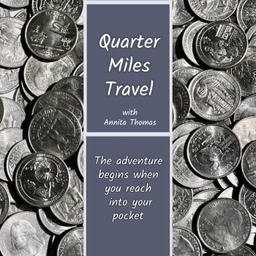
Quarter Miles Travel With Annita
Hosted by Annita and Annita Thomas · Travel With Annita and Friends
5.0from 1 ratings
- 71
- Episodes
- 1
- Ratings
- Weekly
- Cadence
- 2018
- First episode
- 109K
- YouTube views
About Quarter Miles Travel With Annita
The Adventure begins when you reach into your pocket. Each U.S. Mint Commemorative Quarter design tells a unique story. Each quarter is filled with pride, from hometown heroes to iconic landmarks; wildlife and nature to music and culture. Reach into your pocket and let Quarter Miles Travel take it from there, we’ll turn that quarter into an adventure.
- Publisher
- Travel With Annita and Friends
- Category
- education · leisure · society & culture
- Language
- en
- Explicit
- No
- First episode
- 3 Aug 2018
- Latest episode
- 20 Sept 2026
Latest episodes
71 episodes in the feed.
20 Sept 2026
Dogs on the Road: The South’s Best Cities for Travel With Your Pup
Radio segment from Mornings on Maine With Bill Maine Dogs on the Road: The South’s Best Cities for Travel With Your Pup Pet travel stats, airline and national park rules, and five great Southern getaways for you and your dog Annita and her English Lab. By Annita Stokes Thomas If there’s a dog riding shotgun in your car more often these days, you’re not imagining it. Americans are traveling with their pets in record numbers, and the hospitality industry is scrambling to keep up. Here’s a look at where that trend stands right now, what to know before you fly or head into a national park with your dog, and five great Southern destinations worth the trip. Are We Really Traveling With Our Dogs? Short answer: yes, and more every year. Multiple recent surveys peg the number of American pet owners who travel with their pets annually at right around 78 percent. More than half of dog and cat owners say they now plan their trips around their pet, not the other way around. And it’s not just a domestic trend. A global pet-parent study out last year found that 56 percent of people worldwide now own a pet, with nearly half of those being first-time owners, a whole new generation of pet parents who don’t want to leave the dog behind. A 2025 survey of US and UK travelers found that 27 percent of pet owners who brought their pet on a big vacation last year were doing it for the very first time. The number one reason people leave the dog at home? Fear that travel would be too stressful for the pet — that’s the top reason cited, followed by not trusting that a destination is truly pet-friendly. How are they getting there? Road trips still win, hands down — nearly two-thirds of pet owners, right around 64 percent, say they prefer traveling with their dog by car. Flying is a distant second, with roughly a third of pet owners saying they’ve flown with a pet. About 75 percent of hotels nationwide — luxury, midscale, and economy — now allow pets in some form, and the vast majority of pet parents say they’d choose a pet-friendly hotel over any other option. RVs and camping are part of that road-trip boom too — pet owners increasingly point to hiking and fresh-air destinations as their top pick for a pet-friendly trip, right up there with beaches. The trend line is clear: dogs are road-tripping more than ever, hotels are adapting fast, and flying — while it’s growing — comes with a lot more fine print. A little dog in an airline pet carrier sized to fit under the seat in front of you. Flying With Fido: What the Airlines Actually Allow Here’s something that surprises a lot of people: as of this year, only two major U.S. airlines will still fly a dog in the cargo hold for an everyday passenger — Alaska Airlines and Hawaiian Airlines. American, Delta, United, Southwest, JetBlue, Spirit, and Frontier have all discontinued or paused their pet cargo programs for the general public. If you’ve got a bigger dog who can’t fit under an airplane seat, your options for flying with them have really narrowed. Here’s the cabin picture, airline by airline: Delta: small dogs, cats, and household birds only, in a ventilated carrier under the seat in front of you. No cargo option for regular travelers. American Airlines: small cats and dogs in the cabin only, around $150 each way, first-come first-served with a limited number of pet spots per flight. United: dogs, cats, rabbits, and household birds allowed in an approved hard- or soft-sided kennel under the seat, roughly $125 each way, advance reservation required. Southwest: small cats and dogs only, in a carrier under the seat, about $95 each way — and no pets on international flights. JetBlue: small dogs and cats, combined pet-and-carrier weight can’t exceed 20 pounds, about $125 each way. One more wrinkle worth knowing: the rules changed a few years back for emotional support animals. They no longer have protected status the way a trained service dog does — airlines can now treat an ESA like any other pet, subject to the regular carrier fees. A true service dog still flies free, but it needs the Department of Transportation’s standard Service Animal Air Transportation Form, usually submitted 48 hours ahead of the flight. Bottom line: if your dog is small enough to ride under the seat, flying is very doable, just book early, since cabin pet spots are limited per flight. If you’ve got a bigger dog, ground transportation is your best bet, which most pet-travel experts say is safer and less stressful anyway. Expert traveler tip – always call ahead to check airline rules, regulations and fees. They change and your fur baby is looking forward to the trip too. And, always consider your pet’s temperament. Talk with your vet about the best way to ensure a pleasure flight for your pet, you and the other passengers. National Parks and most campsites have specific rules to follow. Can Your Dog Come to the National Park? If your road trip includes a national park, here’s what to know before you go: most national parks allow dogs, but with real restrictions. The National Park Service uses a simple rule of thumb called B.A.R.K. — Bag your pet’s waste, Always use a leash, Respect wildlife, and Know where you can go. Leashes are required almost everywhere dogs are allowed, and that leash can’t be longer than six feet. In most national parks, dogs are limited to paved roads, parking lots, picnic areas, and campgrounds — they generally are not allowed on backcountry or wilderness trails, since their scent and noise can disturb wildlife. Pet-friendly campgrounds are common inside national parks, but your dog can never be left unattended at the site, even for a quick walk to the restroom. National forests and national recreation areas are typically much more permissive, with most trails open to leashed dogs. If the park itself is restrictive, check whether there’s a national forest right next door. Some of the more dog-friendly national parks people point to include Acadia in Maine, Shenandoah in Virginia, Great Sand Dunes in Colorado, and Cuyahoga Valley in Ohio, which welcomes just about any domesticated animal. Always check the specific park’s website before you go — rules vary park to park, and some, like Sequoia, don’t allow dogs on any trails at all. Expert traveler tip – Check before leaving, but also check Facebook pages to see how other National Park visitors have experienced the park with their dog. Many hikers share personal experiences both challenging and excitingly fun. America’s Most Pet-Friendly Cities: The Study Traveling with your fur baby is fun for the whole family. There’s a well-known study out from WalletHub called “Most Pet-Friendly Cities,” updated again for 2026. It compares the 100 largest U.S. cities across 23 different measures, grouped into three categories: pet budget, worth 25 percent of the score and covering things like vet costs and insurance; pet health and wellness, the biggest category at 50 percent, covering vets and trainers per capita and dog-friendly dining; and outdoor pet-friendliness, worth the final 25 percent, covering parks, trails, and weather. Top five for 2026: Scottsdale, Arizona; Tampa, Florida; Cincinnati, Ohio; Las Vegas, Nevada; and Portland, Oregon. Also cracking the top ten: Orlando, Birmingham, Lexington-Fayette, Austin — and our own Atlanta, Georgia. Dead last, at number 100: Honolulu, Hawaii. Here’s the catch: this study only covers the 100 largest U.S. cities, which means Charleston, Savannah, and St. Augustine are all too small to even be measured by it — Atlanta is the only one of the five Southern cities below big enough to show up on this particular list. For the smaller, more historic towns, the rankings below come from different, more specialized studies. Bring along your fur baby with these suggestions. Five Of My Favorite Trips for You and Your Dog Atlanta — The Day Trip Atlanta ranked 9th out of the 100 largest U.S. cities in that WalletHub 2026 study — the only one of today’s five cities big enough to make that particular list. It scored well on vet access, pet businesses per capita, and walkability. Where to walk: Piedmont Park, with its off-leash Piedmont Dog Park, and the Atlanta BeltLine, which has become the go-to spot for locals walking their dogs on weekends. Two dog-friendly restaurants: Joy Cafe near Piedmont Park, where the chef makes food for humans and dogs alike — dogs can order burgers or grilled chicken breast off their own menu — and Hampton + Hudson in Inman Quarter, which has a big pet-friendly patio and even hosts Sunday “Doggie Mingle” hours with a signature Puppy Love Cocktail that benefits local rescues. Two pet-friendly hotels: The Kimpton Sylvan in Buckhead, which welcomes dogs with no size limit and no pet fee at all, plus washed dog beds and treats in the room; and the Four Seasons in Midtown, which bakes a complimentary biscuit for dogs 35 pounds and under at check-in. Athens — Game Day With the Bulldogs Athens didn’t make the WalletHub top-100 list since it’s too small, but it did land at number 32 out of 500 cities in a separate, broader study from LawnStarter — specifically called out for its generous yard space, meaning lots of room for dogs to roam. Dog parks: Athens has close to 20 acres of off-leash space spread across its parks. Memorial Park has a wooded, 1.5-acre off-leash dog park on a hillside, and Sandy Creek Park — a sprawling 782-acre park around Lake Chapman — has four fenced off-leash areas plus private dog parks you can rent by the hour. Hotels: The Graduate Athens — formerly the site of an old ironworks foundry — allows two pets up to 50 pounds for a $50 fee, and Hotel Indigo downtown charges a flat $75 pet fee. Restaurants: Mama’s Boy, the beloved Southern brunch spot, welcomes dogs on its patio — try the Georgia peach French toast; Paloma Park downtown has a spacious back patio and even features guest dogs on its own pet Instagram account; and if you want a beer after the game, Terrapin Beer Co. has a big dog-friendly yard. Savannah — Coastal R&R Heading to the coast for some rest and relaxation, Savannah is hard to beat. It ranked 74th out of 500 cities in that LawnStarter study, standing out for its density of dog-friendly shopping and dining. Savannah’s famous squares are genuinely built for dog walking — 22 shaded squares under Spanish moss, connected by a walkable historic grid, with leashed dogs welcome throughout. Forsyth Park, the crown jewel at the south end, has a mile-long paved perimeter path that’s a favorite for morning walks and doubles as the site of the Saturday Forsyth Farmers’ Market, where plenty of dogs come along. Dog parks: Herty Pines Dog Park, on the edge of Daffin Park, is the local favorite — fully fenced, well-shaded, with separate sections for big and small dogs. Mother Matilda Beasley Dog Park sits right downtown on East Broad Street if you don’t want to leave the historic district. Hotels: The Mansion on Forsyth Park welcomes one dog up to 60 pounds for $150 per stay, right across from the park itself; and the Olde Harbour Inn, voted Savannah’s best pet-friendly hotel by the Savannah Morning News, sits directly on River Street. Restaurants: Look for patio dining throughout the historic district — it’s genuinely common in Savannah to see a dog resting under the table while its owner has dinner. Ask when you sit down; you’ll be surprised how often the answer is yes. Charleston — Beaches, Bars, and the Famous Dog Menu A well-cited 2020 Vetnaturals analysis crowned Charleston the single most dog-friendly city in the entire country, measuring dog-friendly venues, hotels, and beaches per capita. Charleston had 161 dog-friendly venues per capita — the highest of any city studied — plus more dog-friendly beaches per capita than anywhere else in America. The beaches: Isle of Palms allows dogs on the beach year-round, with off-leash hours early in the morning and evening; Folly Beach allows dogs on the sand daily before 10 a.m. and after 6 p.m., and off-leash entirely from October through April. And then there’s Saltwater Cowboys, (https://www.saltwater-cowboys.com) right on Shem Creek in Mount Pleasant. This waterfront seafood spot has a genuinely famous dog-friendly deck — dolphins and shrimp boats pass right by while you eat — and it’s one of the rare restaurants with an entire separate dog treat menu, alongside its regular food menu, drink menu, and gazebo bar menu. What’s on the dog menu: Dog-friendly hamburgers and fish, a doggy version of a margarita, dog beer, and even puppy ice cream for dessert. Fido eats right there on the dog-friendly outdoor deck alongside you, with water service and treats provided as a matter of course. Two Charleston hotels for your dog: The Charleston Place downtown has a whole “Pet in Residence” package, a dog bed, bowls, a leash and collar for the stay, and even a pet-sitting session arranged through Charleston Dog Walkers, all with no pet fee; and the Tides Folly Beach, Charleston’s only true oceanfront hotel, allows two dogs of any size for a flat $100 per stay, and sends up a house-made “Folly Beach Dog Rules” brochure along with bowls and a bed. St. Augustine — Further South on the Road Trip Keep driving south down A1A into St. Augustine — the nation’s oldest city, and one that the pet-travel site BringFido specifically calls out as a top dog-friendly destination, thanks to its historic sites, beaches, and year-round mild weather. St. Augustine’s beaches are leashed-dog friendly along most of A1A Beach Boulevard — a real rarity, since so few Florida beaches allow dogs at all. The one exception to know: Anastasia State Park does not allow dogs, since it’s a protected bird sanctuary. Dog parks: Treaty Park, just south of downtown, has a fully fenced, off-leash “Paws Dog Park” with separate small- and large-dog areas, watering holes, and even a mock fire hydrant; and if you’re staying at the beach, Ron Parker Park has its own off-leash dog run just off Old Beach Road. Hotels: The Saint Augustine Beach House sits right across the street from St. Augustine Beach, with a fenced dog run and a dog-washing station on site for rinsing off sandy paws; and the historic Bayfront Marin House downtown welcomes two pets up to 75 pounds in designated rooms. Restaurants: St. Augustine has more than 20 pet-friendly restaurants according to the local tourism board — Salt Life Food Shack and Harry’s Seafood Bar & Grille are two reliable, casual options with dog-friendly outdoor seating. Let BringFido.com (http://www.bringfido.com) Do the Homework for You Before you head out on any dog trip, pull up BringFido.com or the BringFido app. It’s the one resource that consistently shows up across every city covered above — Atlanta, Athens, Savannah, Charleston, and St. Augustine all have dedicated BringFido guides. You can search pet-friendly hotels with exact weight limits and fees, browse restaurants with confirmed outdoor pet policies, and filter by dog parks and beaches in whatever city you’re headed to next. It’s free, it’s specific to dogs — not just generically “pet friendly” — and it’ll save you a phone call to double-check a hotel’s policy before you arrive with a very excited Labrador in the back seat. Check what’s allowed before you leave home. Traveling With Your Dog: The Do’s and Don’ts Do: Call ahead, even when a hotel or restaurant is listed as pet-friendly — weight limits, breed restrictions, and fees vary widely and change without notice. Pack a copy of your dog’s vaccination records, especially if you’re crossing state lines or flying — some airlines and campgrounds will ask for it. Make sure your dog’s collar tag has a current phone number, and consider a microchip if you don’t already have one — new environments are exactly when dogs slip away. Bring your own water and a collapsible bowl for the car and any hike — don’t count on a park having a working water fountain. Book pet-friendly hotel rooms and flight pet spots as early as possible — most airlines cap the number of pets per flight, and the best pet rooms at popular hotels book up first. Don’t: Don’t leave your dog alone in a national park campsite, even briefly — it’s against the rules almost everywhere and it’s not safe for your dog either. Don’t assume a beach, trail, or park is dog-friendly just because the town is — check current signage and hours, since rules like Isle of Palms’ seasonal off-leash windows change throughout the year. Don’t skip the leash on a hiking trail in a national park, even if you don’t see another soul around — most parks require a six-foot leash at all times outside of designated off-leash areas. Don’t leave your dog in a parked car, even for a quick errand — temperatures inside a car climb dangerously fast, even on a mild day. Don’t wait until the day of your flight to check your airline’s current pet policy — with several major carriers having recently dropped cargo programs, last year’s rules may no longer apply. From the BeltLine in Atlanta to a dog beer on Shem Creek in Charleston, the South is one giant welcome mat for your four-legged travel companion. Wherever your next trip takes you and your dog, safe travels. A girl and her dog – on Nanny Goat Beach – Sapelo Island, (http://www.sapeloislandbirdhouses.com) GA.
16 Sept 2026
Episode 56: The Three Fifths Compromise
The Three Fifths Compromise What it was and who benefited COLD OPEN [SOUND: Quill scratching on parchment. A gavel, once, distant. Silence.] ANNITA (V.O.): In the summer of 1787, in a locked room in Philadelphia, fifty-five men sat down to build a government. And for weeks, in that room, they talked about hundreds of thousands of human beings — argued about them, bargained over them, measured them, weighed their worth against tax revenue and political power — and not one of those human beings was ever asked what they thought. Not one of them was in the room. Not one of them had a vote, a voice, or a name that made it into the record. They were husbands and wives. Mothers who had already buried children sold away from them. Grandfathers who remembered a homeland none of these delegates could have pointed to on a map. Blacksmiths, healers, midwives, farmers, cooks — entire lives, entire families, entire histories, reduced in that room to a single question: how much of a person should the law say they were. The men in that room decided on three-fifths. Not because they believed it. Because it was useful. [SOUND: Silence holds, then fades.] This is Quarter Miles Travel. I’m Annita. On this show, I always tell you — we say their names, and we tell their stories. But today, that promise is harder to keep than it’s ever been. Because the truth is, we don’t have most of their names. History didn’t record them. The Constitution didn’t ask for them. An entire population was debated, decided, and written into law — without a single one of them ever being permitted to speak for themselves in that room. So today, we’re not just telling you what happened in Philadelphia in 1787. We’re standing in for the hundreds of thousands of voices that should have been in that room and weren’t — and we’re telling their story anyway, exactly as fully and as honestly as we can, because somebody finally should. [SOUND: Music begins, low, unresolved.] This replaces the original cold open — everything from Segment One (“The Number That Came Before”) onward stays exactly as it was. Want me to also adjust the close so the “we say their names” line lands with this same framing — acknowledging the names we don’t have, alongside the names we do? This is Quarter Miles Travel. I’m Annita. On this show, I always tell you — we say their names, and we tell their stories. But today, that promise is harder to keep than it’s ever been. Because the truth is, we don’t have most of their names. History didn’t record them. The Constitution didn’t ask for them. An entire population was debated, decided, and written into law — without a single one of them ever being permitted to speak for themselves in that room. So today, we’re not just telling you what happened in Philadelphia in 1787. We’re standing in for the hundreds of thousands of voices that should have been in that room and weren’t — and we’re telling their story anyway, exactly as fully and as honestly as we can, because somebody finally should. [SOUND: Music begins, low, unresolved.] QUARTER MILES TRAVEL “Three-Fifths of a Promise” The Story of the Compromise That Wrote Dehumanization Into the Constitution COLD OPEN [SOUND: slow violins.] ANNITA (V.O.): In the summer of 1787, in a locked room in Philadelphia, a group of men sat down to build a government meant to embody the words “all men are created equal.” And in that same room, they wrote a fraction into the founding law of the United States — a fraction that measured the worth of a human being. Three-fifths. Not because anyone in that room believed a human being was sixty percent of a person. Because it was a number two sides could live with, in a negotiation that was never, not for one single moment, about morality at all. [SOUND: Silence holds, then fades.] This is Quarter Miles Travel. I’m Annita. Today, we look directly at the compromise this country built its government on — and we don’t look away. SEGMENT ONE: The Number That Came Before [SOUND: Soft, sparse instrumental bed, low — something unresolved, not comforting] ANNITA (V.O.): This story doesn’t start in Philadelphia in 1787. It starts four years earlier, in 1783, in a much quieter argument about money. Under the Articles of Confederation, the fledgling national government had almost no way to fund itself. It could only ask the states for money — “requisitions” — based on the value of land within each state, a system nobody could measure fairly or enforce honestly. So Congress considered a fix: base each state’s tax burden on population instead. And here, for the first time, the question arrived — a question this country would spend the next seventy-eight years failing to answer honestly. If a state’s population determined what it owed, did enslaved people count as part of that population? James Madison, then a young Virginia delegate to the Confederation Congress, proposed a number: three-fifths. It wasn’t drawn from any principle about human worth. It was, by most accounts, simply a number that split the difference between two sides who couldn’t agree on anything else. That 1783 proposal came up for a vote as an amendment to the Articles — and it failed, falling two states short of the unanimous approval required. But a number, once spoken aloud in a room full of powerful men, doesn’t simply disappear. It waits. SEGMENT TWO: The Room Reopens the Question ANNITA (V.O.): Four years later, delegates from twelve states gathered in Philadelphia, in the same stifling summer heat we’ve talked about before on this show, to write an entirely new Constitution. And on June 11th, 1787, the three-fifths number walked back into the room. It was delegate James Wilson of Pennsylvania who formally reintroduced it — proposing that enslaved people be counted at a three-fifths ratio as an amendment to the Virginia Plan, the framework then being debated for how the new government would be structured. Charles Pinckney of South Carolina seconded it. Here’s something worth sitting with: Wilson wasn’t a slaveholder, and by most historical accounts, he wasn’t ideologically committed to protecting slavery. He appears to have simply reached for a number that had almost worked once before — a number he calculated might actually get enough votes to hold this fragile convention together. Practicality, not principle, put that fraction back on the table. And once it was on the table, the room split — but not in the way you might expect. SEGMENT THREE: The Argument Nobody Wants to Admit They Made [SOUND: Music drops low, more tense] ANNITA (V.O.): Here is the detail that should stop you cold, and it’s the one most people never learn: the two sides of this debate did not argue from principle. They argued from advantage — and they switched sides entirely, depending on what was being counted. When it came to representation — how many seats a state got in Congress, how many electoral votes it held — southern delegates wanted enslaved people counted as full persons. Every enslaved person counted meant more political power for the state that held them in bondage. Northern delegates objected. Elbridge Gerry of Massachusetts asked the room a question that exposed the entire moral rot of the argument in a single sentence: why should “the blacks, who were property in the South, be in the rule of representation more than the cattle & horses of the North?” Notice what that question does. Gerry is arguing against the compromise — and even in his objection, he reaches for cattle and horses as his comparison. This was not, on either side of the room, a debate about the humanity of enslaved people. It was a debate about property, dressed in the language of political philosophy. But then came taxation — and the exact same men flipped their positions entirely. When it came to how much a state would owe in federal taxes, southern delegates suddenly wanted enslaved people counted as little as possible, to keep their tax burden low. Northern delegates now wanted them counted fully, to raise it. Let that sink in. The very same enslaved human being was, in the same room, in the same week, argued to be a full person when it helped the North, a full person when it helped the South, and no person at all when it helped either side avoid a cost. The only consistent principle in the entire debate was self-interest. South Carolina’s John Rutledge said the quiet part aloud, telling the convention plainly: “Religion & Humanity had nothing to do with this question. Interest alone is the governing principle with Nations.” His fellow South Carolinian, Charles Pinckney, went further, declaring that his state would never accept Congress “meddling with the importation of negroes” — a warning that slavery, and the ongoing trade in human beings, was not up for negotiation at all. And some southern delegates made an even starker threat. They stated outright that they would “never confederate” — that they would walk out, refuse to join this new nation entirely — unless enslaved people were counted at a ratio of at least three-fifths. The compromise, in other words, wasn’t reached through persuasion. It was reached through the threat of national collapse. One voice in that room said something closer to the truth than almost anyone else. Gouverneur Morris of New York called slavery a “nefarious institution… the curse of heaven on the states where it prevailed.” He attacked the compromise directly, for rewarding the act of enslaving people with more political power — the more a state enslaved, the more it would be represented in the very government built on the promise of liberty. SEGMENT FOUR: The Compromise, Written Into Law ANNITA (V.O.): In the end, the room settled on the same fraction it had nearly settled on four years earlier. Article One, Section Two, Clause Three of the United States Constitution: representation and taxation would be determined “by adding to the whole Number of free Persons… three fifths of all other Persons.” They didn’t even use the word “slave.” The Constitution never does — not once, anywhere in its original text. The framers wrote around it deliberately, using euphemism to avoid stating plainly what they had just built into the nation’s founding law. Three-fifths of all other persons. A whole system of human bondage, folded into a single evasive phrase. And it worked — not morally, but mechanically. It held the convention together. It got the South to sign on to a union it might otherwise have refused. And it embedded, permanently, into the mathematics of American democracy, the idea that enslaved human beings were worth counting, but not worth freeing. [SOUND: Music softens into something heavier, more solemn] SEGMENT FIVE: What It Built — The Presidency and the Power ANNITA (V.O.): The effect was not abstract. It was immediate, measurable, and it shaped the government for generations. Because House seats — and therefore Electoral College votes, since electoral votes are based on congressional representation — were calculated using three-fifths of the enslaved population, southern states received significantly more political power than their actual voting population ever justified. Not one enslaved person could cast a ballot. And yet their existence, counted at sixty percent value, inflated the power of the very people who held them in chains. The numbers tell the story bluntly. After the 1790 census, enslaved people made up roughly 39 percent of Virginia’s population, 43 percent of South Carolina’s. Constitutional scholar Akhil Amar has pointed out that after the 1800 census, Pennsylvania’s free population was actually ten percent larger than Virginia’s — and yet Virginia received twenty percent more electoral votes. Pennsylvania’s power came from free citizens who could vote. Virginia’s came, in significant part, from human beings who could not. The result: for thirty-two of the first thirty-six years under this Constitution, a white, slaveholding Virginian held the presidency of the United States. And there’s one election historians point to again and again. In 1800, Thomas Jefferson defeated the incumbent, John Adams. Historian Garry Wills has argued that without the extra electoral votes Virginia and other southern states gained through the three-fifths clause, Jefferson likely does not win that election at all. Some historians trace consequences outward from that single result — the admission of Missouri as a slave state, the trajectory of Indian removal policy, decades of legislative compromises that kept expanding slavery’s reach. Whether you follow every link in that chain or not, the central fact holds: this compromise didn’t just shape political theory. It plausibly changed who held the most powerful office in the country, at a moment that shaped everything after it. SEGMENT SIX: The Incentive Nobody Wanted to Say Out Loud ANNITA (V.O.): Here is where this story turns from abstract political mechanics into something that reached directly into the lives of enslaved people, and it’s a detail that deserves far more attention than it usually gets. Some northern delegates, right there in the debate, raised an uncomfortable warning: if enslaved people counted toward political representation, it would create a direct incentive for southern states to hold — and import — more of them. Not simply because enslaved labor built plantation wealth, which it already did. But because every enslaved person now represented a literal unit of political power for the state that claimed ownership of them. Think about what that means. A system that already reduced human beings to property now layered a second incentive on top of the first — human beings as a source of state power, not just plantation profit. And this is precisely why the Constitution’s protection of the international slave trade — the compromise that barred Congress from banning it until at least 1808 — sits alongside the three-fifths clause as two halves of the same machine. One clause protected the ongoing importation of enslaved people. The other made every one of them, once imported, worth more to the state that held them, politically as well as economically. SEGMENT SEVEN: Did They Know? [SOUND: Music thins to near silence] ANNITA (V.O.): Here’s a question worth asking honestly, and I want to answer it honestly too, rather than claim more certainty than the historical record actually gives us. Enslaved people across the South were, by law, overwhelmingly denied literacy. The Constitutional Convention itself was conducted in near-total secrecy — the delegates didn’t release detailed records of their debates to the public at the time, let alone to enslaved communities specifically. There is no clear historical record of enslaved people referencing “three-fifths” by that specific name. But here’s what we do know: enslaved communities maintained sophisticated, active networks of information — historians often call it the grapevine telegraph — through which news of the outside world moved by word of mouth, sometimes faster and more accurately than official channels expected. It is entirely plausible, even likely, that many enslaved people understood, in a general and deeply felt way, that the government forming around them was counting their existence for the benefit of the very people who enslaved them, while granting them nothing in return. They may not have known the fraction. They almost certainly understood the arithmetic in their bones — that they were being used, and not being freed. SEGMENT EIGHT: The Undoing, and What Remained ANNITA (V.O.): The three-fifths clause survived for seventy-eight years — through the growth of the plantation economy it helped protect, through the presidencies it helped elect, through decades of laws and compromises that expanded slavery’s reach across a growing nation. It survived until the Civil War finally broke the political structure it had helped build. In 1868, the Fourteenth Amendment formally superseded the three-fifths clause, mandating that the whole number of persons in each state be counted, regardless of race. The fraction was gone from the law. But a fraction, once written into the founding document of a nation, doesn’t simply vanish from a country’s memory the way it vanishes from a legal text. SEGMENT NINE: What the Fraction Left Behind ANNITA (V.O.): I want to be careful and honest here, because this is where history stops being simple and starts being something people genuinely disagree about — and that disagreement itself is part of the story. Some historians and legal scholars argue that the Electoral College — the very system that still elects American presidents today — carries the direct legacy of the three-fifths clause, since the compromise was built explicitly to boost slaveholding states’ influence over presidential selection, and the structure it produced has outlived the clause that shaped it. Other scholars push back on drawing too straight a line from 1787 to the present, arguing the Electoral College has evolved and been defended on other grounds since. That debate is very much alive today, and it’s not my place to settle it for you — only to tell you that serious people, looking honestly at the same history, land in different places on how much of that original architecture still shapes American elections now. What isn’t up for debate is this: for seventeen decades and counting, American schoolchildren have learned that their country’s founding document once measured a human being’s worth as three-fifths of a whole — a number chosen not out of any belief in partial humanity, but out of naked political calculation, argued by men who, in the very same debate, revealed they saw enslaved people as comparable to cattle and horses when it suited their argument, and as full political assets when it suited their power. That fact doesn’t stay contained in 1787. It’s part of the inheritance every American carries, whether they’ve ever heard the word “compromise” attached to it or not — a reminder, written into the mathematics of the nation’s founding, that the promise of “all men are created equal” was, from its very first draft, a promise this country chose not to keep for everyone in the room. [SOUND: Music holds low, weighted] CLOSE [SOUND: Music swells softly under the narration] ANNITA (V.O.): There is no version of this story where a clean answer waits at the end. There’s no dog who gets his statue forty years late, no woman who wins her freedom in a single courtroom victory. This is a story about a whole population, reduced to a fraction, by men who could not even agree on their own reasons for doing it — only on the fact that doing it kept the union together. Three-fifths of a person. Argued over, not because anyone believed it was true, but because it was useful. Used to build a government, to elect a presidency, to protect a trade in human beings for twenty more years, to give power to those who claimed ownership over people who had none. We cannot travel to a single building and stand where this was made right, because it never fully has been. What we can do is stand in the room where it happened — Independence Hall, where this exact compromise was debated and signed — and refuse to let the fraction go quietly back into the footnotes of history. [BEAT — sound fades to near-silence] We say their names — the millions the Constitution reduced to three-fifths, and the delegates who wrote it, argued it, and lived with what it built. And we tell the story, fully, without looking away. [MUSIC: Theme swells, transition out — held longer than usual before fading]
5 Sept 2026
Destination: The History of America’s Labor Force
The History of America’s Labor Force “The Price of a Day’s Work: Labor, Jobs, and the Fight for Fairness in America” *Photos at the bottom SEGMENT ONE — approx. 9:00 The History of America’s Labor Force and How Labor Day Became a Holiday [SOUND: Show theme, warm, fades under welcome] ANNITA: I’m Annita with Travel With Annita, and this weekend, most of us will fire up a grill, maybe hit one last beach trip, and enjoy a day off work. Let’s talk about The History of America’s Labor Force. But Labor Day didn’t start as a cookout holiday. It started as a protest — and understanding how it became a national holiday tells you almost everything about how hard-fought every single workplace protection in this country has been. The story actually has two men fighting for credit, and historians still argue about which one truly deserves it. Peter J. McGuire has long been called the “Father of Labor Day” — his gravestone in Pennsauken, New Jersey, is inscribed with those very words, and every year, labor leaders still gather there to honor him. McGuire’s own story is worth knowing: he was the child of Irish immigrants, and he quit school at a young age to go to work himself, long before he ever became a labor leader. He co-founded the United Brotherhood of Carpenters in 1881, and helped lead the movement that eventually became the American Federation of Labor. The AFL-CIO itself has said that McGuire “probably did more than anyone else” to convince skeptical, locally-minded union activists around the country that a national labor federation wasn’t just necessary, but actually possible. But there’s another man in this story — Matthew Maguire, a machinist who served as secretary of the Central Labor Union in New York, and many historians now believe he actually proposed the idea first. It was Maguire who sent out the announcements and invitations for that first Labor Day gathering, and Maguire who rode in the lead carriage of the parade itself. For decades, credit for founding Labor Day actually went to Maguire — it wasn’t until 1924, forty years after the fact, that the credit was formally shifted over to McGuire instead, and the debate over who truly deserves the title has never fully settled. That first parade happened on September 5th, 1882, in New York City. Somewhere between ten thousand and twenty-five thousand workers marched that day, sponsored by an organization called the Knights of Labor — one of the largest and most influential labor organizations of the era, open to nearly all workers regardless of skill, trade, race, or gender, at a time when that kind of inclusiveness in a labor union was genuinely radical. There was no deep historical significance to that particular date, by the way — McGuire simply said it fell about halfway between the Fourth of July and Thanksgiving, giving working families a break during that long stretch of the calendar with no holiday at all. It took twelve more years, and something far more tragic, to turn that one parade into a national holiday. In the summer of 1894, the Pullman railroad strike erupted — and we’re going to come back to Pullman a little later in the show, because that story matters more than you might think. That strike turned violent, and federal troops were sent in to break it up. Workers died in the clashes. Congress and President Grover Cleveland, looking to make peace with an angry and grieving labor movement, rushed a bill through just days after the strike ended, and Cleveland signed Labor Day into law as a national holiday on June 28th, 1894. Here’s a detail that doesn’t often make it into the story: Cleveland specifically chose to elevate Labor Day, held safely in September, rather than embrace May Day, the international workers’ holiday already celebrated in many countries. May Day carried socialist and radical associations in the public mind at the time, tied to earlier labor unrest, and Cleveland wanted nothing to do with that reputation. So America ended up with its own separate labor holiday, deliberately distanced from the more radical politics of the labor movements happening elsewhere in the world. So the very holiday we use to close out summer was born, in part, out of federal troops firing on American workers, and a president trying to calm public anger without embracing the more radical wing of the movement that made the holiday necessary in the first place. When we come back, I want to take you somewhere this history rarely goes — because you cannot talk honestly about American labor without talking about Black workers, both enslaved and free. [SOUND: Music bridge] SEGMENT TWO — approx. 9:35 From Bondage to the Fields — Sharecropping and the Migrant Workers of Florida ANNITA: Welcome back to Travel With Annita. I want to be honest with you. For the first two hundred fifty years of this nation’s story, Black labor wasn’t paid at all — it was stolen. When emancipation finally came in 1865, the promise was freedom. What actually followed, for millions, was a different kind of chain, dressed up to look like opportunity. It’s called sharecropping. Formerly enslaved people, with no land and no money, needed to survive. White landowners — sometimes the very people who had enslaved them — needed labor but had no cash to pay wages. So a system formed: a family would work a parcel of land, and in exchange, they’d owe the landowner a share of whatever they grew, often as much as half the harvest. On paper, that sounds almost like a fair trade. In practice, it was a trap, and here’s exactly how the trap worked. Sharecropping families had no money for seed, tools, food, or clothing until harvest time — so they had to borrow against a crop they hadn’t grown yet, usually from a store owned by the very same landlord, at interest rates that could run fifty percent or higher. This is called the crop-lien system, and it functioned like a plantation commissary designed to keep a family owing more than they could ever hope to repay. By the time harvest came and the books were “settled up,” most sharecropping families ended the year owing money, not earning it — trapped for another season, then another, then another, sometimes for generations. In Georgia alone, by 1910, over fifty percent of Black farmers were sharecroppers or wage laborers, while more than forty percent of white farmers owned their own land outright. Across the entire South, by 1880, nearly eighty percent of Black farmers were sharecroppers or tenants, not landowners. And when Black families tried to organize together — to demand fairer terms, the same way industrial workers up north were organizing into unions — the response was often violent. In Elaine, Arkansas, in 1919. In Camp Hill, Alabama, in 1931. In Lowndes County, Alabama, in 1935. Black sharecroppers who tried to unionize were attacked, and in some cases killed, simply for asking to be paid fairly for their own labor. Historians today describe this system for exactly what it was: freedom in name, but economic bondage in practice — the plantation, rebuilt with paperwork and interest rates instead of chains. Now let’s bring this closer to home, because Florida has its own chapter of this story, and it deserves to be told just as clearly. Starting in the late 1800s, and picking up heavily in the early 1900s, thousands of Black Bahamians began migrating to South Florida — drawn by the construction of Henry Flagler’s Florida East Coast Railroad, the rapid growth of Miami, and agricultural work in citrus groves and the pineapple industry, which the Bahamas themselves had once depended on before disease and hard winters collapsed it. Between 1900 and 1920 alone, somewhere between ten and twelve thousand Bahamians made that crossing — many settling in communities like Coconut Grove, which still carries that island heritage today, in its food, its churches, and its culture. Bahamian men cleared roads and built homes and hotels; Bahamian women staffed the hotels rising up along Florida’s booming coastline. And alongside them worked Black Americans who’d migrated down from Georgia, Mississippi, and across the South — many of them refugees from the very sharecropping system we just described, following the crops from state to state: peaches in South Carolina, cabbage in North Carolina, tomatoes and strawberries right here in Florida. There’s a literary connection here worth knowing, too. The great Florida-born author Zora Neale Hurston wrote about exactly this world of Black migrant farmworkers in the Everglades muck, laboring around towns like Belle Glade — culminating, in her most famous novel, in the catastrophic 1928 Okeechobee hurricane, which killed thousands, a large share of them Black migrant agricultural workers whose deaths were undercounted and under-mourned for decades afterward. Hurston didn’t invent that world. She documented it. And then there’s Florida’s sugarcane industry — this piece of the story isn’t ancient history at all. From 1941 all the way into the mid-1990s, virtually every stalk of sugarcane grown in Florida was cut entirely by hand, by workers brought in mostly from Jamaica under a federal guest worker program. Cutting cane by hand, in Florida heat, with machetes, hour after hour, is some of the most physically brutal agricultural labor in this country’s history. Workers were housed in company camps around towns like Belle Glade, paid low wages, and had little real power to push back against unsafe conditions — the same basic pattern of debt and dependency that shaped sharecropping generations earlier, simply relocated to a new crop, a new labor force, a new era. This history isn’t finished, either. Today, in places like Immokalee, Florida, Haitian and Mexican farmworkers still fight the same fundamental battle — fair wages, humane housing, and freedom from wage theft — carrying forward a fight that Black agricultural workers in this state have been waging for well over a century. I share all of this because Labor Day cannot only be about factory whistles and union halls in northern cities. It has to include the fields, too — the cane, the citrus, the tomatoes — and the Black hands, enslaved, sharecropped, and migrant, that worked them, mostly without recognition, and often without fair pay at all. [SOUND: Music bridge] SEGMENT THREE — approx. 9:35 The Children in the Factories ANNITA: Now let’s head north, to the factories, where a different injustice was unfolding at almost exactly the same time. Here’s a number that should stop you cold: according to the 1900 census, roughly two million American children were working — in factories, mills, mines, cotton fields, and city streets. Some were as young as six or seven years old. Factory owners actually preferred hiring children. They were cheaper to pay, less likely to organize or strike, and small enough to fit into tight spaces around dangerous machinery that adults simply couldn’t reach. A child working a factory job in this era commonly worked twelve to eighteen hours a day, six days a week, for around one dollar. Most weren’t in school. Many couldn’t read. In 1904, reformers formed the National Child Labor Committee to fight this, and in 1908 they hired a young photographer named Lewis Hine to document what he found. Hine had actually quit his job as a New York City schoolteacher to take on this work, and he went to remarkable lengths to get his photographs — sneaking into mills and mines disguised as a Bible salesman, a postcard vendor, or an industrial photographer simply cataloguing factory machinery, because owners didn’t want the truth photographed and Hine was often thrown out or chased off by police once discovered. He photographed a six-year-old cotton picker in Comanche County, Oklahoma. A fifteen-year-old boy working as a “trapper” deep in a West Virginia coal mine. A twelve-year-old Vermont spinner named Addie Card, who told Hine she’d started working during a school vacation and simply never left the mill again. One of his most haunting images was taken at midnight in an Indiana glass factory, boys working the overnight shift lit only by the furnace glow. Hine put the purpose of his work simply: “There is work that profits children, and there is work that brings profit only to employers.” Change came, but it came slowly, and it kept running into legal walls. In 1916, Congress passed the Keating-Owen Act, setting real national limits — no factory work under age fourteen, no mine work under sixteen, no more than eight hours a day, no shifts starting before six in the morning or running past seven at night. It looked like real progress. Then, in 1918, the Supreme Court struck the entire law down, in a case called Hammer v. Dagenhart, ruling that Congress had overstepped its constitutional authority to regulate interstate commerce. Reformers tried again a few years later with a different legal approach — a tax penalty on companies that employed children — and the Supreme Court struck that down too, in 1922. Congress then attempted something even bigger: a constitutional amendment, passed by Congress in 1924, that would have explicitly given the federal government power to regulate child labor nationwide. It was sent out to the states for ratification — and it never received enough state support to actually become part of the Constitution. It took the Great Depression, and a very different political climate, before real, lasting protection finally arrived. In 1938, the Fair Labor Standards Act established nationwide, enforceable standards on child labor, minimum wage, and the maximum work week — and this time, in 1941, the Supreme Court upheld it, in a case that explicitly overturned that earlier 1918 ruling. It had taken over three decades, from Lewis Hine’s first photographs to a Supreme Court that would finally let the protection stand. Coming up in our final segment — how wages themselves got determined in this era, the surprising origin of the first system built to protect injured workers, and exactly where this fight for fairness stands in this country today. [SOUND: Music bridge] SEGMENT FOUR — approx. 9:50 Wages, Safety Nets, and a Fight That Isn’t Over ANNITA: Welcome back, final segment of the show. So how were wages actually decided, back before minimum wage laws existed at all? Mostly, it was whatever an employer felt like paying, and whatever a desperate worker was willing to accept. There was no floor. And in some company towns, workers weren’t even paid in ordinary cash at all — they were paid in company scrip, usable only at a company-owned store, for company-set prices, with rent for company-owned housing deducted straight from their pay before they ever saw a dime. This is actually exactly the arrangement at the heart of that Pullman strike we mentioned back in our first segment — George Pullman built an entire company town outside Chicago, controlled workers’ wages and their rent and their store prices all at once, and when he cut wages during an economic downturn without lowering rent to match, his workers had nowhere left to turn. That’s what exploded into the strike, the strike that led to federal troops, and ultimately, to the creation of Labor Day itself. It’s worth sitting with that for a second — the very holiday honoring workers exists because of a company that controlled every dollar its workers ever touched. Now — what folks sometimes still call “old peasant insurance” is really workers’ compensation insurance, and its story actually starts in Europe, not America. Germany passed the first industrial accident insurance law back in 1884. Here in America, it took a horrifying tragedy to really move the needle. In 1911, the Triangle Shirtwaist Factory in New York caught fire, and one hundred forty-six garment workers — most of them young immigrant women, some as young as fourteen — died, many of them because the factory’s exit doors had been locked to prevent unauthorized breaks and theft. Workers jumped from ninth-floor windows rather than burn. A young woman named Frances Perkins happened to witness that fire firsthand from the street below, and it changed the entire direction of her life — she went on to become the U.S. Secretary of Labor under President Franklin Roosevelt, the very first woman ever to serve in a presidential cabinet, and she became the chief architect behind both Social Security and, yes, that same Fair Labor Standards Act we just discussed. One factory fire, one witness, and decades of protection that followed because of what she saw that day. The year of that fire, 1911, Wisconsin passed America’s first comprehensive workers’ compensation law, and nine more states followed within months. This was the very first social insurance program in the entire United States, arriving decades before Social Security itself — built on a simple, almost revolutionary idea for its time: if you’re hurt on the job, you shouldn’t have to sue your employer and hope to win. You should simply be covered. And here’s the honest truth for today: this story doesn’t have a finished ending. As of Equal Pay Day this year, March 26th, 2026, U.S. Census data show that women working full-time still earned only about eighty-three cents for every dollar men earned — and that gap actually widened over the past two years, the first time that’s happened in over two decades of tracking this data. For Black women specifically, the gap is significantly worse. Equal Rights Advocates reports Black women earned just sixty-five cents on the dollar in 2024, down from sixty-nine cents just two years earlier. For Latina women, it’s worse still, around fifty-eight cents on the dollar — which adds up to more than thirty-three thousand dollars in lost income over a single year. This is what I want you to sit with this Labor Day. The eight-hour workday. The weekend itself. Protection from being hurt on the job without recourse. The idea that a six-year-old shouldn’t be working a cotton field instead of sitting in a classroom. None of it was ever handed down out of generosity. Every piece of it was fought for, marched for, and in some cases, died for — by the sharecroppers of Elaine, Arkansas, refusing to accept a rigged system; by the Bahamian families who built Coconut Grove out of nothing; by the cane cutters of Belle Glade; by the children Lewis Hine photographed so the world couldn’t look away; and by Frances Perkins, who turned the worst thing she ever witnessed into decades of protection for working people she’d never even meet. The fight for equal pay, and equal treatment, and fair opportunity, is still happening, right now, in workplaces all across this country. So this Labor Day, when you’re enjoying that cookout or that last beach day of summer, take just a moment to think about all of it — the two men who couldn’t even agree on who deserved credit for the holiday, the families still working toward the promise this country made and hasn’t fully kept. That’s our show for today. I’m Annita with Travel With Annita — join me Saturdays 1 to 2 on WDUN, always here, always local. [SOUND: Theme swells, out] Photos of early American labor
Who has been a guest on Quarter Miles Travel With Annita
Names identified in recent episode analyses. Showing up to five guests.
- Michelle da Silva Richmond
- Bill Clevlen
- Dorothy Cochrane
- Sarah Fisher
- Gigi Coleman
Reach and audience
Public platform figures. Ratings count people who left a rating, not total listeners.
- YouTube views
- 109,353
- Score snapshot 15 Sept 2025
- Apple Podcasts (US)
- 5.0 / 5
- 1 ratings
Podcast Authority Score: 49 / 100
A composite of feed quality, social presence, YouTube performance and engagement. Read the methodology.
- Quality
- 66
- Social presence
- 0
- YouTube
- 82
- Engagement
- 0
Contact Quarter Miles Travel With Annita
- Guest appearances
- Books guests
Based on episode analysis; this does not confirm that the show is currently accepting guests.
Questions about Quarter Miles Travel With Annita
Who hosts Quarter Miles Travel With Annita?
Annita and Annita Thomas host the show. Published by Travel With Annita and Friends.
How often do new episodes come out?
The show publishes weekly, based on its RSS feed.
Does Quarter Miles Travel With Annita take guests?
Yes. Guests have been identified in episode analyses.
Host of Quarter Miles Travel With Annita?
Claim your podcast to manage its listing and keep your show details accurate.
Pod Engine is an independent podcast discovery and analytics service and is not affiliated with or endorsed by this podcast. Artwork and show content belong to their owners. Full legal notice.
Explore this show
Podcast research with Pod Engine