- 30
- Episodes
- 3
- Ratings
- Bi-weekly
- Cadence
- 2025
- First episode
- 78K
- YouTube views
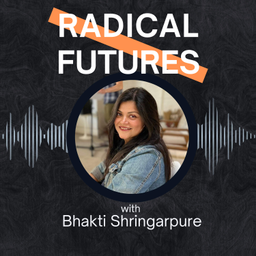
About Radical Futures
An invitation to imagine freedom, decolonization and liberatory futures.
- Publisher
- Bhakti Shringarpure
- Category
- arts · news · society & culture
- Language
- en
- Explicit
- No
- First episode
- 2 May 2025
- Latest episode
- 16 Oct 2026
Latest episodes
30 episodes in the feed.
16 Oct 2026
G is for Gaze: Featuring Fady Joudah
Fady Joudah’s seventh collection of poems is titled Exhibit G. After three years, G is now the most chilling letter in the alphabet. But before the mind races to G for Gaza or G for genocide, it is the word “exhibit” that stops you in your tracks. Never before in history has suffering been exhibited, presented, demonstrated, broadcast, documented, and paraded before us as it has been with Palestinians. The ridiculous “us,” the bystanders and the consumers, have willingly or unwillingly, become complicit in a shocking spectacle. We imagine that we are the ones who see but Joudah’s Exhibit G makes painstakingly clear that it is they, the Palestinians, who see us. The G will also be for guilt. Exhibit G makes its readers squirm. It is a moving collection of poems, essays and photographs of Gaza, as the subtitle announces, but it is despairing because it disturbs. This is not only because of the power of the poems and essays but due to the cumulative effect of the photographs juxtaposed alongside the words. Joudah’s friendship with Hani Almadhoun who had started the Gaza Soup Kitchen in northern Gaza made him the recipient of an influx of photos and videos from 2024 onwards, a vast majority of them children. People received such things from Gaza “only as images or representations of horror” but Joudah “received them as a much wider world.” They were “ordinary portraits” but he realized the profound gesture embedded in their ordinariness. “When they were filming or photographing other Palestinians coming to get water or food, it was because they were really keen and tender on capturing Palestinian beauty, color, life…and the love that shows in the adults or the parents who send kids to stand in line for water and food, and to dress them up a certain way.” This ordinary, wider world revealed itself in the puzzling sweetness of the details: “Why is one wearing a fake Prada shirt and the irony of it, or a Superman pajama, or barefoot or not. The kids are asked to pose for a victory sign…” For Joudah, they unlocked a Palestinian interiority that spoke on its own terms. “I really let all this Palestinian-ness come into me.” The poems that accompany--Joudah’s as well as a few by Rawan Hussien and Nima Hassan that he translates into English--weave through the archive of photos with startling intimacy. They complement and compound. They reflect on Palestinian interiority and the insufficiencies of the English language; on history, memory and mythology; and, on truth and time. The tender ordinariness of quotidian life during a genocide captured in the book creates a sinking feeling. But it is the gaze of the children that pierces. Sometimes they have big grins on their faces, sometimes tired smiles, sometimes a questioning glance, but their eyes always sparkle with life. Exhibit G triumphs over all the savagery and abjecthood inflicted upon Palestinians by the sheer, life-giving force of Palestinians who make direct and unwavering eye contact with us. The G is for their gaze. Buy the book here: https://milkweed.org/book/exhibit-g (https://milkweed.org/book/exhibit-g) Fady Joudah is the author of […], a finalist for the National Book Award and winner of the Lenore Marshall Poetry Prize. His other poetic works include The Earth in the Attic; Alight; Textu, Footnotes in the Order of Disappearance; and Tethered to Stars. He has translated several collections of poetry from the Arabic and is the co-editor and co-founder of the Etel Adnan Poetry Prize. He lives in Houston, with his wife and kids, where he practices internal medicine. Hosted by Bhakti Shringarpure. Edited by Agatha Jamari Radical Futures is produced by Warscapes Title Music: “Cottonstorm” by Bayern Boom Beat Subscribe | Follow www.radicalbookscollective.com
10 Sept 2026
Becoming Afghan, Becoming American After 9/11: Featuring Zohra Saed
“You had to go and perform Afghan-ness,” scholar and poet Zohra Saed recalls as she speaks of the scary and difficult days soon after the towers fell in New York City. Afghanistan was suddenly in the spotlight as the location of 9/11 mastermind and head of Al Qaeda, Osama Bin Laden. On the one hand, there were drums of war, boycotts of Afghan businesses, and violence towards Afghans in the US. But on the other hand, soft imperialism was in immediate motion as numerous cultural interventions began springing up. Afghan-American youth were being recruited by the US government for a suite of programs including language acquisition, visits to Afghanistan, starting a career as a journalist, or humanitarian work. All this was done under the guise of rescuing Afghan culture and saving Afghan women from the Taliban. There was a caveat: participants would often have to work alongside the American military. At the time, young people like herself were to become the “bridge generation” that would return to rebuild Afghanistan and bring democracy back. Instead, these returnees “became complicit in a lot of the corruption.” Zohra would come to refer to it as “a circus or like a masquerade of what Afghan-ness is.” Even as Zohra found herself in these settings and got lucrative offers to be part of various American programs, she chose to become a keen observer of the phenomenon. and honed a sharp critique of US imperialism. Despite a resistance to perform her Afghan identity for the West, Zohra admits that these unfolding events and eventually, the US invasion of Afghanistan, was instrumental in shaping her trajectory as a thinker, poet, teacher and activist. She also became a tireless advocate for the victims of a horrific war and occupation that raged in Afghanistan right until 2021. It is clear to Zohra that Afghanistan became a “bait and switch scam” where after two decades of promising democracy and freedom, Americans threw up their hands and resorted to hawkish Rudyard Kipling-like declarations that “Afghanistan can never be defeated.” And so, today, the Taliban carries on, stronger than ever, and empowered by foreign investments in what has been a horrific last five years. In this intimate, powerful and honest conversation, Zohra recounts what was done and undone by 9/11 and by the War on Terror that blazed across the world for decades after, and ways in which these tragedies also led to building new worlds and new collectives. She is invigorated by working with archival material and remains committed to memory and heritage work focused on the Central Asia region through many exciting writing, editing, publishing and cooking projects. Further reading: Langston Hughes: Poems, Photos & Notebooks from Turkestan by Zohra Saed https://centerforthehumanities.org/product/langston-hughes-poems-photos-notebooks-from-turkestan/ (https://centerforthehumanities.org/product/langston-hughes-poems-photos-notebooks-from-turkestan/) One Story, Thirty Stories: An Anthology of Contemporary Afghan American Literature, edited by Zohra Saed and Sahar Muradi https://www.uapress.com/product/one-story-thirty-stories/ (https://www.uapress.com/product/one-story-thirty-stories/) Decolonizing Afghanistan: Countering Imperial Knowledge and Power, edited by Wazhmah Osman and Robert D. Crews https://www.dukeupress.edu/decolonizing-afghanistan (https://www.dukeupress.edu/decolonizing-afghanistan) UpSet Press https://upsetpress.org/ (https://upsetpress.org/) Hosted by Bhakti Shringarpure. Edited by Agatha Jamari Radical Futures is produced by Warscapes Title Music: “Cottonstorm” by Bayern Boom Beat Subscribe | Follow www.radicalbookscollective.com
2 Sept 2026
Palestine and the Collapse of American Journalism: Featuring Joe Sacco
Joe Sacco admits that he began to clash with many of the existing principles of journalism early in his career. He had graduated with a degree in journalism from a university in the US and had begun following the coverage of Israel’s invasion of Lebanon in 1982. As news of the massacres of Palestinians in the Sabra and Shatila refugee camps reached him, he had an epiphany: “I remember seeing the photographs and looking at all this, and the thought that came to my mind is, ‘Wait a minute, I thought the Palestinians were the terrorists.’” Surprised by his own realization, Sacco resolved to interrogate this assumption about Palestinians that seemed to always hang in the air. He found himself in the West Bank, and eventually in Gaza, and his experiences became the foundation for a longstanding relationship with the region. Along the way, Sacco blazed a trail with a new style of journalism: fusing cartoons with in-depth reportage and historical research. His first book Palestine: A Nation Occupied was published by Fantagraphic Books in 1993. Visually stunning, witty and incredibly moving, it was a groundbreaking for its commitment to detailed, on-the-ground reporting while offering a glimpse into a besieged community. Sacco continued to report from war zones, and books on Palestine and Bosnia followed. He had grown up with parents who lived through heavy bombings during World War II in Malta, and their experiences of war and displacement have remained at the core of his work: “They lived under very desperate conditions, very little food. Malta was basically surrounded by German and Italian forces. They saw a lot and lived through a lot, and those are the stories I heard around the dinner table.” Perhaps this is also why engaging with history came naturally to Sacco. He produced works on the 1956 massacres in Gaza (Footnotes in Gaza, 2009); a powerful book on poverty in the US co-authored with Chris Hedges (Days of Destructions, Days of Revolt, 2012); an account of the Dene community living in the subarctic Canadian Northwest Territories (Paying the Land, 2020); and a controversial work on the deadly sectarian violence in northern India in 2013 (Once and Future Riot, 2026). This month, Sacco will publish his third long work on Palestine, titled Requiem for Gaza and co-authored again with Chris Hedges. Distraught about the last two years of genocide, and with no real possibility of entering Gaza, Sacco and Hedges spoke with 29 families who had escaped to Egypt. In Gaza, “all means of life have been extinguished,” he said. “I mean, purposefully destroyed, not accidentally destroyed, but in many, many cases dynamited.” In this Radical Futures conversation, Sacco opens up about a range of topics: his journey as a self-taught cartoonist; his long historical works that take years to complete; his first brush with censorship in India; and his disappointment with what journalism has become today. Further reading: Requiem for Gaza by Joe Sacco and Chris Hedges, Fantagraphics, 2026. https://www.fantagraphics.com/products/requiem-for-gaza (https://www.fantagraphics.com/products/requiem-for-gaza) Hosted by Bhakti Shringarpure. Edited by Agatha Jamari Radical Futures is produced by Warscapes Title Music: “Cottonstorm” by Bayern Boom Beat Subscribe | Follow www.radicalbookscollective.com (www.radicalbookscollective.com)
Who has been a guest on Radical Futures
Names identified in recent episode analyses. Showing up to five guests.
- Huda Fakhreddine
- Laura Kasinof
- Rim Mugahed
- Reem Gaafar
- Sim Kern
Reach and audience
Public platform figures. Ratings count people who left a rating, not total listeners.
- YouTube views
- 78,292
- Score snapshot 15 Sept 2025
- Apple Podcasts (US)
- 5.0 / 5
- 2 ratings
- Spotify
- 5.0 / 5
- 1 ratings
Podcast Authority Score: 28 / 100
A composite of feed quality, social presence, YouTube performance and engagement. Read the methodology.
- Quality
- 21
- Social presence
- 0
- YouTube
- 85
- Engagement
- 0
Host of Radical Futures?
Claim your podcast to manage its listing and keep your show details accurate.
Pod Engine is an independent podcast discovery and analytics service and is not affiliated with or endorsed by this podcast. Artwork and show content belong to their owners. Full legal notice.
Explore this show
Podcast research with Pod Engine