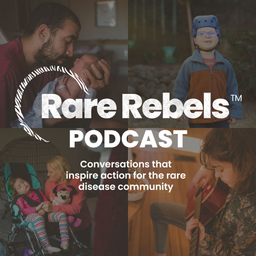
The Rare Rebels™ Podcast shares unscripted conversations with patients, caregivers, advocates, and researchers who are changing the future of rare disease. These aren’t polished soundbites — they’re real voices from the front lines, revealing the humanity, heartbreak, and hope woven into the rare disease experience.
Because change doesn’t happen through statistics alone — it happens through connection.
Hosted by award-winning storyteller and advocate Melody Joy Paine, Rare Rebels™ brings lived experiences to the forefront, bridging gaps between families, researchers, nonprofits, and industry stakeholders. Through these deeply personal stories, we build understanding, inspire action, and drive meaningful change.
Formerly known as the Images of Joy Podcast, Rare Rebels™ is a relaunch and expansion that retains archived episodes while introducing a new lens: one focused on amplifying the rebels in rare disease who refuse to wait for systems to change and are doing something about it.
Episode 9: Jeevan Mann | Research Through Lived Experience
Jeevan Mann understands Ehlers-Danlos syndrome from two perspectives. He lives with one of the rarest forms of EDS and also works as a researcher studying the condition.
In this conversation, Jeevan shares his path from patient to researcher and how his own experiences have shaped the way he approaches the science. We talk about what lived experience can contribute in the laboratory, why patients can bring insights that complement scientific and clinical expertise, and what it means to research a condition that directly affects your own future.
We also explore why diagnosis matters even when there isn’t a specific treatment available. Jeevan explains how knowing a patient has EDS can inform preventative care and help care teams better understand potential risks. The conversation expands into some of the broader barriers surrounding EDS, including awareness, access to knowledgeable clinicians, and the need for more research.
Jeevan also reflects on his own uncertainty about aging with EDS and how that uncertainty has become part of his motivation. For him, research offers a way to help build a future in which patients may have better options than they do today.
24 Feb 2026
Shelley Bowen | No One Will Care More Than a Parent
When this conversation with Shelley Bowen was recorded, there was no resolution yet. Families were still waiting — still pushing — still living inside the uncertainty of whether a treatment would ever make it across the finish line.
Shelley is a parent of children with Barth syndrome, and in this episode, she speaks from inside that reality. She talks about what happens when no one will care more than a parent — when families become advocates not by choice, but by necessity. When parents learn how to build websites, organize communities, navigate regulatory systems, and show up in rooms they never expected to enter, because their child’s life depends on it.
This conversation captures what that kind of waiting costs. The emotional weight. The exhaustion. And the quiet determination that keeps families moving forward even when progress feels impossibly slow.
Before we begin, though, there’s important context I want to share.
Since this episode was recorded, the story has moved forward. After years of sustained, parent-led advocacy, the first treatment for Barth syndrome has now been approved. That outcome is not part of this conversation — but it is an essential part of Shelley’s story today.
What you’re about to hear is a conversation from the depths of the struggle.The update shows what can happen when families refuse to stop advocating, even when the system moves slowly.
17 Feb 2026
Episode 7: Léon van Wouwe | Finding the Patients We’re Missing
Léon van Wouwe works at the intersection of data science, healthcare systems, and rare disease. In this episode, we explore how machine learning can be used not as a shiny new technology, but as a practical tool to help clinicians recognize patients who are already in the system but remain undiagnosed.
Our conversation focuses on how patterns hidden in healthcare data can surface patients years earlier than traditional diagnostic pathways, why underdiagnosis is far more common than most people realize, and what it takes to move these insights from theory into real clinical workflows. We also talk about the human side of adoption, including clinician trust, system constraints, and why technology only works when it serves people.
This episode adds a critical infrastructure layer to the Rare Rebels™ map, showing how precision, specificity, and collaboration across stakeholders can shorten diagnostic timelines and open new possibilities for treatment and care.
Contact Rare Rebels™
Guest appearances
Books guests
Based on episode analysis; this does not confirm that the show is currently accepting guests.
Host of Rare Rebels™?
Claim your podcast to manage its listing and keep your show details accurate.
Pod Engine is an independent podcast discovery and analytics service and is not affiliated with or endorsed by this podcast. Artwork and show content belong to their owners. Full legal notice.
Explore this show Podcast research with Pod Engine