

An interactive, chapter-by-chapter class on Karl Marx's 'Capital' Volume 1 for all skill levels, taught in 12 episodes by socialist educators.
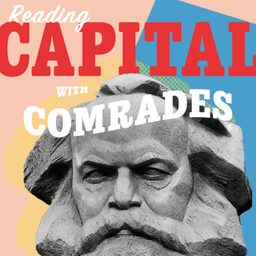
Reading Capital With Comrades
Claim This Podcastby Reading Capital With Comrades
4.9(473 reviews)
12 episodes
Updated Daily
Accepts GuestsHas Sponsors
Podcast Overview
An interactive, chapter-by-chapter class on Karl Marx's 'Capital' Volume 1 for all skill levels, taught in 12 episodes by socialist educators.
Language
🇺🇲
Publishing Since
4/26/2021
1 verified contact email on file for Reading Capital With Comrades
Pitch yourself as a guest, propose sponsorships, or reach out directly to the host.
Recent Episodes
April 26, 2021
#12: BLOODY CAPITAL (Ch. 26-33)
<p>Our twelfth episode studies the last part of the book, chapters 26-33, which Marx begins by critiquing bourgeois political economy’s concept of “primitive accumulation.” Throughout the book so far, Marx has assumed that the conditions of capitalism already exist: a class of those with nothing to sell but their labor power and a class that owns the means of production (while noting they are not “natural” conditions). Now we discover how these conditions–and the legal and ideological structure of capitalism–came to be: the individual and state-sanctioned thefts of land, the repression (including incarceration, whipping, branding, and execution) of the dispossessed, slavery, and colonialism. Along the way, Marx presents a brief but important summary/overview of the rise of capitalism and the potential rise of socialism, as well as some quick hints about what exactly revolution might entail. Noting that Marx never relegated this form of accumulation to a bygone era, we go over some examples of how it shows up today and how it continues to be important to capitalism.</p> <p>Contact us with questions or feedback at ReadingCapital@LiberationSchool.org</p>
April 26, 2021
#11: CAPITAL’S TENDENCIES (Ch. 25)
<p>Our eleventh episode concentrates on chapter 25, where Marx synthesizes his findings so far to articulate some general laws (or tendencies) of capitalist accumulation. We cover the different compositions of capital before turning to the two models of accumulation Marx proposes, the difference between concentration and centralization, and how the centralization of capital provides the material foundation for communism. We clarify the general law of capitalist accumulation and the absolute general law of capitalist accumulation before examining the impacts they have on the working class, including the production of an industrial reserve army. After examining how the reserve army serves as a lever of capitalist accumulation, we go next to reviewing some of the layers of the industrial reserve army--including the “dangerous classes”--and relating them to our contemporary condition. We draw out that here Marx is insisting that the working class includes all of those who are oppressed and exploited by capitalism and what this means for organizing. Finally, we spend some time on the colonization of Ireland and how Marx’s thought about the relationship between anti-colonial and socialist revolution developed over time.</p> <p><strong>Articles mentioned in this chapter</strong></p> <ul> <li>US gov’t jobs report: The reality behind the fakery<u><br> </u><a href="https://www.liberationnews.org/us-govt-jobs-report-the-reality-behind-the-fakery/"><u>https://www.liberationnews.org/us-govt-jobs-report-the-reality-behind-the-fakery/</u></a></li> </ul> <p>Contact us with questions or feedback at ReadingCapital@LiberationSchool.org</p>
April 26, 2021
#10: REPRODUCTION (Ch. 23-24)
<p>Our tenth episode marks a transition from examining the production of capital on an individual scale to capitalism as a totality that continually reproduces and expands. We begin with the introduction to Part 7 of the book (the only part that has one), where Marx defines the circulation of capital and articulates the assumptions he makes in the following 3 chapters. Then in chapter 23, we define simple reproduction, a logical schema Marx uses to set the the stage for the next two chapters on reproduction on an expanding scale. Simple reproduction allows us to see that the reproduction of capital is the reproduction of the class relation--of the command of capital over labor--and that it is the working class that reproduces the totality of capital. Next, we return to Marx’s concept of productive labor in light of this analysis, because here Marx shows that workers--even those who are unemployed or engaged in non-waged forms of work--are still crucial to reproducing capitalism. With chapter 24, we move from simple reproduction to reproduction on an expanding scale--or the accumulation of capital--where Marx corrects some erroneous assumptions of bourgeois political economy, attends to the relationship between economic production, the legal system, and ideology, and explains how the logic of capital requires the constant revolutionizing of the means of production. We again draw out his mention of communism and consider its relationship to his earlier remarks.</p> <p><strong>Article mentioned in this episode:</strong></p> <ul> <li>Social reproduction: A theoretical framework with organizing potential<u><br> </u><a href="https://liberationschool.org/social-reproduction-a-theoretical-framework-with-organizing-potential/"><u>https://liberationschool.org/social-reproduction-a-theoretical-framework-with-organizing-potential/</u></a></li> </ul> <p>Contact us with questions or feedback at ReadingCapital@LiberationSchool.org</p>
12 total episodes available
Similar Podcasts
Discover related shows you might enjoy
Deep-dive analytics for Reading Capital With Comrades
Frequently asked questions
Have a different question and can't find the answer you're looking for? Reach out to our support team by sending us an email and we'll get back to you as soon as we can.
- What is Reading Capital With Comrades?
- How often does this podcast release new episodes?
This podcast updates daily.
- Where can I listen to this podcast?
This podcast is available on 4 platforms including Apple Podcasts, Spotify, and more. You can also use the RSS feed directly.
- Does this podcast accept guests?
No, this podcast does not typically feature guests.
Legal Disclaimer
Pod Engine is not affiliated with, endorsed by, or officially connected with any of the podcasts displayed on this platform. We operate independently as a podcast discovery and analytics service.
All podcast artwork, thumbnails, and content displayed on this page are the property of their respective owners and are protected by applicable copyright laws. This includes, but is not limited to, podcast cover art, episode artwork, show descriptions, episode titles, transcripts, audio snippets, and any other content originating from the podcast creators or their licensors.
We display this content under fair use principles and/or implied license for the purpose of podcast discovery, information, and commentary. We make no claim of ownership over any podcast content, artwork, or related materials shown on this platform. All trademarks, service marks, and trade names are the property of their respective owners.
While we strive to ensure all content usage is properly authorized, if you are a rights holder and believe your content is being used inappropriately or without proper authorization, please contact us immediately at hey@podengine.ai for prompt review and appropriate action, which may include content removal or proper attribution.
By accessing and using this platform, you acknowledge and agree to respect all applicable copyright laws and intellectual property rights of content owners. Any unauthorized reproduction, distribution, or commercial use of the content displayed on this platform is strictly prohibited.