
This is the audio archive of my personal travel research for Rivers West: The Path of Lewis and Clark RV Tour. I dive deep into the history, logistics, and "must-see" stories of this expedition. These episodes are the result of that preparation—distilled into audio briefings designed for me to listen to while in transit. From historical deep-dives to logistical reminders, this channel is my hands-free travel binder. It’s curated specifically for my interests, my pace, and my upcoming itinerary. If you’re hearing this, you’re listening in on the prep work for my latest journey.
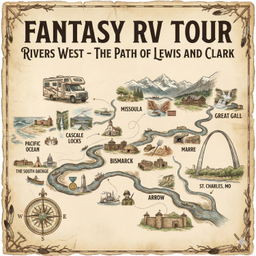
Rivers West - The Path of Lewis and Clark
Claim This Podcastby Bob Taylor
28 episodes
Updated Daily
Accepts GuestsHas SponsorsLocation 🇺🇸
Podcast Overview
This is the audio archive of my personal travel research for Rivers West: The Path of Lewis and Clark RV Tour. I dive deep into the history, logistics, and "must-see" stories of this expedition. These episodes are the result of that preparation—distilled into audio briefings designed for me to listen to while in transit. From historical deep-dives to logistical reminders, this channel is my hands-free travel binder. It’s curated specifically for my interests, my pace, and my upcoming itinerary. If you’re hearing this, you’re listening in on the prep work for my latest journey.
Language
🇺🇲
Publishing Since
2/25/2026
1 verified contact email on file for Rivers West - The Path of Lewis and Clark
Pitch yourself as a guest, propose sponsorships, or reach out directly to the host.
Recent Episodes
April 7, 2026
Podcast 28 - The Untold Story of Sacagawea
<p><strong>The Untold Story of Sacagawea: Beyond the Legend</strong></p><p>For most people, Sacagawea is simply known as the fearless teenage mother who guided the Lewis and Clark Expedition across America with her baby tied to her back. But the true story of this Indigenous icon is filled with harrowing tragedy, incredible resilience, and untold sacrifices.</p><p>In this episode, we peel back the myths to uncover the real life of the Shoshone explorer. Listeners will discover:</p><ul><li><strong>A Tragic Childhood:</strong> How Sacagawea survived a vicious raid by the Hidatsa tribe, only to be abducted and treated as a servant for years before being sold at age 16 to Toussaint Charbonneau—a cruel French-Canadian trapper 30 years her senior who was already married to another woman.</li><li><strong>The Expedition's True Hero:</strong> Why Lewis and Clark primarily tolerated the terrible Charbonneau just to get Sacagawea's translation skills, and how she proved her grit by trekking across the continent mere weeks after giving birth to her son, Jean Baptiste.</li><li><strong>Acts of Unbelievable Bravery:</strong> We recount the famous moment when Charbonneau panicked and nearly capsized their boat, while Sacagawea bravely dove into the water to rescue the expedition's most valuable journals and scientific instruments.</li><li><strong>Heartbreak and Abuse:</strong> We dive into the darker realities of the journey, including how she contracted a severe illness from her husband, the brutal physical abuse she suffered at his hands until William Clark intervened, and the emotional moment she was unexpectedly reunited with her brother—now a Shoshone chief.</li><li><strong>A Mother's Ultimate Sacrifice:</strong> We explore her platonic, uncle-niece-like bond with William Clark, and her devastating decision to leave her beloved son "Pompy" with him in St. Louis to ensure the boy had a better life and education.</li></ul><p>Join us as we honor the complete, unvarnished story of Sacagawea—a woman who endured unimaginable hardships, whose tragic death at just 24 years old cut short a remarkable life, and whose adventurous spirit helped shape a nation.</p>
April 7, 2026
Podcast 27 - Navigating the Unknown
<p><strong>Navigating the Unknown: How Lewis and Clark Crossed a Continent</strong></p><p>The Lewis and Clark Expedition's 8,000-mile journey to the Pacific Ocean and back was not just a feat of human endurance, but a masterclass in logistical adaptation. In this video, we explore the incredible and diverse transportation methods the Corps of Discovery utilized to conquer the unpredictable rivers and rugged mountains of the American West.</p><p>Listeners and viewers will discover the fascinating evolution of the expedition's transportation, which included:</p><ul><li><strong>The Flagship Keelboat:</strong> The journey began with a <strong>custom-built, 55-foot keelboat</strong> capable of carrying 12 tons of cargo. Designed by Meriwether Lewis and built in Pittsburgh, this vessel was propelled by 22 oars, sails, and setting poles. It served as a floating fortress and laboratory until the Missouri River became too shallow, and it was sent back to St. Louis in the spring of 1805.</li><li><strong>The Red and White Pirogues:</strong> Accompanying the keelboat were two smaller, flat-bottomed pirogues. The <strong>Red Pirogue</strong> hauled heavy cargo and was manned by experienced French engagés, while the highly stable <strong>White Pirogue</strong> served as the command auxiliary and transported sensitive instruments and journals.</li><li><strong>Dugout Canoes:</strong> As the rivers narrowed, the expedition had to build their own fleet. They spent a winter carving <strong>six cottonwood canoes</strong> at Fort Mandan. Later, after crossing the Bitterroot Mountains, the Nez Perce taught them to use a "burning-out" method to hollow out <strong>five ponderosa pine canoes</strong> for their descent to the Pacific.</li><li><strong>The Failed "Experiment":</strong> We dive into Lewis's brilliant but ultimately doomed invention—a <strong>40-foot collapsible, iron-framed boat</strong>. Intended to be covered with elk and buffalo hides, the vessel leaked uncontrollably and had to be abandoned when the crew couldn't find pine trees to make the pitch necessary to waterproof its seams, relying instead on an ineffective mixture of beeswax, charcoal, and buffalo tallow.</li><li><strong>Improvised Watercraft:</strong> Discover how the explorers adapted by acquiring <strong>two Native American-made canoes</strong> on the lower Columbia River. We also recount the incredible ingenuity of Sergeant Nathaniel Pryor's detachment; when their horses were stolen by a Crow raiding party on the return trip, they quickly constructed <strong>two circular, Mandan-style bullboats out of buffalo hides</strong> to float down the Yellowstone River.</li><li><strong>Overland Travel and Equestrian Lifelines:</strong> The rivers couldn't take them everywhere. The crew endured a brutal 18-mile overland portage around the Great Falls of the Missouri, building <strong>makeshift wagons with cottonwood wheels</strong> to haul their heavy canoes and supplies. Ultimately, crossing the rugged Continental Divide was only possible after Sacagawea helped them negotiate for <strong>29 horses and a mule from the Shoshone</strong>.</li><li><strong>Grueling River Mechanics:</strong> We also unpack the immense physical labor required to move upstream. When rowing and sailing weren't enough, the men used setting poles to push against the riverbed, or resorted to <strong>"cordelling"—towing the massive boats by hand using elk-skin ropes</strong> while walking or wading along muddy, treacherous riverbanks.</li></ul><p>Join us as we explore the frontier engineering, the grueling physical labor, and the impressive, shifting modes of transportation that carried the Corps of Discovery into history!</p>
March 30, 2026
Podcast 26 - The Right Boat
<p><strong>Engineering the Corps: The Fleet That Conquered the Missouri</strong>The success of the Lewis and Clark Expedition relied on much more than overland endurance; it demanded a sophisticated, custom-engineered maritime fleet designed to navigate the chaotic, unpredictable, and fiercely powerful Missouri River. In this episode, we explore the incredible navigational architecture and grueling riverine labor that propelled the Corps of Discovery into the unknown.At the center of our story is the expedition's flagship: a <strong>custom-built, 55-foot keelboat</strong>. Far from a simple transport barge, this vessel served as a floating laboratory, a diplomatic stage, and a fortified military command center capable of carrying 12 tons of essential cargo upstream. We dive into Meriwether Lewis's ingenious frontier design features, including a <strong>32-foot hinged mast</strong> that could be quickly lowered to avoid overhanging tree branches, and heavy-duty storage lockers that could be raised to form <strong>defensive breastworks</strong>, instantly transforming the boat into a floating blockhouse to protect the crew during an ambush.Listeners will also discover the immense physical toll of early 19th-century river travel. We unpack the "human engine" of the expedition, detailing how the crew had to row, push the boat upstream using 18-foot setting poles, and even <strong>"cordell" (tow the massive boat by hand using elk skin ropes)</strong> through violent currents, shifting sandbars, and deadly submerged trees.Beyond the keelboat, we explore the critical roles of the fleet's auxiliary vessels. We highlight the heavy-lifting <strong>Red Pirogue</strong> operated by expert French engagés, and the highly stable <strong>White Pirogue</strong>, which the captains trusted with their most sensitive scientific journals and diplomatic gifts. Finally, we examine the limits of their technological planning by looking at <strong>"The Experiment"</strong>—Lewis's brilliant but ultimately doomed collapsible iron-framed boat, which catastrophically leaked when the crew couldn't find proper pine pitch to seal its elk-skin hull.Join us as we navigate the maritime triumphs, the grueling physical labor, and the specialized river technology that made America's greatest voyage of discovery possible!<br /></p>
28 total episodes available
Deep-dive analytics for Rivers West - The Path of Lewis and Clark
Frequently asked questions
Have a different question and can't find the answer you're looking for? Reach out to our support team by sending us an email and we'll get back to you as soon as we can.
- What is Rivers West - The Path of Lewis and Clark?
- How often does this podcast release new episodes?
This podcast updates daily.
- Where can I listen to this podcast?
This podcast is available on 4 platforms including Apple Podcasts, Spotify, and more. You can also use the RSS feed directly.
- Does this podcast accept guests?
No, this podcast does not typically feature guests.
Legal Disclaimer
Pod Engine is not affiliated with, endorsed by, or officially connected with any of the podcasts displayed on this platform. We operate independently as a podcast discovery and analytics service.
All podcast artwork, thumbnails, and content displayed on this page are the property of their respective owners and are protected by applicable copyright laws. This includes, but is not limited to, podcast cover art, episode artwork, show descriptions, episode titles, transcripts, audio snippets, and any other content originating from the podcast creators or their licensors.
We display this content under fair use principles and/or implied license for the purpose of podcast discovery, information, and commentary. We make no claim of ownership over any podcast content, artwork, or related materials shown on this platform. All trademarks, service marks, and trade names are the property of their respective owners.
While we strive to ensure all content usage is properly authorized, if you are a rights holder and believe your content is being used inappropriately or without proper authorization, please contact us immediately at hey@podengine.ai for prompt review and appropriate action, which may include content removal or proper attribution.
By accessing and using this platform, you acknowledge and agree to respect all applicable copyright laws and intellectual property rights of content owners. Any unauthorized reproduction, distribution, or commercial use of the content displayed on this platform is strictly prohibited.