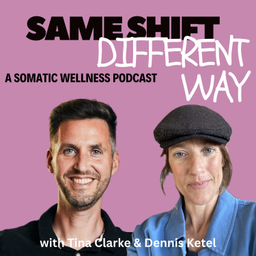
SAME SHIFT, DIFFERENT WAY
Hosted by Dennis and Tina · Dennis Ketel / Tina Clarke
4.7from 6 ratings
- 16
- Episodes
- 6
- Ratings
- Weekly
- Cadence
- 2025
- First episode
About SAME SHIFT, DIFFERENT WAY
In the Same Shift Different Way podcast episodes, we’re exploring all the different ways of navigating through life using our bodies to reclaim sensory intelligence and shift forward. This podcast aims to inspire you to find a somatic approach—body awareness—to handle stress, anxiety, chronic illness, developmental trauma, and challenging, uncomfortable emotions. Using our own experiences and those of our clients, we reclaim bodily sensations as tools to manage life's tough stuff. Through our backgrounds, experience, and training, we've found we have more in common than you'd expect.
- Publisher
- Dennis Ketel / Tina Clarke
- Category
- health & fitness
- Language
- en
- Explicit
- No
- First episode
- 26 May 2025
- Latest episode
- 16 Mar 2026
Latest episodes
16 episodes in the feed.
16 Mar 2026
Holding your horses
Tina's off to a quiet start, whilst Big D thinks about manifesting a large appendage. Then they get straight into the spring feel of the moment hopefully avoiding narcissists in their gardens. The subject of today is growth and emergence and how that shows up in our lives. Tina mentions her own fears of showing up and emerging into the world, and how others with chronic illness can have fears around overwhelm or collapse if they emerge too hard or too fast. Developmental trauma can also cause us to brace ourselves or retract, and Tina likens flow to the world of water - how there are stages and cycles, and honouring them, just like the seasons of nature. Dennis talks about how pulling back is often a way to stay safe, and he shares his journey with running and applying his safety brakes in that part of his life to demonstrate how fears or retractions can work and how a small shift can change everything. They also notice that we can "practice" playing with our fear boundary, in a safer way that gives the message to your brain and body that we "can" grow more than we think, whilst still feeling safe, aka "titrate" to restore trust, and how it might look different for people. Dennis shares about anticipatory fear, and they look at why that happens from a nervous system perspective, and that it's not a bad thing in essence, it's a survival thing! T and D talk a bit about the start of the year of the fire horse (in chinese astrology) and how it aligns with this topic of growth and harnessing the energy of the moment - but noticing how our language and thinking around energy can impede our use of of it. They notice the nuance between power and energy and how that differentiation can change a lot - do we need to harness the power of love for example, or is it infinite? Maybe power is infinite, whereas we associate energy as limited so we hold back through fear of "not enough". They talk about over-extending and going into burnout when we ignore the stages and timings of growth. They look at how we can slow burn rather than fireworks with our energy. Growth and expansion starts with our foundation, like good food, sleep, "training" before spring growth can happen. Are we giving too much and not respecting the stages and then collapsing or running out too soon? Tina and Dennis get to their last listener question of the podcast season, and guide us how to notice when we are over extending or pushing too hard, how to go through your body to regulate and match your body energy tone, and decoupling any thoughts of failure from slowing down or getting fatigued. For more information, coaching or to ask a listener question please go to: www.omnamo.nl (http://www.omnamo.nl) or email Dennis at dennis@omnamo.nl (mailto:dennis@omnamo.nl) www.tinaclarkewellness.com (http://www.tinaclarkewellness.com) or email Tina at tina@tinaclarkewellness.com (mailto:tina@tinaclarkewellness.com) Feeling the urge to work with this? Come and join us on April 25th, 2026 in Arnhem for a day of practice on the theme of Unfolding to Grow (https://omnamo.nl/diensten/one-day-retreat/).
2 Mar 2026
Resistance is needed for growth and change
Dennis and Tina start today with being on time, 2am dog turds, a surprised husband and central heating. They qet into the topic and start talking about resistance and their initial thoughts on it, including through the lens of Tom Jones. They observe how our brains prefer same-ness and routine and why resistance can be a good thing, rather than a pathology. They notice how resistance can be something we bump up against and can feel uncomfortable or confronting, but can we then enquire what might it be that we need? Dennis talks about knocking on the door of possibility and seeing how far we can go, and the meeting point of expansion and resistance and what dialogue can arise from that place. They talk about how we might recognise resistance in ourselves or others, including how it can feel like rejection and how resistance is inter-relational. when we are curious about our resistance, we can notice patterns like whether we tend to push through it, or move away from it too soon. They get into how our bodies show resistance and where their own resistance tends to show up (with the related beliefs that underpin the resistance) and the early years of programming which leads us into boundaries in relation to resistance: what is boundary and what is resistance? Dennis tells us about a childhood singing moment and how it showed up in adulthood. Is resistance a fear of rejection or is resistance rejection? They dive a bit deeper into the enquiry around resistance and what resistance might be telling us. They discuss how resistance might be asking for more safety or time. The vulnerable moment of change that we all have to face, like hermit crabs moving to bigger homes. T and D go int the more somatic aspects and how resistance shows up in our body: the muscles, the skeletal structure, the digestive system, the fascia or body fluids. They look through an IFS (Internal Family Systems) lens at resistance, and what parts might be taking over in those moments. Dennis tells us the story of the loyal soldier to illustrate a part that might need reassurance that it can stop fighting and put down it's metaphorical weapon. Come and join us in Arnhem for our One Day Retreat "Unfold to Grow" on April 25th! Learn more (https://omnamo.nl/diensten/one-day-retreat/) For more information, coaching or to ask a listener question please go to: www.omnamo.nl (http://www.omnamo.nl) or email Dennis at dennis@omnamo.nl (mailto:dennis@omnamo.nl) www.tinaclarkewellness.com (http://www.tinaclarkewellness.com) or email Tina at tina@tinaclarkewellness.com (mailto:tina@tinaclarkewellness.com) (https://omnamo.nl/diensten/one-day-retreat/)
16 Feb 2026
Living with Uncertainty
Dennis and Tina briefly reflect on the workshop they held at the weekend, and announce their new one on April 25th 2026 in Arnhem, Netherlands called "Unfolding to Grow" to experience harnessing a natural sense of timing and natural energy of growth rather than needing to force or push our way through with too much effort. They then get right into this weeks topic of Living with Uncertainty. They acknowledge the scariness of of the associated feelings, particularly relevant in these times with geopolitical change occurring as well as environmental and even financial. They look at how the sheer amount of information available at our fingertips is evolutionarily too much, but especially on top of whatever we are managing and processing in our own cosmos of our body and life. Dennis pays a little tribute to our autonomic nervous system that controls many things in our body that we don't even need to think about or control - like digestion or breathing. They discuss the art of finding balance in our focus - not too much outside, nor too inward, and the benefits of being in contact with our immediate environment, like the ground under our feet or the trees outside the window. Tina and Dennis look at what uncertainty is and how it shows up in our body and mind, like contraction and gripping in body and breath and overthinking, in an effort to gain come control. They discuss the certainty or uncertainty of our breath for some people - and how can we find some sense of stability in an uncertain body, and how Tina uses "okayness" as a They look at the false perceptions through social media that everyone looks like they are feeling or doing great, which in turn can make us feel 'less than', and the american/english Vs dutch approach to the question "how are you?" Tina knows all too well how people with chronic illness never know really how to answer that question! Dennis explains some ways that uncertainty can be felt in people with developmental trauma, and how uncertainty comes up in relation to death and dying, but also stepping into living. Our western society creates so many certainties but can we take on a more buddhist approach of trusting change as a certainty. They look at other things that we can rely on to be able to allow uncertainty, and the trouble with being individualistic. They discuss how the brain deals with uncertainty and the unknown and how the body can help support trusting the unknown. They throw in some more somatic or embodied ways to deal with uncertainty and of course have a great listener question to tackle. For more information, coaching or to ask a listener question please go to: www.omnamo.nl (http://www.omnamo.nl) or email Dennis at dennis@omnamo.nl (mailto:dennis@omnamo.nl) www.tinaclarkewellness.com (http://www.tinaclarkewellness.com) or email Tina at tina@tinaclarkewellness.com (mailto:tina@tinaclarkewellness.com) (https://omnamo.nl/diensten/one-day-retreat/)
2 Feb 2026
With Grief, Not Over it
It's that oh so painful emotion of grief - we all know this one, even if we haven't identified it by name. Dennis and Tina get into it by recognising the many ways that grief can show up in our lives - it's not just about someone dying...who knew! Dennis tells us how the japanese have emotional and poetic words for feelings that we don't even recognise or have words for in more western languages. They discuss how solitary grief feels, through it's very nature we feel like our pain of grief is so isolating and unique to us and how it feels difficult to reach out to others in the midst of our grief, even though it's very beneficial...especially if we don't have pressure to explain it or express it in a particular way. They look at in more detail in when grief shows up - feelings of loss of identity or sense of your future, feelings of emptiness or despair. Dennis describes one model of the "wave" of grief and yet that grief is actually non-linear. They talk about how grief doesn't need to be something you let go of, it can be something that you find a way to live alongside, and they go further to notice that one grief can bring up old grief that hasn't been acknowledged or given space yet still lives within us. Dennis and Tina share their personal experiences of grief, which can partner with relief, recognition of grief suppression, needing a safe container for grief and the interesting bodily expressions when we feel safe enough to allow grief to come through and how grief can hide deeply within us. They discuss the social and cultural norms around grief and loss, like holding it in, wailing it out, or encasing it or expressing it in black clothing. They mention the Kübler Ross 5 Stages of Grief, and it's helpful edges as well as it's limitations, and the more modern way of understanding grief. Dennis notices how feelings of aloneness can be triggered by grief and loss, and yet gives us the gift of opportunity to integrate the reality that part of life is being alone. Tina dives a bit into the grief that is associated with health challenges, from the loss of stability of health through to chronic illness where grief penetrates the past, the present and the future. She talks about hers and others experience where grief is often not recognised in chronic illness, or it's expected to come and then "you get over it" and it's not like that - it comes up time and again, and that's ok. They of course go on to explore some helpful somatic and bodily approaches to grief and how to meet it and support it. They summarise about some of the ways that developmental trauma and medical trauma can bring grief and then they get to the listener question! For more information, coaching or to ask a listener question please go to: www.omnamo.nl (http://www.omnamo.nl) or email Dennis at dennis@omnamo.nl (mailto:dennis@omnamo.nl) www.tinaclarkewellness.com (http://www.tinaclarkewellness.com) or email Tina at tina@tinaclarkewellness.com (mailto:tina@tinaclarkewellness.com)
19 Jan 2026
How to really deal with anger?
Tina and Dennis have a quick catch-up and chat about how they are trying to slow down a bit, particularly after the holiday season and counteract that "new year, new you" bollocks. The topic of the day is Anger. What is this emotion really and what does it want? They recognise how tricky it is for all of us, particukarly if we are in Northern Europe, where Anger is categorised or badmouthed depending on gender and in the context of different cultures. They talk about how we are afraid of anger and why, and what this emotion arises for. They talk about the power of anger and how it can get distorted or deformed and what that looks like. It also turns out that there aren't just 50 shades of grey, but 50 shades of anger too. They look at how incomplete or suppressed anger can show up and how much energy is required to keep that shit down! They discuss how anger and wanting space are related, and boundaries and the inner message of anger. Dennis and Tina then get down to the nitty gritty and reframe what anger is in the nervous system, how childhood and socialisation, as well as lack of agency can form and shape anger in us. They go on to share how anger can be related to, processed and what to DO with it. This can differ in different people and communities - and how people with chronic illness can work with feelings of anger without getting depleted or feeling like there is nowhere or no-one for it to land (on). How making choices and finding agency can be the perfect completion for anger - who knew! Dennis informs us about a wonderful symbol of the energy of anger from Japan called Fudo Myoo (not to be mistaken as a "puppet") and how it could be a useful image for grounded and empowered anger. They also give us some great somatic and other embodied ways of feeling and processing anger, and being aware of not bypassing it with rationality or positivity. They help us stay in our bodies with anger, and not feeling "out of control" or letting rage take over. They finish as always with the listener question which may help us all, giving different options for when anger comes up in relationship to another, without causing relational damage. For more information, coaching or to ask a listener question please go to: www.omnamo.nl (http://www.omnamo.nl) or email Dennis at dennis@omnamo.nl (mailto:dennis@omnamo.nl) www.tinaclarkewellness.com (http://www.tinaclarkewellness.com) or email Tina at tina@tinaclarkewellness.com (mailto:tina@tinaclarkewellness.com)
5 Jan 2026
People pleasing & assuming responsibility for "fixing" other's emotions
New year, new episode, and Tina and Dennis are starting off with a catch up and carrot cake. They go on to chat about what "people pleasing" is and how it shows up in us - from saying yes too much to being the fixer in emotional situations or not being able to stand back and give space for others to feel the difficult stuff. They observe it from an attachment, nervous system and embodiment perspective and look at what is happening in us, and the lack of feeling of safety that can be present. Dennis and Tina share their own patterns of fixing others emotions, and discuss what fear and avoidance of feeling might be happening underneath these behaviours. They dive in a bit to what is happening in our nervous system and that our tendency to please others is a nervous system strategy - a bit like hitting the brakes and the accelerator at the same time. They describe how we can notice in ourselves these tendencies, from posture to our sense of self and they remind us that these behaviours are not to be ashamed of, they are an intelligent developmental strategy. Tina mentions how this type of pattern can also show up in people living with chronic illness, maybe to appease the guilt of being a burden to others or also as a way to regulate their own nervous system, by regulating someone elses. Dennis describes "internalisation" where we can learn that our safety and belonging depends on keeping others happy. Tina goes on to give an explanation of people pleasing in relation to Developmental Patterns/Sequencing and the interrupted stages of development, for example, connecting to a sense of reaching for your desires gets replaced with scanning others for what they need. They go on to discuss on how to "meet" these states gently and to track when you have enough capacity to make small movements or breath to move through the stillness. They describe self merging with another, placing "silent boundaries" and allowing others have their own experiences. They go further into other ways we can bring feelings of safety into our system, and Dennis guides us through a short visualisation practice to invite a loving shift in connection to others. They end with a very relevant listener question! For more information, coaching or to ask a listener question please go to: www.omnamo.nl (http://www.omnamo.nl) or email Dennis at dennis@omnamo.nl (mailto:dennis@omnamo.nl) www.tinaclarkewellness.com (http://www.tinaclarkewellness.com) or email Tina at tina@tinaclarkewellness.com (mailto:tina@tinaclarkewellness.com)
22 Dec 2025
Apathy, procrastination, lack of motivation & "laziness"
Oh the shame and guilt! We are talking about those frowned upon states of apathy, procrastination, lack of motivation or "laziness". But worry not, Tina and Dennis are offering some interesting psychobiological re-framing so that we think twice before "shoulding all over ourself". Tina and Dennis share how they recognise these states in themselves, and they describe and differentiate between these common states, and look at them through a nervous system lens, specifically the dorsal/collapse state and sympathetic freeze. They offer the understanding that it's not really a choice or personality type or a "failing", but a system that gets stuck, and they ask, "what would happen if we listened to the body when it's saying "I can't move right now"".. They reflect on what the body might need in these states, and how we can honor it. They chat about what could be the causes of these chronic bodily states and patterns and remind us that these states don't have be forever - there are many, gentle ways of having open communication with our body, where we enquire with curiosity and meet our body in supportive ways. Dennis guides us through a little practice to gently dial up or down the volume of our energy, in tiny amounts, whilst listening to our system, and they offer some other helpful suggestions to gently come out of "stuckness". They finish by answering a great listener question about how to deal with/support someone in your home environment who is experiencing one of these states. Here are the names of the people we mentioned on developmental sequencing/reflexes: Bonny Bainbridge Cohen Carla van Wensen Please join us for a day of wintering on January 31st in Arnhem the Netherlands. Tickets are sold out, but you may register for our waiting list here: https://omnamo.nl/diensten/workshopdag-diepe-rust-in-de-winter/ (https://omnamo.nl/diensten/workshopdag-diepe-rust-in-de-winter/) For more information, coaching or to ask a listener question please go to: www.tinaclarkewellness.com (http://www.tinaclarkewellness.com) or email Tina at tina@tinaclarkewellness.com (mailto:tina@tinaclarkewellness.com) www.omnamo.nl (http://www.omnamo.nl) or email Dennis at dennis@omnamo.nl (mailto:dennis@omnamo.nl)
8 Dec 2025
Rest and wintering
We're back with season 2 of Same Shift, Different Way podcast! Tina & Dennis' friendship collides again with two microphones and their shared love of embodiment, somatics and wellness. In this first episode of season two they are bringing the subject of rest, wintering and the qualities of "Yield". They start by having a quick catch-up about Dennis' recognition of his own need to embrace rest and how he had a sweaty healing experience with some brothers from another mother. Tina mirrors him in her own way of restoring and "wintering" by bringing in heat too. They expand and open up the topic of rest to observe how winter as a season is mirrored in the body naturally and the cultural resistance to slowing down. The pose the reflective question, "what would your body choose if you weren't overriding it with expectation?" They reflect on societal structures, capitalism and productivity as influential factors in ignoring our body's rhythms, and Dennis asks why our mind is wanting to escape and not be in resting mode. They look at the action of Yield (relax) and how that might feel in the body, particularly vs collapse and how yielding can feel difficult or slightly frightening to many of us, particularly if we are stuck in a more active state or we feel that if we give into yield, we might collapse and not "get things done". They consider animals and nature and their seasonal cycles, and how rest is part of living cycles, along with expansion, expression, and integration. The episode ends with a great listener question around the topic of rest to have a go at answering. The stomach point we mentioned is (garbage point): stomach 41 specifically if you would like to look it up Please join us for a day of wintering on January 31st in Arnhem the Netherlands, where we will be exploring and playing around this topic in a small group. Book here : https://bookwhen.com/tinaclarkewellness/e/ev-s31ej-20260131100000 (https://bookwhen.com/tinaclarkewellness/e/ev-s31ej-20260131100000) or here : https://omnamo.nl/diensten/workshopdag-diepe-rust-in-de-winter/ (https://omnamo.nl/diensten/workshopdag-diepe-rust-in-de-winter/) For more information, coaching or to ask a listener question please go to: www.omnamo.nl (http://www.omnamo.nl) or email Dennis at dennis@omnamo.nl (mailto:dennis@omnamo.nl) www.tinaclarkewellness.com (http://www.tinaclarkewellness.com) or email Tina at tina@tinaclarkewellness.com (mailto:tina@tinaclarkewellness.com)
1 Sept 2025
Trauma & traumatic wounds Part 2
Tina and Dennis continue their talk on trauma, starting off by recognising that emotional trauma has only been recognised by medical researchers and the medical establishment as having biopsychosocial effects in the last few decades. Dennis talks us a little through a new research paper about developmental trauma, the physical and mental effects and the benefits of a "multimodal" treatment approach and Big D does a great job of summarising the research for us so we don't have read it ourselves. Tina points out how important research papers like these are because it demonstrates medically how chronic trauma can be a real cause of addictions, chronic illnesses and mental illnesses - the more recent understanding of "psychosomatic illness" is recognising the deep brain/body connection, rather than the outdated meaning which implied that people were "making up" their illnesses. Dennis expands on that to describe how our brain is physically changed by trauma, but luckily due to neuroplasticity, it can be changed. One of the conclusions is that we are contextual beings. Tina talks about the pioneering ACE Study - the first large, long term study demonstrating the long terms effects of childhood trauma, and the famous book, The Body Keeps The Score by Bessel Van der Kolk and his work around trauma and its effects on brain, behaviour and body. Dennis talks about our childhoods or past experiences don't need to be talked about extensively, but the knowing of various symptoms and history can help us repattern. T & D discuss the many symptoms of trauma on body and mind, including dissociation and relationship difficulties and behavioural patterns like people pleasing or perfectionism. They talk about the many sleep interruptions that can occur due to trauma and a disturbed autonomic nervous system. They discuss how the somatic approach can gently and effectively help the body and mind after trauma, interrupting the neuroplastic patterns. Dennis makes the link between the holistic approach and the multimodal approach recommended in the research paper. They then get into specific approaches and practices they use with people who have trauma...then they get rudely interrupted by Tina's dog Lila who is the adorable trouble maker and Tina's perimenopause brain gets easily lost in it's train of thought. They answer the listener question as best they can and Tina guides us through a Havening practice which is one very effective somatic body practice for trauma. You’ll find the mentioned study on: https://www.sciencedirect.com/science/article/pii/S2352289525000311 (https://www.sciencedirect.com/science/article/pii/S2352289525000311) If you are interested in finding out more, go to Dennis’ or Tina’s website: For more information, coaching or to ask a listener question please go to: www.omnamo.nl (http://www.omnamo.nl) or email Dennis at dennis@omnamo.nl (mailto:dennis@omnamo.nl) www.tinaclarkewellness.com (http://www.tinaclarkewellness.com) or email Tina at tina@tinaclarkewellness.com (mailto:tina@tinaclarkewellness.com)
18 Aug 2025
Trauma & traumatic wounds
Tina and Dennis start off this double episode about emotional trauma by sharing a bit about their own experiences with trauma - Tina's medical trauma and Dennis' childhood trauma - and surprise, surprise, it turns out that that's why they both got into coaching and facilitating others with trauma as part of their experience. They both demonstrate how we can discuss these impactful things with a little lightness - which makes it easy to listen to, and they recognise that chronic trauma doesn't really fully leave us but it can become a thread rather than a constant wave of crap overwhelming us. They talk about how the trauma can show up in us in moments, where our nervous system is effectively has the accelerator peddle and the brake peddle on at the same time, which makes Dennis rather red and sweaty. They acknowledge how our physical and emotional responses in those triggering moments can cause feelings of shame and self compassion is important. They discuss what trauma is and how we are still whole, wounds and all. They describe the different types of trauma and the disruptions in body and mind that trauma causes - unconsolidated memories, patterns of protection Vs patterns of connection, becoming "stuck" in the nervous system. They describe developmental trauma, inter generational trauma, shock trauma, medical trauma and death awareness. Dennis and Tina then begin to approach the WIDE ranging effects of trauma on behaviour, mind, emotions, body and relationships. WAIT FOR EPISODE 8 TO HEAR MORE. Books and researchers mentioned: Laurence Heller - NARM Institute Stephen Porges - Polyvagal Theory For more information, coaching or to ask a listener question please go to: www.omnamo.nl (http://www.omnamo.nl) or email Dennis at dennis@omnamo.nl (mailto:dennis@omnamo.nl) www.tinaclarkewellness.com (http://www.tinaclarkewellness.com) or email Tina at tina@tinaclarkewellness.com (mailto:tina@tinaclarkewellness.com)
4 Aug 2025
Resilience (or Assimilate!)
Tina and Dennis catch up on how they're feeling and what they have been up to. Dennis talks about holding a lovely group at his studio/clinic and they riff about the dynamics and forces involved in a "lovely" group atmosphere for both leader and attendees. This week is all about Resilience - so they start off by discussing what it is and what is isn't, in their perspectives and in a body-mind and worldly context. As a closet-Trekkie Dennis brings up the Borg to make a distinction between resistance and resilience. Where resilience is more of a sweet spot in between softness and sturdiness. Remembering that we are a part of a bigger whole, but without the nanobots and hive-mind. Tina concludes that resilience in the end is about choice. Resilience as a dynamic process that brings about change, movement, shifts; the multidirectional influence of change in body, behaviour, mind and environment. They talk about how awareness and thinking can sometimes get in each others way rather than improving resilience - exploring openly rather than resorting to old patterns or behaviours keeps us open and expanding, therefore being resilient as opposed to stuck. Dennis reminds us that resilience is already within us and that we want to come into contact with it rather than "finding it", and taking the pressure off of needing to achieve something else. Tina brings up feelings of safety as an important part of feeling resilient. Dennis maneuvers his way out of mansplaining patriarchy to Tina, in relation to societal structures that mould western society's interpretation of resilience and "being strong". D goes off on his own loop about mens behaviour, strength, resilience and masculinity. And where do boundaries come into all this? Knowing the spectrum of resilience is key to nervous system regulation, being aware using tracking of sensations within the body. We conclude that that is as a part of resilience. Luckily T&D agree on welcoming duality or multiplicity of experience in the somatic approach ( the importance of "And") and the body as a container of experiences, where emotions and sensations are contents. Resilience as allowing vulnerability... What now!?! Here once more, practice with the body makes perfect to feeling safe of experiencing these feelings (contents) within a safe perimeter (contents) that are all fluid like . Great listener question this week - how to stop "performing" and be authentic/ true to yourself. With another blast back to the past referring to teletext pages and disclosing their age, Dennis and Tina engage in a lovely practice to guide our listeners into softening (for “performance reviews" or preparing for a zombie apocalypse). And Tina does her best (with obviously trying not to outperform) to prevent herself from dozing off and dropping from her chair.
21 Jul 2025
When Shit’s Going Down (Stress and Our Nervous System)
Dennis and Tina go about defining what stress is and in the context of current news and activities and stress of needing to have an opinion about everything and how to balance the information overload. They have a laugh over some relatively light stress moments in their own lives recently and how Dennis can frantically run around when he is short on time. They ponder over how stress is a normal bodily response to threat and the ways it can become chronic, which is undesirable. How chronic or intense stress shows up and for what reasons; the stress of living with chronic illness and the emotional stress due to developmental trauma and wounds. Maladaptive coping mechanisms, including the societally revered or accepted ones (depending on the type of friends) are explored. As well as the fight/flight response and physical response to threat/stress. The Freeze response, stuckness and procrastination. The immobilisation and/or dissociation state and when that can happen, why and what it feels like. All these states are part of our nervous system and it is important to view these states and coping mechanisms with tenderness and understanding helps us to move back to the safe, connected state. As an example, they talk about how to approach burnout and chronic illness from this view point. When they discuss the power of connection & communication and which nervous system state that corresponds with, Tina brings up the big issue of lack of connection and help available when you live with chronic health issues and how to possibly manage that. And finally, they answer a lovely Listener's Question: "Is it OK to avoid stress and the feelings it brings?" Or how to make it feel a bit more palatable. For more information, coaching or to ask a listener question please go to: www.omnamo.nl (http://www.omnamo.nl) or email Dennis at dennis@omnamo.nl (mailto:dennis@omnamo.nl) www.tinaclarkewellness.com (http://www.tinaclarkewellness.com) or email Tina at tina@tinaclarkewellness.com (mailto:tina@tinaclarkewellness.com)
7 Jul 2025
Are you aware of the body-mind connection?
Hosts Dennis and Tina explore the body-mind connection as a comprehensive approach to navigating feelings and sensations, offering methods for cultivating body awareness, especially when it feels intimidating, in this interview episode.
23 Jun 2025
I get so emotional, baby!
Hosts Dennis and Tina explore the nuances of emotional awareness, delving into the distinctions between emotions and feelings, and examining the impact of social conditioning on emotional expression.
9 Jun 2025
Shitting Yourself, Emotionally Speaking.
Hosts TINA CLARKE and “BIG D” explore emotional and mental readiness for self-growth, contrasting medical interventions with lifestyle changes, and examining anxiety versus fear, especially with chronic illness or trauma.
26 May 2025
OK... so talk! What is healing?
Hosts Dennis and Tina explore the complexities of somatic healing, question the traditional definition, and emphasize the body's intelligence over the mind's fallibility in this interview episode.
Reach and audience
Public platform figures. Ratings count people who left a rating, not total listeners.
- Spotify
- 4.7 / 5
- 6 ratings
Podcast Authority Score: 18 / 100
A composite of feed quality, social presence, YouTube performance and engagement. Read the methodology.
- Quality
- 23
- Social presence
- 0
- YouTube
- 0
- Engagement
- 32
Contact SAME SHIFT, DIFFERENT WAY
- Guest appearances
- Does not typically book guests
Based on episode analysis; this does not confirm that the show is currently accepting guests.
Questions about SAME SHIFT, DIFFERENT WAY
Who hosts SAME SHIFT, DIFFERENT WAY?
Dennis and Tina host the show. Published by Dennis Ketel / Tina Clarke.
How often do new episodes come out?
The show publishes weekly, based on its RSS feed.
Does SAME SHIFT, DIFFERENT WAY take guests?
The show does not typically feature guests, based on episode analyses.
Host of SAME SHIFT, DIFFERENT WAY?
Claim your podcast to manage its listing and keep your show details accurate.
Pod Engine is an independent podcast discovery and analytics service and is not affiliated with or endorsed by this podcast. Artwork and show content belong to their owners. Full legal notice.
Explore this show
Podcast research with Pod Engine