- 15
- Episodes
- 2
- Ratings
- 2024
- First episode
About ScaleUp & Up
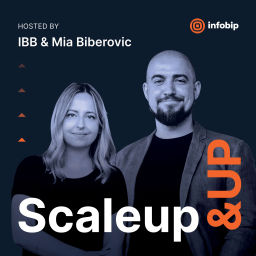
Get lessons from the world’s greatest (tech) scaleup stories. Hosted by IBB and Mia Biberovic.
- Publisher
- Infobip
- Category
- business · business
- Language
- en
- Explicit
- No
- First episode
- 29 Jan 2024
- Latest episode
- 5 Dec 2024
Latest episodes
15 episodes in the feed.
5 Dec 2024
How We Built a Calm Company – Without the Chaos (Amir Salihefedinic)
Amir Salihefedinic, CEO of Doist, shares his experience building a remote-first company that scaled to 30+ million users without raising money, prioritizing persistence and passion for the product over growth at all costs.
21 Nov 2024
Raising $350 Million for Rho Banking (Alex Wheldon)
Rho Banking co-founder Alex Wheldon shares insights on disrupting the business banking sector, simplifying financial operations, and the importance of managing cash flow for sustainable business growth.
7 Nov 2024
Hacking Revenue Growth with Design (Andy Budd)
Why do we hire designers? Is it just to make things look pretty or can they actually drive revenue? Well, according to Andy Budd (https://andybudd.com/), a proper design legend, one of the first UX designers in the United Kingdom and a VC nowadays, it's the latter. We caught up with Andy during our recent visit to the How To Web (https://www.howtoweb.co/) conference in Bucharest, where we had the opportunity to pick Andy's brain on design and growth. He talked about the things that founders miss when it comes to design and about the things that designers miss and often overlook when it comes to actually running a profitable and scalable business. As somebody who works on bringing those two sides closer through mentoring and consultancy work, our guest shared his views on product-led and founder-led marketing, noting that many founders are focused on product development and often overlook the significance of effective marketing and sales strategies: "The founder’s involvement in sales and marketing is crucial for connecting with customers and building a successful growth strategy." Throughout the episode, Andy took the time to explain why retaining users is a common challenge for startups, as founders often assume customers will instantly see the value of their product. He emphasized the need to prioritize usability and user onboarding, noting that customers usually need guidance to understand and utilize a product’s features fully. He stated: "Founders should really resist the urge to continually add new features and instead focus on optimizing existing features to provide clear, accessible value." Continuing our conversation, Andy underlined that UX plays an important role in a product’s success. Our guest encouraged founders to value design not just as an aesthetic element but as a strategic tool that can improve user engagement and business outcomes. He also noted that design leaders should focus on measurable outcomes and collaborate with other departments to demonstrate the impact of design on the company’s growth and success — especially nowadays when organizations are trying to streamline their budgets. Saving the best for last, Andy also gave us an insight into his latest book, The Growth Equation. (https://andybudd.com/book) This book summarizes the past 30 years of his work and discusses valuable principles for growing companies, teams, and revenue. *** Engage with your customers over WhatsApp, SMS and iMessage – just like Uber, HubSpot and Meta → bit.ly/44xYxqy (https://bit.ly/44xYxqy) *** Timestamps: 00:00 - Intro 01:49 - Falling in love with web design 03:38 - Discovering CSS 05:55 - Starting the first UX agency in UK 10:29 - Publishing "The Growth Equation" 13:37 - Founders on the frontlines 15:33 - It's not just about the product 20:47 - Usual mistakes about retention 25:40 - Understanding users 29:49 - What founders need to know about design 32:10 - Designing for profit 33:57 - Proving why design is valuable 37:09 - Design 2.0 39:56 - Being a team player
24 Oct 2024
How We Grew Paddle to $75 Million in ARR (Andrew Davies)
What is the role of marketing in a successful tech company? Do marketers only care about the brand, or are they more user-focused? In today’s episode, we talked with Andrew Davies (https://www.linkedin.com/in/andjdavies/), CMO of Paddle (https://www.paddle.com/), a unicorn valued at over 1,4 billion dollars. We explored the critical role of marketing in navigating the multiple ceilings that scale-ups face as they grow – particularly the importance of investing in a brand to avoid escalating customer acquisition costs. Andrew opened up about the thoughts and fears that keep him up at night, particularly the challenge of understanding and reaching new customer segments as the Paddle continues to scale. He emphasized the need for continuous innovation and testing to uncover new areas of growth - especially when expanding beyond a tightly defined ideal customer profile. Paddle’s CMO addressed the challenges of navigating market fluctuations and the importance of observation over prediction in understanding market dynamics. He also discussed the company’s approach to product-led, sales-led, and marketing-led growth strategies and the differences between these strategies. Towards the end, Andrew touched on the importance of branding for tech companies, discussing how a strong brand can reduce customer acquisition costs and enhance demand generation. Our guest concluded with practical advice on fostering a brand that resonates with customers and drives long-term success. *** Engage with your customers over WhatsApp, SMS and iMessage – just like Uber, HubSpot and Meta → bit.ly/44xYxqy (https://bit.ly/44xYxqy) *** Timestamps: 00:00 - Intro 01:22 - What keeps you up at night? 03:41 - Testing is key 05:08 - Serving small businesses globally 07:09 - Recognizing the challenges in SaaS 09:44 - Signs of recovery 11:56 - Looking for markets outside US 13:36 - Marketing for scaleups 16:33 - How is Paddle helping other businesses? 18:14 - Growing with acquisitions 21:25 - Buying audiences for marketing purposes 23:00 - Different types of growth 27:51 - Product led growth 29:29 - Aligning the team 31:22 - Relationships with analysts 36:50 - Branding for scaleups 38:47 - Branding lessons from Paddle 42:52 - Actually investing in marketing 44:04 - Acquiring ProfitWell (the documentary) 46:36 - Content marketing done right 51:27 - AI impacts marketing talent 53:47 - Scaling skills and expertise
10 Oct 2024
How I Grew Netlify To $33 Million In Revenue (Mathias Biilmann)
How does one go from a music journalist to a founder and CEO of one of the most recognizable companies in the web dev area? This week, we talked with Mathias Biilmann Christensen (https://www.linkedin.com/in/mathias-biilmann-christensen-a5a3805/), who, alongside his co-founder Christian Bach (https://www.linkedin.com/in/christianbachdk/), started Netlify (https://www.netlify.com/) - a web builder / hosting company that supports more than 35 million websites globally. Matthias shared his journey of building Netlify and the concept of Jamstack (https://jamstack.org/), which he coined to revolutionize web development by separating the user experience from backend logic. Throughout the episode, he explains how nurturing a community and investing in it pays off big time. Our hosts IBB and Mia Biberovic explored the early days of Netlify, including the company's strategy of targeting key influencers in the developer community and the importance of a product-led approach. Mathias talked about Netlify's pricing model, which included a free plan that catered to open-source projects, helping to drive adoption. Speaking of supporting the community, Biilmann explained how he and his team intentionally branded Jamstack to be inclusive and larger than just Netlify. He emphasized the significance of genuine community building and the pitfalls of trying to position oneself at the center of a new category. We also touched on the cultural differences between the tech ecosystems in the United States and Europe, with our guest highlighting the unique optimism and risk-taking mentality found only in Silicon Valley. He shared personal anecdotes about his background as a music journalist and how his journey into tech was shaped by his passion for programming and problem-solving. Finally, Matthias opened up about the human challenges faced in entrepreneurship, particularly during his co-founder’s battle with cancer, and the importance of maintaining a healthy perspective on identity and roles within a startup. He concluded the talk by discussing the value of a distributed company culture and how music continues to play a significant role in his life, drawing parallels between music and programming - saying how composers were the first programmers! Interested in the whole interview? Click the video below or find us on Apple Podcast (https://podcasts.apple.com/gb/podcast/scaleup-up/id1728068419), Spotify (https://open.spotify.com/show/6z3sk3AHzi5u2i9srIYjST), or Pocket Casts (https://pca.st/5y1gprwf)! *** Engage with your customers over WhatsApp, SMS and iMessage – just like Uber, HubSpot and Meta → bit.ly/44xYxqy (https://bit.ly/44xYxqy) *** Timestamps: 00:00 - Intro 01:18 - What is Jamstack? 04:24 - Scaling Netlify 11:26 - Make scaling easier and more successful 17:38 - Early investors 20:54 - Why is Europe GOOD and BAD for startups? 26:16 - Setting up corporate and human values 37:25 - Personal story of Mathias Biilmann
26 Sept 2024
From Engineers to Entrepreneurs – The Story of Tenderly (Bogdan Habic)
What does it take to become one of the most prominent players in Web3 / blockchain community? How do you build tools for Web3 developers and how do you market them? How do you do all of this and become one of the fastest growing developer tooling companies? This week, we talked to Bogdan Habic (https://www.linkedin.com/in/bogdan-habic/), co-founder and CTO of Tenderly (https://tenderly.co/), a full-stack infrastructure for Web3 professionals which was founded in 2018. and has so far raised almost 60 million dollars from VC’s such as Accel, Point Nine, Version One Ventures and Spark Capital. In this episode, Bogdan shared his experience with starting a Web3 company by coming from a Web2 community, highlighting the importance of understanding developer mindset and the need for reliable tools that they can use. Our hosts, IBB and Mia Biberovic, explored how Tenderly transitioned from a tooling company to a broader infrastructure provider thanks to their investors and mentors. Habic emphasized the significance of community engagement and direct communication with users, which was pivotal in shaping their product offerings. He also touched upon the subject of hiring in Web3 space, noting that most of their team comes from Web2 backgrounds and required training in order to adapt to the new enviroment. This nurturing approach became a cornerstone for their successful growth. Throughout our conversation, Bogdan shared valuable lessons on navigating the complexities of developer marketing, the importance of building a strong company culture, and the need for continuous learning and adaptation in a rapidly evolving industry. Habic noted the parallels between the current AI boom and the Web3 landscape, suggesting that both fields are on the brink of mainstream acceptance. Towards the end, our guest emphasized the importance of giving back to the community through initiatives such as Garaza (https://garaza.org/) which is aimed at supporting and mentoring the next generation of founders. Timestamps: 00:00 - Intro 01:52 - How do you scale in Web3? 04:15 - Build it and they will come? 06:45 - Engineers as consumers 08:33 - Investor pep talk 10:52 - Market effect on Tenderly 12:52 - Web3 over promised the timeline not the value 15:24 - Hiring for Web3 space 18:57 - The NEW 20% RULE 23:49 - Community is everything 27:01 - Communicating with developers 28:32 - Giving back with Garaza Engage with your customers over WhatsApp, SMS and iMessage – just like Uber, HubSpot and Meta → bit.ly/44xYxqy (https://bit.ly/44xYxqy)
18 Jul 2024
Honest Advice from ex Trello Product Director (Hamid Palo)
Have you ever wondered what building and scaling products from the frontlines is like? To be at the intersection between customers and teams shaping digital tools and products? This week, we discuss those questions with Hamid Palo (https://www.linkedin.com/in/hamidpalo/), a former Director of Product at Trello and Uber with extensive knowledge and experience in product development. Our hosts, IBB and Mia Biberović, caught up with Hamid in Brooklyn, where this seasoned product leader talked about his career and experiences and shared valuable insights into the world of startups, scale-ups, and large organizations. Hamid talked about his time at Trello, where he joined the company as employee number five. He recounted pivotal moments that led to Trello's acquisition by Atlassian, shedding light on the emotional rollercoaster and strategic decisions that followed. He reflected on the importance of people-first leadership and the challenges of letting go of ownership in a rapidly evolving organization. Since our guest spent almost nine years at Trello and Atlassian, he also discussed people development in large organizations and how decision-making works from top to bottom. After a short sabbatical in 2022, Hamid joined Uber, where he worked on grocery delivery, a new product at the time, bringing it to market from zero to one. He highlighted the significance of team ownership, accountability, and the iterative process of scaling a new product while emphasizing the value of storytelling and innovation. As the conversation unfolded, Hamid shared his transition to working on his own AI company (like everybody these days!), showcasing his entrepreneurial spirit and commitment to tackling inefficiencies in the construction industry. Join us as we explore the intricacies of scaling products in the ever-evolving landscape of technology and business! Timestamps: 00:00 - Intro 01:14 - In the beginning there was a developer 03:10 - Working on Trello for mobile 04:02 - Transition to product management 06:00 - Product management at Trello 09:06 - Localization vs. internationalization 10:59 - Trello's acquisition 13:35 - Atlassian did it the right way 14:30 - Culture is the key 15:28 - Atlassian's mistake 18:17 - Personal growth at Atlassian 21:05 - Taking time off 22:24 - Working on M&A 24:37 - High level decision making 26:38 - Putting out fires 30:09 - What makes a good leader? 32:35 - The importance of team ownership 34:13 - Boosting people's creativity 37:01 - Building new products at Uber 38:02 - How do you go Zero-to-One? 41:19 - Starting an AI company 43:33 - Pen and paper baby! Actually engage with your customers over WhatsApp, SMS and iMessage. Grow your startup or scaleup with Infobip’s platform – just as Uber, HubSpot and Meta! → bit.ly/44xYxqy (https://bit.ly/44xYxqy)
4 Jul 2024
How I Created TWO Billion Dollar Companies (Jason Cohen)
What's the secret behind scaling not one, but two multi-million dollar companies? What better person to talk to about growing businesses than Jason Cohen (https://www.linkedin.com/in/jasoncohen/), the founder of WP Engine and someone who has been navigating the world of technology for more than 30 years! In this episode, our hosts IBB and Mia talked with Jason about his passion for blogging (https://longform.asmartbear.com/jason-cohen/) and how it has been a key aspect of his journey as an entrepreneur. He emphasized the importance of writing to organize thoughts, share ideas, and receive feedback from the audience. Cohen highlighted the ego-driven aspect of blogging, where positive feedback and impact on readers serve as motivation. Throughout the episode, our guest shared his experiences from bootstrapping to scaling using VC money - both with SmartBear (https://smartbear.com/) and WP Engine (https://wpengine.com/). He talked about the critical shift in focus from exploration and experimentation to optimization and defense of existing strategies post-product market fit. He pointed out the challenges of managing rapid growth, including the need for effective delegation, as well as hiring the right people and adapting to changing organizational dynamics. Cohen also touched upon the importance of hiring individuals who are not just skilled, but also passionate about their work. He shared his views on the need for hiring individuals who are better than the founders with the work they do, in order to drive further improvement and growth within the company. Along with the hosts, our guest also discussed why founders choose to hire CEO's, why it's not an easy choice, and why the decision is always hard because of the ego. Stay with us for the rest of the interview as we explore the lessons behind scaling to hundreds of millions in revenue, and why starting a company is much about personal growth as well as it is about money! Timestamps: 00:00 - Intro 01:20 - Blogging since 2007. 03:24 - Growing your audience 06:31 - Writing as a form of marketing 10:33 - This can help with the hiring 12:30 - Bootstrapping WP Engine 13:05 - Growing was a choice 15:30 - How to price your services? 16:51 - Why 2nd time founders fail? 17:13 - Bootstrapped vs. VS money growth 19:41 - Founders can be obstacles 22:06 - Hiring a CEO 26:35 - Solving bigger problems 32:04 - Why do OKR's fail? 32:36 - You can't use off the shelf solutions 34:05 - Should EM's be good at coding? 38:01 - Hire passionate people! 45:51 - Difference between juniors and seniors 48:11 - Navigating acquisitions 51:40 - Why is culture important? 54:49 - Why do founders leave? 56:32 - Ups and downs 58:54 - What is next for Jason Cohen? 01:02:06 - Life after scaleups Actually engage with your customers over WhatsApp, SMS and iMessage. Grow your startup or scaleup with Infobip’s platform – just as Uber, HubSpot and Meta! → bit.ly/44xYxqy (https://bit.ly/44xYxqy)
20 Jun 2024
Taking On $17.3M Debt And Buying Out Investors (Wistia)
Is there such a thing as overscaling the company? Is growth at all costs a good thing or can it actually harm the company and its culture? Meet Wistia (https://wistia.com/), a Cambridge-based video marketing platform for businesses which was founded in 2006. with a vision to create a competition website for filmmakers, and which later evolved into a fully customizable video solution for businesses with various editing and marketing tools at the user's disposal. The story of Wistia is not the story of your average scaleup. Our hosts, IBB and Mia Biberovic, had the opportunity to talk to Wistia's CTO and co-founder, Brendan Schwartz (https://www.linkedin.com/in/brendanschwartz/), who shared the experiences of scaling rapidly and investing heavily in growth and the lessons behind the strategy that almost bankrupted the entire business. Brendan gave us an insight into the decisions to go the standard VC route, why other paths were not as common a decade ago, as well as other challenges that he and his co-founder, Chris Savage, faced along the way. He talked about the importance of pivoting and how Wistia did it early on, and how working with experienced people affects the culture in the beginning when the team is still searching for product market fit. One of the key moments for Wistia was when its co-founders started receiving offers to sell the company. After much deliberation, they decided not to do it but to instead raise $17,3 million in debt to buy out the investors and employees who had the equity. Schwartz also talked about shifting strategy from growth to profitability and how this move is especially important in 2024. when profitability is what everyone is talking about. This episode of podcast puts special emphasis on open communication and transparency within the company, as well as the value of creative projects and long-term investments into content marketing. Join us as we share the unusual story of Wistia and share the business lessons that drive sustainable growth. Timestamps: 00:00 - Intro 01:18 - From living room to first users 04:13 - Pivoting to video marketing tools 06:27 - Raising venture capital 08:51 - Hardest moments at growing the company 10:48 - CTO that loves the product 12:36 - Invest your profits back 15:21 - What went wrong with growth? 19:50 - Reaching the bottom 22:49 - Feeling depressed about work 24:18 - Should we sell the company? 27:38 - Deciding not to sell 30:34 - Buying out the investors 34:22 - Clear vision for the future 36:59 - Profitability over growth 39:46 - Investing back into content 42:33 - Running the business our own way 46:03 - Paying off the debt Actually engage with your customers over WhatsApp, SMS and iMessage. Grow your startup or scaleup with Infobip’s platform – just as Uber, HubSpot and Meta! → bit.ly/44xYxqy (https://bit.ly/44xYxqy)
6 Jun 2024
From Losing Everything To Building A $10 Million Company (Robin Powered)
Boston-based office management tool Robin Powered faced a significant challenge at the beginning of 2020 when the world went into lockdown, making their business model obsolete overnight. Forced to adapt quickly, the company experienced its fastest-growing period by pivoting to meet the demands of the new work-from-home era. During a visit to Boston, we interviewed Robin’s co-founder, Brian Muse, and current CEO, Micah Remley. They discussed the company’s evolution, the enduring relevance of hybrid work, and the mixed responses from companies regarding a return to the office. Brian shared the company's journey from an agency experimenting with various startups to creating a successful office management tool that helps companies manage workspaces and book desks and conference rooms. With over 20 years of management experience, Micah talked about leading Robin through these changes and adapting to the shifting market landscape. He highlighted the need for companies to focus on revenue and sustainability, moving away from the era of raising large amounts of capital based on growth alone. Join us as we share the story of Robin Powered and the lessons behind running a scaleup in the ever-changing world of office space and the future of work! Timestamps: 00:00 - Intro 01:16 - It all started with an agency 05:30 - Going all in 07:27 - Reaching Product Market Fit 09:02 - Why should we even exist anymore? 12:13 - Co-founders leaving 14:32 - Hiring a new CEO 17:04 - CEO's role in a Scaleup 20:26 - Biggest mistake founders make 21:40 - Onboarding a CEO 27:21 - What should CEO focus on? 30:16 - Being a CTO and a founder 32:27 - Impact of remote work on scaling Robin 34:11 - Downsides of remote work 36:30 - Working remote (States vs. World) 37:49 - Acquiring Flow n Form from Croatia 40:27 - Shifting to product mentality 44:26 - The impact of layoffs 47:10 - Art and science of running a scaleup 50:08 - Investing into relationships Actually engage with your customers over WhatsApp, SMS and iMessage. Grow your startup or scaleup with Infobip’s platform – just as Uber, HubSpot and Meta! → https://bit.ly/44xYxqy
23 May 2024
From Fired By Zuck To $100 Million - Noah Kagan Interview
Noah Kagan is a self-made millionaire, the founder of App Sumo, and a content creator with over one million YouTube subscribers! In this episode, Noah shares valuable insights on his journey, including how he overcame challenges, the importance of finding the right people, and the power of experimenting with low-risk activities. He also discusses his experience scaling a tech product to millions of users, valuable insights into creating a $100 million business from past mistakes, working with billionaires, and his new book, Million Dollar Weekend. Actually engage with your customers over WhatsApp, SMS and iMessage. Grow your startup or scaleup with Infobip’s platform – just as Uber, HubSpot and Meta! → https://bit.ly/44xYxqy
9 May 2024
Scaling Basecamp to Millions of Users With DHH
In this episode, we dive into a fascinating conversation with David Heinemeier Hansson, also known as DHH. As the creator of Ruby on Rails and co-founder of Basecamp, DHH shares insights on prioritizing profitability over investments, challenging mainstream business models, and the importance of building trust through admitting mistakes. Join us as we explore the keys to success for scale-up founders, the significance of effective communication, and the potential for affordable products in a subscription-dominated industry. Don't miss out on this engaging discussion that delves into the core skills needed for entrepreneurship, the power of writing as a communication tool, and the excitement of venturing into the unknown in the world of business. Actually engage with your customers over WhatsApp, SMS and iMessage. Grow your startup or scaleup with Infobip’s platform – just as Uber, HubSpot and Meta! → https://bit.ly/44xYxqy
27 Feb 2024
Mario Ancic: You Fight For Your Success – in Business and Sports!
Mario Ancic, a former professional tennis player known for his Wimbledon appearances and Davis Cup victory in 2005 with Croatia's national team, has transitioned from the tennis court to Wall Street. Currently serving as Vice President at One Equity Partners, Ancic's journey from sports to finance was discussed in the third episode of the ScaleUp & Up podcast. In the new episode, Ancic delved into his upbringing in Croatia, highlighting the support he received from his family in both sports and academics. He shared insights into the parallels between his experiences as a professional athlete and his subsequent career in finance, drawing from lessons learned on the court. Additionally, he discussed his education at Columbia University and the trajectory of his finance career, providing context to his current role at One Equity Partners. Furthermore, the conversation explored Ancic's involvement in supporting businesses like Infobip, shedding light on Croatia's emerging status as a hub for innovative startups in Southeastern Europe. Ancic emphasized the importance of technical expertise in entrepreneurship and discussed the dynamics of investor-founder relationships, underlining the significance of personal connections and mutual commitment to creating value in the investment landscape.
13 Feb 2024
Ivan Ostojic: From PhD to a $1,000,000,000 Scaleup’s Chief Business Officer
Ivan Ostojic, Chief Business Officer at Infobip, has been immersed in science and technology since childhood. In the second episode of ScaleUp & Up podcast, Ivan discusses his journey from a fascination with technology and molecular biology to becoming a pivotal figure in the tech industry as a "business translator." His academic pursuits include a doctorate in natural sciences from the University of Basel and a Master’s degree in management, technology, and economics from the Swiss Federal Institute of Technology. These studies melded his background in biomedicine with a keen understanding of emerging technology trends, ultimately leading to leadership roles at McKinsey & Company, where he co-founded and co-led the Global Technology Council. Ivan emphasizes the significance of grasping both technological and business aspects to drive innovation. He underscores the role of business translators in bridging the gap between technical expertise and business impact, advocating for asking the right questions, iterating on insights, and integrating technical advancements to achieve business objectives. Additionally, he sheds light on the CPaaS industry's current state, particularly the emergence of conversational apps and the transformative potential of the conversational era. He elaborates on how businesses can harness these solutions to enhance customer experiences, stressing the importance of true omnichannel communication and the evolving role of AI in consumer interactions.
29 Jan 2024
Silvio Kutic: Turning a $27,000 Loan Into a Billion Dollar Company
In the first episode of ScaleUp & Up podcast, we talked with our very own Silvio Kutic, CEO and founder of Infobip - Croatia's first ever tech unicorn. Silvio gave us an insight into what made him quit his first job after just a couple of hours and pursue his passion for developing communication technologies which later turned into the creation of Infobip - a billion-dollar company and one of the leaders in the CPaaS industry which is actively working with WhatsApp and Uber. We talked with Silvio about the early days of the company, what it's like to work with a family member and why the company chose to build their first campus in the same village where the company is founded. He shared with us how Infobip scaled its services to millions of end users, as well as his views on the future of SMS, WhatsApp, Message and RCS, as well as AI which is rapidly changing the landspace of communications.
Reach and audience
Public platform figures. Ratings count people who left a rating, not total listeners.
- Spotify
- 5.0 / 5
- 2 ratings
Contact ScaleUp & Up
- Guest appearances
- Does not typically book guests
Based on episode analysis; this does not confirm that the show is currently accepting guests.
Host of ScaleUp & Up?
Claim your podcast to manage its listing and keep your show details accurate.
Pod Engine is an independent podcast discovery and analytics service and is not affiliated with or endorsed by this podcast. Artwork and show content belong to their owners. Full legal notice.
Explore this show
Podcast research with Pod Engine