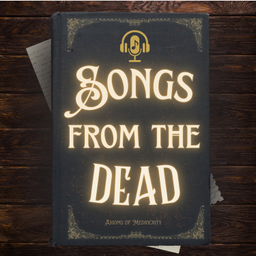
About Songs from the Dead: 10-Minute Histories of Legendary Songs
Every Monday, we take one legendary song, uncover its strange history, and play a brand-new reinterpretation.
In about 10 minutes, we try to bring old songs back to life: murder ballads, folk standards, lost anthems, and melodies that refused to disappear.
If you like music history, dark stories, and fresh versions of ancient songs, this is for you.
Twinkle, Twinkle: Mozart, the Mad Hatter, and Edison's Talking Doll
Twinkle, Twinkle, Little Star is one of those songs you seem to know before anyone teaches it to you.
But Mozart did not write it.
The melody first appears in eighteenth-century France, where one early set of words is about a young woman telling her mother about a shepherd who has talked his way into her arms. Mozart later wrote twelve piano variations on the tune. Jane Taylor's poem The Star arrived only in 1806, and the words and melody were joined later still.
This episode follows six remarkably durable notes through Mozart, the Alphabet Song, Lewis Carroll's Mad Hatter, Saint-Saëns, Edison's talking doll, Dohnányi, Steeleye Span, and Dead Space.
Along the way, the tune keeps changing jobs without really changing itself: love song, piano exercise, nursery rhyme, teaching tool, musical joke, technological experiment, and horror soundtrack.
Apparently, if a melody is simple enough for a child to remember, it is also difficult for culture to get rid of.
19 Oct 2026
In the Hall of the Mountain King: Trolls, Metal, and The Social Network
In the Hall of the Mountain King begins with a tiny tune in the low strings and ends with what sounds like the orchestra being overrun.
Grieg wrote it for Peer Gynt, where Peer arrives at the Mountain King’s court on a giant pig, considers marrying the king’s daughter, and discovers that the trolls would quite like to boil him. The music follows the scene perfectly: the melody barely changes, but it gets faster, louder, and more crowded. Grieg simply keeps admitting more trolls.
This episode follows that little tune after it escaped the theatre. It becomes a murderer’s whistle in Fritz Lang’s M, a Duke Ellington big-band number, a rock instrumental for Nero and the Gladiators, an experiment by The Who and ELO, metal with Savatage and Apocalyptica, synth-pop with Erasure, mounting electronic pressure in The Social Network, and finally, inevitably, music for actual animated trolls.
The tune survives because it is almost absurdly efficient. You hear it once. You know it. Then it starts coming closer.
15 Oct 2026
Bonus Episode: The Imperfect Enjoyment
The Imperfect Enjoyment sounds like a polite complaint about dinner.
It is actually a seventeenth-century poem about premature ejaculation, impotence, wounded pride, and a man becoming so furious with his own penis that he starts addressing it as a military deserter.
John Wilmot, Earl of Rochester, wrote the poem in the 1670s. It begins with two eager lovers and every expectation of spectacular sex. The narrator finishes almost immediately, cannot recover, and reacts as though something much more serious than disappointing sex has occurred. Corinna, who has considerably more reason to complain, is remarkably patient.
What makes the poem funny is the gap between the problem and the response. Rochester’s verse remains elegant and controlled while his narrator completely falls apart.
This short bonus episode follows the disaster from optimism to shame, rage, treason, and one extraordinarily generous proposal for solving Corinna’s problem.
Reach and audience
Public platform figures. Ratings count people who left a rating, not total listeners.
Spotify
4.0 / 5
4 ratings
Contact Songs from the Dead: 10-Minute Histories of Legendary Songs
Guest appearances
Does not typically book guests
Based on episode analysis; this does not confirm that the show is currently accepting guests.
Pod Engine is an independent podcast discovery and analytics service and is not affiliated with or endorsed by this podcast. Artwork and show content belong to their owners. Full legal notice.
Explore this show Podcast research with Pod Engine