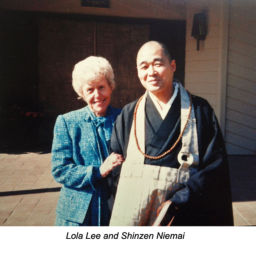
Talks by Lola McDowell Lee
Claim This Podcastby I & A Publishing
Podcast Overview
<p>This is a series of newly digitized talks by spiritual teacher, Lola McDowell Lee, spanning two decades—from the early Seventies through the Nineties.</p><p>Lola was a Zen Roshi whose Rinzai lineage included Doctor Henry Platov and renowned Zen master, Shigetsu Sasaki. Lola was a religious scholar as well as an ordained Christian minister.</p><p>While the talks are focused mainly on Zen and Buddhism, Lola drew on many spiritual traditions—including those of Jesus, Plato, Lao-Tzu, the Hindu Vedas, Meister Eckhart and Gurdjieff.</p><p>If you find Lola’s talks valuable, more will be posted in days to come. <strong>RSSVERIFY</strong></p>
Language
🇺🇲
Publishing Since
8/28/2023
Reach the team behind Talks by Lola McDowell Lee
Verified contact details for this show aren't on file yet — sign up to get notified when they land.
Recent Episodes

June 27, 2026
The Trap of Words - Delivered August 3, 1986
<p>Zen Roshi, Lola McDowell Lee, recounts Chuang Tzu’s advice: the purpose of a fish trap is to catch fish, and once the fish are caught, the trap is forgotten. So too with words — once an idea is truly grasped, the words that carried it should be released. Yet we find this nearly impossible. Words stick. They cling to the mind and take on a life of their own, trapping the very people who use them.</p><p>She illustrates with two ancient stories. In Egyptian lore, a god wished to thank humanity for its devotion and decided to give people the gift of words — only to be warned by the great god Ra that this would put them in bondage.</p><p>And the Buddha’s tale of five men who crossed a flooded river in a small boat. So grateful were they that the boat had saved their lives, they would not leave it behind. And so they hoisted the boat onto their heads and pointlessly carried it for the rest of their journey.</p><p>Lola asks how many boats, ladders, and paths are we still carrying in our heads?</p><p>Lola points to silence as the source of truly alive communication. When the mind is not churning with its stored content, heart can speak to heart--unlike ordinary social chatter, which acts as a relief valve for inner disturbance rather than genuinely meeting another person.</p><p>Lola tells a humorous story of a Zen monk who calls a bartender repeatedly in the middle of the night asking when the bar will open. When the exasperated bartender finally shouts that he will have to wait until nine for a drink, the monk replies that he does not want a drink — he is locked in the barn and wants to get out.</p><p>We are locked inside and mistakenly reaching outward. The real movement is inward.</p><p>Lola describes the uncreated mind through the image of a polished mirror or a crystal ball. The mirror is originally clear and unblemished; our likes, dislikes, prejudices, envies and graspings settle on it like dust, obscuring it. Yet the mirror itself is never changed by what it reflects. But actually, the uncreated mind from the very beginning has not been anything else but pure.</p><p>The created mind has accumulated so much authority that it has mistaken itself for the master of the house — when in truth it is only the manager, meant to serve something deeper. </p><p>Glimpses of no-mind do arise in meditation, in a sudden beauty, in an unguarded moment with a butterfly or a ray of sunlight — but the moment the created mind rushes in saying “look what I’ve done, give me more of this,” the contact is lost. The appropriate response to such glimpses, she says, is simply gratitude. </p><p>Delivered August 3, 1986</p>

June 12, 2026
Zen is not an intellectual exercise. Delivered Jun 20, 1986
<p>(Note on the recording: Thank you for your patience. Many of the remaining cassettes of Lola’s talks have substantial noise and echo issues. To overcome that, I’m trying out a different software to clean the audio. This software removes the noises, but it also sounds slightly clipped. Just so you know...if this sounds a little different from what you're used to. For those of you that follow her talks, I’m curious if you can accept these changes to improve the audio. Your comments are welcome. Thank you. – Bob)</p><p>***</p><p>Zen Roshi, Lola McDowell Lee, explores the dilemma of human life: the internal division caused by human desire, and the pursuit of external validation.</p><p>Chuang Tzu tells of an archer who possesses perfect skill when shooting for the simple joy of the act. However, the moment an external prize is introduced the archer grows nervous, develops double vision, and goes out of his mind. Roshi Lee points out that while the archer's physical skill remains entirely unchanged, the introduction of a prize divides him against his own nature. He becomes obsessed with winning rather than the immediate, physical act of shooting. The need to achieve a specific outcome drains him of his innate power.</p><p>Lola contrasts this fractured modern state with the consciousness of early human beings, whom she describes as children of the earth. Early humans viewed nature directly, and naturally concluded that the divine was immanent within everything—living inside trees, the sun, and so on. Because they lived without complex intellectual frameworks, their world was simple.</p><p>In contrast, modern human beings, burdened by education and the knowledge of good and evil, find themselves alienated. Lola explains the tragic irony of this search: the divine cannot be uncovered intellectually. It is the very subjective ground where we stand. We need to unify the heart and mind, bringing an end to this exhausting external search and returning us to our natural wholeness.</p><p>Lola shares the tale of an inebriated monk who staggers home, knocks repeatedly at his own front door, and asks his wife who he is and where he lives. This, she notes, is the universal state of humanity—staggering through life and begging the external world to tell us our identity.</p><p>This identity confusion stems directly from desire, which creates idealized mental images that pull us away from immediate reality. We form a false ego-image by collecting the opinions of others in a basket and calling it "ourselves." Trying to prove we are "somebody" is an endless, suffering-filled trap because there will always be someone greater to compare against.</p><p>True liberation is the realization that you are actually "nobody." To be nobody is to be free of the constant need to prove your worth. In this sweet spot of non-clinging, you paradoxically realize your identity as the totality of existence.</p><p>Lola describes how ancient Chinese masters structured this text into a beautiful four-fold vision of reality based on the terms Li (Absolute Reality or Emptiness) and Shi (Particular Events or Forms). In a fully awakened state, Li and Shi are completely interfused and unified.</p><p>Like a golden lion in an imperial palace, she explains that the lion (the form/event) has no reality without the gold (the substance/absolute), and the gold cannot be expressed without the lion. They are structurally inseparable (interdependent). To see the world as it truly is means letting go of the false dichotomy.</p><p>Zen is not an intellectual exercise. It is a hundred-foot pole that requires a final leap. Let the arrow release itself without ego involvement.</p><p>We need to recognize that the door to the spiritual world is not something we need to pound on frantically from the outside; rather, we have been safely inside the sanctuary all along. Jun 20, 1986</p>

May 16, 2026
Emptiness is not nothingness. Jul 14, 1986
<p>Zen Roshi, Lola McDowell Lee, discusses the concept of the "Unborn," the central teaching of Master Bankai.</p><p>Lola recounts the story of an arrogant Abbot trying to challenge Bankai. The Abbot told his congregation, “If I put a difficult question to him, I can stymie him with just one word. So saying this, he went off to see this supposed master. And here in this large crowd, in the middle of the talk, the Abbot shouted in his booming voice, “Everyone here accepts your sermon and believes it. But someone educated like myself doesn't accept. If a person doesn't accept, how are you going to save him?”</p><p>And Bankai raised his fan and says, “Come forward.” So the Abbot went forward to stand before him. And then Bankai says, come a little closer. So the abbot shuffled forward again. And Bankai looks at him and says, “See how well you accept what I say?”</p><p>Indian patriarch Nagarjuna’s doctrine of Shunyata, or emptiness. This emptiness is not a nihilistic nothingness or an absence, but rather an absolute state where relativity disappears.</p><p>The Prajñāpāramitā represents a noetic leap across the abyss of contradiction.</p><p>To explain, Lola uses the metaphor of passing through a chain-link fence into a garden that the mind could never have previously imagined. One should not waste time speculating about what is on the other side, as the mental process is inherently dualistic and incapable of grasping the Absolute.</p><p>Lola discusses the human condition through the lens of the Five Aggregates. Everything in the phenomenal world—cells, organs, and thoughts —is a temporary aggregation of elements. By examining the body, one realizes there is no permanent, self-existing entity to be found. This leads to the practice of the via negativa, or the path of negation. Through non-attachment and non-judgment, the practitioner learns to perceive the formless within form.</p><p>She tells Zen story of Basso, who sat in meditation for hours hoping to become a Buddha. Frustrasted, he looked to his master who began scrubbing a brick. When asked what he was doing, the master said, like you, I’m trying to polish this brick into a mirror.</p><p>The Threefold Truth—the Real (emptiness), the Unreal (the empirical world), and the Synthesis (the Middle Way). </p><p>Lola explains how the Middle Way transcends and embraces both the absolute and the relative. This synthesis grants the practitioner three eyes: the Dharma eye to see interdependency, the Wisdom eye to see unchanging silence, and the Buddha eye to see the union of both.</p><p>Lola ends a week-long Sesshin with a reminder that even small enlightenments are worth our gratitude.</p><p>The speaker reinforces that the market of spiritual truth provides exactly what the seeker demands. If one asks for childish toys, one receives them; if one asks for gold, one receives gold. This puts the agency of spiritual growth squarely on the shoulders of the individual. The teacher cannot eat or be enlightened for the student. By turning one's light inward, the root of false thinking can be dug out, leading eventually to the Golden Wind, where the leaves of the ego have fallen and the trees are bare, yet reality remains vibrant and full.</p><p>Jul 14, 1986</p>
138 total episodes available
Deep-dive analytics for Talks by Lola McDowell Lee
Frequently asked questions
Have a different question and can't find the answer you're looking for? Reach out to our support team by sending us an email and we'll get back to you as soon as we can.
- What is Talks by Lola McDowell Lee?
<p>This is a series of newly digitized talks by spiritual teacher, Lola McDowell Lee, spanning two decades—from the early Seventies through the Nineties.</p><p>Lola was a Zen Roshi whose Rinzai lineage included Doctor Henry Platov and renowned Zen master, Shigetsu Sasaki. Lola was a religious scholar as well as an ordained Christian minister.</p><p>While the talks are focused mainly on Zen and Buddhism, Lola drew on many spiritual traditions—including those of Jesus, Plato, Lao-Tzu, the Hindu Vedas, Meister Eckhart and Gurdjieff.</p><p>If you find Lola’s talks valuable, more will be posted in days to come. <strong>RSSVERIFY</strong></p> - How often does this podcast release new episodes?
This podcast updates bi-weekly.
- Where can I listen to this podcast?
This podcast is available on 9 platforms including Apple Podcasts, Spotify, and more. You can also use the RSS feed directly.
- Does this podcast accept guests?
Yes, this podcast regularly features guests.
Legal Disclaimer
Pod Engine is not affiliated with, endorsed by, or officially connected with any of the podcasts displayed on this platform. We operate independently as a podcast discovery and analytics service.
All podcast artwork, thumbnails, and content displayed on this page are the property of their respective owners and are protected by applicable copyright laws. This includes, but is not limited to, podcast cover art, episode artwork, show descriptions, episode titles, transcripts, audio snippets, and any other content originating from the podcast creators or their licensors.
We display this content under fair use principles and/or implied license for the purpose of podcast discovery, information, and commentary. We make no claim of ownership over any podcast content, artwork, or related materials shown on this platform. All trademarks, service marks, and trade names are the property of their respective owners.
While we strive to ensure all content usage is properly authorized, if you are a rights holder and believe your content is being used inappropriately or without proper authorization, please contact us immediately at hey@podengine.ai for prompt review and appropriate action, which may include content removal or proper attribution.
By accessing and using this platform, you acknowledge and agree to respect all applicable copyright laws and intellectual property rights of content owners. Any unauthorized reproduction, distribution, or commercial use of the content displayed on this platform is strictly prohibited.
