
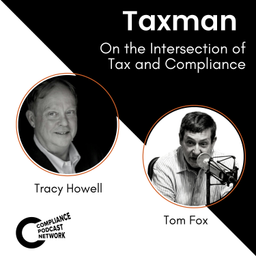
What is the intersection of tax and compliance? Why should every compliance professional work with their corporate tax department to ensure more effective compliance program. In this podcast series, join Tom Fox and noted tax professional Tracy Howell as the explore the intersection of tax and compliance as well other tax issues that every business executive needs to be aware of for efficient business operations.
Podcast Overview
What is the intersection of tax and compliance? Why should every compliance professional work with their corporate tax department to ensure more effective compliance program. In this podcast series, join Tom Fox and noted tax professional Tracy Howell as the explore the intersection of tax and compliance as well other tax issues that every business executive needs to be aware of for efficient business operations.
Language
🇺🇲
Publishing Since
4/20/2022
1 verified contact email on file for Taxman
Pitch yourself as a guest, propose sponsorships, or reach out directly to the host.
Recent Episodes
April 20, 2022
What is the Role of Tax in ESG?
What is the intersection of tax and compliance? Why does a Chief Compliance Officer (CCO) or compliance professional need to sit down with the corporate head of tax? How does a corporate tax function fit into a best practices compliance program? It turns out there is quite a bit a compliance professional can learn from a tax professional. Moreover, there are many aspects of tax which should be considered by a CCO and compliance professional from an overall risk management perspective. Unfortunately, these questions are rarely explored in the compliance community. In this episode, we explore the unexplored topic of the role of tax in a corporate ESG program. How Tax and ESG Intersect Tracy tells Tom, “There are external forces pulling tax into the ‘S’ and ‘G’ of ESG.” In the social sector, different jurisdictions have different tax rates and laws, and as companies begin to operate in a tax-efficient manner, their activities will gravitate towards lower tax regimes. Tracy adds, “You’ve got forces trying to push the concept of ‘fair share’ rather than compliance with tax laws of different jurisdictions.” Governance-wise, it’s becoming more common for companies to be required to talk about their compliance tax audits. The Role of Tax in a Company With the growing pressures on ESG transparency, there’s a push to standardize reporting and scorecarding of companies based on their tax transparency. This would include things like the reporting of an organization’s effective tax rate. Tax and ESG in Multinational Organizations Institutional investors play a major role in impacting the activities of a multinational company. When making investment decisions, these entities heavily incorporate ESG scorecards with tax transparency, further emphasizing the need for a relationship between the two sectors. Resources Tracy Howell | Email | LinkedIn
April 20, 2022
The Intersection of Tax and Supply Chain
What is the intersection of tax and compliance? Why does a Chief Compliance Officer (CCO) or compliance professional need to sit down with the corporate head of tax? How does a corporate tax function fit into a best practices compliance program? It turns out there is quite a bit a compliance professional can learn from a tax professional. Moreover, there are many aspects of tax which should be considered by a CCO and compliance professional from an overall risk management perspective. Unfortunately, these questions are rarely explored in the compliance community. In this episode, we explore the intersection of tax and Supply Chain. How Tax Can Help Supply Chain Supply chain in a traditional sense focuses on the acquisition of goods, in particular the quality, cost, and delivery. There can be a substantial tax component in each of those steps to help companies attain goods at the lowest possible cost. Consequently, if supply chain does not have a relationship with tax, it can result in additional surprise costs being attached to goods. Data beyond the cost of goods, material, and service can be used to model and predict the additional tax burden so that better procurement decisions can be made. Mitigating the Risk of Mission Creep Establishing a connection between tax and supply chain in an organization is good, but the relationship needs to be kept fresh for a positive impact. In a company, people may be focused on so many different things that they forget to interact. Creative people tend to expand their roles and look for goods and services in different locations, which can be the cause of a mission creep. Hence, having constant close interaction between supply chain and tax allows for changes in functionality to be documented and implemented into the organizational framework. Elements of a Tax-Efficient Supply Chain Tom and Tracy discuss the elements of a tax-efficient supply chain. This includes: Examination of the entire scope of what’s being manufactured and sold to allow the creation of tax opportunities to bring value-based on special purpose entities. Coordination of transactions in a supply chain with transfer pricing. Compliance with tax laws and regulations. Documentation of the process. Resources Tracy Howell | Email | LinkedIn
April 20, 2022
Why Does Tax Need a Seat at the Table?
What is the intersection of tax and compliance? Why does a Chief Compliance Officer (CCO) or compliance professional need to sit down with the corporate head of tax? How does a corporate tax function fit into a best practices compliance program? It turns out there is quite a bit a compliance professional can learn from a tax professional. Moreover, there are many aspects of tax which should be considered by a CCO and compliance professional from an overall risk management perspective. Unfortunately, these questions are rarely explored in the compliance community. In this episode, explore the question of why tax needs a seat at the table. Tax and the Table The table refers to the front end of when an organization is trying to define what it wants to do, where it wants to do it, and how it’s going to perform. A corporation’s ultimate objective is to generate net income or distributable profit, something tax professionals are well-suited to assist with because they are experts in damage control and risk mitigation. Tracy points out, “Tax can provide an umbrella to achieve corporate objectives if they’re involved in the front end.” Tax’s Relationship with Other Stakeholders In a company, a functional lead will often pose the question: ‘Why do we need tax here?’ According to Tracy, “A good tax guy has to be proactive and provide examples to get the tax men at the table.” Educating Corporate Functions Outside of Tax Tracy’s advice is to build a relationship with the functional experts, and “create the situation where you’re a trusted business advisor”. He recommends one-on-one interactions above all. However, it is important to remember that in a global organization, the outcome may not always be successful. For this approach to yield positive results, he comments, “there has to be some buy-in, compliance, and a willingness to talk tax.” Resources Tracy Howell | Email | LinkedIn
5 total episodes available
Deep-dive analytics for Taxman
Frequently asked questions
Have a different question and can't find the answer you're looking for? Reach out to our support team by sending us an email and we'll get back to you as soon as we can.
- What is Taxman?
- How often does this podcast release new episodes?
This podcast updates daily.
- Where can I listen to this podcast?
This podcast is available on 4 platforms including Apple Podcasts, Spotify, and more. You can also use the RSS feed directly.
- Does this podcast accept guests?
No, this podcast does not typically feature guests.
Legal Disclaimer
Pod Engine is not affiliated with, endorsed by, or officially connected with any of the podcasts displayed on this platform. We operate independently as a podcast discovery and analytics service.
All podcast artwork, thumbnails, and content displayed on this page are the property of their respective owners and are protected by applicable copyright laws. This includes, but is not limited to, podcast cover art, episode artwork, show descriptions, episode titles, transcripts, audio snippets, and any other content originating from the podcast creators or their licensors.
We display this content under fair use principles and/or implied license for the purpose of podcast discovery, information, and commentary. We make no claim of ownership over any podcast content, artwork, or related materials shown on this platform. All trademarks, service marks, and trade names are the property of their respective owners.
While we strive to ensure all content usage is properly authorized, if you are a rights holder and believe your content is being used inappropriately or without proper authorization, please contact us immediately at hey@podengine.ai for prompt review and appropriate action, which may include content removal or proper attribution.
By accessing and using this platform, you acknowledge and agree to respect all applicable copyright laws and intellectual property rights of content owners. Any unauthorized reproduction, distribution, or commercial use of the content displayed on this platform is strictly prohibited.