
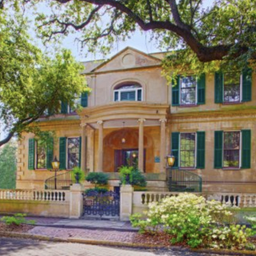
Built as a beautiful Regency style mansion in 1819, the Owens-Thomas House, along with its adjacent gardens, carriage house, and slave quarters, allows visitors to explore the complicated relationships between the most and least powerful people in the city of Savannah in the early 19th century.
Telfair Museums Owens-Thomas House & Slave Quarters Audio Tour
Claim This Podcastby Telfair Museums
5.0(1 reviews)
18 episodes
Updated Daily
Accepts GuestsHas SponsorsLocation 🇺🇸
Podcast Overview
Built as a beautiful Regency style mansion in 1819, the Owens-Thomas House, along with its adjacent gardens, carriage house, and slave quarters, allows visitors to explore the complicated relationships between the most and least powerful people in the city of Savannah in the early 19th century.
Language
🇺🇲
Publishing Since
6/10/2020
1 verified contact email on file for Telfair Museums Owens-Thomas House & Slave Quarters Audio Tour
Pitch yourself as a guest, propose sponsorships, or reach out directly to the host.
Recent Episodes
June 19, 2020
Listening Station 1: Welcome & Timeline
<p>Welcome to the Owens-Thomas House & Slave Quarters. As you make your way around the property today, you’ll explore the lives of the free and enslaved people who lived and worked here. Our story focuses primarily on the 1820s and 1830s, when Savannah’s population numbered around 7,000 people, including wealthy white residents, working-class white residents, and enslaved and free people of color.</p> <p>Shipping merchant Richard Richardson commissioned this house around 1816, and his family moved in upon its completion in 1819. The family only lived in the home for a few years before the combination of a major fire in the city, a yellow fever epidemic, and several deaths in his family forced Richardson to relocate to Louisiana and sell the property. For six years after the Richardsons’ departure, Mary Maxwell, a widowed entrepreneur, operated an upscale boarding house on the site. In 1825, the Marquis de Lafayette, the famous American Revolutionary War general, stayed in the boarding house during his visit to Savannah. In 1830, lawyer and landholder George Welshman Owens purchased this home for his family’s primary residence. He lived here with his wife, Sarah, and their six children. George and Sarah Owenses’ granddaughter Margaret Gray Thomas bequeathed the property to the Telfair Academy of Arts and Sciences, now known as Telfair Museums, upon her death in 1951. It opened to the public as a museum in 1954.</p> <p>As you can see on this timeline, census records indicate that often more enslaved people lived on this property than the numbers of individuals in the Richardson and Owens families. Today, tours at the Owens-Thomas House & Slave Quarters tell the story of the relationships between the wealthy white families that lived in this home and the individuals of African descent whom they enslaved. Most of this information is derived from letters and documents written by the Owenses and their peers, so it is inherently biased. Research on these families and the individuals they enslaved is ongoing.</p> <p>This Orientation Gallery is located in the original carriage house. It had space for horses and carriages on the first floor and a hayloft on the second. Your next listening station is in this room at the Wall of Names.</p>
June 19, 2020
Listening Station 2: Wall of Names
<p>The entire political and economic system of the South was structured around the institution of slavery in the early 19th century. Although five to 14 people were enslaved on this property at any given time, the creation of the wealth required to maintain the Richardsons’ and Owenses’ lifestyles was reliant on exploiting enslaved labor in a variety of industries.</p> <p>Richard Richardson made most of his fortune shipping goods in and out of the bustling port of Savannah. In addition to transporting goods like cotton that were generated through enslaved labor, Richardson also participated in the slave trade. During his time in Savannah, he shipped hundreds of people out of the port, and a large portion of them were children.</p> <p>George Welshman Owens worked as an attorney and served in several elected offices, including mayor and U.S. Congressman, but most of his income came from his vast agricultural holdings. Owens enslaved over 400 people on various properties around the state, producing rice, cotton, and other goods for market.</p> <p>The names of some of the people enslaved by the Richardson and Owens families are displayed on this wall to remind us that the economic exploitation of slavery reached far beyond this urban property.</p> <p>Please proceed out the doors and up the ramp to your right to visit the next stop on your tour.</p>
June 19, 2020
Listening Station 3: Slave Quarters
<p>The majority of the enslaved people who worked on this property lived in this building. Most of the enslaved people here were female, and many were children or teenagers, but it is not clear what relationships they had, if any. The Owenses may have pulled enslaved laborers from an agricultural labor setting because of their skills or lack of usefulness in the fields. Instead, these individuals worked in domestic labor duties like cooking, cleaning, washing laundry, caring for horses and livestock, driving carriages, and raising children. Life for enslaved people in urban settings had some key differences from enslaved people’s experiences on rural sites. While they might receive better food, clothing, and shelter here, they also were kept under close watch by their enslavers, white neighbors, constables, and others. Enslaved people at urban locations were more likely to be separated from relatives and friends who lived at rural sites. Their proximity to their enslavers also made them more susceptible to violence and sexual assault.</p> <p>You can view the second floor of the slave quarters via the staircase. Please proceed up the stairs one person at a time.</p> <p>Architectural evidence suggests that wood partitions divided each floor in this building into two small rooms and a large room near the fireplace. Originally, stairs on the left side of the fireplace led to the second floor, with a small landing and hallway to reach the other rooms. It is not apparent if these divisions were for privacy and sleeping, or for other purposes. Some individuals, like the nursemaid and cook, probably slept closer to their workspaces in the main house. The beds on view here are examples of sleeping arrangements that former enslaved individuals described to interviewers during Works Progress Administration fieldwork in the 1930s.</p> <p>Once you have finished here, you will find the next listening station in the garden. Please be mindful of other visitors as you descend the stairs and exit this building.</p>
18 total episodes available
Deep-dive analytics for Telfair Museums Owens-Thomas House & Slave Quarters Audio Tour
Frequently asked questions
Have a different question and can't find the answer you're looking for? Reach out to our support team by sending us an email and we'll get back to you as soon as we can.
- What is Telfair Museums Owens-Thomas House & Slave Quarters Audio Tour?
- How often does this podcast release new episodes?
This podcast updates daily.
- Where can I listen to this podcast?
This podcast is available on 4 platforms including Apple Podcasts, Spotify, and more. You can also use the RSS feed directly.
- Does this podcast accept guests?
No, this podcast does not typically feature guests.
Legal Disclaimer
Pod Engine is not affiliated with, endorsed by, or officially connected with any of the podcasts displayed on this platform. We operate independently as a podcast discovery and analytics service.
All podcast artwork, thumbnails, and content displayed on this page are the property of their respective owners and are protected by applicable copyright laws. This includes, but is not limited to, podcast cover art, episode artwork, show descriptions, episode titles, transcripts, audio snippets, and any other content originating from the podcast creators or their licensors.
We display this content under fair use principles and/or implied license for the purpose of podcast discovery, information, and commentary. We make no claim of ownership over any podcast content, artwork, or related materials shown on this platform. All trademarks, service marks, and trade names are the property of their respective owners.
While we strive to ensure all content usage is properly authorized, if you are a rights holder and believe your content is being used inappropriately or without proper authorization, please contact us immediately at hey@podengine.ai for prompt review and appropriate action, which may include content removal or proper attribution.
By accessing and using this platform, you acknowledge and agree to respect all applicable copyright laws and intellectual property rights of content owners. Any unauthorized reproduction, distribution, or commercial use of the content displayed on this platform is strictly prohibited.