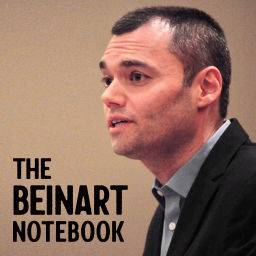
A conversation about American foreign policy, Palestinian freedom and the Jewish people. <br/><br/><a href="https://peterbeinart.substack.com?utm_medium=podcast">peterbeinart.substack.com</a>

The Beinart Notebook
Claim This Podcastby Peter Beinart
Podcast Authority
Beta
Podcast Overview
A conversation about American foreign policy, Palestinian freedom and the Jewish people. <br/><br/><a href="https://peterbeinart.substack.com?utm_medium=podcast">peterbeinart.substack.com</a>
Language
🇺🇲
Publishing Since
12/4/2023
Unlock The Full Podcast Authority Score Report
See how your podcast performs across key metrics
Podcast Authority
Beta
Recommendations available
Unlock the full report to see detailed tips
Recommendations available
Unlock the full report to see detailed tips
Unlock comprehensive insights including:
- • YouTube presence analysis
- • Social media reach metrics
- • RSS compliance scoring
- • Podcast 2.0 features
- • Technical standards
Detailed Analytics
- Complete breakdown of all 19 authority metrics
- Personalized recommendations for each metric
- Industry benchmarks and comparisons
- Technical RSS feed analysis and compliance scoring
Growth Strategies
- Step-by-step action plans for improvement
- Quick wins to boost your score immediately
- Pro tips from successful podcasters
See how your show performs across every key metric
High authority scores make your podcast more attractive to industry leaders and influencers who want to appear on credible shows.
Sponsors look for podcasts with proven authority and engagement. Your score demonstrates your podcast's value to potential partners.
Understanding your strengths and weaknesses helps you make data-driven decisions to expand your listener base effectively.
1 verified contact email on file for The Beinart Notebook
Pitch yourself as a guest, propose sponsorships, or reach out directly to the host.
Recent Episodes

June 24, 2026
June “Ask Me Anything” Tomorrow
This is a public episode. If you'd like to discuss this with other subscribers or get access to bonus episodes, visit <a href="https://peterbeinart.substack.com/subscribe?utm_medium=podcast&utm_campaign=CTA_2">peterbeinart.substack.com/subscribe</a><br/><br/><p>A monthly “Ask Me Anything” session is the one perk offered to Premium paid subscribers only. The June AMA will be tomorrow, Thursday, June 25, from 4-5pm Eastern time. </p><p>The May AMA video is here for Premium members. A sample question and answer is free for all. </p><p>Topics include:</p><p>* Israel bombing Lebanon</p><p>* Cenk Uygur</p><p>* The Brooklyn Food Co-Op Israel boycott</p><p>* The BDS movement </p><p>* Right of return negotiations in Oslo</p><p></p><p>June AMA Zoom link is below for Premium paid subscribers</p>

June 22, 2026
Israel’s Defenders Say Legal Equality Would Bring Repression and Bloodshed
<p>This week’s Zoom call will be at our regular time: Friday at 1 PM. Our guests will be <a target="_blank" href="https://law.yale.edu/asli-u-bali">Aslı Bâli</a>, professor international law at Yale, and <a target="_blank" href="https://quincyinst.org/author/trita-parsi/">Trita Parsi</a>, executive vice president of the Quincy Institute. When I imagine the people I’d want to advise the next Democratic president, Asli and Trita are near the top of my list. They care deeply about the United States but they’re not American exceptionalists, which helps them see past the mythology that prevents so many in Washington from understanding American foreign policy’s actual impact on the rest of the world. In a perfect illustration of the insanity of contemporary Washington, Trita— whose predictions about this criminal and catastrophic war have been proven entirely correct—is being <a target="_blank" href="https://www.thefp.com/p/iran-war-critic-deportation-trita-parsi">threatened with deportation</a>. We’ll talk about why this war happened, how it has changed the Middle East and world, and whether Washington will ever learn. Please join us.</p><p><strong>Ask Me Anything</strong></p><p>This Thursday, June 25, at 4 PM Eastern, we will hold an Ask Me Anything session, for PREMIUM SUBSCRIBERS ONLY.</p><p><strong>Things to Read</strong></p><p>(Maybe this should be obvious, but I link to articles and videos I find provocative and significant, not necessarily ones I entirely agree with.)</p><p>In Jewish Currents (<a target="_blank" href="https://secure.jewishcurrents.org/forms/subscribe">subscribe</a>!), Zachary Jablow <a target="_blank" href="https://jewishcurrents.org/the-war-to-bring-democracy-to-iran">writes</a> about why the US media still pretends that America’s Mideast wars are about democracy.</p><p>The Jewish candidate for New York City comptroller who <a target="_blank" href="https://forward.com/authors/drew-warshaw/">wants to divest</a> from Israel bonds.</p><p>On the Spiritually Incorrect podcast, I <a target="_blank" href="https://www.youtube.com/watch?v=ZXatAaM945U">talked</a> about American Christians, American Jews and the US debate over Israel.</p><p>See you on<strong> </strong>Thursday and<strong> </strong>Friday,</p><p>Peter</p><p>VIDEO TRANSCRIPT:</p><p>I’ve done a couple conversations recently with folks who argued that if there were equality under the law in Israel-Palestine—if Jews and Palestinians, were treated equally under the law wherever they lived, whether that was in one state or in two states where Jews and Palestinians both lived and were treated equally under the law, or in a confederation, you know, something in between—that liberal democracy would fail, that there would be some kind of dictatorship or authoritarianism, and also that there would be tremendous, tremendous violence, terrible bloodshed. This was really their primary rejoinder to my argument that, equality under the law would better serve the people who live in Israel-Palestine today than the system where you have now, where Jews enjoy legal rights, and Palestinians either hold no citizenship or a kind of second-class citizenship.</p><p>And I think it’s just worth pausing on this argument that equality under the law would produce a dictatorship, you know, authoritarianism, and also tremendous bloodshed. What I find odd about the argument is that it’s imagining terrible things in the future that could happen if a true liberal democracy failed, without acknowledging that those same terrible things that folks are warning about exist now.</p><p>It’s odd to say that an Israel-Palestine that treated everybody equally under the law might not succeed as a liberal democracy, without acknowledging that Israel is not a liberal democracy for Palestinians today. Most of the Palestinians who live under Israeli control, those in the West Bank and Gaza and East Jerusalem, don’t hold Israeli citizenship—a very small number in East Jerusalem, but generally, vast majority in the West Bank and Gaza and East Jerusalem live under the control of the State of Israel. It has life and death power over them, but they can’t be citizens of the state in which they live. They can’t vote for the government that has life and death decision-making power over them. In the West Bank, they live under military law, under a completely different legal system than their Jewish neighbors, right?</p><p>So, this is not by anyone’s definition, I think, could be considered a liberal democracy. This is the situation in which most Palestinians live. A minority of Palestinians, so-called Arab-Israelis, have a kind of second-class citizenship where they can vote, but the structure of the state is designed to prioritize, in many, many, many ways, prioritize the needs of Israeli Jews over them, right?</p><p>But when people say that liberal democracy might not succeed, they seem to be ignoring the fact that Israel is not a liberal democracy for Palestinians now. And then when they say, well, this situation, a situation in which people were treated equally under the law, might be tremendously violent, I wonder, are they paying attention to how violent the current situation is?</p><p>Israel has killed maybe 100,000 Palestinians, based on the best estimates we have in Gaza alone, right? That’s maybe roughly, you know, 5% of the population not even counting the injured. And the killing continues. Israel’s continuing to kill Palestinians despite this ceasefire, not to mention the many who are dying because there’s been no rebuilding of the medical infrastructure because there’s no sewage system, right? This is a recipe for continued death in Gaza on a pretty significant scale. And in the West Bank, you have attacks and killings of Palestinians virtually constantly, right?</p><p>So, when you say Israel-Palestine might succumb, might be a very, very violent place, you have to measure that against how extraordinarily violent it is for Palestinians today. And I think part of this move of saying Israel-Palestine might be very dangerous, might be very violent, is that it actually simply kind of ignores what the reality is for Palestinians today, and in a way, suggests that the only real question that we should be concerned about is, would it be more or less dangerous for Israeli Jews?</p><p>But even there Israel is a very dangerous place for Israeli Jews, too. Not nearly as dangerous as for Palestinians, but when you compare it to the life situations of Jews in virtually every other large Jewish community in the world, living as an Israeli Jew is much more dangerous. Twelve hundred Israeli Jews were killed on October 7th. Israelis have continued to die and be wounded in the wars in Israel’s assault on Gaza, in fighting against Hezbollah.</p><p>So, again, when one says this could be a dangerous place, one has to ask, compared to what Israel is currently an extraordinarily dangerous place for Palestinians. Really, probably being a Palestinian under Israeli control is one of the most dangerous situations you could possibly be in in the world, certainly in Gaza, and even in the West Bank, and even for Jews, despite their legal supremacy and their relative safety, this situation of domination and oppression, structural violence against Palestinians, produces this counter-violence, and also creates incentives for other groups, whether, like, Hezbollah or Iran, to come in on the Palestinian side, and also use violence against Israeli Jews. Which means that Israeli Jews are going into bomb shelters, right, all the time in a way that Jews in the United States, in France, in Australia, in Britain, in Canada, no matter what you think of the dangers of antisemitism, those places are simply not doing at all, right?</p><p>So, it just seems to me, if we’re going to have an honest conversation about the potential perils of trying to move towards equality under the law in Israel-Palestine, which is a very, very frightening prospect for many, many Jews—I think much less frightening prospect for Palestinians, but a frightening prospect for Israeli Jews—we have to compare that against the baseline of how authoritarian and how extraordinarily violent Israel-Palestine is today.</p><p>And unless you’re facing that squarely, it seems to me, you can’t have a productive conversation about the potential risks and the potential opportunities in trying to move from a situation that is now classified as apartheid by the world’s leading human rights organizations towards a legal reality in which people are treated equally under the law, regardless of whether they’re Palestinian or Jewish.</p> <br/><br/>This is a public episode. If you'd like to discuss this with other subscribers or get access to bonus episodes, visit <a href="https://peterbeinart.substack.com/subscribe?utm_medium=podcast&utm_campaign=CTA_2">peterbeinart.substack.com/subscribe</a>

June 14, 2026
Christian Anti-Zionism
Peter Beinart interviews Palestinian minister and theologian Munther Isaac about Christian anti-Zionism and Palestinian life in the West Bank.
254 total episodes available with 11 transcripts
Recent guests on The Beinart Notebook
Guests from recent episodes — sign up to see every guest that has ever appeared on this show.
Munther Isaac
Guest
Dan Shapiro
Guest
Daniel Shapiro
Guest
James Zogby
Guest
Francesca Albanese
Guest
Ben Lorber
Guest
Ariel Beery
Guest
Ruwa Romman
Guest
Issa Amro
Guest
Sari Bashi
Guest
Brad Lander
Guest
Ro Khanna
Guest
Similar Podcasts
Discover related shows you might enjoy

On the Nose
Jewish Currents

Makdisi Street
Makdisi Bros.

Haaretz Podcast
Haaretz

The Ezra Klein Show
New York Times Opinion

The New Yorker Radio Hour
WNYC Studios and The New Yorker

The Nation Podcasts
The Nation Magazine

The Political Scene | The New Yorker
The New Yorker

Intercepted
The Intercept

The Opinions
The New York Times Opinion

The Chris Hedges Report
Chris Hedges

Drop Site News
Drop Site News

Jacobin Radio
Jacobin

First Person
The New York Times

Democracy Now! Audio
Democracy Now!

Why Is This Happening? The Chris Hayes Podcast
MS NOW, Chris Hayes
Deep-dive analytics for The Beinart Notebook
Frequently asked questions
Have a different question and can't find the answer you're looking for? Reach out to our support team by sending us an email and we'll get back to you as soon as we can.
- What is The Beinart Notebook?
- How often does this podcast release new episodes?
This podcast updates daily.
- Where can I listen to this podcast?
This podcast is available on 7 platforms including Apple Podcasts, Spotify, and more. You can also use the RSS feed directly.
- Does this podcast accept guests?
Information about guest appearances is not available.
Legal Disclaimer
Pod Engine is not affiliated with, endorsed by, or officially connected with any of the podcasts displayed on this platform. We operate independently as a podcast discovery and analytics service.
All podcast artwork, thumbnails, and content displayed on this page are the property of their respective owners and are protected by applicable copyright laws. This includes, but is not limited to, podcast cover art, episode artwork, show descriptions, episode titles, transcripts, audio snippets, and any other content originating from the podcast creators or their licensors.
We display this content under fair use principles and/or implied license for the purpose of podcast discovery, information, and commentary. We make no claim of ownership over any podcast content, artwork, or related materials shown on this platform. All trademarks, service marks, and trade names are the property of their respective owners.
While we strive to ensure all content usage is properly authorized, if you are a rights holder and believe your content is being used inappropriately or without proper authorization, please contact us immediately at hey@podengine.ai for prompt review and appropriate action, which may include content removal or proper attribution.
By accessing and using this platform, you acknowledge and agree to respect all applicable copyright laws and intellectual property rights of content owners. Any unauthorized reproduction, distribution, or commercial use of the content displayed on this platform is strictly prohibited.