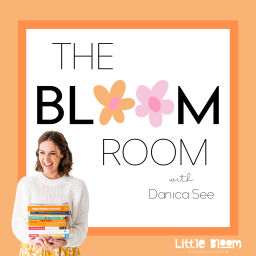
Where big feelings are welcome, tricky behaviour isn’t shamed, and early childhood educators finally feel seen.
Are you an educator, teacher, or school leader navigating the messy, beautiful world of guiding children’s behaviour, emotions, and sense of belonging? You’ve just found your people.
I’m Danica - early childhood mentor and consultant, and your go-to gal for honest, heart-led conversations about what actually works when supporting young children. Inside The Bloom Room, we go beyond sticker charts and surface-level strategies. Each week, I bring you fresh episodes packed with:
✨ Real, evidence-informed tools you can use tomorrow .
✨ Thoughtful chats with experts and educators doing the work.
✨ Practical guidance for supporting behaviour without shame.
✨ A whole lot of validation, nuance, and “OMG SAME” moments.
Whether you're a seasoned leader or fresh out of uni, this is your space to grow, reflect, and reimagine what’s possible for the children in your care - and for yourself.
New episodes drop every Tuesday. Come on in and let’s bloom 🌼
EP 70 | Are We Expecting Too Much From Children? My Take on Developmentally Aligned Expectations
Are we expecting too much from children, or have we become a little too attached to what they should be able to do?
From sitting through group time to navigating transitions and managing big feelings, there are a whole lot of expectations we place on children based on their age and what we think they should be capable of. In this episode, I'm unpacking why I prefer the term developmentally aligned expectations, how those little shoulds can get in the way of understanding behaviour, and how we can work out when to hold an expectation, scaffold towards it, or recognise that the expectation itself needs to shift.
You'll hear:
✨ Why developmentally aligned expectations encourage us to work with the child in front of us, rather than relying on what children of a particular age should be able to do
✨ How knowing a skill and being able to access it in the moment are two very different things
✨ How to decide when an expectation needs to hold, when a child needs more scaffolding, and when the expectation itself might need adjusting
✨ Why some of the expectations we place on entire groups of children might be contributing to the very behaviours we're finding difficult
We can hold high expectations for children while recognising what they're currently capable of. Sometimes that means offering more support, and sometimes it means questioning what we're asking of them in the first place.
Let's Connect!
Want to feel joy in your teaching again (and not like you're spending every moment putting out behaviour spot fires)? Join the waitlist for my course: The Behaviour Reset (https://littlebloomconsultancy.com.au/thebehaviourreset)
Want to know how to respond to baffling behaviours better? Download my free guide with 90 behaviour scripts (https://littlebloomconsultancy.com.au/behaviour-scripts)
Join me on Instagram: @littlebloom.consultancy (https://www.instagram.com/littlebloom.consultancy/)
5 Oct 2026
EP 69 | Is Saying “Good Job” Really That Bad? When Praise Helps (and When It Doesn't)
Come along to my online workshop on October 10: Leading Behaviour With Warm Authority. (https://littlebloomconsultancy.com.au/warmauthoritywebinar)
When did praising children become so dang controversial?!
There’s a lot of noise around praise, from warnings about “good job” destroying intrinsic motivation to advice that we should avoid praise altogether. In this episode, I’m unpacking what the research actually tells us about praise, when it can be genuinely useful, and how we can use it as meaningful feedback without turning it into approval children need to chase.
You’ll hear:
✨ Why the research doesn’t support a blanket “praise is bad” approach — and where some of the concerns around praise do have merit
✨ The difference between less effective praise like person, outcome and generic praise, and praise that draws attention to effort, process and progress
✨ Why sincerity, specificity and how praise is received by the child matter just as much as the words we choose
✨ How behaviour-specific praise can make behavioural learning visible, helping children notice the baby steps they’re making without turning praise into a tool for compliance
**Very (very) mild coarse language in this episode.
Praise doesn’t need to go in the bin, and neither does “good job.” When we use praise thoughtfully, it can give children useful information about their effort, choices and growing skills. Good job isn’t the problem; it just shouldn’t have to do all the heavy lifting.
Let's Connect!
Want to feel joy in your teaching again (and not like you're spending every moment putting out behaviour spot fires)? Join the waitlist for my course: The Behaviour Reset (https://littlebloomconsultancy.com.au/thebehaviourreset)
Want to know how to respond to baffling behaviours better? Download my free guide with 90 behaviour scripts (https://littlebloomconsultancy.com.au/behaviour-scripts)
Join me on Instagram: @littlebloom.consultancy (https://www.instagram.com/littlebloom.consultancy/)
28 Sept 2026
EP 68 | What If We Scaffolded Behaviour Like We Scaffold Learning?
Come along to my online workshop on October 10: Leading Behaviour With Warm Authority. (https://littlebloomconsultancy.com.au/warmauthoritywebinar)
What if we scaffolded children’s behaviour in the same way we already scaffold every other area of their learning?
As educators, we understand that knowing how to do something and being able to do it independently aren’t necessarily the same thing but, when it comes to behaviour, we can forget this pretty quickly. In this episode, I’m taking Vygotsky’s ideas around scaffolding and the Zone of Proximal Development and applying them to behaviour, so we can think differently about the support children might need to meet our expectations.
You’ll hear:
✨ How the Zone of Proximal Development can help us understand what children can do independently, with support, and what might currently sit outside their capacity
✨ Why scaffolding behaviour doesn’t automatically mean lowering our expectations
✨ How co-regulation, behavioural momentum, playfulness and boundaries can scaffold children towards the behaviour we’re asking for
✨ Why the same expectation can require completely different levels of support for different children (and even for the same child on different days)
Behaviour deserves the same developmental lens we already bring to learning, and sometimes the most useful thing we can do is stop repeating the expectation and ask what support might help this child actually get there.
Let's Connect!
Want to feel joy in your teaching again (and not like you're spending every moment putting out behaviour spot fires)? Join the waitlist for my course: The Behaviour Reset (https://littlebloomconsultancy.com.au/thebehaviourreset)
Want to know how to respond to baffling behaviours better? Download my free guide with 90 behaviour scripts (https://littlebloomconsultancy.com.au/behaviour-scripts)
Join me on Instagram: @littlebloom.consultancy (https://www.instagram.com/littlebloom.consultancy/)
Reach and audience
Public platform figures. Ratings count people who left a rating, not total listeners.
Pod Engine is an independent podcast discovery and analytics service and is not affiliated with or endorsed by this podcast. Artwork and show content belong to their owners. Full legal notice.
Explore this show Podcast research with Pod Engine