


What if doing less made you a better fundraiser? Welcome to The Focused Fundraiser — the podcast for nonprofit leaders who are tired of the chaos and ready to prioritize what actually drives impact. Hosted by Rob Burke, each episode features honest conversations with fundraisers in the trenches who are cutting through the noise, saying no to the never-ending to-do list, and focusing on what matters most. We cover: ✔️ Fundraising strategy that doesn’t burn you out ✔️ High-touch stewardship that builds real relationships ✔️ Personal productivity and leadership in nonprofit life ✔️ Systems that help you work smarter, not harder If you’re ready to drop the “do more” mindset and lead with clarity, focus, and purpose — you’re in the right place. Live every Tuesday at 11am CT.
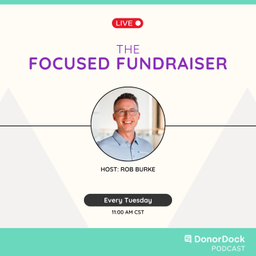
The Focused Fundraiser
Claim This Podcastby Donor Dock
Podcast Overview
What if doing less made you a better fundraiser? Welcome to The Focused Fundraiser — the podcast for nonprofit leaders who are tired of the chaos and ready to prioritize what actually drives impact. Hosted by Rob Burke, each episode features honest conversations with fundraisers in the trenches who are cutting through the noise, saying no to the never-ending to-do list, and focusing on what matters most. We cover: ✔️ Fundraising strategy that doesn’t burn you out ✔️ High-touch stewardship that builds real relationships ✔️ Personal productivity and leadership in nonprofit life ✔️ Systems that help you work smarter, not harder If you’re ready to drop the “do more” mindset and lead with clarity, focus, and purpose — you’re in the right place. Live every Tuesday at 11am CT.
Language
🇺🇲
Publishing Since
7/9/2025
2 verified contact emails on file for The Focused Fundraiser
Pitch yourself as a guest, propose sponsorships, or reach out directly to the host.
Recent Episodes
June 23, 2026
Why Development Directors Quit in 16 Months | Eddie Allen
<p>Most nonprofits run the same play: hire a development director, watch them work themselves to the bone, then watch them walk out the door 16 months later. Eddie Allen says that cycle isn't a people problem. It's a systems problem.</p><p>In this episode, Rob Burke sits down with Eddie Allen, founder of Pacific Northwest Fundraising and author of the forthcoming book The Unicorn Development Director, to unpack why fundraising breaks when an organization builds it around one impossible job. Eddie explains the difference between fundraising, development, and philanthropy, why the math behind turnover is far worse than the often-cited $130K, and how "infrastructure fundraising" gives the person in the seat a fighting chance.</p><p>If you have ever felt like your role wasn't actually possible, this conversation reframes the problem and points to what to do instead.</p><p>Chapters</p><p>00:00 - Doing More Isn't the Goal</p><p>00:52 - Meet Eddie Allen and the Fractional Model</p><p>03:04 - The Unicorn Development Director Problem</p><p>05:30 - The Real Cost of Turnover</p><p>08:18 - Raising Money Now Without Burning Out</p><p>11:39 - Systems Problem or Money Problem?</p><p>15:35 - Why Retention Beats Acquisition</p><p>17:23 - Where to Spend 10 Focused Hours a Week</p><p>20:05 - The Tactical Takeaway</p><p>21:01 - The Book and How to Reach Eddie</p><p>Key Takeaways</p><p>Communications, marketing, database management, grant writing, and major gifts are separate jobs at large nonprofits. Smaller orgs pile them all onto one development director and wonder why the role fails.</p><p>"No database, no donor development." Almost every project starts by building the data clearinghouse first, because data lives in someone's head or scattered across spreadsheets.</p><p>Development takes time. Major gifts can take 24 to 48 months, yet most hires are told to raise money right now. That timing mismatch is built to fail.</p><p>The true cost of turnover is roughly double the $130K salary-and-benefits figure once you count mission interruption, brand damage, donor distrust, and staff stress.</p><p>Retention loses to acquisition because of bandwidth, not strategy. When one person is doing nine jobs, stewardship is the first thing to get dropped.</p><p>Block standing time on your calendar for donor conversations (Eddie protects a weekly Wednesday lunch slot) and spend 80% of your time on the 20% that moves the organization forward.</p><p>About the Guest</p><p>Eddie Allen is the founder, CEO, and self-described "lead guide" of Pacific Northwest Fundraising, a fractional development team that gives nonprofits C-suite-level fundraising experience without the cost of building a full team in-house. His book, The Unicorn Development Director, comes out in July.</p><p>Links</p><p>Pacific Northwest Fundraising: <a rel="noopener noreferrer nofollow" href="https://pacificnorthwestfundraising.us" target="_blank">https://pacificnorthwestfundraising.us</a></p><p>Email Eddie: <a rel="noopener noreferrer nofollow" href="mailto:eddie@pacificnorthwestfundraising.us" target="_blank">eddie@pacificnorthwestfundraising.us</a></p><p>Learn how DonorDock helps you build relationships and retention through smart stewardship: <a rel="noopener noreferrer nofollow" href="https://donordock.com" target="_blank">https://donordock.com</a></p>
June 16, 2026
Galas Are Getting Played Out. Try This Instead | Ryan Yuhas
<p>Ryan Yuhas has fundraised for food, faith, animals, and now furniture. He's seen what carries across every mission type and what only worked in one place. In this episode, he digs into why galas and golf outings are losing steam, the events grassroots nonprofits are using to bring in entirely new donor bases, and the simple mechanic Open Door Exchange uses to turn in-kind furniture donors into recurring cash donors.</p><p>We also get into the human side of stewardship, including why donors leave when fundraisers leave, what a great executive director actually does for your job, and the story of a veteran with PTSD and five kids that explains why furniture is more than furniture.</p><p>If you run events, work with in-kind donations, or have ever felt like you're carrying your fundraising shop alone, this one is for you.</p><p>Chapters</p><p>00:00 - Welcome and intro to Ryan Yuhas<br />00:56 - Ryan's path: food, faith, animals, furniture<br />02:10 - Five rescue dogs and the animal welfare outlier<br />02:31 - Galas are getting played out: trivia night, music bingo<br />03:46 - The Glass Pumpkin Patch annual event<br />05:05 - What's on the scorecard besides net revenue<br />06:09 - Scaling grassroots into a larger budget<br />06:23 - Spinning out as their own 501(c)(3)<br />07:03 - What great EDs do and the red flags to avoid<br />08:44 - Donors invest in the mission AND the person<br />10:14 - Turning in-kind donors into financial donors<br />13:05 - Telling impact stories that go beyond the dollar amount<br />14:00 - The veteran's story and "the foundation of the home"<br />15:21 - Story plus statistics: how to communicate impact<br />16:43 - Tactical takeaway: ask for help, you're not alone<br />17:55 - How to connect with Ryan and Open Door Exchange</p><p>Key takeaways</p><ul><li>Galas and golf outings are flat. Trivia nights, music bingo, and signature partnerships bring new donors.</li><li>Net revenue is not the only scorecard. Attendance and new audience reach matter just as much.</li><li>Free in-kind pickup is your best cash cultivation tool. Donors who would've paid $150 to dump it now want to support you instead.</li><li>When a fundraiser leaves, donors leave too. Rebuild the relationship from scratch, in person, with a warehouse tour.</li><li>The story plus the statistic always beats either one alone.</li><li>A two-person shop survives by asking for help. Burnout is the real fundraising risk.</li></ul><p>Links</p><ul><li>Open Door Exchange: <a rel="noopener noreferrer nofollow" href="https://opendoorexchange.org" target="_blank">https://opendoorexchange.org</a></li><li>Ryan Yuhas: <a rel="noopener noreferrer nofollow" href="mailto:ryan@opendoorexchange.org" target="_blank">ryan@opendoorexchange.org</a></li><li>DonorDock: <a rel="noopener noreferrer nofollow" href="https://www.donordock.com" target="_blank">https://www.donordock.com</a></li></ul>
June 9, 2026
Be a Secret Shopper to Your Own Nonprofit | Farra Trompeter, Big Duck
<p>What if your donor retention problem is not a copy problem, but a brand problem?</p><p>Farra Trompeter has spent 30+ years in the nonprofit sector and 19 of those at Big Duck, helping organizations build brands that move donors. In this episode, she breaks down why brand is more than logos and colors, how brand stickiness inside your team determines whether donors recognize you, and why most rebrands fail to lift fundraising results.</p><p>We dig into the donor retention crisis, the difference between major-donor stewardship and the watered-down version everyone else gets, and the sub-brand strategy Big Duck used with the International Rescue Committee to build the Rescue Collective. Farra also explains why Q4 planning starts in Q3, and ends the episode with a tactical move every fundraiser can do this week: become a secret shopper to your own giving.</p><p>If you want donors who stay, this is the conversation.</p><p>Chapters</p><p>00:00 - Cold open: Be a secret shopper to your own giving</p><p>00:38 - Welcome and intro to Farra Trompeter</p><p>01:48 - Farra's path: from telefundraiser to Big Duck Co-Director</p><p>03:30 - What brand actually means for a development director</p><p>05:33 - Brand, culture, and where they overlap</p><p>06:22 - Why rebrands fail to lift fundraising results</p><p>09:04 - AI, generative tools, and brand consistency</p><p>10:43 - Donor retention is a stewardship problem, not a copy problem</p><p>12:54 - Monthly giving and sub-brands (Rescue Collective)</p><p>15:26 - Designing Q4: start in Q3 with a warm-up</p><p>17:25 - Prioritizing stewardship year-round</p><p>18:31 - Segmentation and treating mid-level donors like they matter</p><p>20:31 - Tactical takeaway: secret shop your own giving</p><p>21:46 - How to connect with Farra and Big Duck</p><p>Key takeaways</p><p>- Brand is every email, ask, event, and acknowledgement, not just your logo.</p><p>- Internal "brand stickiness" comes before external recognition.</p><p>- Donor retention is built between asks, not inside them.</p><p>- Q4 results are decided in Q3 with a non-fundraising warm-up.</p><p>- The fastest way to find your stewardship gaps: give to your own organization from a personal account and watch what happens.</p><p>Links</p><p>- Smart Communications Podcast: <a rel="noopener noreferrer nofollow" href="https://bigduck.com/insights/?type=podcasts" target="_blank">https://bigduck.com/insights/?type=podcasts</a></p><p>- Farra Trompeter on LinkedIn: <a rel="noopener noreferrer nofollow" href="https://www.linkedin.com/in/farra" target="_blank">https://www.linkedin.com/in/farra</a></p><p>- DonorDock: <a rel="noopener noreferrer nofollow" href="https://www.donordock.com" target="_blank">https://www.donordock.com</a></p>
50 total episodes available
Similar Podcasts
Discover related shows you might enjoy
Deep-dive analytics for The Focused Fundraiser
Frequently asked questions
Have a different question and can't find the answer you're looking for? Reach out to our support team by sending us an email and we'll get back to you as soon as we can.
- What is The Focused Fundraiser?
- How often does this podcast release new episodes?
This podcast updates daily.
- Where can I listen to this podcast?
This podcast is available on 4 platforms including Apple Podcasts, Spotify, and more. You can also use the RSS feed directly.
- Does this podcast accept guests?
Yes, this podcast regularly features guests.
Legal Disclaimer
Pod Engine is not affiliated with, endorsed by, or officially connected with any of the podcasts displayed on this platform. We operate independently as a podcast discovery and analytics service.
All podcast artwork, thumbnails, and content displayed on this page are the property of their respective owners and are protected by applicable copyright laws. This includes, but is not limited to, podcast cover art, episode artwork, show descriptions, episode titles, transcripts, audio snippets, and any other content originating from the podcast creators or their licensors.
We display this content under fair use principles and/or implied license for the purpose of podcast discovery, information, and commentary. We make no claim of ownership over any podcast content, artwork, or related materials shown on this platform. All trademarks, service marks, and trade names are the property of their respective owners.
While we strive to ensure all content usage is properly authorized, if you are a rights holder and believe your content is being used inappropriately or without proper authorization, please contact us immediately at hey@podengine.ai for prompt review and appropriate action, which may include content removal or proper attribution.
By accessing and using this platform, you acknowledge and agree to respect all applicable copyright laws and intellectual property rights of content owners. Any unauthorized reproduction, distribution, or commercial use of the content displayed on this platform is strictly prohibited.