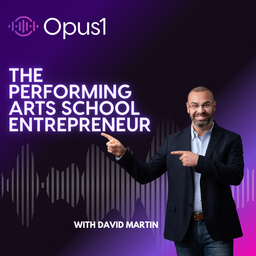
Podcast thumbnail for The Performing Arts School Entrepreneur

The Performing Arts School Entrepreneur

Claim This Podcast

by David Martin

5.0(4 reviews)
22 episodes
Updated Daily
Accepts GuestsHas SponsorsLocation 🇺🇸

Podcast Overview

Hosted by David Martin, the Performing Arts School Entrepreneur podcast brings you inside the journeys of music and performing arts school founders who turned passion into thriving businesses. Each episode features real stories from leaders who've scaled their schools, built strong cultures, and found sustainable ways to grow—without losing sight of their mission to inspire the next generation. From lessons in leadership and hiring, to parent engagement, marketing, and the systems that keep schools running smoothly, you'll hear practical strategies and fresh inspiration designed for music and performing arts school owners. Brought to you by Opus1, the all-in-one platform built to help music and performing arts schools simplify operations, strengthen culture, and scale with confidence.

Language

🇺🇲

Publishing Since

10/13/2025

1 verified contact email on file for The Performing Arts School Entrepreneur

Pitch yourself as a guest, propose sponsorships, or reach out directly to the host.

Recent Episodes

Episode thumbnail for The Music School Flip: Tong Liu on Buying, Growing, and Selling Music Schools

June 4, 2026

The Music School Flip: Tong Liu on Buying, Growing, and Selling Music Schools

<p class= "font-claude-response-body break-words whitespace-normal leading-[1.7]"> Tong Liu's path into music school ownership was anything but conventional. Raised in China, Tong spent years homeschooled and practicing piano 8 hours a day before moving to the U.S. at 17. She started teaching lessons out of her townhouse to fund graduate school, got reported to the city by a neighbor, and eventually rented her first commercial space. What followed was a series of deliberate decisions to build, grow, and sell music schools in a way few owners ever attempt: buying undervalued schools, systematizing operations quickly, and scaling enrollment before moving on.</p> <p class= "font-claude-response-body break-words whitespace-normal leading-[1.7]"> In this episode, host David Martin sits down with Tong to unpack her unique model of buying, growing, and selling performing arts schools. From negotiating a $180,000 asking price down to $32,000 to running a school 12 hours away, Tong shares hard-won lessons on marketing, teacher hiring, SOPs, and the financial metrics that actually matter. Her perspective is refreshingly direct, and her story is one of the most distinctive entrepreneurial journeys the podcast has featured.</p>

Episode thumbnail for Roll-Up Revolution: Jeff Homer on Acquiring and Scaling Music Schools | Ep. 21

May 20, 2026

Roll-Up Revolution: Jeff Homer on Acquiring and Scaling Music Schools | Ep. 21

<p>Jeff Homer didn't grow up in music education. He came from 10 years in finance, investing in small and mid-size businesses, before a job in Denver led him to a music school owner looking for a business partner. That chance encounter sparked something he couldn't let go. Today, Jeff is the founder of Ensemble Performing Arts, a national roll-up of music and dance schools with an audacious goal: 250 locations by 2030.</p> <p>In this conversation, host David Martin sits down with Jeff to unpack the business model behind Ensemble's growth, what Jeff looks for when acquiring schools, and why an outsider's perspective turned out to be one of his biggest assets. From valuation methodology and acquisition process to teacher retention, marketing strategy, and the power of follow-up, Jeff brings a clear-eyed, data-driven lens to an industry he has come to deeply admire.</p> <p>In this episode, you'll learn:</p> <ul> <li class= "font-claude-response-body whitespace-normal break-words pl-2"> <strong>An outsider's advantage.</strong> Jeff came from finance, not music, and turned that into a strength. While music school owners excel at teaching and student experience, many struggle with HR, marketing, and financial operations. Jeff built Ensemble around centralizing exactly those back-office functions so schools can focus on what they do best.</li> <li class= "font-claude-response-body whitespace-normal break-words pl-2"> <strong>What Ensemble looks for in an acquisition.</strong> Jeff uses three primary screening criteria: geographic fit (major metro markets where they can eventually own multiple schools), size (typically $750K or more in revenue as evidence of product-market fit), and culture (schools built around joy and individualized learning, not rigid conservatory models).</li> <li class= "font-claude-response-body whitespace-normal break-words pl-2"> <strong>The onboarding moment is the most vulnerable.</strong> Jeff describes the post-acquisition onboarding as the highest-risk period. His approach: keep messaging simple, emphasize continuity, validate what the team has built, and hint at career growth opportunities rather than leading with change. Increasingly, he sends regional managers who joined via acquisition to deliver that message firsthand.</li> <li class= "font-claude-response-body whitespace-normal break-words pl-2"> <strong>Growth beats cost-cutting every time.</strong> Ensemble's primary lever for improving school margins is enrollment growth, not expense reduction. Because fixed costs are already covered, adding a single student can carry a 50% incremental margin. Going from 200 to 250 students can, in some cases, double profitability.</li> <li class= "font-claude-response-body whitespace-normal break-words pl-2"> <strong>How music schools are valued.</strong> Jeff walks through the concept of seller's discretionary earnings (SDE): stripping out personal expenses, estimating the cost to replace the owner's time, and then applying a market-rate multiplier. For most schools, that multiplier lands in the 3 to 3.5x range, with larger schools trending toward the higher end.</li> <li class= "font-claude-response-body whitespace-normal break-words pl-2"> <strong>Teacher retention drives student retention.</strong> Jeff is clear that retaining great teachers is the real engine of long-term student retention. Ensemble monitors teacher pay as a percentage of revenue, invests in career progression, and treats compensation growth as a strategic priority rather than an afterthought.</li> <li class= "font-claude-response-body whitespace-normal break-words pl-2"> <strong>Follow-up is the biggest unlock most schools are leaving on the table.</strong> Jeff describes the gap between the average school's approach to a new lead (a single thoughtful email, then forgotten) and a system-driven approach with speed, sequence, and multi-channel outreach. In his experience, systematizing follow-up is the most accessible and impactful improvement any school can make.</li> </ul>

Episode thumbnail for The Rock School Secret: John Kozicki on How Community Drives Music School Retention (Ep. 20)

May 5, 2026

The Rock School Secret: John Kozicki on How Community Drives Music School Retention (Ep. 20)

<p>John Kozicki has one of the more unconventional paths in the music school world: corporate marketing background, punk rock touring years, two music schools built and sold, and now co-host of the Rock School Proprietor podcast. In this episode, John joins David Martin for a wide-ranging conversation about what it really means to build a music school around community and purpose. John shares his philosophy on what he calls "the rock school secret" (why students in band programs stay longer and engage more deeply than those in private lessons alone) and makes the case that the instrument is really just the conduit for something much bigger. He also gets candid about brand identity, the importance of knowing who your school is actually for, and why copying another studio's marketing is a fast track to churn.</p> <p>In this episode, you'll hear:</p> <ul class= "[li_&]:mb-0 [li_&]:mt-1 [li_&]:gap-1 [&:not(:last-child)_ul]:pb-1 [&:not(:last-child)_ol]:pb-1 list-disc flex flex-col gap-1 pl-8 mb-3"> <li class="whitespace-normal break-words pl-2">How a bad experience with piano lessons as a kid shaped John's entire approach to running Michigan Rock School today.</li> <li class="whitespace-normal break-words pl-2">The origin story of John's first music school: quitting a corporate PR job without another one lined up, stumbling into guitar teaching to pay for a wedding, and gradually realizing this might actually be the thing.</li> <li class="whitespace-normal break-words pl-2">The "rock school secret": students participating in band programs have significantly higher retention than those in private lessons alone. John explains why community and performance create a deeper connection to music, and why that keeps students enrolled longer.</li> <li class="whitespace-normal break-words pl-2">Why John believes the instrument is just the conduit. His firm belief: everyone comes to music for a reason that runs deeper than wanting to learn guitar or piano, and great instructors and studio owners tap into that.</li> <li class="whitespace-normal break-words pl-2">How Michigan Rock School's marketing leads with community, socialization, and belonging. John explains why the benefits that keep kids in team sports are exactly what a well-run music program can offer.</li> <li class="whitespace-normal break-words pl-2">John's hiring philosophy: he looks for instructors he'd want to be in a band with. The reasoning goes deeper than culture fit, it's about whether that person can build the kind of trust with students that feels different from every other adult in their lives.</li> <li class="whitespace-normal break-words pl-2">His candid advice on brand identity for music school owners who don't have a marketing background: identify the two or three current families you always have the best conversations with, figure out what you talk about, and build your marketing from there.</li> <li class="whitespace-normal break-words pl-2">Why copying what a competitor is doing will attract the wrong students and drive up churn. Your marketing has to match who you actually are.</li> <li class="whitespace-normal break-words pl-2">The evolution (not transition) from teacher to manager, and how COVID was the unexpected moment that forced John to fully embrace his role as the person steering the ship.</li> <li class="whitespace-normal break-words pl-2">What's next: John's plans to make Michigan Rock School's rock band curriculum available to other schools, an ongoing songwriting book project, and continued work on the Rock School Proprietor podcast with co-host Mandy York.</li> </ul> <p>Learn more about how Opus1 helps performing arts schools build community and retention: <a href="http://opus1.io/" target= "_blank" rel="noopener">opus1.io</a><br /> <br /> Explore all episodes of the Performing Arts School Entrepreneur Podcast for more stories, strategies, and insights from leaders across the industry.</p>

22 total episodes available

Deep-dive analytics for The Performing Arts School Entrepreneur

Frequently asked questions

Have a different question and can't find the answer you're looking for? Reach out to our support team by sending us an email and we'll get back to you as soon as we can.

What is The Performing Arts School Entrepreneur?

Hosted by David Martin, the Performing Arts School Entrepreneur podcast brings you inside the journeys of music and performing arts school founders who turned passion into thriving businesses. Each episode features real stories from leaders who've scaled their schools, built strong cultures, and found sustainable ways to grow—without losing sight of their mission to inspire the next generation.

From lessons in leadership and hiring, to parent engagement, marketing, and the systems that keep schools running smoothly, you'll hear practical strategies and fresh inspiration designed for music and performing arts school owners.

Brought to you by Opus1, the all-in-one platform built to help music and performing arts schools simplify operations, strengthen culture, and scale with confidence.

How often does this podcast release new episodes?

This podcast updates daily.

Where can I listen to this podcast?

This podcast is available on 4 platforms including Apple Podcasts, Spotify, and more. You can also use the RSS feed directly.

Does this podcast accept guests?

Yes, this podcast regularly features guests.

Legal Disclaimer

Pod Engine is not affiliated with, endorsed by, or officially connected with any of the podcasts displayed on this platform. We operate independently as a podcast discovery and analytics service.

All podcast artwork, thumbnails, and content displayed on this page are the property of their respective owners and are protected by applicable copyright laws. This includes, but is not limited to, podcast cover art, episode artwork, show descriptions, episode titles, transcripts, audio snippets, and any other content originating from the podcast creators or their licensors.

We display this content under fair use principles and/or implied license for the purpose of podcast discovery, information, and commentary. We make no claim of ownership over any podcast content, artwork, or related materials shown on this platform. All trademarks, service marks, and trade names are the property of their respective owners.

While we strive to ensure all content usage is properly authorized, if you are a rights holder and believe your content is being used inappropriately or without proper authorization, please contact us immediately at hey@podengine.ai for prompt review and appropriate action, which may include content removal or proper attribution.

By accessing and using this platform, you acknowledge and agree to respect all applicable copyright laws and intellectual property rights of content owners. Any unauthorized reproduction, distribution, or commercial use of the content displayed on this platform is strictly prohibited.