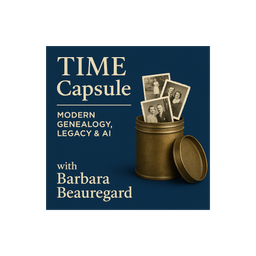
TIME Capsule: Modern Genealogy, Legacy & AI
Claim This Podcastby Barbara Beauregard
Podcast Overview
<p><strong>TIME Capsule</strong> is a podcast for anyone who wants to preserve their family history with confidence, clarity, and modern tools. Each episode offers practical ways to:</p><ul><li><strong>Capture memories and stories</strong> while you still can</li><li><strong>Organize photos, documents, and research</strong> without feeling overwhelmed</li><li><strong>Protect your digital files</strong> so your hard work never disappears</li><li><strong>Use new tools—including AI—thoughtfully and ethically</strong></li><li><strong>Turn your research into a lasting legacy</strong> your family can access, understand, and appreciate</li></ul><p>Hosted by <strong>Barbara Beauregard</strong>, genealogist, educator, and creator of the TIME Capsule Method™, this show blends traditional genealogy with modern strategies to help you build a legacy that lasts.</p>
Language
🇺🇲
Publishing Since
12/1/2025
1 verified contact email on file for TIME Capsule: Modern Genealogy, Legacy & AI
Pitch yourself as a guest, propose sponsorships, or reach out directly to the host.
Recent Episodes

August 10, 2026
How to Interview Relatives Before It's Too Late
<p>How to Interview Relatives Before It's Too Late</p><p>Every family has stories that will never be found in a census record, birth certificate, or DNA test. They live in the memories of parents, grandparents, aunts, uncles, and older relatives—and once those memories are gone, they are gone forever.</p><p>In this episode of <strong>TIME Capsule: Modern Genealogy, Legacy & AI</strong>, Barbara Beauregard shares practical tips for interviewing relatives in a way that captures not only names and dates, but the stories, traditions, emotions, and everyday experiences that bring your family history to life.</p><p>You'll learn how to ask meaningful questions that encourage conversation, why ordinary memories are often the most valuable, and how simple tools like your smartphone and artificial intelligence can help preserve these priceless family stories for future generations.</p><p>Whether you're just beginning your genealogy journey or have been researching for years, this episode will inspire you to start recording the memories that no archive can ever replace.</p><p>In This Episode You'll Learn:</p><ul><li>Why interviewing relatives is one of the most important genealogy projects you'll ever undertake.</li><li>How to ask open-ended questions that encourage storytelling.</li><li>Tips for making family interviews comfortable and enjoyable.</li><li>Why everyday memories are often more valuable than major life events.</li><li>How photographs, heirlooms, and keepsakes can unlock forgotten stories.</li><li>Common interviewing mistakes to avoid.</li><li>How AI can help transcribe, organize, and preserve family interviews.</li><li>Simple ways to begin recording your family's history today.</li></ul><p>Every conversation you preserve becomes a priceless gift for future generations.</p><p>For more genealogy resources, educational articles, online courses, and podcast episodes, visit <a target="_blank" rel="noopener noreferrer nofollow" href="http://AncestrySeeking.com"><strong>AncestrySeeking.com</strong></a>.</p>

August 3, 2026
Two Sisters, One Hidden Truth - An Adoption Mystery Solved Through DNA
<p><strong>Case Study Series #1: One Branch, Two Sisters, One Hidden Truth</strong></p><p>How DNA, Patience, and Ethical Genealogy Solved an Adoption Mystery</p><p><strong>Episode Summary</strong></p><p>What happens when DNA points you to the right family—but not the right person?</p><p>In this first episode of the <strong>Case Study Series</strong>, Barbara shares a remarkable real-life adoption case that demonstrates how DNA and traditional genealogy work hand in hand. After a man adopted as an infant discovers the identity of his biological father through a close DNA match, the search for his biological mother proves far more challenging.</p><p>DNA narrows the search to one family branch, but several women fit the timeline. Through careful research, relationship analysis, and nearly a year of patience, the investigation eventually narrows to two sisters. Then, an unexpected DNA match changes everything.</p><p>This episode isn't just about solving a mystery—it's about understanding the importance of evidence, patience, ethical decision-making, and treating every family story with compassion.</p><p>All names and identifying details have been changed to protect the privacy of those involved.</p><p><strong>In This Episode You'll Learn</strong></p><ul><li>Why DNA testing doesn't always provide immediate answers.</li><li>How close DNA matches can quickly identify biological family members.</li><li>Why traditional genealogy is still essential alongside DNA evidence.</li><li>How to build and evaluate a candidate list.</li><li>The importance of eliminating possibilities through documented evidence.</li><li>Why patience is often one of the most valuable research tools.</li><li>How one unexpected DNA match provided the final answer.</li><li>Ethical considerations when uncovering long-held family secrets.</li><li>Why genealogy is about people—not just records.</li></ul><p><strong>Key Takeaways</strong></p><p>✔ DNA opens doors—but traditional genealogy helps you walk through them.</p><p>✔ A family branch is not the same as identifying an individual.</p><p>✔ Never rely on a single piece of evidence. Build a proof argument using multiple independent sources.</p><p>✔ Sometimes the best research strategy is simply waiting for new evidence to appear.</p><p>✔ Every DNA match represents a real person with real emotions and family relationships.</p><p>✔ Genealogists have a responsibility to balance truth with compassion.</p><ul><li><strong>Question for Listeners</strong>Have you ever solved a family mystery using DNA—or are you currently working through one?What has been your biggest challenge: finding the right records, interpreting DNA matches, or simply waiting for the next clue?I'd love to hear your story.<strong>Coming Up Next</strong><strong>Episode 29</strong><strong>How to Interview Relatives Before It's Too Late</strong>Discover practical strategies for preparing meaningful family interviews, asking questions that spark memories, using AI transcription tools, and preserving stories before they're lost forever.<strong>Connect with Barbara Beauregard</strong>🌐 <strong>Website:</strong> <a target="_blank" rel="noopener noreferrer nofollow" href="https://ancestryseeking.com">https://ancestryseeking.com</a>🎙 <strong>Podcast:</strong> TIME Capsule: Modern Genealogy, Legacy & AI📬 Subscribe to Barbara's free genealogy newsletter for research tips, podcast updates, and educational resources.</li></ul>

July 27, 2026
Shared DNA Matches Explained Simply
<p>Shared Matches Explained Simply</p><p>Understanding One of the Most Powerful Tools in DNA Research</p><p>If you've ever looked at your DNA match list and wondered how all those people are connected, you're not alone.</p><p>One of the most valuable tools available to genealogists today is the <strong>Shared Matches</strong> feature. Whether you're researching your family tree, solving a DNA mystery, identifying unknown ancestors, or working on an adoptee case, shared matches can provide important clues about how individuals are related.</p><p>But for many researchers, shared matches can feel confusing and overwhelming.</p><p>What exactly is a shared match?</p><p>How do shared matches help identify family lines?</p><p>And how can you use them to make sense of your DNA results?</p><p>In this episode, Barbara Beauregard breaks down shared matches in simple, easy-to-understand language. You'll learn what shared matches are, why they matter, and how they can help you organize DNA evidence and uncover family connections with greater confidence.</p><p>Whether you're new to DNA testing or have been working with DNA results for years, understanding shared matches is an essential skill for every family historian.</p><p>In This Episode You'll Learn:</p><p>✔ What shared matches are and how they work</p><p>✔ Why shared matches are one of the most valuable DNA research tools</p><p>✔ How shared matches can help identify family groups</p><p>✔ The difference between direct matches and shared matches</p><p>✔ How to use shared matches to organize DNA evidence</p><p>✔ Common mistakes researchers make when interpreting shared matches</p><p>✔ Practical ways to use shared matches to break down genealogy brick walls</p><p>Key Takeaway</p><p>Shared matches help transform a long list of DNA matches into meaningful family groups. By understanding who shares DNA with whom, researchers can identify family lines, confirm relationships, and uncover new clues about their ancestry.</p><p>Questions to Consider</p><ul><li>Have you explored the shared matches for your closest DNA matches?</li><li>Are there clusters of people who appear repeatedly in your shared match lists?</li><li>Could shared matches help identify an unknown ancestor or family connection?</li><li>Are you using shared matches as part of your DNA research strategy?</li></ul><p>Simple Action Steps</p><ol><li>Select one of your stronger DNA matches.</li><li>Open the Shared Matches section.</li><li>Identify people who appear repeatedly among the shared matches.</li><li>Look for common surnames, locations, or family lines.</li><li>Create a simple group or cluster to organize your findings.</li></ol><p>Resources Mentioned</p><ul><li>The TIME Capsule Method™</li><li>DNA Match Analysis Techniques</li><li>Shared Match Clustering Strategies</li><li>DNA Research Workflows</li><li>Genetic Genealogy Best Practices</li><li>Family Tree Building Techniques</li></ul><p>Connect with Barbara</p><p>🌐 Website: <a target="_blank" rel="noopener noreferrer nofollow" href="http://AncestrySeeking.com">AncestrySeeking.com</a></p><p>🎙 Podcast: TIME Capsule: Modern Genealogy, Legacy & AI</p><p>📚 Books, Courses, and Resources: Visit <a target="_blank" rel="noopener noreferrer nofollow" href="http://AncestrySeeking.com">AncestrySeeking.com</a> for genealogy education, preservation tools, and family history resources.</p><p>Enjoyed This Episode?</p><p>Please consider:</p><p>⭐ Following the podcast</p><p>⭐ Leaving a review</p><p>⭐ Sharing this episode with a friend or family member interested in DNA research</p><p>⭐ Exploring your own shared matches this week</p><p>Because every DNA match tells part of the story—but shared matches help reveal how the pieces fit together.</p><p><strong>Your family history matters. Your stories matter. Your legacy matters.</strong></p>
34 total episodes available
Similar Podcasts
Discover related shows you might enjoy

Branching Out Genealogy Podcast

Ancestors and Algorithms: AI for Genealogy
Brian

Genealogy TV Podcast
Connie Knox

The Research Like a Pro Genealogy Podcast
Nicole Dyer

Family Tree Magazine Podcast
Family Tree Editors

The Genealogy Gems Podcast with Lisa Louise Cooke - Your Family History Show
Lisa Louise Cooke

Ancestral Findings
AncestralFindings.com

Ancestor's Footprints
Bernice Alexander Bennett

Pod Save America
Pod Save America
Deep-dive analytics for TIME Capsule: Modern Genealogy, Legacy & AI
Frequently asked questions
Have a different question and can't find the answer you're looking for? Reach out to our support team by sending us an email and we'll get back to you as soon as we can.
- What is TIME Capsule: Modern Genealogy, Legacy & AI?
<p><strong>TIME Capsule</strong> is a podcast for anyone who wants to preserve their family history with confidence, clarity, and modern tools. Each episode offers practical ways to:</p><ul><li><strong>Capture memories and stories</strong> while you still can</li><li><strong>Organize photos, documents, and research</strong> without feeling overwhelmed</li><li><strong>Protect your digital files</strong> so your hard work never disappears</li><li><strong>Use new tools—including AI—thoughtfully and ethically</strong></li><li><strong>Turn your research into a lasting legacy</strong> your family can access, understand, and appreciate</li></ul><p>Hosted by <strong>Barbara Beauregard</strong>, genealogist, educator, and creator of the TIME Capsule Method™, this show blends traditional genealogy with modern strategies to help you build a legacy that lasts.</p> - How often does this podcast release new episodes?
This podcast updates daily.
- Where can I listen to this podcast?
This podcast is available on 4 platforms including Apple Podcasts, Spotify, and more. You can also use the RSS feed directly.
- Does this podcast accept guests?
No, this podcast does not typically feature guests.
Legal Disclaimer
Pod Engine is not affiliated with, endorsed by, or officially connected with any of the podcasts displayed on this platform. We operate independently as a podcast discovery and analytics service.
All podcast artwork, thumbnails, and content displayed on this page are the property of their respective owners and are protected by applicable copyright laws. This includes, but is not limited to, podcast cover art, episode artwork, show descriptions, episode titles, transcripts, audio snippets, and any other content originating from the podcast creators or their licensors.
We display this content under fair use principles and/or implied license for the purpose of podcast discovery, information, and commentary. We make no claim of ownership over any podcast content, artwork, or related materials shown on this platform. All trademarks, service marks, and trade names are the property of their respective owners.
While we strive to ensure all content usage is properly authorized, if you are a rights holder and believe your content is being used inappropriately or without proper authorization, please contact us immediately at hey@podengine.ai for prompt review and appropriate action, which may include content removal or proper attribution.
By accessing and using this platform, you acknowledge and agree to respect all applicable copyright laws and intellectual property rights of content owners. Any unauthorized reproduction, distribution, or commercial use of the content displayed on this platform is strictly prohibited.