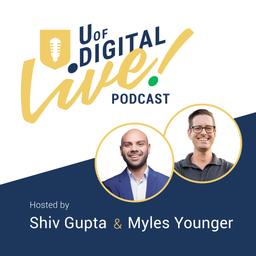
The AI Edge podcast is where AI pop culture meets marketing and technology. Hosted by trusted educators in the space: Shiv Gupta, founder of U of Digital, and Myles Younger, ad tech veteran, the show breaks down what’s actually happening in AI and what it means for marketers, agencies, and leaders focused on tech.
Each week, Shiv and Myles cover the latest AI news, and dive deep with a guest into topics like the future of work with AI or how marketers should think about building their AI tech stack. If you want someone to cut through the noise, decode what’s really happening, and help you stay ahead, this is your AI edge.
Ep 37. Ads in AI Are Here — But Nobody’s Figured Out the Right Format Yet, with Roger Dunn, Thrad
Meta launched Muse Wonder Models to power its personal AI assistant. Google dropped Gemini Argon — faster, better at brand guidelines, better at writing. A startup called TypeSafe launched Jev, a model purpose-built for fast decision-making in multiple choice scenarios. And Character AI — once one of the top sources of AI ad inventory on the open web — filed for bankruptcy and is now being acquired by Disney for $20 million. The math of compute cost versus ad revenue caught up with them.
This week, Shiv and Myles welcome Roger Dunn, Chief Commercial Officer at Thrad, joining from Sydney. Roger spent a decade agency side, held a global retail media role at Diageo, and is now on the front lines of one of the most interesting unsolved problems in advertising: what does a good ad actually look like inside a conversational AI environment?
Roger breaks down why the comparison between AI advertising and search undersells the opportunity — with search you’re fighting over a couple of keywords, but with conversational AI you have a full multi-turn dialogue with rich pre-qualification already built in. He also introduces a concept most people haven’t considered: in AI, a well-placed ad doesn’t just respond to a conversation, it can redirect it entirely. His marathon runner and supplements example makes it immediately concrete. And he gives the clearest map of where AI ad inventory actually exists beyond ChatGPT — browsers, companion apps, social platforms, vertical agents, publishers with AI interfaces, and retail.
They also get into why Character AI was burning $8–10 million a month on compute and why the ad math simply never worked, why polling ads — a sponsored question with answer options — might be the most native format anyone has found so far, and why the $60 CPM that OpenAI launched with was never going to hold.
📅 AI Edge Live — October 29thJoin us for a free webinar on synthetic audiences, personas, and digital twins in marketing — featuring a live demo from Verve CEO and founder Chad.Register at uof.digital
New episodes every two weeks. Get your AI Edge here.
5 Oct 2026
Ep 36. Brand Is No Longer a Long-Term Play — Agentic Commerce Is Making It Urgent, with Mike Finnerty, Mutinex
Amazon rebranded its entire ad platform — there's no more DSP, the default is now a PMax replica, and they're calling it Amazon Ads Agent. Meta's Muse started crawling Amazon and got shut down within hours. OpenAI launched Dots as a small business tool overnight — apparently because Zuckerberg can't beat Sam Altman, not even on a Tuesday. And President Trump signed an executive order renaming AI to SI. Superintelligence. Because it's super.
This week, Shiv and Myles sit down with Mike Finnerty, US President of Mutinex — the agentic MMM platform that has spent the last four years doing what the measurement industry has been promising to do for 80 years, but never quite pulled off operationally.
Mike breaks down why every walled garden platform grading its own homework creates a math problem that doesn't add up — when you sum the self-reported performance of five or six platforms, the total is always higher than actual sales. It was the ad network problem of 2008 all over again. Mutinex's answer: inject a neutral third-party incrementality signal back into the bidding algorithms so platforms optimize for actual growth instead of their own metrics. And every single time they've done it, platform-reported performance has improved.
He also introduces one of the cleanest frameworks in the episode — read vs. write for LLMs. Until recently, everything AI did was read: research, information gathering, journey changes. What's happening now with Muse, Dots, and Amazon's branded conversations is write: actually taking actions on behalf of consumers. Someone's Muse agent negotiated a Facebook Marketplace deal without the other person knowing. The write era has started.
They also get into why the conventional wisdom that brand is a long-term investment is about to be flipped on its head — if your consumer doesn't say "I want a Stanley water bottle" before the agent fires up, the agent will just pick whatever's cheapest and available — why this holiday season will be the first where agentic transactions actually show up in commerce data, and why the entire marketing ecosystem should stop counting clicks and start asking one question: how much went in, how much came out?
Shiv and Myles will be at Ad Week — send a DM if you want to connect.
Ready to level up your AI skills? Join the U of Digital AI Accelerator.Now enrolling | https://uof.digital/ai/accelerator/
Learn more about the AI Literacy Alliance at uof.digital/alliance
New episodes every two weeks. Get your AI Edge here.
21 Sept 2026
Ep 35. The Old World Is Melting — Are You Retooling Fast Enough? with Paul Boruta, Slingwave
Amazon just partnered with ChatGPT to let advertisers buy AI inventory through Amazon's DSP — and ChatGPT still won't let Amazon crawl its product catalog. Meta charged advertisers a software fee for the first time in company history. Big tech captured 56% of all ad spend this year, up from 53% last year, and AI is the tailwind driving every bit of that growth. And OpenAI's IPO apparently isn't happening this year — which tells you everything you need to know about where they actually are.
This week, Shiv and Myles welcome Paul Boruta, Founder and CEO of Slingwave — an independent AI-native marketing decision engine built for eCommerce and DTC brands. Paul started at Overture and Yahoo, built and sold a startup in the YouTube space, and has spent the last several years building what he describes as a closed loop system that puts all of your marketing data — paid, organic, competitive, and contextual — into one model that gets smarter with every campaign.
Paul breaks down why the Amazon/ChatGPT partnership makes perfect strategic sense once you map the funnel correctly: Amazon and Google are the cash register, ChatGPT is excellent at the mid-funnel research and discovery phase where neither of them is particularly strong. He also makes a notable admission: 18 months ago he would have told you synthetic data for incrementality testing was too flawed to be useful. That's changed — and changed fast. And he explains why doing it wrong — one person, one deck, no validation, no closed loop — is worse than not doing it at all.
They also get into why real-time competitive signals changed the measurement game entirely — because advertising isn't turn-based, you and your competitors are all in market simultaneously — why sponsored AI agents live or die on the neutrality question, and why the old world of deterministic multi-touch attribution is melting fast and everyone needs to be retooling for what comes next.
🎓 The U of Digital AI Accelerator starts Tuesday, September 22nd — a few spots still available.Enroll now: https://uof.digital/ai/accelerator/
U of Digital is proud to partner with the ANA to bring AI education to over 20,000 brands and 50,000 marketers.
New episodes every two weeks. Get your AI Edge here.
Reach and audience
Public platform figures. Ratings count people who left a rating, not total listeners.
Apple Podcasts (US)
5.0 / 5
7 ratings
Spotify
5.0 / 5
2 ratings
Podcast Authority Score: 14 / 100
A composite of feed quality, social presence, YouTube performance and engagement. Read the methodology.
Quality
15
Social presence
0
YouTube
0
Engagement
32
Contact U of Digital Live!
Guest appearances
Does not typically book guests
Based on episode analysis; this does not confirm that the show is currently accepting guests.
Pod Engine is an independent podcast discovery and analytics service and is not affiliated with or endorsed by this podcast. Artwork and show content belong to their owners. Full legal notice.
Explore this show Podcast research with Pod Engine