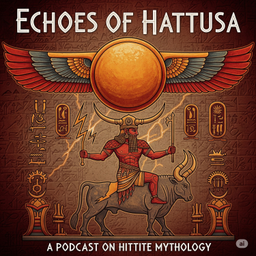
Discover the myths of ancient Anatolia and Mesopotamia with Veritas Antiqua. From Hittite storm gods to Sumerian creation stories, each episode brings ancient narratives to life and explores the beliefs, rituals, and human questions behind them. Join us for stories and discussions of power, fate, love, and mortality—and the worlds that gave them meaning.
The Storm God's Ultimatum: Debt, Doom, and the First Fables | Hittite Mythology
Welcome to Veritas Antiqua. Beneath the ruins of Hattusa, a chilling warning echoes across three and a half millennia. We all know the classic structure of animal fables, but long before Aesop's talking creatures delivered their moral lessons, a civilization in ancient Anatolia was weaving tales of clumsy deer and rebellious grinding stones. Today, we descend into the heavy, baked-clay archives of the Hittite Empire to unearth the Song of Release.
Also known by its original name, the Kasafi, this narrative of Hurrian origin is far more than a collection of simple folk tales—it is a dense, philosophical framework analyzing the fragility of human civilization. Through vivid allegories, these ancient voices warn that a society crushing its lowest laborers under the weight of systemic debt courts absolute cosmic ruin. Discover how the great Storm God, Tishub, delivered a terrifying ultimatum to the elite lords of Ebla, demanding a sweeping debt jubilee to prevent their fields from turning to thorns and weeds.
In this episode, you will learn:
The profound origins of the Song of Release, preserved in 1400 BC, which upends the traditional timeline of human literature by a full millennium.
How the fable of "The Deer and the Stone" brilliantly explores human scapegoating, reckless behavior, and the rejection of personal free will.
The chilling metaphor of the grinding stone that goes on strike against its baker, illustrating the devastating collapse of a society when its foundational working class is pushed past its breaking point.
The high-stakes divine assembly at the city of Ebla, where the Storm God Tishub threatens the elites with total destruction.
The ancient mechanics of the Anandaranu—a formal decree demanding the total cancellation of debts and the return of debt-slaves to their families.
Why the ancient world believed that the collective "sigh of the people" possessed the toxic power to completely destroy a nation's prosperity.
⏱️ Timestamps
00:00 - Intro
01:25 - The Storm God's terrifying ultimatum to the lords of the earth.03:10 - Rewinding the clock to 1400 BC: Leaving Greece for the archives of Hattusa.05:45 - Unearthing the Kasafi (The Song of Release) and its Hurrian origins.08:00 - The Deer and the Stone: A 3,500-year-old debate on free will versus determinism.10:30 - The Grinding Stone's Rebellion: How an ancient fable perfectly mirrors systemic labor collapse.13:15 - The divine assembly at Ebla and Tishub's demand for an Anandaranu (debt reset).15:50 - The final warning: Will the fields yield prosperity, or a harvest of thorns and weeds?.
#VeritasAntiqua #HittiteEmpire #AncientHistory #BronzeAge #SongOfRelease #AncientAnatolia #MythologyPodcast #Hattusa #AncientFables #DebtForgiveness #Tishub #HistoryUncovered #AncientNearEast
13 Apr 2026
The Spindle Lie: Treachery in the House of Gods | Hittite Mythology
Deep in the rugged, sun-drenched landscape of ancient Anatolia, beneath the cyclopean limestone walls of Hattusa, lies a story of divine vengeance that predates the classical myths of Greece by a millennium. In this episode of Veritas Antiqua, we unearth the shattered clay tablets of the Hittite Empire to reconstruct the harrowing legend of Elkunirsa and Ashertu.
It is a tale of a passive creator god, a dangerously seductive mother goddess, and a young storm god caught in a web of celestial blackmail. We explore how a single rejection—and the brandishing of a wooden spindle—set off a chain reaction of psychological warfare and mathematical cruelty that would eventually form the architectural blueprint for some of the most famous stories in human history. From the banks of the Euphrates to the court of Pharaoh, we trace the "Spindle Lie" as it evolves into a universal literary archetype of power, lust, and the lethal weight of a false accusation.
The Power of Cultural Assimilation: How the Hittites weaponized the myths of their neighbors to solidify imperial dominance.
The Covenant of Bread and Salt: Why ancient hospitality was a binding blood oath of survival in the harsh Near Eastern landscape.
The "Slanderous Woman" Archetype: How the story of Ashertu served as the original template for the biblical account of Joseph and Potiphar’s wife.
Divine Imperfection: Why ancient civilizations viewed their gods as mirrors of human ego and malice rather than pillars of moral perfection.
The Math of Vengeance: The symbolic significance of numbers like 77 and 88 in ancient Near Eastern numerology.
TimeStamps
00:00 - Intro: A young god flees into the darkness.01:34 - The mission: Deciphering the shattered clay tablets of Anatolia.03:02 - The Hittite Strategy: Conquering territories by absorbing their heavens.04:22 - The Hierarchy: Elkunirsa’s passive power vs. Ashertu’s insatiable hunger.05:54 - The Forbidden Tent: Ashertu’s blunt demand and the Storm God's refusal.07:11 - Bread, Salt, and Water: The ancient mechanics of loyalty.08:24 - The Spindle: Weaponizing the ultimate symbol of domesticity.10:15 - The River Euphrates: Seeking the Creator at the boundary of the world.12:12 - Proxy Warfare: Elkunirsa’s casual cruelty and the "loaded weapon."13:46 - The Lie: The mathematical total eradication of a legacy.15:52 - Seven Years of Silence: Ashertu’s patient, fermenting revenge.17:35 - The Feast of Betrayal: A golden cup and an invisible death warrant.18:55 - Ishtar’s Intervention: A goddess of war becomes a bird of prey.20:00 - The Cliffhanger: Why the physical record of history often shatters at the climax.21:28 - The Blueprint: Tracking the "Potiphar’s Wife" motif through Egypt and Greece.
11 Apr 2026
The Monster Made of Words: Trapping the Hittite Lord of the Tongue | Hittite Mythology
Imagine every cruel rumor and vicious word ever spoken behind your back physically clumping together into a towering, boastful monster whose only goal is to dismantle your life. For the Ancient Hittites, this wasn't just a metaphor for anxiety—it was an ontological reality.
In this episode of Veritas Antiqua, we descend into the shadows of Bronze Age Anatolia to explore the terrifying entity known as the Lord of the Tongue. We examine how the Hittites viewed language not as abstract sound, but as a tangible force capable of creating a metaphysical "oil spill" called papratar. Join us as we break down the theatrical, high-stakes rituals led by wise women to outsmart cosmic bullies and restore balance to a universe threatened by the power of gossip.
In this episode, you will learn:
How the Hittites viewed words as physical objects with mass and force.
The nature of papratar, the "cosmic stain" generated by malicious rumors.
The psychological strategy of anthropomorphizing vague dread into the "Lord of the Tongue".
The "Legalistic Trap": How ritual experts used a giant’s own boasts to strip him of his power.
The visceral use of "inability" magic, featuring newborn lions, fawns, and the social outcasts of the Hittite world.
The ritual of Madam Zuwi: Harnessing "taboo energy" from criminals to cure physical illness.
Timestamps
00:00 - Intro: Visualizing the monster born from gossip.
01:32 - Words as Weapons: The Hittite concept of ontological language.
02:28 - Papratar: The metaphysical pollution of the "Evil Tongue".
03:54 - Giving Evil a Face: Why the Hittites imagined a "Lord of the Tongue".
05:41 - The Boasting Trap: Outsmarting a giant through sympathetic magic.
07:46 - The Circle of Life: Using lions and fawns to represent universal laws.
09:12 - The Ritual of Inability: Weaponizing the physical reality of the blind and deaf.
10:48 - Madam Zuwi’s Outcasts: Using "Harkul" criminals to break the laws of nature.
13:10 - Conclusion: The enduring weight of our words in the modern ether.
Reach and audience
Public platform figures. Ratings count people who left a rating, not total listeners.
Spotify
5.0 / 5
1 ratings
Contact Veritas Antiqua
Guest appearances
Does not typically book guests
Based on episode analysis; this does not confirm that the show is currently accepting guests.
Host of Veritas Antiqua?
Claim your podcast to manage its listing and keep your show details accurate.
Pod Engine is an independent podcast discovery and analytics service and is not affiliated with or endorsed by this podcast. Artwork and show content belong to their owners. Full legal notice.
Explore this show Podcast research with Pod Engine