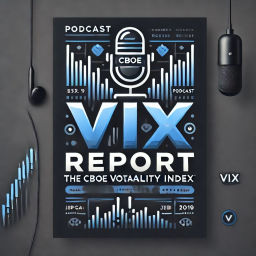
Podcast thumbnail for VIX Report - Cboe Volatility Index News

VIX Report - Cboe Volatility Index News

Claim This Podcast

by Inception Point AI

1.0(1 reviews)
345 episodes
Updated Daily
Accepts GuestsHas SponsorsLocation 🇺🇸
47

Podcast Authority

Beta
FairBased on show quality, social media presence, reviews, charts, and more
Pod Engine
Quality94
Social0
YouTube0
Engagement0

Podcast Overview

Stay ahead of the market with the "VIX Report: The Cboe Volatility Index" podcast. Dive deep into the dynamics of the VIX, the premier measure of market volatility and investor sentiment. Our expert analysis, market insights, and interviews with financial professionals provide you with the knowledge to navigate the ever-changing financial landscape. Whether you're a seasoned investor or just getting started, this podcast offers valuable information to help you make informed decisions. Subscribe now and never miss an update on the Cboe Volatility Index and its impact on global markets. This content was created in partnership and with the help of Artificial Intelligence AI.

Language

🇺🇲

Publishing Since

8/7/2024

Unlock The Full Podcast Authority Score Report

See how your podcast performs across key metrics

47

Podcast Authority

Beta
FairBased on show quality, social media presence, reviews, charts, and more
Pod Engine
Quality94
Social0
YouTube0
Engagement0
8
Excellent Areas
2
Good Performance
9
Growth Opportunities
excellent
Publishing Consistency
Every 2 days
Performing excellently!
good
Show Notes Quality
3.0/5

Recommendations available

Unlock the full report to see detailed tips

poor
Episode Thumbnails

Recommendations available

Unlock the full report to see detailed tips

+16 More Metrics

Unlock comprehensive insights including:

  • • YouTube presence analysis
  • • Social media reach metrics
  • • RSS compliance scoring
  • • Podcast 2.0 features
  • • Technical standards
What's Included in Your Full Report

Detailed Analytics

  • Complete breakdown of all 19 authority metrics
  • Personalized recommendations for each metric
  • Industry benchmarks and comparisons
  • Technical RSS feed analysis and compliance scoring

Growth Strategies

  • Step-by-step action plans for improvement
  • Quick wins to boost your score immediately
  • Pro tips from successful podcasters
Get your free podcast insights report

See how your show performs across every key metric

Instant delivery
No spam
Attract Better Guests

High authority scores make your podcast more attractive to industry leaders and influencers who want to appear on credible shows.

Secure Sponsorships

Sponsors look for podcasts with proven authority and engagement. Your score demonstrates your podcast's value to potential partners.

Grow Your Audience

Understanding your strengths and weaknesses helps you make data-driven decisions to expand your listener base effectively.

2 verified contact emails on file for VIX Report - Cboe Volatility Index News

Pitch yourself as a guest, propose sponsorships, or reach out directly to the host.

Recent Episodes

Episode thumbnail for VIX Drops 7.27 Percent to 17.10: Stock Market Volatility Expectations Ease as Equity Markets Stabilize

June 18, 2026

VIX Drops 7.27 Percent to 17.10: Stock Market Volatility Expectations Ease as Equity Markets Stabilize

The Cboe Volatility Index, or VIX, is currently trading at a sale price of about 17.10, according to the Cboe VIX dashboard on Cboe Global Markets. Cboe reports that this represents a percent change of roughly minus 7.27 percent, a drop of about 1.34 points from the last close near 18.44. That negative percent change indicates that expected volatility in the U.S. stock market over the next 30 days has eased meaningfully since the last session. The VIX is derived from real-time options prices on the S&P 500 Index, and Cboe explains that it reflects investors’ consensus view of future 30‑day volatility in the equity market based on those SPX option premiums. When traders are willing to pay less for downside protection or upside speculation, the implied volatility embedded in options prices falls, and the VIX declines. Several underlying factors typically drive a move like today’s drop. According to Cboe’s description of the index, calmer equity price action and narrowing daily trading ranges in the S&P 500 tend to pull implied volatility lower as realized volatility comes down and market participants adjust their hedges. If recent macroeconomic data or central bank communications have come in largely in line with expectations, that also reduces uncertainty, which can translate into more aggressive selling of volatility by institutional investors and systematic strategies. In addition, a constructive tone in risk assets, such as rising stock prices and tightening credit spreads, often coincides with investors unwinding prior hedges, contributing to a softer VIX reading. Looking at recent levels reported by Cboe, the VIX has been oscillating in a relatively moderate band compared with the elevated spikes seen during periods of acute stress, such as major policy surprises or geopolitical shocks. A reading in the high teens, even after today’s sizable percentage decline, is broadly consistent with a market that is not in full risk‑off mode but still pricing in some degree of event risk and uncertainty. Historically, extended stretches of VIX trading in the low to mid‑teens have aligned with steady bull markets and subdued realized volatility, while moves above 20 and especially above 30 have marked phases of heightened concern. The current pullback of more than 7 percent from the prior close continues a broader trend in which volatility has been mean‑reverting after any brief flare‑ups, as option markets repeatedly reprice from fear back toward a more neutral stance once immediate worries fade or data clarify the outlook. According to Cboe’s materials on VIX and its related products, this pattern of short‑lived spikes followed by declines is a defining characteristic of volatility markets, reflecting how quickly sentiment can shift as new information is absorbed. Thanks for tuning in, and be sure to come back next week for more. This has been a Quiet Please production, and for more from me check out Quiet Please dot A I. For more http://www.quietplease.ai Get the best deals https://amzn.to/3ODvOta

Episode thumbnail for VIX Drops to 16.2 as Options Market Signals Investor Calm and Reduced Hedging Demand

June 16, 2026

VIX Drops to 16.2 as Options Market Signals Investor Calm and Reduced Hedging Demand

The Cboe Volatility Index, or VIX, is currently trading at a sale price of about 16.2, according to Cboe’s own VIX dashboard and major quote services. That puts the percent change since the last reported close at roughly minus 0.1%, essentially flat to slightly lower on the day. In practical terms, a VIX level near 16 suggests a relatively calm options market on the S&P 500. Cboe and S&P Dow Jones Indices describe the VIX as a real-time gauge of 30‑day expected volatility derived from S&P 500 index option prices. When traders bid up option premiums because they expect big market swings, the VIX rises. When demand for downside protection fades and option prices ease, the VIX drifts lower. The small negative percent change today reflects modestly cheaper option premiums versus the prior close and indicates that investors are slightly less eager to pay for protection than they were yesterday. Broadly, levels below about 20 are often associated by market commentators with a more stable or complacent environment, while readings above 30 tend to coincide with episodes of stress or fear. Recent trends help explain today’s move. Data from Cboe, the St. Louis Fed’s VIX closing series, and real‑time charting platforms show that in recent sessions the VIX has pulled back from the high teens toward the mid‑teens. This follows a period when volatility briefly picked up on concerns about interest rates, inflation data, and pockets of equity market weakness, pushing the VIX several points higher week over week. As those worries eased and equity indexes firmed, implied volatility bled lower, bringing the VIX back toward its longer‑run post‑crisis range. Several underlying factors are contributing to the muted percent change: First, major macroeconomic releases and central bank decisions immediately ahead appear relatively well telegraphed, so there is less need for investors to rush into protective options. Second, realized volatility in the S&P 500 – the actual day‑to‑day price swings – has been contained, which historically pressures implied volatility lower as option sellers grow more confident. Third, there is an ongoing pattern of “volatility selling” strategies, where institutions systematically sell index options to harvest premium. When markets are calm, this supply of options can weigh on implied volatility and keep the VIX subdued. At the same time, the VIX is not at extreme lows; it is sitting in a middle‑of‑the‑road zone that suggests investors are relaxed but not oblivious to potential shocks. This is consistent with an environment where the market is balancing solid corporate earnings and resilient economic data against lingering risks from policy shifts, geopolitics, and the possibility of an abrupt correction after strong equity gains. Overall, today’s small downgrade in the VIX sale price and modest negative percent change fit into a broader trend of gradually easing volatility after a short‑lived spike, with traders content, for now, to pay a little less for insurance while still keeping one eye on the horizon. Thanks for tuning in, and be sure to come back next week for more. This has been a Quiet Please production, and for more from me check out QuietPlease dot A I. For more http://www.quietplease.ai Get the best deals https://amzn.to/3ODvOta

Episode thumbnail for VIX Holds Steady at 17.68: Market Fear Gauge Shows Cautious Equilibrium With No Change

June 13, 2026

VIX Holds Steady at 17.68: Market Fear Gauge Shows Cautious Equilibrium With No Change

The Cboe Volatility Index, or VIX, is currently showing a sale price of 17.68, with a percent change of 0.00% since it was last reported, according to the Cboe VIX Index dashboard on Cboe Global Markets. The VIX is often called the market’s “fear gauge” because it reflects expectations for S&P 500 volatility over the next 30 days, derived from real-time SPX option prices. Cboe explains that it is based on the implied volatility embedded in a broad strip of near-term S&P 500 call and put options, making it a forward-looking measure of how turbulent investors expect the market to be in the short term. A reading of 17.68 places volatility modestly above the very low teens that are typical of calm, complacent markets, but well below the extreme spikes seen during major crises when the VIX can surge above 40 or even 80, as documented historically by Cboe and the St. Louis Fed’s VIX series. The fact that the percent change is flat at 0.00% suggests that, since the last close, there has been no meaningful re-pricing of near-term risk in SPX options. In other words, the options market is currently in a holding pattern on volatility expectations. Several underlying factors likely explain this lack of movement. According to Cboe’s own description of the index, VIX levels are most sensitive to shifts in equity market direction, option demand for protection, macroeconomic data, central bank signals, and event risk. When markets are relatively stable, with no major surprise in economic releases, policy announcements, or geopolitical developments, demand for downside protection tends to normalize and the VIX can hover with little day-to-day change. A flat percent change also fits the broader pattern that volatility often compresses after large moves. After periods of elevated stress or uncertainty, markets frequently experience a “volatility decay” as traders adjust hedges, risk managers reduce emergency protection, and realized volatility in the S&P 500 settles down. With the index now in the high teens and unchanged on the day, it suggests that investors see some risk on the horizon but nothing new enough to warrant repricing since the last close. In terms of trend, data from Cboe’s historical VIX series and commentary from market educators like TD Direct Investing show that the VIX tends to oscillate in regimes: low-to-mid teens in benign environments, high teens to mid-20s in more cautious phases, and much higher during shock events. Sitting at 17.68 with no change aligns with a cautious but not alarmed regime. It hints that traders are watching macro and earnings developments closely, but positioning remains measured rather than panicked. As always, because the VIX is derived from option prices, any sudden shift in equity markets, option volumes, or expected catalysts can quickly break this calm and produce a meaningful percentage move, up or down. For now, though, the unchanged reading underscores a temporary equilibrium in the market’s collective outlook on short-term volatility. Thanks for tuning in, and be sure to come back next week for more. This has been a Quiet Please production, and for more from me check out Quiet Please dot A I. For more http://www.quietplease.ai Get the best deals https://amzn.to/3ODvOta

345 total episodes available

Deep-dive analytics for VIX Report - Cboe Volatility Index News

Frequently asked questions

Have a different question and can't find the answer you're looking for? Reach out to our support team by sending us an email and we'll get back to you as soon as we can.

What is VIX Report - Cboe Volatility Index News?

Stay ahead of the market with the "VIX Report: The Cboe Volatility Index" podcast.

Dive deep into the dynamics of the VIX, the premier measure of market volatility and investor sentiment. Our expert analysis, market insights, and interviews with financial professionals provide you with the knowledge to navigate the ever-changing financial landscape. Whether you're a seasoned investor or just getting started, this podcast offers valuable information to help you make informed decisions.

Subscribe now and never miss an update on the Cboe Volatility Index and its impact on global markets.

This content was created in partnership and with the help of Artificial Intelligence AI.

How often does this podcast release new episodes?

This podcast updates daily.

Where can I listen to this podcast?

This podcast is available on 8 platforms including Apple Podcasts, Spotify, and more. You can also use the RSS feed directly.

Does this podcast accept guests?

No, this podcast does not typically feature guests.

Legal Disclaimer

Pod Engine is not affiliated with, endorsed by, or officially connected with any of the podcasts displayed on this platform. We operate independently as a podcast discovery and analytics service.

All podcast artwork, thumbnails, and content displayed on this page are the property of their respective owners and are protected by applicable copyright laws. This includes, but is not limited to, podcast cover art, episode artwork, show descriptions, episode titles, transcripts, audio snippets, and any other content originating from the podcast creators or their licensors.

We display this content under fair use principles and/or implied license for the purpose of podcast discovery, information, and commentary. We make no claim of ownership over any podcast content, artwork, or related materials shown on this platform. All trademarks, service marks, and trade names are the property of their respective owners.

While we strive to ensure all content usage is properly authorized, if you are a rights holder and believe your content is being used inappropriately or without proper authorization, please contact us immediately at hey@podengine.ai for prompt review and appropriate action, which may include content removal or proper attribution.

By accessing and using this platform, you acknowledge and agree to respect all applicable copyright laws and intellectual property rights of content owners. Any unauthorized reproduction, distribution, or commercial use of the content displayed on this platform is strictly prohibited.