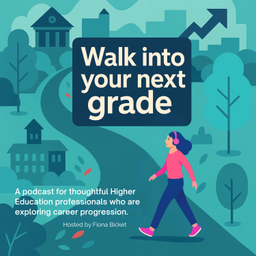
Walk Into Your Next Grade with Fiona Bicket
Fiona Bicket
5.0from 1 ratings
- 31
- Episodes
- 1
- Ratings
- Weekly
- Cadence
- 2025
- First episode
About Walk Into Your Next Grade with Fiona Bicket
Management Matters is a podcast for Higher Education Professional Services staff who want to become more confident, effective managers and leaders. Hosted by Fiona Bicket, specialist self-belief coach and former HE manager, each episode explores what's actually going on at work and what to do about it. From difficult conversations, delegation and accountability to leadership development, career progression and navigating the realities of Higher Education, you'll find practical insights, thoughtful reflection and real-world management advice grounded in the HE context. If you're a manager, aspiring leader or Professional Services colleague who wants work to feel clearer, more manageable and more effective, you're in the right place. You can find out about ways to work with me at https://www.fionabicket.co.uk/
- Publisher
- Fiona Bicket
- Category
- business · education
- Language
- en
- Explicit
- No
- First episode
- 9 Dec 2025
- Latest episode
- 14 Oct 2026
Latest episodes
31 episodes in the feed.
14 Oct 2026
Episode 30 - How to Find your Leadership Style
How do you work out what kind of leader you want to be? This week's episode was inspired by a question from a coaching client who had recently started their first line management role. They asked me: "How do I figure out what my leadership style is?" It's a really good question, and one that I think quite a few people ask themselves when they first move into management. The reality is that many people stumble into their leadership style. They try different approaches, notice what feels comfortable, see what works and gradually develop their own way of doing things. But I think there's something to be said for being a little more intentional about it. In this episode, I'm exploring some of the things that can help you develop a leadership style that feels authentic, grounded and aligned with who you are. Start with your values One of the most useful starting points is understanding your personal values. Your values influence what feels right to you, how you make decisions and how you respond when things become challenging. They can also help explain why certain management situations feel uncomfortable or create a sense of internal conflict. Perhaps there's a gap between how you believe you should behave and what you feel you're being asked to do. Or perhaps one of your values is being expressed in a way that's no longer particularly helpful. For example, compassion is a wonderful value. But when compassion becomes overexpressed, it can lead us towards rescuing people, taking responsibility for things that aren't ours to manage or allowing personal circumstances to influence decisions that need to be made on a different basis. Understanding your values helps you recognise those patterns and make more deliberate choices. Download the Grounded Manager Values Exercise I've created a free worksheet to help you identify and explore your values. It includes some questions to get you thinking, followed by an extensive list of values to help you work out which ones really matter to you. You might find that several words initially resonate, such as honesty, transparency and truthfulness. Part of the exercise is working out which of those best captures what's important to you. Download the free Grounded Manager Values Exercise (https://www.fionabicket.co.uk/offers/vHFtPzS6/checkout) I'd love to know what you discover if you give it a try. What happens when your values are tested? It's relatively straightforward to say that you value compassion, fairness or honesty when everything is going well. But what happens when you're faced with a difficult management decision? In the episode, I use the example of a manager who has been asked to make significant staffing reductions. How do you remain aligned with your values while making decisions that will inevitably have difficult consequences for other people? And how do you make sure those values aren't pushing you towards decisions that are outside your responsibilities or aren't appropriate for the situation? This is where understanding your values becomes particularly useful. It's not simply about knowing what matters to you. It's about learning how to put those values into practice, including when the circumstances are uncomfortable. The difference between management and leadership I also explore how I think about the distinction between management and leadership. For me, management is often about helping people understand what needs to be done and, where appropriate, how to do it. Leadership is more about helping people understand how to think. And I think effective management needs to be grounded in personal self-leadership. Whether you're giving feedback, setting boundaries, delegating or making difficult decisions, the aim is to approach those responsibilities from a sturdy, grounded leadership position. Understanding your values is one part of developing that. Your experiences are part of your leadership style Your leadership style isn't just about your values. It's also shaped by your experiences, your motivations, your sense of purpose and the things you've learned throughout your career. One exercise I sometimes use with coaching clients is a life map. You draw a line across a page and plot significant experiences above or below it, depending on whether they felt positive or challenging. Then you look back over those experiences and begin to notice patterns. What felt particularly satisfying? What was difficult? How did you respond? What does that tell you about the way you naturally approach leadership? Sometimes you learn just as much about your leadership style by reflecting on what you've already done as you do by thinking about what you want to do next. Developing your own approach to leadership I don't think you need to become a particular type of leader. For example, I tend to lead from the middle rather than the front. I like experimenting, learning through experience and sharing what I've discovered with other people. Your approach might look quite different. The important thing is to understand what matters to you, how you want to show up and what you've learned about yourself along the way. And then to keep developing that approach intentionally. If you're just starting out in management, this can help you establish some useful foundations. And if you've been managing for years, it might be an opportunity to reflect on whether your current leadership style is still the one you want to practise. Have a go at the values exercise If you'd like somewhere practical to begin, download my free Grounded Manager Values Exercise. Get the Grounded Manager Values Exercise here (https://www.fionabicket.co.uk/offers/vHFtPzS6/checkout) And if you give it a try, I'd genuinely love to hear which values you settle on. You can email me at: info@fionabicket.co.uk (mailto:info@fionabicket.co.uk)
9 Oct 2026
Episode 29 - Finding Your Feet - A Meditation for the Start of the Academic Year
The first few weeks of the academic year can be intense. Students have arrived, Welcome Week is behind us, teaching has begun, and after weeks of preparation, last-minute changes and unexpected challenges, things might finally be settling into something resembling business as usual. But even when the immediate demands begin to ease, it can take a little longer for our minds and bodies to slow down. And with uncertainty around budgets, restructures and institutional change, you might be carrying more than the usual start-of-term busyness. So this week's episode of Management Matters is something a little different. Rather than our usual discussion about management and leadership, I'm inviting you to take some time for yourself with a guided meditation. An opportunity to pause, acknowledge what you've already navigated and reconnect with your own judgement as you look towards the months ahead. Taking a moment to slow down When you're responsible for other people, it's easy to become accustomed to constantly thinking ahead. Anticipating problems. Making decisions. Supporting colleagues. Trying to create calm and stability for your team, even when things feel uncertain for you. In this meditation, we'll begin by slowing down and noticing how you're actually feeling. Not how you think you should be feeling, or how you're presenting yourself to everyone else. Just how you are. There's nothing you need to fix or work out in this moment. Recognising what you've already done One of the things I've noticed about people who care deeply about doing a good job is how quickly they move past their successes. There's always another problem to solve, another conversation to have or another thing that could have gone better. But you've already navigated the first few weeks of the academic year. You've made decisions, supported people, dealt with unexpected challenges and kept things moving. So I'll invite you to acknowledge some of that work and consider what it tells you about your strengths, your judgement and your capacity to handle what comes next. Because self-trust isn't about believing you'll always get everything right. It's about recognising that you already have experience of meeting challenges, making decisions, learning and adapting. Leading when you don't have all the answers For many people working in Higher Education, the months ahead may bring considerable uncertainty. You might be navigating a restructure, financial pressures, staffing changes or decisions that haven't yet been made. And when you're responsible for a team, it can feel uncomfortable not knowing what will happen. But you don't need to be able to predict or control everything to lead well. In this meditation, we'll explore the difference between the things happening around you and the things you can meaningfully influence. The conversations you choose to have. The information you share. The decisions that are yours to make. The way you respond to concerns. And the way you look after yourself. Sometimes doing more isn't the same as leading better. Finding your feet as a leader As we move towards the end of the meditation, I'll invite you to think about how you want to approach the next few weeks. Not simply what you want to achieve, but how you want to show up as a manager or leader. We'll reflect on three questions: What do I want to be known for as a leader this term? How do I want people to experience working with me? What is one thing I could do to help my team feel more stable and supported? What do I need to do differently to look after myself as I lead? You don't need to turn your answers into another to-do list. This is an opportunity to notice what feels important and give yourself permission to return to it when you're ready. A little time for yourself I'd encourage you to listen somewhere you can sit comfortably and give yourself some uninterrupted time. You can close your eyes if you'd like to, or simply soften your gaze. There's no particular outcome you're trying to achieve and nothing you need to get right. Just an opportunity to slow down, reflect and remember that you already have experience, judgement and the capacity to respond to what comes next. You don't need certainty to lead with integrity. You don't need to control everything to make a meaningful difference. And you don't need to wait until you feel completely confident before you act. You can trust yourself to find your way.
7 Oct 2026
Episode 28 - Finding balance in the busyness
Are you competing at being busy? It feels as though everybody is busy at the moment. Ask someone how they are and "busy" is almost the default answer. Then someone else shares what they're dealing with, someone else adds theirs, and before long busyness has become a kind of competitive sport. There's bonding in the busyness. But what if you decided to step outside of that competition? In this episode, I'm exploring what it might take to find some balance in the busyness, without pretending that we're somehow going to make all the work disappear. What do you actually want instead? I'm not someone who wants to eliminate busyness altogether. I'm actually quite happy being busy. But I want that busyness to feel in balance. I want to feel on top of things. I want to be well rested. And I think one of the problems with constantly bonding over how busy and overwhelmed we are is that we don't necessarily stop to ask ourselves a fairly important question: What do I actually want instead? Choosing a different experience can feel surprisingly countercultural when everyone around you is caught up in the same patterns. It requires you to step outside of the group and bet on yourself. Boundaries need consequences Finding more balance might require you to set some boundaries. And boundaries aren't simply about saying what you would prefer. A boundary needs consequences and follow-through. If something bumps up against the boundary you've set, you need to be prepared to take the action you said you would take. That requires courage, particularly if setting boundaries isn't something you've practised much before. I explored this in more detail in Episode 10: The Repeating Conversation Loop, which looks at the shift from repeatedly having the same supportive conversation to setting a clear boundary and following through. Listen to Episode 10: The Repeating Conversation Loop (https://www.fionabicket.co.uk/podcasts/management-matters-notes-from-an-he-coach/episodes/2149178491?utm_source=chatgpt.com) Finding congruence in the busyness Last week, in Episode 27: Searching for Peace of Mind, I talked about congruence: the alignment between who you believe yourself to be, how you think and what you actually do. That matters here too. Who are you if you're not busy all the time? Do you believe you're worthy of having your time respected and feeling on top of things? What do you believe about the work on your to-do list? And, perhaps most importantly, are you actually taking action on the plans you make for yourself? Because thinking about changing things and actually changing them aren't the same thing. Listen to Episode 27: Searching for Peace of Mind (https://www.fionabicket.co.uk/podcasts/management-matters-notes-from-an-he-coach/episodes/2149262053?utm_source=chatgpt.com) Need some help getting on top of things? If the problem is that your to-do list feels overwhelming and you need some structure to work out what matters this week, come along to Strategy Hour. It's my completely free Monday morning drop-in session. Bring all your half-finished lists, notes and competing priorities, and we'll gather everything together, get it sorted and prioritised, and help you make a plan for the week ahead. Join Strategy Hour (https://www.fionabicket.co.uk/offers/HzKEKX9u/checkout?utm_source=chatgpt.com) If there's something else getting in the way, perhaps you know what you intend to do but aren't following through, you're struggling to set boundaries, or you're caught in a pattern you can't quite shift, coaching might be useful. Book an introductory call with me to talk about coaching (https://calendly.com/fionabicket/intro-chat?utm_source=chatgpt.com) The aim isn't an empty to-do list. There will always be more work. It's finding a way to match your energy to what needs doing, feel more on top of things and find some balance amid the busyness.
Reach and audience
Public platform figures. Ratings count people who left a rating, not total listeners.
- Spotify
- 5.0 / 5
- 1 ratings
Contact Walk Into Your Next Grade with Fiona Bicket
- Guest appearances
- Does not typically book guests
Based on episode analysis; this does not confirm that the show is currently accepting guests.
Host of Walk Into Your Next Grade with Fiona Bicket?
Claim your podcast to manage its listing and keep your show details accurate.
Pod Engine is an independent podcast discovery and analytics service and is not affiliated with or endorsed by this podcast. Artwork and show content belong to their owners. Full legal notice.
Explore this show
Podcast research with Pod Engine