
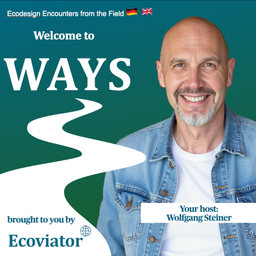
WAYS - Ecodesign Encounters
Claim This Podcastby Wolfgang Steiner
Podcast Overview
<p><b>WAYS – Ecodesign Encounters from the Field</b></p><p></p><p>Because ecodesign is not a checklist.</p><p>It’s a journey you take.</p><p></p><p>On <b>WAYS</b>, we meet people who are paving new paths for sustainable products and services.</p><p>Straight from practice – in walking conversations or studio discussions.</p><p></p><p>We share perspectives on ecodesign in practice, the ESPR regulation, Digital Product Passports, data management, and the circular economy.</p><p>Because ecodesign creates products and services that are fit for the future.</p><p></p><p>Hosted by <b>Wolfgang Steiner (Ecoviator).</b></p><p></p><p>New episodes every two weeks. Subscribe & share!</p><p></p><p><a rel="noopener noreferrer nofollow" href="http://ecoviator.com/ways" target="_blank"><b>ecoviator.com/ways</b></a></p>
Language
🇩🇪
Publishing Since
2/20/2026
1 verified contact email on file for WAYS - Ecodesign Encounters
Pitch yourself as a guest, propose sponsorships, or reach out directly to the host.
Recent Episodes
June 3, 2026
The Human Side of Circular Economy – Mihaela Stefanescu (UNFCCC)
<p>WAYS – Ecodesign Encounters from the Field</p><p><br /><b>Episode #6 – The Human Side of Circular Economy – Mihaela Stefanescu (UNFCCC)</b><br /></p><p><b>About WAYS</b></p><p>WAYS explores real-world experiences at the intersection of ecodesign, circular economy, product sustainability and the systems that help make sustainable transformation possible.</p><p><br /><b>Who This Episode Is For</b></p><p>Relevant for sustainability professionals, policy makers, product teams, circular economy practitioners and anyone interested in the connection between climate action and product design.</p><p><br /><b>About the Guest</b></p><p>Mihaela Stefanescu</p><p>Circular Economy and Climate Governance Expert | UNFCCC Roster of Experts | Senior Counselor to the Romanian Ministry of Environment, Waters and Forests<br /><a rel="noopener noreferrer nofollow" href="https://www.linkedin.com/in/mihaela-stefanescu-9b76702/" target="_blank">https://www.linkedin.com/in/mihaela-stefanescu-9b76702/</a></p><p><br /><b>About the Host</b></p><p>Wolfgang Steiner</p><p>Founder & Owner, Ecoviator</p><p><a rel="noopener noreferrer nofollow" href="https://www.linkedin.com/in/wolfgangsteiner/" target="_blank">https://www.linkedin.com/in/wolfgangsteiner/</a></p><p><a rel="noopener noreferrer nofollow" href="https://www.ecoviator.com" target="_blank">https://www.ecoviator.com</a><br /></p><p><b>Summary</b></p><p>In this episode, Wolfgang speaks with Mihaela Stefanescu about the relationship between circular economy, climate policy and product design.<br /></p><p>Mihaela shares insights from her work on circular economy policy and as a nominated expert on the United Nations Framework Convention on Climate Change (UNFCCC) roster of experts supporting technical reviews under the Paris Agreement.<br /></p><p>Together they explore why circularity is essential for achieving climate goals, why waste is often the result of design decisions made long before a product reaches consumers, and why repairability, transparency and material choices play a crucial role in creating more sustainable systems.<br /></p><p>The conversation also highlights a theme often overlooked in technical discussions: circular economy is not only a challenge of technology and regulation, but also one of governance, education, trust and human behaviour.<br /></p><p><b>Topics Discussed</b></p><p>• Circular economy and climate action</p><p>• The role of the UNFCCC and Paris Agreement</p><p>• Why waste is often a design problem</p><p>• Repairability and product longevity</p><p>• Material choices and product sustainability</p><p>• Transparency and Digital Product Passports</p><p>• Building trust across countries and value chains</p><p>• The human side of circular economy<br /></p><p><b>Presented by Ecoviator</b></p><p>Your Journey Companion for the Twin Transformation of Products</p><p><a rel="noopener noreferrer nofollow" href="https://www.ecoviator.com" target="_blank">https://www.ecoviator.com</a></p><p></p><p>Music Credits:<br />“Lullaby | Hip-Hop Instrumental” by kontraamusic<br />Source: <a rel="noopener noreferrer nofollow" href="http://Freesound.org" target="_blank">Freesound.org</a><br />Licensed under Creative Commons CC0</p>
May 20, 2026
From Scrap-Yard-Vibes to Industrial-Grade Recycling – Christian Aschenbrenner (PA)
<p><b>Über WAYS:</b></p><p>WAYS beleuchtet echte Erfahrungen an der Schnittstelle von <b>Eco-Design</b>, <b>Circular Economy</b>, <b>Produktnachhaltigkeit</b>, <b>digitaler Transformation</b> und <b>Regulatory Readiness</b> (u. a. ESPR, Digital Product Passport, Daten-Governance).</p><p></p><p><b>Für wen diese Episode gedacht ist:</b></p><p>Relevant für <b>Produktdesigner:innen</b>, <b>Produktmanager:innen</b>, <b>Sustainability Teams</b>, <b>Hersteller</b> sowie Akteure aus <b>Recycling, Refurbishment, </b>und<b> Repair.</b> </p><p></p><p><b>Über den Gast: Christian Aschenbrenner</b></p><p>Gründer & Geschäftsführer, <b>PA GmbH (</b><a rel="noopener noreferrer nofollow" href="http://we-are-pa.com" target="_blank"><b>we-are-pa.com</b></a><b>)</b> – „Circular Architects“ mit Fokus auf <b>profitablere Recyclinglösungen</b>, insbesondere <b>WEEE</b> (E-Waste) und <b>große Hausgeräte</b>. </p><p></p><p><b>Über den Host: Wolfgang Steiner</b></p><p>Founder, Ecoviator</p><p><a rel="noopener noreferrer nofollow" href="https://www.linkedin.com/in/wolfgangsteiner/" target="_blank">https://www.linkedin.com/in/wolfgangsteiner/</a></p><p><a rel="noopener noreferrer nofollow" href="https://www.ecoviator.com" target="_blank">https://www.ecoviator.com</a></p><p></p><p><b>Summary:</b></p><p>In dieser Episode spreche ich mit Christian Aschenbrenner über Kreislaufwirtschaft dort, wo sie oft am wenigsten glamourös – aber am wirkungsvollsten – ist: <b>im Recyclingprozess selbst</b>. Christian beschreibt, warum echte Zirkularität nicht mit „mehr Recycling“ beginnt, sondern mit <b>besserer Trennung</b>, <b>saubereren Fraktionen</b> und <b>Materialqualitäten</b>, die am Markt wirklich bestehen können. </p><p></p><p><b>Key Topics:</b></p><p>• Zero Waste WEEE: Anspruch, Nutzen, Grenzen </p><p>• Industrialisierung im Recycling: Qualität, Standards, Prozessfähigkeit </p><p>• Skalierung: Mengenlogik der Hersteller vs. Realität der Stoffströme </p><p>• Design for Disassembly: Kleben/Materialmix als Circularity-Blocker </p><p>• DPP aus Recycler-Perspektive: welche Infos wirklich fehlen </p><p>• KI & Robotik für E-Waste-Behandlung (inkl. Demontage) </p><p>• Wertschöpfungskette auf Augenhöhe: Zusammenarbeit als Voraussetzung</p><p></p><p><b>Soundbites:</b></p><p>• „Kreislaufwirtschaft entscheidet sich im konkreten Prozess – nicht im Konzeptpapier.“ </p><p>• „Zero Waste WEEE ist ein Zielbild – und es gibt viel Potenzial zu holen.“ </p><p>• „Hersteller brauchen Masse <i>und</i> gleichbleibende Qualität – nicht viele unterschiedliche Qualitäten.“ </p><p></p><p><b>Chapters:</b></p><p>00:00 Intro & Kontext </p><p>02:03 Vor Ort bei PA: Recycling, Refurb, Repair </p><p>04:42 Zero Waste WEEE – was heißt das praktisch? </p><p>10:43 Industrialisierung im Recycling & Qualitätslogik </p><p>14:31 Designentscheidungen, die Circularity blocken </p><p>16:42 DPP: fehlende Infos aus Sicht der Recycler </p><p>24:56 Blick nach vorn: Robotik & KI in der E-Waste-Behandlung </p><p>27:33 „Wenn Hersteller nur eine Sache tun…“ (First Step) </p><p></p><p>Content Type: Interview</p><p>Primary Goal: Education</p><p></p><p>Music Credits:</p><p>“Lullaby | Hip-Hop Instrumental” by kontraamusic</p><p>Source: <a rel="noopener noreferrer nofollow" href="http://Freesound.org" target="_blank">Freesound.org</a></p><p>Licensed under Creative Commons CC0</p>
May 5, 2026
Better Materials for Better Products – Efrat Friedland (Materialscout)
<h2><b>WAYS – Ecodesign Encounters from the Field</b></h2><p>Episode #4 – Efrat Friedland (Materialscout)<br /></p><p><b>About WAYS</b></p><p>WAYS explores real-world experiences at the intersection of eco-design, product sustainability, digital transformation and regulatory readiness (ESPR, Digital Product Passport, data governance and the twin transformation).</p><h3><b>Who This Episode Is For</b></h3><p>Relevant for product designers, product managers, sustainability teams and organisations working on better material choices, circularity and eco-design readiness.</p><h3><b>About the Guest</b></h3><p><b>Efrat Friedland</b><br />Founder, Materialscout</p><h3><b>About the Host</b></h3><p><b>Wolfgang Steiner</b><br />Founder, Ecoviator<br /><a rel="noopener noreferrer nofollow" href="https://www.linkedin.com/in/wolfgangsteiner/" target="_blank">https://www.linkedin.com/in/wolfgangsteiner/</a><br /><a rel="noopener noreferrer nofollow" href="https://www.ecoviator.com" target="_blank">https://www.ecoviator.com</a></p><h3><b>Summary</b></h3><p>In this episode, Wolfgang speaks with Efrat Friedland, material expert and founder of Materialscout, about the role of materials in sustainable product design.</p><p>Efrat shares her journey from industrial design into material expertise – shaped by the realisation that the world does not simply need more products, but better decisions on what products are made of.</p><p>The conversation explores how material choices influence environmental impact, product perception, storytelling and collaboration across design, engineering, procurement and marketing. Through a real-world case with BSH / Bosch Siemens Hausgeräte, Efrat shows how teams can align around better material decisions – and how easily sustainability claims such as “recyclable” can be misunderstood.</p><p>A key insight: material selection alone does not define sustainability. Materials may represent only one part of a product’s footprint, but they remain a powerful lever when combined with lifecycle thinking, supply chain strategy and portfolio-level decisions.</p><p>Looking ahead, Efrat calls for reduced material complexity, fewer unnecessary product variants, closed material loops and a shift in mindset: brands should start seeing materials as their own long-term assets.</p><h3><b>Key Topics</b></h3><p>• Materials as emotional and strategic product drivers<br />• BSH case: recycled materials in consumer electronics<br />• Recyclable vs. recycled – terminology matters<br />• Limits of material impact in lifecycle assessments<br />• Barriers to adopting new materials<br />• Positive Plastics as a learning tool for designers<br />• Closing material loops and reducing portfolio complexity</p><h3><b>Action Items</b></h3><p>• Reduce unnecessary material complexity<br />• Align design, procurement, engineering and marketing early<br />• Think beyond one product: look at the whole portfolio<br />• Prioritise lower material use, not only material substitution<br />• Explore take-back and closed-loop material systems</p><h3><b>Soundbites</b></h3><p>• “We don’t need more products – we need better material decisions.”<br />• “Recyclable does not mean recycled.”<br />• “Brands should think of materials as their own assets.”</p><h3><b>Chapters</b></h3><p>00:00 Introduction<br />05:31 From designer to material expert<br />11:35 BSH material case<br />17:04 Recyclability claims<br />20:05 Materials and LCA<br />22:58 Introducing better materials<br />28:20 Positive Plastics<br />31:43 Future material standards<br />35:50 Making eco-design the norm</p><p></p><p><b>Content Type:</b> Interview</p><p><br /><b>Primary Goal:</b> Education</p><p></p><p><b>Music Credits:</b><br />“Lullaby | Hip-Hop Instrumental” by kontraamusic<br />Source: <a rel="noopener noreferrer nofollow" href="http://Freesound.org" target="_blank">Freesound.org</a><br />Licensed under Creative Commons CC0</p>
10 total episodes available
Deep-dive analytics for WAYS - Ecodesign Encounters
Frequently asked questions
Have a different question and can't find the answer you're looking for? Reach out to our support team by sending us an email and we'll get back to you as soon as we can.
- What is WAYS - Ecodesign Encounters?
<p><b>WAYS – Ecodesign Encounters from the Field</b></p><p></p><p>Because ecodesign is not a checklist.</p><p>It’s a journey you take.</p><p></p><p>On <b>WAYS</b>, we meet people who are paving new paths for sustainable products and services.</p><p>Straight from practice – in walking conversations or studio discussions.</p><p></p><p>We share perspectives on ecodesign in practice, the ESPR regulation, Digital Product Passports, data management, and the circular economy.</p><p>Because ecodesign creates products and services that are fit for the future.</p><p></p><p>Hosted by <b>Wolfgang Steiner (Ecoviator).</b></p><p></p><p>New episodes every two weeks. Subscribe & share!</p><p></p><p><a rel="noopener noreferrer nofollow" href="http://ecoviator.com/ways" target="_blank"><b>ecoviator.com/ways</b></a></p> - How often does this podcast release new episodes?
This podcast updates daily.
- Where can I listen to this podcast?
This podcast is available on 4 platforms including Apple Podcasts, Spotify, and more. You can also use the RSS feed directly.
- Does this podcast accept guests?
Yes, this podcast regularly features guests.
Legal Disclaimer
Pod Engine is not affiliated with, endorsed by, or officially connected with any of the podcasts displayed on this platform. We operate independently as a podcast discovery and analytics service.
All podcast artwork, thumbnails, and content displayed on this page are the property of their respective owners and are protected by applicable copyright laws. This includes, but is not limited to, podcast cover art, episode artwork, show descriptions, episode titles, transcripts, audio snippets, and any other content originating from the podcast creators or their licensors.
We display this content under fair use principles and/or implied license for the purpose of podcast discovery, information, and commentary. We make no claim of ownership over any podcast content, artwork, or related materials shown on this platform. All trademarks, service marks, and trade names are the property of their respective owners.
While we strive to ensure all content usage is properly authorized, if you are a rights holder and believe your content is being used inappropriately or without proper authorization, please contact us immediately at hey@podengine.ai for prompt review and appropriate action, which may include content removal or proper attribution.
By accessing and using this platform, you acknowledge and agree to respect all applicable copyright laws and intellectual property rights of content owners. Any unauthorized reproduction, distribution, or commercial use of the content displayed on this platform is strictly prohibited.