- 21
- Episodes
- Monthly
- Cadence
- 2025
- First episode
About We come to lead
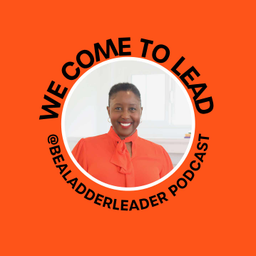
Conversations from the edge—We Come to Lead explores leadership, equity, and systems change through the lens of Black women and intersectional leaders who dare to defy the odds. Hosted by Nataki Garrett, this podcast asks bold questions, shares unfiltered truths, and spotlights the resilience, power, and complexity of those who lead from the intersections. It’s a space for curiosity, courage, and reimagining what leadership can—and should—be. bealadderleader.substack.com (https://bealadderleader.substack.com?utm_medium=podcast)
- Publisher
- created by Nataki Garrett Myers
- Category
- business · society & culture
- Language
- en
- Explicit
- No
- First episode
- 17 Jan 2025
- Latest episode
- 11 Sept 2026
Latest episodes
21 episodes in the feed.
11 Sept 2026
EP. 18 Art I Facts
Lonnie Bunch is leaving the Smithsonian. I was five and a half years old on the observation deck of the Washington Monument when I first felt the tension in my tummy about whether I was included in the ideas that this country touts about liberty and happiness. Years later I rode past the National Museum of African American History and Culture for the first time and had a thought I couldn't deny once I heard it. This episode is what happened between and since those two moments, and how it feels to watch it come full circle. pic taken August 2017. I look like my paternal grandmother in this picture.. This is a public episode. If you'd like to discuss this with other subscribers or get access to bonus episodes, visit bealadderleader.substack.com/subscribe (https://bealadderleader.substack.com/subscribe?utm_medium=podcast&utm_campaign=CTA_2)
25 May 2026
Ep. 17 Path Clear, Lights On
A piece crossed my desk recently. Twenty-one practical tips for new artistic directors, written by a long-tenured white man at a major regional theater. I read it twice. The second time, I felt tired. Not because the advice was bad. Most of it was technically correct in the way general advice tends to be technically correct. The tips are not the problem. The tips are the symptom. The choice to write tips, in this moment, is the data. So this episode is not a critique of the piece. The piece is evidence. This episode is a transmission, from one generation of leaders to the next, naming what is happening across higher education, federal government, the nonprofit sector, and the arts, and naming what those of us who came through the last shift owe the leaders coming up now. What is inside the episode We are not in a new generational moment. We are in the wreckage of the last one. More than half of the cohort the New York Times called a sea change in 2019 are no longer in their positions, and the bulk of the leaders who left did not move up. They left the field. The field that called them historic could not hold them for five years. And I name what I am doing now, and what some of us are doing now, building infrastructure outside the institutions that could not hold us, clearing path, keeping the lights on, for the leaders coming up behind us. Who this episode is for The leader reading the job description and wondering whether to apply. The leader already in the chair, trying to lead in conditions the practical wisdom of the field cannot account for. The leader who has read the tips and the articles and the LinkedIn posts and felt the gap between the advice and the actual conditions of her life, and who has been wondering, in the private place where leaders do that wondering, whether anyone in the generation ahead of her actually understands what she is walking into. I do. Some of us do. And what I want you to take from this episode is not despair. It is information. You are not crazy for noticing what you are noticing. You are not alone in seeing what you are seeing. The path is being cleared. The lights are on. Keep going. References cited in the episode The donor rescission at Oregon Shakespeare Festival was first reported by Drew Lindsay in the Chronicle of Philanthropy (https://www.philanthropy.com/news/race-shakespeare-and-a-theaters-fight-to-survive/). The most recent naming of the pattern across cultural institutions, including my own departure from OSF, is Emil J Kang (https://substack.com/profile/419766246-emil-j-kang) ’s essay “Men Retire. Women Get Fired (https://open.substack.com/pub/emilkang/p/men-retire-women-get-fired?r=4r4uav&utm_campaign=post-expanded-share&utm_medium=post%20viewer).” in The Reprise, published May 24, 2026. Anne Pasternak, director of the Brooklyn Museum, is quoted in that piece. Higher education data on the Ivy League women presidents draws from the Chronicle of Higher Education’s August 2024 reporting and the American Council on Education’s most recent presidential survey. Dr. Antoinette Candia-Bailey’s death is documented in coverage by 19th News and Office Hours with Dr. DeVeau, January 2024. Nonprofit demographic data comes from Candid’s 2024 State of Diversity in the U.S. Nonprofit Sector report and the Race to Lead surveys from the Building Movement Project. Federal workforce data is documented by ProPublica’s June 2025 investigation and the Feminist Majority Foundation’s July 2025 report on DEI rollbacks. The 69,000 federal positions eliminated by mid-2025, and the disparate impact by agency, is from those sources. Theater data on artistic director departures comes from HowlRound’s Regenerative Artistic Leadership Change report and American Theatre magazine’s reporting on theater closures since 2020. The Ohio political context, Senate Bill 1 and related legislation, is public record across Higher Ed Dive, Ohio Capital Journal, Signal Cleveland, and the Statehouse News Bureau. A note to subscribers If you have read this far and you are one of the leaders this episode is for, I want you to know that the coaching practice I run exists for exactly this reason. The Pay It Forward Initiative (https://coaching.natakigarrett.com/lls), supported by the Mellon Foundation, makes that work financially accessible for leaders in the arts and nonprofit sector who would not otherwise have access to it. If that is you, the application materials are on my site. And if you are not in that situation but you know a leader who is, send them this. The path gets clearer for the next person when the leaders who came before stop pretending the conditions are normal. We are writing the ending of this story ourselves. With you in view. Thanks for reading Be a Ladder Leader! This post is public so feel free to share it. DATA SOURCES (FOR REFERENCE) Higher Ed — Ivy League women presidents resignations: Chronicle of Higher Education, August 2024. Higher Ed — Claudine Gay tenure: NBC News, 19th News, January 2024. Higher Ed — Dr. Antoinette Candia-Bailey: Lincoln University, January 8, 2024; coverage via 19th News and Office Hours with Dr. DeVeau. Higher Ed — HBCU presidents departures: Washington Post / TheGrio, September 2023. Higher Ed — College presidency demographics: American Council on Education Presidential Survey, 2023; Eos Foundation Women’s Power Gap Initiative. Nonprofit — CEO and staff demographics: Candid, State of Diversity in the U.S. Nonprofit Sector, 2024. Nonprofit — BIPOC leadership underrepresentation across budget tiers: Candid, 2024; Race to Lead surveys (Building Movement Project) 2017–2024. Nonprofit — Voluntary turnover and workforce trends: Johnson Center Nonprofit Workforce Report, January 2025. Federal — 69,000 federal positions eliminated by mid-2025: Feminist Majority Foundation, July 2025. Federal — Disparate impact by agency: ProPublica, June 2025. Federal — Black women in federal workforce: U.S. Office of Personnel Management data, cited in Feminist Majority Foundation, July 2025. Federal — Black women’s unemployment increases: Feminist Majority Foundation, July 2025. Theater — 121 artistic director departures, theater closures: HowlRound, Regenerative Artistic Leadership Change, April 2025; American Theatre, Theatre in Crisis, July 2023. Theater — 2019 New York Times sea change article: Michael Paulson, New York Times, 2019. Arts and culture — Donor rescission and subsequent restoration of gifts at Oregon Shakespeare Festival: Drew Lindsay, Chronicle of Philanthropy. Arts and culture — Pattern of women and leaders of color being fired while men retire, including OSF reference: Emil Kang, ‘Men Retire. Women Get Fired.’, The Reprise (Substack), May 24, 2026. https://emilkang.substack.com/p/men-retire-women-get-fired Ohio — DEI legislation overview (Senate Bill 1, March 2025; House Bill 698, February 2026; K-12 expansion bills): Higher Ed Dive, Ohio Capital Journal, Signal Cleveland, WVXU, WOSU Public Media, Statehouse News Bureau, Prism Reports. Thanks for reading Be a Ladder Leader! This post is public so feel free to share it. This is a public episode. If you'd like to discuss this with other subscribers or get access to bonus episodes, visit bealadderleader.substack.com/subscribe (https://bealadderleader.substack.com/subscribe?utm_medium=podcast&utm_campaign=CTA_2)
27 Feb 2026
Ep. 16 It’s the Systems
This week on We Come to Lead, I take on celebrity scandal — not as gossip, but as a leadership case study. After watching the America’s Next Top Model docuseries, I found myself revisiting a familiar tension: why does our culture immediately narrow harm to a single person? Why do we focus on character and intention while leaving the system untouched? From ANTM to Ray Rice, from Puffy to the BAFTAs, from elite training pipelines to the Epstein files, this episode examines how white supremacy and rugged individualism train us to isolate blame — and how that reflex protects power. Oppressed people do not have the luxury of interpreting injustice as a series of bad actors. We experience repetition. Repetition reveals pattern. Pattern reveals structure. As an intersectional leader, I center systems change — not reform. Reform tweaks behavior. Systems change redesigns architecture. In this episode, I explore: * Why individualization is a function of white supremacy * How rugged individualism undermines thrivable leadership * What elite pipelines reveal about vulnerability and ambition * Why intuition and empathy are essential diagnostic tools * The Ladder Leadership lesson that moves us from reaction to redesign If we only remove the offender, we preserve the system. Intersectional leadership demands something more. Listen now. Thanks for reading Be a Ladder Leader! This post is public so feel free to share it. This is a public episode. If you'd like to discuss this with other subscribers or get access to bonus episodes, visit bealadderleader.substack.com/subscribe (https://bealadderleader.substack.com/subscribe?utm_medium=podcast&utm_campaign=CTA_2)
Contact We come to lead
- Guest appearances
- Does not typically book guests
Based on episode analysis; this does not confirm that the show is currently accepting guests.
Host of We come to lead?
Claim your podcast to manage its listing and keep your show details accurate.
Pod Engine is an independent podcast discovery and analytics service and is not affiliated with or endorsed by this podcast. Artwork and show content belong to their owners. Full legal notice.
Explore this show
Podcast research with Pod Engine