
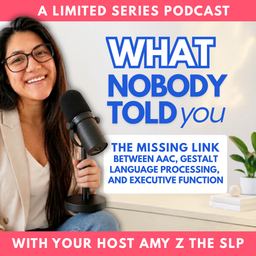
What Nobody Told You: Executive Function For Gestalt Language Processors, AAC Users, & Autistic Kids
Claim This Podcastby Amy Zembriski
Podcast Overview
<p>Families and professionals often ask why the autistic kids they support, specifically gestalt language processors and AAC users, are "stuck" despite all of their best efforts. What Nobody Told You is a podcast for parents, clinicians, and educators who are ready to look deeper. I'm Amy Zembriski, a pediatric speech-language pathologist and executive function specialist, and each episode I explore the connection between executive function, autism, gestalt language processing, and/or AAC — and what it actually looks like to support a child's brain. This is a limited series podcast meant to get you to start thinking beyond just surface level behaviors.</p>
Language
🇺🇲
Publishing Since
7/7/2026
1 verified contact email on file for What Nobody Told You: Executive Function For Gestalt Language Processors, AAC Users, & Autistic Kids
Pitch yourself as a guest, propose sponsorships, or reach out directly to the host.
Recent Episodes
July 7, 2026
Episode 6: Final Episode
<p>This episode is just a brief closing note to you. Thank you for being here and taking the time to listen. Executive function isn't about making neurodivergent kids fit a mold, it's about being truly responsive to how their brain works and showing them what they are capable of.</p><p></p><p><b>Resources:</b><br /><b><i>Freebie for Self-Reflection & IEP Accommodations<br /></i></b><a rel="noopener noreferrer nofollow" href="https://speechtherapyconnections.myflodesk.com/iepselfreflection" target="_blank">https://speechtherapyconnections.myflodesk.com/iepselfreflection</a></p><p></p><p><b><i>Social Media</i></b><br />Instagram: @amyz.theslp</p><p>TikTok: @amyz.theslp</p><p></p><p><b><i>Contact information</i></b></p><p><a rel="noopener noreferrer nofollow" href="mailto:info@speechtherapyconnectionsllc.com" target="_blank">info@speechtherapyconnectionsllc.com</a></p><p><br /><b><i>Blog</i></b><br /><a rel="noopener noreferrer nofollow" href="https://amyztheslp.com/blog/" target="_blank">https://amyztheslp.com/blog/</a></p><p></p><p><b><i>1-Hour Podcast Episode on the Gestalt Get Together: Executive Functioning & Gestalt Language Processing</i></b></p><p><a rel="noopener noreferrer nofollow" href="https://www.youtube.com/watch?v=UTPMVDIpl8k" target="_blank">https://www.youtube.com/watch?v=UTPMVDIpl8k</a><br /><br /><br /></p><p></p>
July 7, 2026
Episode 5: It's Not a Behavior Problem. It's an Executive Function Problem.
<p>This episode is about the kid who gets labeled as "difficult" and why almost every behavior that has that label is actually an executive function problem in disguise.<br /></p><p><b>What you'll take away:</b></p><ul><li>Taking things, shouting out, talking over others, — these aren't character flaws or bad parenting. They're likely showing you that a child has an executive function system that needs support and different supports than what they have been getting.</li><li>Knowing a rule and being able to apply it mid-impulse are two completely different things. Before you can ask a child to pause, they have to be able to notice an impulse is even happening.</li><li>The goal isn't compliance. It's building the internal observer — the part of the brain that can start to watch what's happening from the inside out. That observer is what makes real, lasting change possible.</li></ul><p></p><p><b>Resources:</b><br /><b><i>Freebie for Self-Reflection & IEP Accommodations<br /></i></b><a rel="noopener noreferrer nofollow" href="https://speechtherapyconnections.myflodesk.com/iepselfreflection" target="_blank">https://speechtherapyconnections.myflodesk.com/iepselfreflection</a><br /></p><p><b><i>Social Media</i></b><br />Instagram: @amyz.theslp</p><p>TikTok: @amyz.theslp<br /></p><p><b><i>Contact information</i></b></p><p><a rel="noopener noreferrer nofollow" href="mailto:info@speechtherapyconnectionsllc.com" target="_blank">info@speechtherapyconnectionsllc.com</a></p><p><br /><b><i>Blog</i></b><br /><a rel="noopener noreferrer nofollow" href="https://amyztheslp.com/blog/" target="_blank">https://amyztheslp.com/blog/</a></p><p></p><p><b><i>References</i></b><br />Barkley, R.A. (2012). Executive functions: What they are, how they work, and why they evolved. Guilford Press. <br /></p><p>Geurts, H. M., van den Bergh, S. F., & Ruzzano, L. (2014). Prepotent response inhibition and interference control in autism spectrum disorders: Two meta-analyses. Autism Research, 7(4), 407–420.</p><p></p><p>Magnuson, J. R., Peatfield, N. A., Fickling, S. D., Nunes, A. S., Christie, G., Vakorin, V., D'Arcy, R. C. N., Ribary, U., Iarocci, G., Moreno, S., & Doesburg, S. M. (2019). Electrophysiology of inhibitory control in the context of emotion processing in children with autism spectrum disorder. Frontiers in Human Neuroscience, 13, 78. </p>
July 7, 2026
Episode 4: Executive Functioning For AAC Users
<p>This episode is about AAC and executive function, and why you really can't talk about one without the other.<br /></p><p><b>What you'll take away:</b></p><ul><li>Using an AAC device isn't just pressing a button. It's a full sequence of executive function demands happening simultaneously: perception, attention, working memory, and inhibition.</li><li>When a child isn't accessing their device consistently, motivation might not be the issue. The EF system might just not have the support it needs to coordinate all of those moving parts at once.</li><li>Making the invisible visible through self-reflection is one of the most powerful things you can do for an AAC user. When kids can notice what they're doing well, they can start to replicate it.</li></ul><p></p><p><b>Resource</b></p><p><b><i>Freebie for Self-Reflection & IEP Accommodations<br /></i></b><a rel="noopener noreferrer nofollow" href="https://speechtherapyconnections.myflodesk.com/iepselfreflection" target="_blank">https://speechtherapyconnections.myflodesk.com/iepselfreflection</a></p><p><b><i>Social Media</i></b><br />Instagram: @amyz.theslp</p><p>TikTok: @amyz.theslp</p><p><b><i>Contact information</i></b></p><p><a rel="noopener noreferrer nofollow" href="mailto:info@speechtherapyconnectionsllc.com" target="_blank">info@speechtherapyconnectionsllc.com</a></p><p><br /><b><i>Blog</i></b><br /><a rel="noopener noreferrer nofollow" href="https://amyztheslp.com/blog/" target="_blank">https://amyztheslp.com/blog/</a></p><p><b><i>References</i></b><br />Barkley, R.A. (2012). Executive functions: What they are, how they work, and why they evolved. Guilford Press. </p><p><br />Bombonato, S., et al. (2023). Frontal aslant tract microstructure and executive function in children with childhood apraxia of speech. Brain and Language, 241, 105267.</p><p><br />Demetriou, E. A., et al. (2018). Meta-analysis of executive function in autism spectrum disorder. Neuropsychology Review, 28(3), 388–424.</p><p></p><p>Rakova, B., Hapčová, M., Celusáková, H., Franková, D., Kopčíková, M., Demkaninová, D., Januska, J., & Babinská, K. (2025). Cognitive abilities and executive functions as predictors of adaptive behavior in preschoolers with autism spectrum disorder and typically developing children: A comparative study. Research on Child and Adolescent Psychopathology, 53, 1525–1538.</p><p></p><p>Zelazo, P. D. (2020). Executive function and psychopathology: A neurodevelopmental perspective. Annual Review of Clinical Psychology, 16, 431–454.</p>
6 total episodes available
Deep-dive analytics for What Nobody Told You: Executive Function For Gestalt Language Processors, AAC Users, & Autistic Kids
Frequently asked questions
Have a different question and can't find the answer you're looking for? Reach out to our support team by sending us an email and we'll get back to you as soon as we can.
- What is What Nobody Told You: Executive Function For Gestalt Language Processors, AAC Users, & Autistic Kids?
<p>Families and professionals often ask why the autistic kids they support, specifically gestalt language processors and AAC users, are "stuck" despite all of their best efforts. What Nobody Told You is a podcast for parents, clinicians, and educators who are ready to look deeper. I'm Amy Zembriski, a pediatric speech-language pathologist and executive function specialist, and each episode I explore the connection between executive function, autism, gestalt language processing, and/or AAC — and what it actually looks like to support a child's brain. This is a limited series podcast meant to get you to start thinking beyond just surface level behaviors.</p> - How often does this podcast release new episodes?
This podcast updates daily.
- Where can I listen to this podcast?
This podcast is available on 4 platforms including Apple Podcasts, Spotify, and more. You can also use the RSS feed directly.
- Does this podcast accept guests?
No, this podcast does not typically feature guests.
Legal Disclaimer
Pod Engine is not affiliated with, endorsed by, or officially connected with any of the podcasts displayed on this platform. We operate independently as a podcast discovery and analytics service.
All podcast artwork, thumbnails, and content displayed on this page are the property of their respective owners and are protected by applicable copyright laws. This includes, but is not limited to, podcast cover art, episode artwork, show descriptions, episode titles, transcripts, audio snippets, and any other content originating from the podcast creators or their licensors.
We display this content under fair use principles and/or implied license for the purpose of podcast discovery, information, and commentary. We make no claim of ownership over any podcast content, artwork, or related materials shown on this platform. All trademarks, service marks, and trade names are the property of their respective owners.
While we strive to ensure all content usage is properly authorized, if you are a rights holder and believe your content is being used inappropriately or without proper authorization, please contact us immediately at hey@podengine.ai for prompt review and appropriate action, which may include content removal or proper attribution.
By accessing and using this platform, you acknowledge and agree to respect all applicable copyright laws and intellectual property rights of content owners. Any unauthorized reproduction, distribution, or commercial use of the content displayed on this platform is strictly prohibited.