
A podcast for Black and Brown writers who know their block isn't about discipline; it's about wounds. Hosted by High Priestess Lakeisha, developmental editor and founder of The Story Temple, each episode explores ancestral silence, the white gaze, nervous system patterns that shape creative resistance, and craft practices rooted in truth instead of performance. Ebonics as literary language. Code-switching as a choice, not obligation. Writing rage without apology. No performance required. <br/><br/><a href="https://thestorytemple.substack.com?utm_medium=podcast">thestorytemple.substack.com</a>
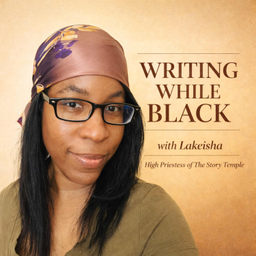
Writing While Black
Claim This Podcastby High Priestess Lakeisha, The Story Temple
10 episodes
Updated Daily
Accepts GuestsHas Sponsors
Podcast Overview
A podcast for Black and Brown writers who know their block isn't about discipline; it's about wounds. Hosted by High Priestess Lakeisha, developmental editor and founder of The Story Temple, each episode explores ancestral silence, the white gaze, nervous system patterns that shape creative resistance, and craft practices rooted in truth instead of performance. Ebonics as literary language. Code-switching as a choice, not obligation. Writing rage without apology. No performance required. <br/><br/><a href="https://thestorytemple.substack.com?utm_medium=podcast">thestorytemple.substack.com</a>
Language
🇺🇲
Publishing Since
9/10/2025
1 verified contact email on file for Writing While Black
Pitch yourself as a guest, propose sponsorships, or reach out directly to the host.
Recent Episodes
March 26, 2026
What I Mean When I Say “I Wasn’t Pulled In”
<p>In this episode, I talk about a sentence I’ve written in editorial letters more times than I can count: I wasn’t pulled in. I break down what I actually mean when I write it — and why it has nothing to do with showing versus telling. If you haven’t listened yet, start there. These notes pick up where the episode lands.</p><p>Once you settle the question of showing versus telling — once you accept that technique isn’t the issue — you’re left with a harder question.</p><p>If it’s not about the technique, what exactly is at stake when a writer stays outside the room? This episode is about diagnosis. These notes are about the cost.</p><p>Managed writing is writing that protects itself.</p><p>It explains before it lets you feel. It summarizes the hard moment instead of inhabiting it. It hedges at the exact sentence where it should commit. All of this looks like caution. It looks like craft consideration. It looks, sometimes, like humility — the writer not wanting to presume too much, not wanting to overstay their welcome on the page.</p><p>But what it really is, is a tax. A quiet, consistent withdrawal from the account.</p><p>The reader feels it even when they can’t name it. They finishes the piece and think it was fine. Well-written, even. But nothing moved. They didn’t carry anything away. They weren’t changed. And they won’t come back. No, the writing wasn’t bad. There was just nothing in it that needed them. The writer managed it so carefully that the reader’s particpation became optional.</p><p>That’s what managed writing costs. Not readers, necessarily. Connection.</p><p>The writer pays a tax too, though it’s less visible.</p><p>Every time a writer steps back from the experience — summarizes the hard moment, explains what the image meant before letting it land, hedges the sentence that should be a declaration — they’re making a trade. Safety for heat. Distance for control. They get to avoid the exposure of full commitment. The vulnerability of saying the true thing plainly and letting the reader do what they want with it.</p><p>What they lose is the reason they started writing in the first place.</p><p>Most writers I work with didn’t come to the page because they wanted to execute technique well. They came because something needed to be said. Because a story was pressing against the inside of them. Because they had something to witness, something to name, something to give. Writing from behind the experience is what happens when that original impulse gets educated out of them — when they learn enough craft to become self-conscious about the very instincts that brought them to the page.</p><p>This is what the performance wound does in the Fire element. It doesn’t kill the writing. It just makes sure the writer is never fully in it. Present enough to produce. Absent enough to stay safe.</p><p>The shift isn’t a craft fix. You can’t revise your way back into the room.</p><p>The shift is a trust decision. Trusting that the experience itself — your specific detail, your bodily truth, your conclusion arrived at in real time — is what the reader really came for. Not the explanation. Not the proof that you know what it means. The reader has no reason to doubt you.</p><p>That trust doesn’t come from better technique. It comes from understanding what’s underneath the distance. Which wound taught you that your presence needed managing. Which voice told you the experience wasn’t enough.</p><p>That’s the work this episode was pointing toward.</p><p>If you want to understand which wound is keeping you outside the room, <a target="_blank" href="https://the-story-temple.kit.com/the3wounds"><strong>The 3 Wounds Blocking Your Writing</strong></a> is the best place to start. It’s free.</p><p>If you’re ready to go deeper into the wound itself — to write from the other side of it — <a target="_blank" href="https://thestorytemple.substack.com/p/write-from-the-wound-a-7-day-shadow"><strong>Write From the Wound</strong></a><a target="_blank" href="https://thestorytemple.substack.com/p/write-from-the-wound-a-7-day-shadow"><strong> </strong></a>is a seven-day shadow work course built for exactly this.</p><p>And if you want to keep doing this work with a community of writers who are in the room with you, <a target="_blank" href="https://thestorytemple.substack.com/subscribe"><strong>the inner room of The Story Temple is open.</strong></a></p><p>with love from the waters,</p><p>High Priestess Lakeisha</p> <br/><br/>This is a public episode. If you'd like to discuss this with other subscribers or get access to bonus episodes, visit <a href="https://thestorytemple.substack.com/subscribe?utm_medium=podcast&utm_campaign=CTA_2">thestorytemple.substack.com/subscribe</a>
March 12, 2026
Your Body Knows: On What We Were Taught — and What it Costs Our Writing
<p>Nobody taught us to listen to our bodies.</p><p>For a lot of Black and Brown people — particularly women — the opposite was true. We were taught that the body is to be beaten into submission. The thing you override. The thing you push past on the way to wherever you’re going.</p><p>We were told: Don’t cry. Stop being so sensitive. You’re too emotional. Toughen up.</p><p>Strength looked like not feeling. Or more accurately — it looked like feeling and not showing it. Feeling and not responding to it. Feeling and continuing anyway, like the feeling wasn’t even there.</p><p>And there is real wisdom in that. Our people survived things by learning to adapt and to keep moving. That is ancestral power, and I won’t downplay it.</p><p>But some survival strategies have a shelf life. What kept our ancestors moving through unbearable circumstances can become — in <strong>our</strong> bodies, in <strong>our</strong> lives — a reflex that overrides information we actually need.</p><p>And it follows us directly to the writing desk.</p><p>The Silence Wound Lives in the Body, Not the Mind</p><p>In Sunday’s essay, The Two Drafts, I wrote about the silence wound — the reflex that deletes the sentence before you know you’re going to delete it. That softens the claim. That translates your voice into something more acceptable before anyone asks.</p><p>What I didn’t have space to say in the essay is this: <strong>that reflex isn’t a thought.</strong> You can’t argue yourself out of it. It’s a physiological response — your nervous system assessing a threat and responding accordingly. That’s just how the nervous system works.</p><p>And if you were taught that your body’s signals are obstacles to override, you will never catch this wound while it’s operating. Because catching it requires noticing it. And noticing requires you to be in relationship with your own body in the first place.</p><p>That’s not a small thing to ask. For a lot of us, our families, our communities, our culture conditioned us not to do that.</p><p>What I’m really asking when I say pay attention to what happens in your body when you write — is a reclamation assignment. Not a writing exercise.</p><p>The Time Spirit Got My Ass Together — One of Many</p><p>A few months ago I felt called to pull cards for the collective. Write up the reading. Share it on Substack.</p><p>I pulled the cards. I wrote it exactly the way Spirit gave it to me — raw, direct, no softening. Let it sit. Then went back to edit.</p><p>And started editing it down to the ground.</p><p>I was debating back and forth with Spirit like — I cannot say it like that. Somebody’s going to get offended. I was doing the thing in real time. Taking the potency out of something that was given to me in that specific form for a reason — because it needed to land a certain way — and sanding it down because my body was afraid of the response.</p><p>Spirit, very lovingly, got my ass together.</p><p>The message: yes, delivery matters. We should always use care in our communication. But sometimes something needs to be said in a specific way so it can land the way it needs to land. Put everything back exactly the way it was.</p><p>So I did. Quick proofread for spelling and grammar — because I’m an editor, that’s non-negotiable — and then I published it before my fear could talk me out of it again.</p><p>Then came the hard part. Sitting with it being out there. Edge-snatching and raw and on the internet for whoever needed it.</p><p>Here’s what that story illustrates: I know this work. I teach this work. I built a career helping writers find their truest voice on the page. And I still had to be corrected in real time.</p><p>That’s how deep the conditioning goes. It doesn’t care what you know. It cares how safe your body feels.</p><p>What Listening Looks Like</p><p>The work starts with noticing. Before you can change anything, you have to be willing to feel it — not analyze it, not fix it right away. Just feel it.</p><p>What does your body do when you open the document? When you start writing the sentence you know is going to make somebody clutch their pearls? Where does the tightness live? What do your hands do?</p><p>These are the beginning of a somatic writing practice. Learning to be in your body while you write — instead of writing from somewhere above it or outside of it entirely.</p><p>And I want to say this directly to the Black and Brown writers here: listening to your body is not self-indulgence. It is not weakness. It is not the opposite of discipline.</p><p><strong>It is the reclaiming of information that was systematically taken from us. The right to feel what we feel. To let the body speak. To treat its signals as data instead of obstacles.</strong></p><p>Our ancestors survived by overriding their bodies. They had to.</p><p>We get to survive differently. We get to write from them.</p><p>You Are Not Broken</p><p>You’re not undisciplined. You’re not someone who just needs better writing habits or a tighter morning routine.</p><p>You’re a writer whose body learned things that made sense at the time. And who now gets to learn something different.</p><p>That’s the work. It’s slower than any productivity system. And it’s worth every single minute.</p><p>If you’re ready to do this work in a structured container, <strong>Write From the Wound</strong> is a 7-day shadow work journey built for exactly this — not to push through the resistance, but to understand what it’s been protecting.</p><p><a target="_blank" href="https://thestorytemple.substack.com/p/write-from-the-wound-a-7-day-shadow"><strong>Join Write From the Wound → Click here</strong></a></p><p>Enjoyed this episode? Share it with a writer who needs it. And subscribe so you don’t miss what’s coming next.</p> <br/><br/>This is a public episode. If you'd like to discuss this with other subscribers or get access to bonus episodes, visit <a href="https://thestorytemple.substack.com/subscribe?utm_medium=podcast&utm_campaign=CTA_2">thestorytemple.substack.com/subscribe</a>
February 26, 2026
Stop Diluting Your Truth: James Baldwin and the Worthiness Wound
<p>James Baldwin didn’t mistake comfort for clarity.</p><p>He loved America. He said so plainly. And because he loved her, he insisted on the right to criticize her perpetually. That’s not a contradiction. That’s integrity.</p><p>In this episode, we move from silence to something more difficult: <strong>refusal.</strong></p><p>The Worthiness Wound doesn’t silence you. It negotiates you. It convinces you to pre-soften your truth before anyone asks you to. It teaches you to cook your sentences for someone else’s stomach. To translate yourself. To balance what doesn’t need balancing. To sand down what was meant to cut clean.</p><p>And then you call that craft.</p><p>That ain’t craft.</p><p>Craft asks: Is this precise? Is this clear? Is this doing what I intended it to do?</p><p>The Worthiness Wound asks: Will they still like me afterward?</p><p>Those are not the same question.</p><p>Baldwin wrote with precision, not palatability. He did not dull his sentences to widen his welcome. He sharpened them. He understood what too many writers are still learning:</p><p><strong>Clarity is not the same thing as comfort.</strong></p><p>Comfort protects the white gaze.Clarity protects the truth.</p><p>There is a difference between precision and palatability. Precision is artistic discipline. Palatability is political conditioning. One strengthens your authority. The other quietly erodes it.</p><p>When you write as if you must earn your place, your sentences apologize. When you write as if your place is already secured, your sentences stand.</p><p>Authority in writing isn’tvolume. It’s posture.</p><p>This episode asks you to notice where you are negotiating your truth before anyone has demanded it. Where you are shrinking preemptively. Where you are confusing “I didn’t relate” with “This failed.”</p><p>Not every room deserves dilution. Not every reader is your audience. Specificity is not exclusion. It’s power.</p><p>Baldwin didn’t dilute himself to widen his welcome.He widened the conversation by refusing to dilute.</p><p>If this conversation struck a nerve, my free guide <a target="_blank" href="https://the-story-temple.kit.com/the3wounds"><strong>The 3 Wounds Blocking Your Writing</strong></a> will help you name the patterns shaping your craft decisions — silence, worthiness and performance — so you can choose alignment over obedience.</p><p>Your truth doesn’t need to audition.</p><p><strong>With love from the waters,</strong></p><p><strong>High Priestess Lakeisha</strong></p><p><p>The Story Temple is a reader-supported publication. To receive new posts and support my work, consider becoming a free or paid subscriber.</p></p><p></p> <br/><br/>This is a public episode. If you'd like to discuss this with other subscribers or get access to bonus episodes, visit <a href="https://thestorytemple.substack.com/subscribe?utm_medium=podcast&utm_campaign=CTA_2">thestorytemple.substack.com/subscribe</a>
10 total episodes available
Deep-dive analytics for Writing While Black
Frequently asked questions
Have a different question and can't find the answer you're looking for? Reach out to our support team by sending us an email and we'll get back to you as soon as we can.
- What is Writing While Black?
- How often does this podcast release new episodes?
This podcast updates daily.
- Where can I listen to this podcast?
This podcast is available on 4 platforms including Apple Podcasts, Spotify, and more. You can also use the RSS feed directly.
- Does this podcast accept guests?
Information about guest appearances is not available.
Legal Disclaimer
Pod Engine is not affiliated with, endorsed by, or officially connected with any of the podcasts displayed on this platform. We operate independently as a podcast discovery and analytics service.
All podcast artwork, thumbnails, and content displayed on this page are the property of their respective owners and are protected by applicable copyright laws. This includes, but is not limited to, podcast cover art, episode artwork, show descriptions, episode titles, transcripts, audio snippets, and any other content originating from the podcast creators or their licensors.
We display this content under fair use principles and/or implied license for the purpose of podcast discovery, information, and commentary. We make no claim of ownership over any podcast content, artwork, or related materials shown on this platform. All trademarks, service marks, and trade names are the property of their respective owners.
While we strive to ensure all content usage is properly authorized, if you are a rights holder and believe your content is being used inappropriately or without proper authorization, please contact us immediately at hey@podengine.ai for prompt review and appropriate action, which may include content removal or proper attribution.
By accessing and using this platform, you acknowledge and agree to respect all applicable copyright laws and intellectual property rights of content owners. Any unauthorized reproduction, distribution, or commercial use of the content displayed on this platform is strictly prohibited.