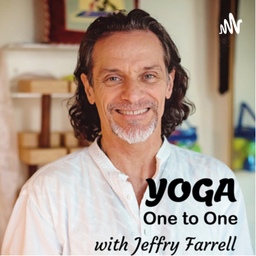
Podcast thumbnail for Yoga One to One with Jeffry Farrell

Yoga One to One with Jeffry Farrell

Claim This Podcast

by Jeffry Farrell

5.0(6 reviews)
6 episodes
Updated Daily
Accepts GuestsHas Sponsors

Podcast Overview

Host Jeffry Farrell has nearly 25 years of experience teaching private one-to-one yoga sessions. He has worked with people of all ages, abilities, and backgrounds, some of them over a period of more than 20 years. Jeffry is an expert at guiding yoga students towards claiming a personal yoga practice. His approach cultivates loyalty and liberation in the heart of the yoga student. Join us as we talk about his best practices on a practical level, his unique approach to yoga, and what he learned from years of study with his own yoga mentor, the Amazing Kumar Pallana.

Language

🇺🇲

Publishing Since

3/17/2021

1 verified contact email on file for Yoga One to One with Jeffry Farrell

Pitch yourself as a guest, propose sponsorships, or reach out directly to the host.

Recent Episodes

Episode thumbnail for The Private Yoga Teacher and the Response to Pain.

April 24, 2021

The Private Yoga Teacher and the Response to Pain.

In this episode, we discuss how to respond when a student comes into the session with pain or an injury. Or what happens when the teacher experiences pain and injury. We'd love to hear what you think! What did you get out of this episode? What else would you like us to talk about? Email jeff@jeffrykfarrell.com, or go to http://www.yogaonetoone.com and click the "contact" link. Below is not a full transcript, but a recap of the conversation: Injury, pain, tears, weaknesses, limitations, failures are all part of what we will address. It's inevitable. Injury is humbling. Pain is an honest teacher. With pain, we've entered a land that is a healing territory. A land of empathy. An opportunity to learn. It teaches us. To experience pain is an invitation to a path of humility. To be humble is to take time. To take an honest look at oneself. A time for self-examination. Svadaya. We see our own limitations, and our abilities, dreams, desires. We can develop a respect for who we are. It leads to a greater understanding of our own identity, and acceptance of our own nature. Our own dignity. When you have that awareness, nobody can take it away from you. These injuries lead us back to stillness. When you're going through injury, you do experience a range of emotions. Not necessarily reactive to that event. Sometimes the emotions are not separate from the event. They lie deep within us and the injuries give us the opportunities to recognize that and perhaps to let them go. To truly make changes within ourselves. And if we can work with that understanding for ourselves, that's what we want to take in our work with other people. Because an injury is physical, but the yoga practices observe us as physical, emotional, mental, soul beings. The patterns in each of those levels become present to us in our injury. If we address it on that level, with patience, and a kind of abiding understanding that lets yourself feel what you're feeling, that's when real change and healing can occur. Some people connect pain with pity. And there are people who completely deny it and go the other direction. And we have to be conscious of what this person is going through, and we want to bring them to a present-moment focus. Because sometimes a diagnosis becomes wrapped up in a person's identity. It is this sense of identification will illness, disease, diagnosis that is in itself a serious problem. We are not those things. We are not truly limited by those things. Sometimes healing does not mean that you get better on a physical level necessarily. But it does mean that you can make an adjustment on some profound level in your life. When someone comes in with pain, illness, injury, a diagnosis, etc., you want to come to a present-moment focus with them. You and them together. It involves trust. While you don't want them to complain about it, you do want them to know that you are interested in what they are experiencing. Invite them to share with you. And we invite them to take a breath and release. Not to deny their experience, but to let it be less grasped. To let go of their expectations, their to-do list, the rest of their day or week or season. Remind them that those programs run in their minds and we invite them to let that go. Let that go and be present. So we begin to loosen some of that identification with suffering. Suffering and pain are not the same. Pain is inevitable. The suffering is sometimes inevitable. We invite the observation of pain, but not the anticipation of it. We invite the recognition of presence. When we begin to self-examine and find further connections with our pain, it's amazing how the suffering becomes present and we begin to unlock it. We can begin to unlock the emotional content. The mental content and the future concern. It's important for the yoga teacher to release judgement, heighten discernment, and cultivate curiosity.

Episode thumbnail for Vision for a Private Yoga Teaching Practice Part One: Biomechanical Modalities

April 17, 2021

Vision for a Private Yoga Teaching Practice Part One: Biomechanical Modalities

About this episode: Jeff discusses various biomechanical modalities adjacent to yoga, whose influence can be an important factor in the cultivation of the vision of a yoga teaching practice, particularly in the one-to-one setting. Recorded in the backyard on a rainy day. Links mentioned: www.yogaonetoone.com Your Yoga Consultation Cheat Sheet More links in the body of the show notes. OVERVIEW/SUMMARY: Most yoga teacher training programs focus on teaching in the group setting. Over the past couple of decades, the number of yoga practitioners has exploded to now 40 million people, and so have yoga teacher training programs, in response. The old-fashioned way, however, was for one yoga teacher to teach one student at a time. This began to change when Sri Rama Krishna directed Vivakananda and others to take the yoga practices into the world, which led to yoga being introduced to the West. B.K.S. Iyengar and Swami Yogananda had a tremendous impact on yoga practices in the United States over the past century. How can a teacher come out of a yoga teacher training, which may have focused on group classes, and prepare themselves specifically to teach in the one-to-one setting? Open your mind to, not only other lineages of yoga than the one you have trained in, but in other biomechanical modalities that may be adjacent to the yoga practice. This is part of claiming your own practice and keeping the beginner’s mind. Additional modalities may include Pilates, the Alexander Technique, the Trager Approach, Feldenkrais, energy practices, and others. The private yoga teacher will benefit from personal experience with these modalities to expand their toolkit for working with students with a variety of needs, backgrounds, and abilities. How does the yoga teacher begin to discern what modalities might be valuable in their teaching practice? They must implement these modalities in their own personal practice and test their value that way. A teacher should not bring to a student what they have not experienced themselves. In addition to the modalities listed above, biomechanical pioneers/pioneering ideas of the 20th century worth investigating: Ida Rolf (developer of the Rolfing technique). Upledger Institute (craniosacral practices) Muscle activation techniques Doug Keller Thomas Myers (Anatomy Trains) Erik Dalton Dr. Timothy McCall Dr. John Sarno The Bates Eye Method Related disciplines of body/voice and speech/movement/dance instruction are valuable, such as: Kristin Linklater Cicely Berry Voice and the actor : Berry, Cicely : Free Download, Borrow, and Streami... Includes index These alternate modalities can open the door to the more subtle aspects of the yoga practice. The most important component of the private yoga teaching practice, however, is loving your students. Seek beyond your own confirmation biases, remain curious, challenge what you know. Work directly with massage therapists, physical therapists, and chiropractors. Learn what works and what doesn’t. Integrate your experience. On a practical level, your connection with these other practitioners can develop into networks that can serve your students, yourself, and these other practitioners through referrals. To sum up: have a beginner’s mind, seek beyond your confirmation bias, remain curious, be grounded, engage in daily practice (awareness, discipline, self examination grounded in biomechanics), connect with practitioners of other modalities and experience them, communicate in terms of the biomechanics and allow that to integrate into more subtle, deeper, broader practices.

Episode thumbnail for How to Conduct Your First Yoga Consultation Session

April 9, 2021

How to Conduct Your First Yoga Consultation Session

About this episode: Jeff discusses the journey of the yoga student, and he gives practical tips for structuring phone inquiries and initial consultation sessions designed to convert the curious to the committed. Recorded in the backyard. You’ll hear the dogs. Links mentioned: www.yogaonetoone.com Your Yoga Consultation Cheat Sheet Yoga Gems by Georg Feuerstein Yoga, Youth, and Reincarnation by Jess Stearn OVERVIEW/SUMMARY: We talk about how the Teacher/Student dynamic shapes the student’s journey. Our aim is for the yoga teacher/listener to walk away with tools and insights to establish - with clarity - the arc of that journey, using guiding principles that give the teacher and students a firm foundation that holds true, despite the wildly unpredictable nature of life. The ultimate destination of a private yoga student’s journey is for them to reach a point where they claim their own personal practice. Because the yoga practice doesn’t fit into neat little boxes, the yoga teacher benefits from principles and systems that can guide them as they work to serve individuals with greatly varying needs. This allows them to be confident in their teaching, but also in the progress of the student. Not just physically, but in the larger development that the yoga addresses. Jeffry then goes through the details of how he approaches an inquiry, when someone calls him asking about private yoga sessions. He talks about the importance of listening carefully, and about using that phone call as an opportunity to determine whether you are even the right teacher for that person. Jeffry uses the inquiry call to establish some baseline understandings, then if appropriate, he schedules a brief, complimentary consultation session. The consultation session is an opportunity for the yoga teacher to observe and listen to the student. You can get a sense of their needs, and establish a rapport. Jeffry goes into great detail about the process of listening and responding to the student as they are. The consultation includes a discussion of the practicalities of the practice, such as payment rates and policies, scheduling, etc. It also includes a very simple mat practice, in which the aim is for the teacher and the student to observe micromovements, the alignment of the spine, and subtleties that form the baseline of the practice. Jeffry details a sample practice, which ultimately brings the student to a point of stillness. This session is also a great opportunity to dispel any myths or misunderstandings about the yoga practice that the student may have come in with, or discuss particular styles of yoga. Jeff emphasizes the importance of the yoga teacher to stay up-to-date with regard to developments in our understanding of functional anatomy. We wrap up with a discussion of the concept of a Good Understanding, where Jeff learned it, and how he implements it - and why we don’t use contracts.

6 total episodes available

Deep-dive analytics for Yoga One to One with Jeffry Farrell

Frequently asked questions

Have a different question and can't find the answer you're looking for? Reach out to our support team by sending us an email and we'll get back to you as soon as we can.

What is Yoga One to One with Jeffry Farrell?

Host Jeffry Farrell has nearly 25 years of experience teaching private one-to-one yoga sessions. He has worked with people of all ages, abilities, and backgrounds, some of them over a period of more than 20 years.

Jeffry is an expert at guiding yoga students towards claiming a personal yoga practice. His approach cultivates loyalty and liberation in the heart of the yoga student.

Join us as we talk about his best practices on a practical level, his unique approach to yoga, and what he learned from years of study with his own yoga mentor, the Amazing Kumar Pallana.

How often does this podcast release new episodes?

This podcast updates daily.

Where can I listen to this podcast?

This podcast is available on 4 platforms including Apple Podcasts, Spotify, and more. You can also use the RSS feed directly.

Does this podcast accept guests?

No, this podcast does not typically feature guests.

Legal Disclaimer

Pod Engine is not affiliated with, endorsed by, or officially connected with any of the podcasts displayed on this platform. We operate independently as a podcast discovery and analytics service.

All podcast artwork, thumbnails, and content displayed on this page are the property of their respective owners and are protected by applicable copyright laws. This includes, but is not limited to, podcast cover art, episode artwork, show descriptions, episode titles, transcripts, audio snippets, and any other content originating from the podcast creators or their licensors.

We display this content under fair use principles and/or implied license for the purpose of podcast discovery, information, and commentary. We make no claim of ownership over any podcast content, artwork, or related materials shown on this platform. All trademarks, service marks, and trade names are the property of their respective owners.

While we strive to ensure all content usage is properly authorized, if you are a rights holder and believe your content is being used inappropriately or without proper authorization, please contact us immediately at hey@podengine.ai for prompt review and appropriate action, which may include content removal or proper attribution.

By accessing and using this platform, you acknowledge and agree to respect all applicable copyright laws and intellectual property rights of content owners. Any unauthorized reproduction, distribution, or commercial use of the content displayed on this platform is strictly prohibited.