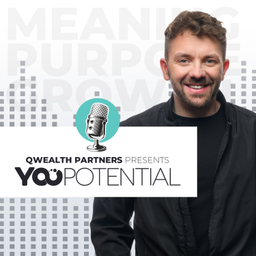
Podcast thumbnail for YouPotential

YouPotential

Claim This Podcast

by Shaun Maslyk

5.0(1 reviews)
57 episodes
Updated Daily
Accepts GuestsHas Sponsors
24

Podcast Authority

Beta
PoorBased on show quality, social media presence, reviews, charts, and more
Pod Engine
Quality48
Social0
YouTube0
Engagement0

Podcast Overview

YouPotential explores what it truly means to live a life well lived — through the lens of psychology, money, and meaning. Hosted by Shaun Maslyk—Certified Financial Planner®, Financial Behaviour Specialist®, and Positive Psychology Practitioner—the podcast delivers science-backed insights, candid conversations, and real stories that help people live with more intention.

Language

🇺🇲

Publishing Since

5/13/2025

Unlock The Full Podcast Authority Score Report

See how your podcast performs across key metrics

24

Podcast Authority

Beta
PoorBased on show quality, social media presence, reviews, charts, and more
Pod Engine
Quality48
Social0
YouTube0
Engagement0
6
Excellent Areas
0
Good Performance
13
Growth Opportunities
excellent
Publishing Consistency
Every 7 days
Performing excellently!
poor
Episode Thumbnails

Recommendations available

Unlock the full report to see detailed tips

+16 More Metrics

Unlock comprehensive insights including:

  • • YouTube presence analysis
  • • Social media reach metrics
  • • RSS compliance scoring
  • • Podcast 2.0 features
  • • Technical standards
What's Included in Your Full Report

Detailed Analytics

  • Complete breakdown of all 19 authority metrics
  • Personalized recommendations for each metric
  • Industry benchmarks and comparisons
  • Technical RSS feed analysis and compliance scoring

Growth Strategies

  • Step-by-step action plans for improvement
  • Quick wins to boost your score immediately
  • Pro tips from successful podcasters
Get your free podcast insights report

See how your show performs across every key metric

Instant delivery
No spam
Attract Better Guests

High authority scores make your podcast more attractive to industry leaders and influencers who want to appear on credible shows.

Secure Sponsorships

Sponsors look for podcasts with proven authority and engagement. Your score demonstrates your podcast's value to potential partners.

Grow Your Audience

Understanding your strengths and weaknesses helps you make data-driven decisions to expand your listener base effectively.

Reach the team behind YouPotential

Verified contact details for this show aren't on file yet — sign up to get notified when they land.

Recent Episodes

Episode thumbnail for The Key to Happiness Isn’t What You Think | Dr. Sonja Lyubomirsky

June 25, 2026

The Key to Happiness Isn’t What You Think | Dr. Sonja Lyubomirsky

<p>After 36 years of studying what makes people happy, Dr. Sonja Lyubomirsky landed somewhere she didn’t expect: the key isn’t success or achievement — it’s feeling loved. And feeling loved, it turns out, is something you can build.</p><p><strong>Episode Summary</strong></p><p>Dr. Sonja Lyubomirsky has spent her career running what she calls happiness interventions — essentially clinical trials, but instead of testing a medication, her lab tests practices like writing gratitude letters or doing acts of kindness. After nearly three decades of this work, she noticed something: almost every practice that reliably makes people happier works for the same underlying reason. It makes them feel more connected to and loved by others.</p><p>That insight became her new book, How to Feel Loved, co-written with relationship scientist Harry Reis. The central, quietly radical idea is that you can be surrounded by love and still not feel it — and that the fix isn’t to change yourself or to persuade anyone to love you more. It’s to change the conversation. A relationship, as Sonja frames it, is just a series of conversations, which means the next one is always within your control.</p><p>The conversation moves from the science to the deeply practical: why “going first” with genuine curiosity disarms the walls we build, how a parent breaks through to a kid over a video game, what makes us reach for the impressive story instead of the connecting one, and the five mindsets that help people feel more loved. Shaun and Sonja also get into money — specifically why the spending that actually buys happiness tends to be spending on connection — and close on the vulnerability paradox: showing more of ourselves, at the right time, usually makes us feel more loved, not less.</p><p>For an audience of people who have built successful lives and are quietly asking what it’s all for, this one lands on the answer that tends to matter most at the end.</p><p><strong>Key Topics Covered</strong></p><p><strong>— </strong>The 36-year conclusion: feeling loved is the key to happiness</p><p><strong>— </strong>Why nearly every happiness intervention works through connection</p><p><strong>— </strong>The difference between being loved and feeling loved</p><p><strong>— </strong>“Change the conversation” — control you actually have</p><p><strong>— </strong>Going first: leading with genuine curiosity</p><p><strong>— </strong>The five mindsets of feeling loved</p><p><strong>— </strong>Multiplicity: holding people as more than one trait</p><p><strong>— </strong>Listening to learn vs. listening to respond</p><p><strong>— </strong>Spending money on connection, growth, and generosity</p><p><strong>— </strong>The vulnerability paradox</p><p><strong>MEMORABLE QUOTES</strong></p><p>“Really the key to happiness is feeling loved.”</p><p><strong>Timestamp: [03:54]</strong></p><p>“You can have love in your life, you can be loved and not feel loved.”</p><p><strong>Timestamp: [17:23]</strong></p><p>“You don’t actually have to change yourself. You don’t actually have to change the other person. All you have to do is change the conversation.”</p><p><strong>Timestamp: [18:32]</strong></p><p>“A relationship is just a series of conversations.”</p><p><strong>Timestamp: [18:38]</strong></p><p>“If you want to feel more loved, the first step is actually to make the other person feel more loved. So you go first.”</p><p><strong>Timestamp: [18:50]</strong></p><p></p><p><strong>ABOUT DR. SONJA LYUBOMIRSKY</strong></p><p>Dr. Sonja Lyubomirsky is a professor of psychology at UC Riverside and one of the most widely cited happiness researchers in the world. For nearly thirty years, her lab has run happiness interventions — rigorous trials testing which practices actually move well-being.</p><p>Born in Russia and raised partly in the United States, she brings a cross-cultural eye to questions of happiness, connection, and what it means to feel at home with other people. She teaches an undergraduate happiness course of 300 students — complete with a song playlist for every lecture.</p><p>Her new book, How to Feel Loved, co-authored with relationship scientist Harry Reis, is, in her words, the most important thing she’s done in her career — because it distills decades of research into the one thing that turned out to matter most.</p><p><strong>CONNECT &amp; RESOURCES</strong></p><p><strong>Connect with Dr. Sonja Lyubomirsky</strong></p><p><strong>— </strong>Website: howtofeelloved.com</p><p><strong>— </strong>Book: How to Feel Loved — howtofeelloved.com (take the mindset quiz)</p>

Episode thumbnail for Train Your Mind Like Your Body | Andy Riise

June 18, 2026

Train Your Mind Like Your Body | Andy Riise

<p>Andy Riise has spent his life around pressure. Twenty years in the U.S. Army, including West Point, Iraq, and Afghanistan. A first post-military job in Major League Baseball with the Cincinnati Reds. Mental performance coaching in the NFL with the Chicago Bears. But the thread running through all of it isn’t toughness in the way we usually picture it. It’s the opposite of the “suck it up and drive on” culture he grew up in.</p><p>In this conversation, Andy lays out his core idea: mental fitness is trainable. He uses the image of an arena — a structure with character as its foundation, the four C’s as its pillars, connection as the frame, and culture as the dome. Around that image he draws a sharper distinction: most people are either lost between arenas, watching from the spectator seats, or actually in the arena, willing to try and fail in public. The invitation of the episode is to step in.</p><p>The turn comes when Andy talks about his own hardest battles — not combat, but the eight inches between his ears. He’s candid about imposter syndrome at West Point, the voice that attacked him daily, and the mentor (Captain Carl Olsen) who first taught him that confidence and focus are skills, not gifts. From there he gives the listener something practical: a thirty-second daily check-in (surviving, resilient, or thriving), the question “what can you do to fight to the right,” and the Four C’s framework for navigating change.</p><p>He also pushes back on the cult of grit. There’s a glass ceiling, he says — a time to grit, a time to quit, and a time to pivot — and he tells the story of a minor-league ballplayer hanging on to a dream at the cost of everything else. The conversation closes where YouPotential always returns: identity, money, and what happens when your whole sense of self is tied to the scorecard.</p><p><strong>Key Topics Covered</strong></p><ul><li><strong>The Arena as operating system:</strong> A visual model for character, mental fitness, connection, and culture.</li><li><strong>Three kinds of people:</strong> The lost, the spectators (and critics), and the performers in the arena.</li><li><strong>Identity in transition:</strong> Leaving a twenty-year military identity and asking “who am I?” not just “what’s next?”</li><li><strong>The real battlefield:</strong> Why the hardest fights are internal, not external.</li><li><strong>Mental fitness is trainable:</strong> Treating the mind like the body — reps, recovery, repeat.</li><li><strong>The daily check-in:</strong> Surviving, resilient, or thriving — and “what can I do to fight to the right?”</li><li><strong>The Four C’s:</strong> Confidence, control, commitment, challenge — with control as the entry point.</li><li><strong>Grit’s glass ceiling:</strong> When to grit, when to quit, when to pivot.</li><li><strong>Money and identity:</strong> What happens when self-worth is tied to being the breadwinner.</li></ul><br/><p><strong>Memorable Quotes</strong></p><p>“The hardest battles you fought weren’t in Iraq or Afghanistan. They were in the eight inches between your ears.”</p><p>Timestamp: [17:33] (host frame, Andy affirms)</p><p>“I thought that it made me automatically mentally tough and I was wrong.”</p><p>Timestamp: [18:25]</p><p>“Everybody’s fighting this war for mental fitness.”</p><p>Timestamp: [22:14]</p><p>“The credit belongs to the performers who are in the arena.”</p><p>Timestamp: [06:33]</p><p>“To develop black belt skills you have to have a white belt mindset.”</p><p>Timestamp: [01:04:04]</p><p><strong>About Andy Riise</strong></p><p>Andy Riise is a mental performance coach who works at the intersection of behavioral science and lived experience. Before coaching, he served twenty years in the U.S. Army, beginning at West Point and including combat deployments to Iraq and Afghanistan, along with work supporting elite special operations units.</p><p>After the military, Andy moved into performance coaching — first in Major League Baseball with the Cincinnati Reds, then in the NFL with the Chicago Bears. His philosophy is built around the idea that mental fitness can be trained like the body, using assessments, skills, and repetition rather than slogans or hacks.</p><p>He’s the host of the Skull Sessions Podcast, the founder of Design to Perform, and is writing a book with the working title Step Into the Arena. He lives with his wife and four children, and names service as his principal core value.</p><p><strong>Connect With Andy Riise</strong></p><ul><li>Website: andyriise.com</li><li>Podcast: Skull Sessions Podcast</li><li>Coaching: Design to Perform</li></ul><br/><p><strong>Resources Mentioned</strong></p><ul><li>Theodore Roosevelt’s “The Man in the Arena” (from the “Citizenship in a Republic” speech)</li><li>The Four C’s model of mental toughness (confidence, control, commitment, challenge)</li><li>Ford v Ferrari (referenced on the mind–body / man–machine relationship)</li><li>The Pantheon in Rome (the architectural metaphor for Andy’s model)</li><li>“The measure of a life is in its service” — motto of Sam Houston State University</li></ul><br/><p><strong>About YouPotential</strong></p><p>YouPotential explores what it means to live a meaningful life — through conversations about money, purpose, relationships, and becoming. Hosted by Shaun Maslyk.</p><p>“Sometimes it’s not the answers we learn from — but the questions.”</p>

Episode thumbnail for I Built a Business That Doesn't Need Me | Jodie Cook

June 11, 2026

I Built a Business That Doesn't Need Me | Jodie Cook

<p><strong>EPISODE SUMMARY</strong></p><p>Jodie Cook has lived several lives most people would be happy with just one of: founder of a social media agency she scaled and sold, author, Forbes columnist, competitive powerlifter for Great Britain, and now the founder of an AI company, Coachbox. But this conversation isn't a highlight reel. It's an excavation of the mental operating system underneath the wins — the framings and beliefs that let her keep moving when most people would freeze.</p><p>We start with Charlie Cole, the alter ego she invented to catch herself in the act of “good girl conditioning” — the inherited training to be polite, agreeable, and small. From there the conversation moves through the stories that shaped her: a self-employed mother who taught her what work looked like, fifteen jobs before she was twenty-one, and an early decision that the words you use to describe yourself are the words you eventually become.</p><p>The emotional center is March 2020. Jodie had built an agency that ran without her — she traveled four months a year, and her team pulled rocks out of her backpack rather than putting them in. Then COVID took a quarter of her clients in a week, and she had to decide who she was when the thing she'd built was on fire. What she did next, and what it taught her about when to hold on and when to let go, is the heart of this episode.</p><p>For anyone who has built something successful and quietly wondered “is this it?” — or who suspects the story running their life was written by someone else — this is a conversation about taking the pen back.</p><p><strong>KEY TOPICS COVERED</strong></p><ul><li>Good girl conditioning &amp; the alter ego: why Jodie invented Charlie Cole, and how an alter ego is permission to be more yourself.</li><li>The power of self-naming: calling it “my business” when it was just her — the label comes before the identity.</li><li>Money as freedom: how a purple Kia Picanto at 17 wired a belief that money equals freedom and travel.</li><li>A business that doesn't need you: rewarding self-sufficiency and getting your ego out of the team's way.</li><li>Reframing fear as “go time”: a childhood framing of nerves as excitement that became a lifelong advantage.</li><li>Adlerian psychology: why she believes you chose your problems — and why that's liberating.</li><li>“Living in the end”: the nightly visualization practice she uses before competitions and big decisions.</li><li>The personal success system: why everyone has a repeatable recipe for their wins.</li><li>Playing your ace cards: the things that come easy to you that you've been taught to hide.</li></ul><br/><p><strong>MEMORABLE QUOTES</strong></p><p>“I think that everyone's alter ego is just them. It's just who they would be if they weren't afraid of something or if they didn't need permission.”</p><p>📍 03:24</p><p>“take your power back. Who are you waiting for? Like no one cares, they're all doing their own stuff.”</p><p>📍 07:01</p><p>“my job is to never put out the same fire twice.”</p><p>📍 16:42</p><p>“I love the idea that nothing in my past had any power at all over who I am now. I chose it. Because you do take your power back.”</p><p>📍 34:36</p><p>“trying is a confession of absence. So as soon as you're trying to get something, you're like basically saying, I don't have it.”</p><p>📍 35:32</p><p><strong>ABOUT JODIE COOK</strong></p><p>Jodie Cook is a British entrepreneur, author, and athlete. She founded a social media agency at 22 and sold it ten years later, then spent time helping other agency owners navigate their own exits. She is a Forbes columnist, the author of several books including Ten Year Career, and competes for Great Britain in bench press.</p><p>Her latest venture is Coachbox AI, a platform that lets coaches, consultants, and founder-led businesses build their own AI version of themselves — a company that grew, fittingly, out of people simply asking her to make one for them. A committed digital nomad, she travels the world with a single suitcase and a clear philosophy: that the words you use to describe yourself shape who you become, and that almost everything you need to succeed, you already have.</p><p><strong>RESOURCES MENTIONED</strong></p><ul><li>The Courage to Be Disliked by Ichiro Kishimi &amp; Fumitake Koga — the Adlerian book Jodie travels with</li><li>Alfred Adler / individual psychology — goal-based vs. cause-and-effect thinking</li><li>Neville Goddard — the “living in the end” philosophy</li><li>Akira the Don &amp; “Meaning Wave” — introduced her to Goddard (album: Stop Trying)</li><li>Dr. Wayne Dyer — “see someone's highest potential and treat them like that's all you see”</li><li>Coachbox AI — Jodie's current company</li></ul><br/><p><strong>ABOUT YOUPOTENTIAL</strong></p><p>YouPotential explores what it means to live a meaningful life — through conversations about money, purpose, relationships, and becoming. Hosted by Shaun Maslyk. “Sometimes it's not the answers we learn from — but the questions.”</p>

57 total episodes available

Deep-dive analytics for YouPotential

Frequently asked questions

Have a different question and can't find the answer you're looking for? Reach out to our support team by sending us an email and we'll get back to you as soon as we can.

What is YouPotential?

YouPotential explores what it truly means to live a life well lived — through the lens of psychology, money, and meaning. Hosted by Shaun Maslyk—Certified Financial Planner®, Financial Behaviour Specialist®, and Positive Psychology Practitioner—the podcast delivers science-backed insights, candid conversations, and real stories that help people live with more intention.

How often does this podcast release new episodes?

This podcast updates daily.

Where can I listen to this podcast?

This podcast is available on 4 platforms including Apple Podcasts, Spotify, and more. You can also use the RSS feed directly.

Does this podcast accept guests?

No, this podcast does not typically feature guests.

Legal Disclaimer

Pod Engine is not affiliated with, endorsed by, or officially connected with any of the podcasts displayed on this platform. We operate independently as a podcast discovery and analytics service.

All podcast artwork, thumbnails, and content displayed on this page are the property of their respective owners and are protected by applicable copyright laws. This includes, but is not limited to, podcast cover art, episode artwork, show descriptions, episode titles, transcripts, audio snippets, and any other content originating from the podcast creators or their licensors.

We display this content under fair use principles and/or implied license for the purpose of podcast discovery, information, and commentary. We make no claim of ownership over any podcast content, artwork, or related materials shown on this platform. All trademarks, service marks, and trade names are the property of their respective owners.

While we strive to ensure all content usage is properly authorized, if you are a rights holder and believe your content is being used inappropriately or without proper authorization, please contact us immediately at hey@podengine.ai for prompt review and appropriate action, which may include content removal or proper attribution.

By accessing and using this platform, you acknowledge and agree to respect all applicable copyright laws and intellectual property rights of content owners. Any unauthorized reproduction, distribution, or commercial use of the content displayed on this platform is strictly prohibited.