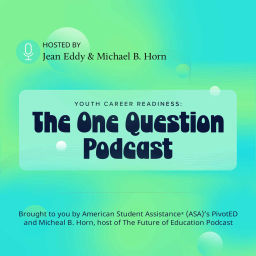
Twice per month, this podcast features one-question interviews with celebrities from various sectors, including arts and entertainment, sports, journalism, and more, on their career advice and insights for youth. Hosts and authors Michael B. Horn and ASA's Jean Eddy will speak with guests about how they navigated a path to career success, things they wish they had known, and advice they would offer to middle and high schoolers about careers. This is for all caring adults interested in learning how they can help the kids and teens in their lives learn about careers and prepare for their futures. <br/><br/><a href="https://michaelbhorn.substack.com/s/youth-career-readiness-the-one-question?utm_medium=podcast">michaelbhorn.substack.com</a>

Youth Career Readiness: The One Question Podcast
Claim This Podcastby Michael B. Horn & Jean Eddy
Podcast Authority
Beta
Podcast Overview
Twice per month, this podcast features one-question interviews with celebrities from various sectors, including arts and entertainment, sports, journalism, and more, on their career advice and insights for youth. Hosts and authors Michael B. Horn and ASA's Jean Eddy will speak with guests about how they navigated a path to career success, things they wish they had known, and advice they would offer to middle and high schoolers about careers. This is for all caring adults interested in learning how they can help the kids and teens in their lives learn about careers and prepare for their futures. <br/><br/><a href="https://michaelbhorn.substack.com/s/youth-career-readiness-the-one-question?utm_medium=podcast">michaelbhorn.substack.com</a>
Language
🇺🇲
Publishing Since
9/10/2024
Unlock The Full Podcast Authority Score Report
See how your podcast performs across key metrics
Podcast Authority
Beta
Recommendations available
Unlock the full report to see detailed tips
Recommendations available
Unlock the full report to see detailed tips
Unlock comprehensive insights including:
- • YouTube presence analysis
- • Social media reach metrics
- • RSS compliance scoring
- • Podcast 2.0 features
- • Technical standards
Detailed Analytics
- Complete breakdown of all 19 authority metrics
- Personalized recommendations for each metric
- Industry benchmarks and comparisons
- Technical RSS feed analysis and compliance scoring
Growth Strategies
- Step-by-step action plans for improvement
- Quick wins to boost your score immediately
- Pro tips from successful podcasters
See how your show performs across every key metric
High authority scores make your podcast more attractive to industry leaders and influencers who want to appear on credible shows.
Sponsors look for podcasts with proven authority and engagement. Your score demonstrates your podcast's value to potential partners.
Understanding your strengths and weaknesses helps you make data-driven decisions to expand your listener base effectively.
1 verified contact email on file for Youth Career Readiness: The One Question Podcast
Pitch yourself as a guest, propose sponsorships, or reach out directly to the host.
Recent Episodes

June 9, 2026
Colin Mochrie: Study, Practice, and Enjoy
<p>Colin Mochrie, the celebrated improv comedian from “Whose Line Is It Anyway,” joined us to discuss breaking into improv comedy as a career!</p><p>Colin shared candid advice for aspiring performers—and emphasized the importance of true passion for the craft, consistent practice, seeking out local opportunities, learning from admired improvisers, and the necessity of having fun and supporting others in the process. The conversation provided honest insights into the realities of pursuing a creative path and encourages young listeners to approach it with their eyes wide open and a love for the art form.</p><p><strong>Julie Lammers</strong></p><p>So, Michael, last time we had John Cusack on the show, he talked about how pursuing the arts isn’t really about chasing fame. It’s about loving the craft enough to stick with it even when the path is uncertain. He basically said that it’s only right when you can’t imagine doing anything else, which is why we’re so excited to have you on, Colin. You’ve built a career doing improvisational comedy from the beloved TV show “Whose Line Is It Anyway,” to live improv and comedy tours. We’d love to get a sense from you what it takes to make it in this field.</p><p><strong>Michael Horn</strong></p><p>Yeah, Julie and that conversation really stuck with me because today it feels like so many young people are drawn to creative careers. But often the most visible path is like becoming an influencer or a content creator online. So we are curious, Colin, what would it actually take for a middle or high school student to break into something like improv comedy and, eyes wide open, what should they know going in?</p><p><strong>Colin Mochrie</strong></p><p>My first piece of advice is if you’re gonna make this a career, make sure if there is anything else in your life that you love as much or more, go for that. Improv, I mean, I was very fortunate, as was everyone on Whose Line, that this show came along and showcased our one talent and gave us a chance to do it around the world.</p><p>Now, if you’re just happy doing it, do it wherever you can, whenever you can. Check, you know, local improv troops or improv classes, and do it, do it, do it. That is the secret, really, because you’re not always great off the top, but you learn. You learn quickly where you need to improve your skills. You learn where your strengths are. I suggest watching other improvisers that you admire and see, what is it about them that somehow speaks to me is their characters or the way they are just totally free. And is it the way they support everyone? Is it their narrative skills? It really is something that is a muscle that needs to be toned and strengthened. And I know even I being the veteran person who has done it over 50 years now, if I haven’t done it for a while, you get a little rusty coming back, your muscle gets a little flabby.</p><p>So do it every day. The beauty of improv is you can do it anywhere. You can make up your own little characters at home. You can have fun with little props. So just do it. Just do it. Don’t listen to other people unless you’re working with them on stage. Love the sport.</p><p>Enjoy it. Make everyone look good. Have fun. That’s the most important thing. Have fun. So I hope that helped in some way. Take care everyone.</p><p></p><p><p>The Future of Education is a reader-supported publication. To receive new posts and support my work, consider becoming a free or paid subscriber.</p></p><p></p> <br/><br/>This is a public episode. If you'd like to discuss this with other subscribers or get access to bonus episodes, visit <a href="https://michaelbhorn.substack.com/subscribe?utm_medium=podcast&utm_campaign=CTA_2">michaelbhorn.substack.com/subscribe</a>

June 2, 2026
John Cusack: Why Succeeding in the Arts is Different
<p>Actor John Cusack joined us to discuss what it takes to succeed in artistic fields. John argued that individuals pursuing these pathways must have an irresistible passion to create and advised students to only pursue the arts if they feel absolutely compelled. If that’s you, only then do the normal rules of what it takes to succeed in any career endeavor apply. </p><p><p>The Future of Education is a reader-supported publication. To receive new posts and support my work, consider becoming a free or paid subscriber. Paying subscribers get unlimited access to <a target="_blank" href="https://www.delphi.ai/michael-horn">My Delphi</a>. </p></p><p><strong>Julie Lammers</strong></p><p>Today we’re excited to welcome actor, writer and producer John Cusack. John has built a decades long career in film, starring in iconic movies like Say Anything, High Fidelity and Being John Malkovich. And he’s also written and produced projects that reflect a strong point of view and a willingness to take creative risks. We’re excited to have him on our podcast today to share his point of view with us.</p><p><strong>Micheal Horn</strong></p><p>Indeed. Indeed. And, John, a lot of middle and high school students, they love music, they love theater, film, writing, art. But they often hear that pursuing the arts, it’s risky or maybe unrealistic. So I’d love to hear based on your own journey, when should students consider a career in the arts? And what do you think they need to understand before deciding to go down that path?</p><p><strong>John Cusack</strong></p><p>I don’t know if the arts are the same as succeeding in any other field, because if you’re going to be in the arts, the only reason to do it is because you don’t have any other choice. Like, you have to express yourself. If you don’t, it’s very difficult to if you don’t feel that. If you’re not really compelled to do it, I wouldn’t suggest getting into it. Unless you want to just make it something that you think is fun and you don’t care about the results, then just do it, you know, as much as you can and don’t worry about it. But if it’s something where you try to earn your living or build a career, it is very competitive, and there’s a lot of failure and there’s a lot of rejection.</p><p>So I guess the only things you could compare it to would be if it isn’t sort of your dream job, or if it isn’t something that you love or feel compelled to do, then the normal rules kind of apply, which is work as hard, harder than the next guy. Do extra. Take initiative. You know, I always say it’s always better to beg forgiveness than to ask permission. So, take your own initiative. Do more. You know, be honest. Be a good teammate, right.</p><p>Because you have to work with other people. And, and if you have the vibe that all boats rise, that helps a lot. But that’s a little different than the arts. You know, if somebody has to sing, they gotta sing, and they’re gonna sing whether they’re out on a street corner or whether they’re in Carnegie Hall. So same thing with performance.</p><p>So the arts are a little bit different, I think. You should only do them if you’re convinced that’s your sort of reason for being here, like, you must do it. But if you want to take any other competitive corporate job or anything like that, then the normal rules apply for excellence. You know, treat everyone well. Be excellent to everyone around you. Be the, you know, be the solution, not the problem. Take initiative and work your ass off and do it happily. That’s how you separate yourself from people who don’t want to be there.</p><p>All right. I hope that helped. Bye.</p><p></p><p><p>The Future of Education is a reader-supported publication. To receive new posts and support my work, consider becoming a free or paid subscriber.</p></p><p></p> <br/><br/>This is a public episode. If you'd like to discuss this with other subscribers or get access to bonus episodes, visit <a href="https://michaelbhorn.substack.com/subscribe?utm_medium=podcast&utm_campaign=CTA_2">michaelbhorn.substack.com/subscribe</a>

May 12, 2026
Yahlin Chang: Be persistent and do your research
<p>Acclaimed television writer and producer Yahlin Chang, known for her work on “The Handmaid’s Tale,” “Shades of Blue,” and “Supergirl,” joined us on the One Question Podcast. Yahlin shared her personal journey of pivoting from journalism to television writing and highlighted the importance of persistence, doing the research and breaking down the steps so you understand what it’ll take to do what you love, and being ready to take advantage of a lucky break in building a meaningful career.</p><p><strong>Michael Horn</strong></p><p>Today, we’re excited to welcome television writer and producer Yahlin Chang. Yahlin has written and produced film for acclaimed shows, most notably the Handmaid’s Tale, Shades of Blue, and Supergirl. Before working in television, she also built a career as a journalist, and we’re thrilled to have her on the podcast today.</p><p><strong>Julie Lammers</strong></p><p>Yahlin, as Michael mentioned, your career path shows how someone can successfully pivot from one field to another, moving from journalism into television writing and production. Some middle and high school students might worry that choosing one path might limit their future options. What lessons from your career change could help young people understand how to successfully shift directions while still building a meaningful career?</p><p><strong>Yahlin Chang</strong></p><p>What the keys were to making that change successfully, I can really only answer it by telling you specifically my specific story, which is very different. Everyone who works in TV writing has a different story about how they got in. The general thing was just dogged persistence and doing a ton of research, talking to everyone I knew about how to become a TV writer. When I was in college, I took a book out of the library that said How to Become a TV Writer. It was written by someone who had done like a single freelance episode for Dukes of Hazzard way back when. This is in 1992. And, you know, I read a book about it. But for me, I just always wanted to write for television.</p><p>I didn’t really know how, but I loved that form of art. I used to watch Dallas and Dynasty and Falcon Crest with my family every Friday and Saturday night. And we’d sit there together and learn what America is by watching these crazy shows. And then as I got older, I watched better shows like LA Law and China Beach and ThirtySomething. And I just loved that specific form. So I knew that I wanted to be involved in some way. And then when I learned about the writers room, which is how episodic TV gets written, you’re working with a group of writers, you’re breaking stories together. I loved the collaborative nature of that.</p><p>I was a nerd. So I loved classes, and I loved the idea that it was like a class. Now I’ve learned it’s nothing like a class at all. And if you treat it like a college seminar, you’re probably not doing the right thing, that’s a subject for something else, you have to pitch actual ideas. You can’t just sort of have fuzzy, abstract thoughts. But I was working as a journalist at Newsweek.</p><p>I worked Tuesday through Saturday, so I had Mondays off. So I spent my Mondays writing spec scripts and then sending my resume and scripts out to every agency I could find. And I finally found an agent who agreed to represent me. And so I broke in in 2000. You know, many other people wanted to make the change from journalism to TV writing because journalism was dying. When I did it journalism wasn’t dying. It was the late 90s, journalism was still pretty lush.</p><p>But I would say that the key is to decide what you love the most, what your passion is, and then you break down the steps. For me, it was writing spec scripts and then finding someone to read the scripts and then getting representation. Now, a lot of people break in by becoming an assistant. That’s one path. I bought scripts, I studied them, I studied the form. And ultimately also you really need to understand the role of luck, especially in Hollywood. You know, you have to be ready when the door opens.</p><p>A lot of very talented people don’t ever have that door open. But I was lucky, and I did, you know, entertainment is incredibly subjective. Successful writing is specific and it’s very personal. So the other thing is, don’t count the role of luck. And because of that, don’t take anything too personally. Just know that, you know, someone might not like what you’re selling. It doesn’t mean that you’re a bad writer.</p><p>A thousand people might not like it. And it doesn’t mean that you’re bad. You just need to find the thousand and first person to say yes. And thousands of people can be wrong. When it comes to writing. It’s good if it’s specific. If you’re honest and truthful, it’s from your heart, then someone will probably connect to it. So good luck, everybody.</p><p></p><p><p>The Future of Education is a reader-supported publication. To receive new posts and support my work, consider becoming a free or paid subscriber.</p></p><p></p> <br/><br/>This is a public episode. If you'd like to discuss this with other subscribers or get access to bonus episodes, visit <a href="https://michaelbhorn.substack.com/subscribe?utm_medium=podcast&utm_campaign=CTA_2">michaelbhorn.substack.com/subscribe</a>
30 total episodes available
Recent guests on Youth Career Readiness: The One Question Podcast
Guests from recent episodes — sign up to see every guest that has ever appeared on this show.
Alec Ingold
Guest
Kensington Tallman
Guest
Colin Kaepernick
Guest
Stevie Van Zandt
Guest
Deep-dive analytics for Youth Career Readiness: The One Question Podcast
Frequently asked questions
Have a different question and can't find the answer you're looking for? Reach out to our support team by sending us an email and we'll get back to you as soon as we can.
- What is Youth Career Readiness: The One Question Podcast?
- How often does this podcast release new episodes?
This podcast updates weekly.
- Where can I listen to this podcast?
This podcast is available on 6 platforms including Apple Podcasts, Spotify, and more. You can also use the RSS feed directly.
- Does this podcast accept guests?
Information about guest appearances is not available.
Legal Disclaimer
Pod Engine is not affiliated with, endorsed by, or officially connected with any of the podcasts displayed on this platform. We operate independently as a podcast discovery and analytics service.
All podcast artwork, thumbnails, and content displayed on this page are the property of their respective owners and are protected by applicable copyright laws. This includes, but is not limited to, podcast cover art, episode artwork, show descriptions, episode titles, transcripts, audio snippets, and any other content originating from the podcast creators or their licensors.
We display this content under fair use principles and/or implied license for the purpose of podcast discovery, information, and commentary. We make no claim of ownership over any podcast content, artwork, or related materials shown on this platform. All trademarks, service marks, and trade names are the property of their respective owners.
While we strive to ensure all content usage is properly authorized, if you are a rights holder and believe your content is being used inappropriately or without proper authorization, please contact us immediately at hey@podengine.ai for prompt review and appropriate action, which may include content removal or proper attribution.
By accessing and using this platform, you acknowledge and agree to respect all applicable copyright laws and intellectual property rights of content owners. Any unauthorized reproduction, distribution, or commercial use of the content displayed on this platform is strictly prohibited.