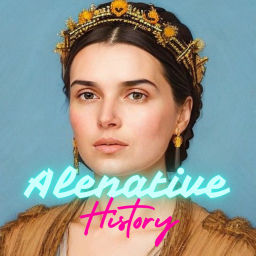
Podcast thumbnail for Alenative History - Die Geschichte des Antiken Griechenlands

Alenative History - Die Geschichte des Antiken Griechenlands

Claim This Podcast

by Alena Riha

4.9(83 reviews)
22 episodes
Updated Bi-weekly
Accepts GuestsHas SponsorsLocation 🇩🇪

Podcast Overview

Tauche ein in die Welt des Antike Griechenland. Alenative History nimmt dich mit auf eine Reise von den Anfängen der Bronzezeit (Minoer & Mykene) über die Archaik & die Perserkriege bis zum Hellenismus. Wir beleuchten große Persönlichkeiten wie Sappho oder Alexander den Großen, analysieren politische Umbrüche & entdecken die oft übersehenen Details des Alltags der Hellenen. Ob Demokratie, Philosophie oder die Geheimnisse der Archäologie – hier wird Geschichte lebendig & fundiert erzählt. Perfekt für: Alle Geschichts-Interessierte, die einen Deep-Dive ins Antike Griechenland machen wollen!

Language

🇩🇪

Publishing Since

6/8/2023

1 verified contact email on file for Alenative History - Die Geschichte des Antiken Griechenlands

Pitch yourself as a guest, propose sponsorships, or reach out directly to the host.

Recent Episodes

Episode thumbnail for Thales von Milet: Der erste Philosoph des Abendlandes

May 31, 2026

Thales von Milet: Der erste Philosoph des Abendlandes

<p>Thales von Milet gilt als der erste Philosoph des Abendlandes — und das, obwohl wir keine einzige seiner eigenen Zeilen besitzen. Wer war dieser Mann, der in einer Welt voller Götter wagte zu sagen: Braucht es wirklich diese, um die Natur und ihre Ereignisse zu erklären? Gibt es denn nicht eine logische Erklärung?</p><p>Heute fragen wir: Wer war Thales wirklich — Denker, Politiker oder Pragmatiker? Warum war ausgerechnet Wasser das Urprinzip? Wie sagte er eine Sonnenfinsternis voraus? Und wie kommt es, dass ein Mann aus dem 6. Jahrhundert v. Chr. bis heute in jedem Schulbuch steht?</p><p><br></p><p><strong>Quellen</strong>:</p><ul><li>Aristoteles</li><li>Cicero</li><li>Diogenes Laertios</li><li>Eusebius von Caesarea</li><li>Herodot</li><li>Hieronymos</li><li>Homer</li><li>Kyrill von Alexandria</li><li>Platon</li><li>Plinius der Ältere</li><li>Plutarch</li><li>Proklos</li></ul><p><br></p><p><strong>Literatur:</strong></p><ul><li>Cooke, The History of Mathematics: A Brief Course, 2005</li><li>Diels, / Kranz (Hrsg.), Die Fragmente der Vorsokratiker, 1951</li><li>Dunham, Journey Through Genius: The Great Theorems of Mathematics</li><li>Ferguson, Pythagoras: His Lives and the Legacy of a Rational Universe, 2011</li><li>Gemelli, M. (Hrsg.), Die Vorsokratiker, 2007</li><li>Gericke, Mathematik in Antike und Orient, 1984</li><li>Guthrie, A History of Greek Philosophy: The Earlier Presocratics and the Pythagoreans, 1978</li><li>Herda, Greek (and our) views of the Karians, 2013</li><li>Herrmann, Die antike Mathematik, 2020</li><li>Lawson, Science in the Ancient World: An Encyclopedia, 2004</li><li>Leloux, The Battle of the Eclipse (May 28, 585 BC): (...), 2016</li><li>Mittelstraß, Hylozoismus. In: Enzyklopädie Philosophie und Wissenschaftstheorie</li><li>Neugebauer, The Exact Sciences in Antiquity, 1969</li><li>Ebd., A History of Ancient Mathematical Astronomy, 1975</li><li>Nietzsche, The Pre-Platonic Philosophers, 2001</li><li>O&#39;Grady, Thales of Miletus: The Beginnings of Western Science and Philosophy, 2017</li><li>Querejeta, On the Eclipse of Thales, Cycles and Probabilities, 2011</li><li>Riedweg, Pythagoras: His Life, Teachings, and Influence, 2005</li><li>Russell, A History of Western Philosophy, Simon &amp; Schuster, 1945</li><li>Schirren/ Rechenauer, Biographie, 2013</li><li>Schwaetzer, Mystik als Ursprung der Naturphilosophie, 2022</li><li>Wenskus, Die angebliche Vorhersage einer Sonnenfinsternis durch Thales von Milet. (...), 2016</li><li>Wöhrle, Thales, ein Phönizier?, 2015</li><li>Wöhrle (Hrsg.), Thales (= Traditio Praesocratica. Die Milesier, Band 1), 2009</li></ul><p>Musik:</p><ul><li>Ancient Frequencies via Pixabay</li><li>Dulcimer Dance Persian Arabic Hammered via Pixabay</li></ul>

Episode thumbnail for Magna Graecia: Der Aufstieg von Großgriechenland | Teil 2

March 15, 2026

Magna Graecia: Der Aufstieg von Großgriechenland | Teil 2

<p>Die Geburt &amp; den Aufstieg Magna Graecias erkunden wir im 2. Teil zur griechischen Kolonisation. Ein Teil der griechischen Welt, wo sich die Kolonien rasch von den Mutterstädten lösten, eine eigene Identität entwickelten, aber auch die gemeinsame Identität als Hellenen prägte.</p><p>Wir werden herausfinden, wie sich das Zusammenleben mit der indigenen Bevölkerung gestaltete, wie die Magna Graecia teilweise das Mutterland an Reichtum überflügelte &amp; es auch mit neuen Ideen, wie Gesetzen, inspirierte. </p><p><br></p><p>Quellen &amp; Literatur:</p><ul><li>Aristoteles</li><li>Diodorus Siculus</li><li>Herodot</li><li>Homer</li><li>Iustinius</li></ul><ul><li>Livius</li><li>Pausanias</li><li>Polybios</li><li>Strabon</li><li>Thukydides</li><li>Plinius der Ältere</li><li>Antonaccio, Colonization: Greece on the Move 900–480, 2007</li><li>Bourbon / Durando, Magna Graecia (...), 2004</li><li>Cerchiai / Janelli / Longo, Die Griechen in Süditalien (...),2004</li><li>Davis / Murray / Walbank, Die Geschichte des antiken Griechenland, 2006</li><li>de Vido, Osci, 2000 (DNP)</li><li>Dewan, A Mediterranean Mosaic (...), online via academia.edu</li><li>Delle Cave / Golin, Agrigent, das Tal der Tempel, 2004</li><li>Dreher, Die Westgriechen: andere Griechen?, 2009</li><li>Ebd., Das antike Sizilien, 2008</li><li>Falco / Olsenhausen, Siculi, 2001 (DNP)</li><li>Ebd., Elymoi, 1997 (DNP)</li><li>Finley, Das antike Sizilien (...), 1979</li><li>Fronda, The Italiote League and southern Italy, 2015</li><li>Funke, Western Greece (Magna Graecia), 2006</li><li>Jeffery, The local scripts of archaic Greece, 1961</li><li>Kracht, Die handelsgeschichtliche Bedeutung der Stadt Sybaris bis zu ihrer Zerstörung im Jahre 510 v.Chr., 1988</li><li>Körner, Metropolis und Apoikie, 2002</li><li>Lazzarini, La Magna Graecia, 1990</li><li>Lentini, Le origine di Naxos (...), 2016</li><li>Lompardo, Messapii, 2000 (DNP)</li><li>Ebd., Iapyges, 1998 (DNP)</li><li>Ebd., Brutti, 1997 (DNP)</li><li>Ebd., Lucani, 1999 (DNP)</li><li>Sjöqvist, Sicily and the Greeks (...), 1973</li><li>Mertens, Städte &amp; Bauten der Westgriechen (...), 2006</li><li>&quot;Krieg &amp; Frieden zwischen dem mykenischen Griechenland &amp; dem bronzezeitlichen Italien (...)&quot; auf oeaw.ac.at </li><li>&quot;Bronzezeitliches Roca Vecchia (...)&quot; auf oeaw.ac.at</li><li>&quot;Die bronzezeitliche Bevölkerung von Syrakus (Sizilien)&quot; in oeaw.ac.at</li><li>&quot;Die Grabsitten des 6.Jh.v.Chr. in der Sibartide (....)&quot; (online) via francavilla.philhist.unibas.ch (Universität Basel)</li><li>&quot;Kulturelle Identitäten in Großgriechenland am Beispiel Eleas&quot; (online: https://austriaca.at/0xc1aa5572%200x0006a6fa.pdf) </li><li>Scoligio del Tonno via archaelogs.com </li><li>Magna Graecia via oterpedia.de </li><li>Sybaris in imperiumromanum.com (Quelle: Der kleine Pauly)</li><li>Magna Graecia in treccani.it</li><li>Magna Graecia, Enciclopedia Italiana (1934), ebd.</li><li>Olimpiadi antiche ebd.</li></ul>

Episode thumbnail for Hesoid: Der Bauernpoet, der die Götter erschuf & die Mächtigen kritisierte

January 30, 2026

Hesoid: Der Bauernpoet, der die Götter erschuf & die Mächtigen kritisierte

<p>Ein Bauer, der den Mächtigen den Kampf ansagte &amp; ganz nebenbei die Götter ordnete.</p><p>Hesiod war die bodenständige Antwort auf die glanzvollen Heldenepen seiner Zeit. Aber wer war der Mann hinter der „Theogonie“ wirklich? Ein begnadeter Moralapostel? Ein misstrauischer Mahner? Oder einfach nur ein Realist, der die Welt durch Arbeit und Ordnung retten wollte? Lasst uns herausfinden, wie dieser eigenwillige Charakter zum Erschaffer der griechischen Mythologie wurde.</p><p><br /></p><p>Quellen:</p><ul><li></li><li><strong>Alkaios von Messene</strong> (Anthologia Palatina)</li><li></li><li><strong>Alkaios von Mytilene</strong>, Fragmente</li><li></li><li><strong>Anthologia Palatina</strong> (Mnasalkas u.a.)</li><li></li><li><strong>Aristoteles</strong>, Metaphysik / Verfassung von Orchomenos</li><li></li><li><strong>Bacchylides</strong></li><li></li><li><strong>Certamen Homeri et Hesiodi</strong> (Der Wettstreit zwischen Homer und Hesiod)</li><li></li><li><strong>Cicero</strong></li><li></li><li><strong>Heraklit</strong>, Fragmente</li><li></li><li><strong>Herodot</strong>, Historien</li><li></li><li><strong>Hesiod</strong>: Theogonie / Werke und Tage / Schild des Herakles / Frauenkatalog (Fragmente)</li><li></li><li><strong>Johannes Tzetzes</strong>, Vita Hesiodi</li><li></li><li><strong>Lukian von Samosata</strong></li><li></li><li><strong>Ovid</strong>, Metamorphosen / Fasti</li><li></li><li><strong>Pausanias</strong>, Beschreibung Griechenlands</li><li></li><li><strong>Pindar</strong></li><li></li><li><strong>Platon</strong>, Politeia / Protagoras / Phaidros</li><li></li><li><strong>Plinius der Ältere</strong>, Naturalis historia</li><li></li><li><strong>Plutarch</strong>, Moralia / Gastmahl der sieben Weisen</li><li></li><li><strong>Proklos</strong>, Kommentar zu Werke und Tage</li><li></li><li><strong>Suda</strong> (Antikes Lexikon)</li><li></li><li><strong>Thukydides</strong>, Geschichte des Peloponnesischen Krieges</li><li><strong>Vergil</strong>, Georgica</li><li><strong>Xenophanes</strong>, Fragment</li></ul><li><p>Literatur:</p></li><ul><li></li><li></li><li><strong>Allen</strong>, "Tragedy and the Early Greek Philosophical Tradition", 2006</li><li></li><li><strong>Boys-Stones; Haubold</strong>, Plato and Hesiod, 2010</li><li></li><li><strong>Ercolani; Rossi</strong>, "Hesiod", Handbuch der griechischen Literatur der Antike (Band 1), 2011</li><li></li><li><strong>Fränkel</strong>, Dichtung und Philosophie des frühen Griechentums, 2006</li><li></li><li><strong>Kivilo</strong>, Early Greek Poets' Lives, 2010</li><li></li><li><strong>Koning</strong>, Hesiod: The Other Poet. Ancient Reception of a Cultural Icon, 2010</li><li></li><li><strong>Lamberton</strong>, Hesiod, 1988</li><li></li><li><strong>Montanari; Rengakos; Tsagalis</strong>, Brill's Companion to Hesiod, 2009</li><li></li><li><strong>Walde; Ciccolella</strong>, Die Rezeption der antiken Literatur. Kulturhistorisches Werklexikon, 2010</li><p><br /></p></ul>

22 total episodes available

Deep-dive analytics for Alenative History - Die Geschichte des Antiken Griechenlands

Frequently asked questions

Have a different question and can't find the answer you're looking for? Reach out to our support team by sending us an email and we'll get back to you as soon as we can.

What is Alenative History - Die Geschichte des Antiken Griechenlands?

Tauche ein in die Welt des Antike Griechenland. Alenative History nimmt dich mit auf eine Reise von den Anfängen der Bronzezeit (Minoer & Mykene) über die Archaik & die Perserkriege bis zum Hellenismus.

Wir beleuchten große Persönlichkeiten wie Sappho oder Alexander den Großen, analysieren politische Umbrüche & entdecken die oft übersehenen Details des Alltags der Hellenen. Ob Demokratie, Philosophie oder die Geheimnisse der Archäologie – hier wird Geschichte lebendig & fundiert erzählt.

Perfekt für: Alle Geschichts-Interessierte, die einen Deep-Dive ins Antike Griechenland machen wollen!

How often does this podcast release new episodes?

This podcast updates bi-weekly.

Where can I listen to this podcast?

This podcast is available on 7 platforms including Apple Podcasts, Spotify, and more. You can also use the RSS feed directly.

Does this podcast accept guests?

Information about guest appearances is not available.

Legal Disclaimer

Pod Engine is not affiliated with, endorsed by, or officially connected with any of the podcasts displayed on this platform. We operate independently as a podcast discovery and analytics service.

All podcast artwork, thumbnails, and content displayed on this page are the property of their respective owners and are protected by applicable copyright laws. This includes, but is not limited to, podcast cover art, episode artwork, show descriptions, episode titles, transcripts, audio snippets, and any other content originating from the podcast creators or their licensors.

We display this content under fair use principles and/or implied license for the purpose of podcast discovery, information, and commentary. We make no claim of ownership over any podcast content, artwork, or related materials shown on this platform. All trademarks, service marks, and trade names are the property of their respective owners.

While we strive to ensure all content usage is properly authorized, if you are a rights holder and believe your content is being used inappropriately or without proper authorization, please contact us immediately at hey@podengine.ai for prompt review and appropriate action, which may include content removal or proper attribution.

By accessing and using this platform, you acknowledge and agree to respect all applicable copyright laws and intellectual property rights of content owners. Any unauthorized reproduction, distribution, or commercial use of the content displayed on this platform is strictly prohibited.