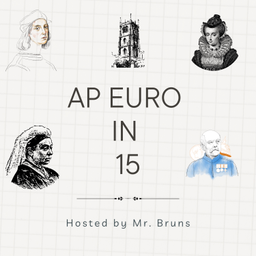
Short on time but serious about earning a 5? AP European History in 15 walks you through the entire AP Euro curriculum — just 15 minutes at a time.
From the crises of Late Medieval Europe to the political aftershocks of Brexit, this podcast helps students or people who love history, understand the social, political, religious, intellectual, technological, and economic developments that shaped Europe and the modern world. We explore Western, Central, and Eastern Europe — and Europe’s deep connections with the Middle East.
England and France A Rivalry for World Power 1648 to 1815
Join Mr. Bruns on AP European History in 15 as we explore the epic struggle between France and Great Britain from 1648 to 1815. Discover how competing ambitions for colonies, trade, naval supremacy, and European dominance transformed the balance of power.
⚔️ In this episode, we explore:
The Anglo-French Rivalry: Absolutism, mercantilism, colonial competition, and the European balance of power.
The Seven Years’ War (1756–1763): How Britain's global victory expanded its empire but created enormous debt and tensions with its American colonies.
The American Revolution (1775–1783): Why France supported American independence, how British imperial authority was challenged, and why French intervention deepened the monarchy's financial crisis.
🎯 AP Exam Golden Nugget: Britain's victory in the Seven Years’ War helped create the financial pressures that contributed to the American Revolution. France's support for American independence weakened Britain but worsened France's own financial crisis, helping set the stage for the French Revolution.
Essential Question: How did the rivalry between France and Britain reshape European politics, global commerce, and the balance of power between 1648 and 1815?
History's great irony? Both nations tried to weaken their rival—and their victories helped unleash revolutions and political transformations neither could fully control.
19 Oct 2026
Ships, Spices & Superpowers: Europe's Race for Global Dominance (1648–1815)
All aboard AP European History in 15 with Mr. Bruns! This episode sets sail into Europe's high-stakes struggle for maritime supremacy between 1648 and 1815. Discover how mercantilism, commercial rivalries, and naval warfare transformed European diplomacy and built global empires.
In this episode, we explore:
Trade Wars & Mercantilism: Why Britain, France, and the Dutch Republic fought for commercial wealth and economic power.
The Atlantic Showdown: How the War of the Spanish Succession, the Seven Years' War, and the American Revolution reshaped colonial empires.
The Race for Asia: How Portuguese, Dutch, French, and British merchants competed for spices, textiles, and trading privileges.
🇮🇳 Britain in India: How the East India Company transformed from a trading enterprise into a territorial power following the Battle of Plassey in 1757.
(VOC) Dutch Dominance in the East Indies: How the Dutch built a powerful spice-trading empire in present-day Indonesia.
The Road to 1815: Why Britain emerged as Europe's leading maritime power.
AP Euro Exam Connection: Master the connections between commerce, diplomacy, warfare, and empire. Learn how maritime competition shaped European power and global history through causation, continuity, and change over time.
12 Oct 2026
Enlightened Absolutism: Kings, Philosophers & the Fight for Religious Tolerance
In this episode, we're exploring Enlightened Absolutism, the fascinating contradiction of eighteenth-century Europe: monarchs who used reason, reform, and selected Enlightenment principles to modernize their states while maintaining control over their subjects.
Meet four European rulers who took very different approaches to political power and religious toleration:
Frederick II of Prussia — The Philosopher King who embraced rational government and religious toleration while preserving Prussian militarism and social hierarchy.
Frederick William I of Prussia — The Soldier King who strengthened the army and bureaucracy, prioritizing state power and discipline.
Maria Theresa of Austria — The reform-minded Habsburg ruler who modernized government and the military while maintaining a strong commitment to Catholicism.
Joseph II of Austria — The ambitious reformer whose Patent of Toleration of 1781 expanded religious freedoms and whose policies challenged traditional privileges.
We'll compare their policies, explore how Enlightenment thinkers influenced political authority, and rate each monarch's religious tolerance on a scale of 1 to 10.
Reach and audience
Public platform figures. Ratings count people who left a rating, not total listeners.
Apple Podcasts (US)
5.0 / 5
2 ratings
Spotify
5.0 / 5
6 ratings
Contact AP European History in 15
Guest appearances
Does not typically book guests
Based on episode analysis; this does not confirm that the show is currently accepting guests.
Host of AP European History in 15?
Claim your podcast to manage its listing and keep your show details accurate.
Pod Engine is an independent podcast discovery and analytics service and is not affiliated with or endorsed by this podcast. Artwork and show content belong to their owners. Full legal notice.
Explore this show Podcast research with Pod Engine