
I can't remember the first time somebody told me that I was bad at keeping secrets. When I met someone new, I'd have to tell them that unless they tell me something like: "Please, Carissa, don't share this with anyone" I would just assume that it's safe to say. There's something about saying everything you feel out loud that's freeing, and also connective. If I'm feeling this way, chances are other humans are, too. I want to talk about these things with you. Hi, I'm Carissa Potter, and this is Bad At Keeping Secrets, a podcast where we create closeness, understanding and acceptance by sifting through the beautiful emotional mess of life and trying to make sense of what it means to be human. Through intimate conversations between people who spend a lot of time thinking about what it means to be human right now in the scientific, creative, and therapeutic disciplines, we weigh into the gray areas, letting go of conclusions and judgments when we can, in hopes of feeling a little - just a little bit more whole, a little more okay with what is. Exploring things that are deeply meaningful, not because they have a capitalist value, but a human one.
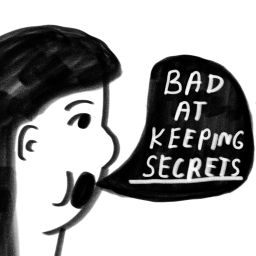
Bad At Keeping Secrets
Claim This PodcastPodcast Overview
I can't remember the first time somebody told me that I was bad at keeping secrets. When I met someone new, I'd have to tell them that unless they tell me something like: "Please, Carissa, don't share this with anyone" I would just assume that it's safe to say. There's something about saying everything you feel out loud that's freeing, and also connective. If I'm feeling this way, chances are other humans are, too. I want to talk about these things with you. Hi, I'm Carissa Potter, and this is Bad At Keeping Secrets, a podcast where we create closeness, understanding and acceptance by sifting through the beautiful emotional mess of life and trying to make sense of what it means to be human. Through intimate conversations between people who spend a lot of time thinking about what it means to be human right now in the scientific, creative, and therapeutic disciplines, we weigh into the gray areas, letting go of conclusions and judgments when we can, in hopes of feeling a little - just a little bit more whole, a little more okay with what is. Exploring things that are deeply meaningful, not because they have a capitalist value, but a human one.
Language
🇺🇲
Publishing Since
10/20/2023
1 verified contact email on file for Bad At Keeping Secrets
Pitch yourself as a guest, propose sponsorships, or reach out directly to the host.
Recent Episodes
April 16, 2024
10. Lissa Soep - Other People's Words
<p><img src= "https://assets.libsyn.com/secure/show/490094/Lissa_Soep.jpeg" alt= "" width="170" height="200" /></p> <p>This week, I'm talking about the shifting power of language after loss with Lissa Soep.</p> <p>Have you ever noticed yourself using a phrase from someone else? Something that comes to mind for me is how my grandmother used to call me baby doll, and I hated it. Then, I found myself calling my daughter the other day. Lissa Soep's recent book, Other People's Words, is an invitation to notice the literal ways in which the people we love live on through us. </p> <p>I hope you take comfort in her ideas about the origins of our words and our deep connection to each other.</p>
April 9, 2024
9. Priya Parker - The Art of Gathering
<p><img src= "https://assets.libsyn.com/secure/show/490094/Priya_2.jpeg" alt="" width="226" height="223" /></p> <p>Have you felt like you didn't belong anywhere before? I strive to feel a sense of belonging and connection, but it rarely happens. This week on Bad At Keeping Secrets, I'm talking to Priya Parker, author of <a href= "https://www.amazon.com/Art-Gathering-How-Meet-Matters/dp/1594634920"> The Art of Gathering, How We Meet and Why It Matters</a>, and host of the podcast, Together Apart. Priya is a conflict facilitator, strategic advisor, international speaker, and recently started the online course, The Art of Gathering, How to Make Meaning With and For People. </p> <p>If you're interested in creating situations where people feel held, safe, and cared for, Priya will show you how to find the connection you're looking for. I hope you enjoy. For a free intro guide, visit priaparker.com/peopleiveloved.</p>
March 18, 2024
8. Fair Play - Eve Rodsky on the Control of Women's Time
<p><img src= "https://assets.libsyn.com/secure/show/490094/Eve_Rodsky.jpg" alt= "" width="250" height="250" /></p> <p>Do you ever wonder if you shoulder more of the work in your family? Humans seem to have the natural tendency to think that they're doing more work than others. But Eve Rodsky points out that women actually are doing more work. The emotional labor and invisible labor that keep households running.</p> <p><a href= "https://www.amazon.com/s?k=fair+play+eve+rodsky&adgrpid=1334807679942052&hvadid=83425550887599&hvbmt=be&hvdev=c&hvlocphy=79627&hvnetw=o&hvqmt=e&hvtargid=kwd-83425822575690%3Aloc-190&hydadcr=20363_10296584&tag=mh0b-20&ref=pd_sl_46rxizb64i_e" target="_blank" rel="noopener">Eve's bestselling book, Fair Play</a>, will help you and your partner make things better. I found Eve's approach to problem solving and communicating your needs so helpful in discussing uncomfortable topics. This book will help you make things more fair in your relationships and with yourself. I hope you enjoy. </p> <p><strong>Eve's Bio:-</strong></p> <p><em>I grew up on the lower east side of New York City with my mother Terry and my brother Josh. I saw my mother struggle as a single mom trying to do it all. I vowed that when I grew up, I would have an equal partner in life . . . and I did! I marked up his operating agreements as he grew a new business and he help me secure my dream job in philanthropy. We took turns making dinner and doing laundry. It felt great and fair.</em></p> <p><em>Cut to two kids later and I found myself sobbing on the side of the road because of a text my husband sent me: “I’m surprised you didn’t get blueberries.” As I sat in my car, I thought to myself: I’m so overwhelmed I can’t even manage a grocery list (when I used to manage a team of employees)—and more importantly, when did I become the default for every single household and childcare task . . . including apparently being the fulfiller of my husband’s smoothie needs? This was not how I envisioned my life. I knew something had to change. So I embarked on a quest to find a solution for domestic rebalance not only for my marriage but for couples everywhere.</em></p> <p><em>I started my journey into the “gendered division of labor” (and other related phrases like “emotional labor” and the “second shift”) by reading every book and article I could get my hands on. I was aware that women shoulder about two-thirds of the work required to run a home and raise a family but I wasn’t sure why. Early on in my research, I came across an article titled “Invisible Work,” written in 1987 by sociologist Arlene Kaplan Daniels. In it she argues that women’s unpaid “invisible” work in the home is often not seen as “work” at all and is significantly devalued. The article had a real impact on me and informed my initial quest—which was to make the invisible domestic tasks I did visible to my husband. My thinking was that it is impossible to value what’s invisible and I believed visibility would equal value. So I created a “Sh*t I Do” spreadsheet. With the help of women across the country, I catalogued every single action I took in service of my family that had a quantifiable time component. But here’s the thing—while the “Shit I Do” list illuminated how much invisible work women were doing for their families, the list also seemed to provoke more rage (and scorekeeping!) than change. I soon realized that my expertise in family mediation, law, and organizational management could be applied to this problem—to create a system to promote sustainable change and get past the resentment and rage. Fair Play is a system tested by couples from all walks of life. At its core is a card game—where couples each hold domestic task cards representing all that it takes to run a home and raise a family.</em></p> <p><em>I advise highly complex family organizations. For more than a decade I have worked to bring solutions for family harmony and efficiency to high-net-worth family foundations by setting up systems customized for each family (sort of like the show Succession). My lightbulb moment was that the same systems I create for these highly complex organizations could also work for any home.</em></p> <p><em>In terms of my research, I wanted to make sure I was well versed in the subject area. I started by reading hundreds of articles, studies, and books. I did not want to rely on third-party sources like newspaper articles, so I worked with a research assistant to comb through actual studies and original research. Where possible, I interviewed experts firsthand in psychology, sociology, social work, neuroscience, clergy, behavioral economics, and law. I took a deeper dive with two experts in particular—Professor Darby Saxbe, a clinical psychology professor who is an expert in the gendered division of labor and read the manuscript through that lens, and Professor Alexis Jemal, a social work professor who is an expert in critical consciousness theory and who read the manuscript through that lens. Second, as the author of this book representing majority social identities, I wanted to ensure that I had a representative sample of the U.S. population to interview in order to make sure my findings were applicable to a wide range of couples with other social identities. I ended up interviewing more than five hundred men and women for this book. The sample was diverse in age, race, ethnicity, socioeconomic status, marital status, educational attainment, employment status, geographical location, and dyadic gender composition. While the majority of couples were heterosexual, same-sex couples were also included in my research. The research was done in a three-stage process. The first stage was the creation of the “Sh*t I Do” list, where domestic tasks were sourced from family, friends, colleagues, and strangers and subsequently organized into “suits.” The second stage involved more in-depth conversations and interviews using open-ended questions. Data and insights from each interview were used (a) to adjust questions for successive interviews, (b) to explore the causes and consequences of inequitable division of domestic labor, and (c) to inform the development of the Fair Play System. Finally, after the Fair Play System was created, couples were chosen for beta testing Fair Play concepts. I conducted follow-up interviews to troubleshoot, assess, and modify the Fair Play System accordingly. All this work culminates in my favorite chapter—“The Top 13 Mistakes Couples Make—and the Fair Play Fix.”</em></p>
10 total episodes available
Similar Podcasts
Discover related shows you might enjoy

We Can Do Hard Things
Treat Media and Glennon Doyle

The Bright Side
iHeartPodcasts and Hello Sunshine

Pulling The Thread with Elise Loehnen
Elise Loehnen

The Happiness Lab with Dr. Laurie Santos
Pushkin Industries

The Liz Moody Podcast
Liz Moody

Dare to Lead with Brené Brown
Vox Media Podcast Network

Depression Detox Show | Daily Inspirational Talks
Maleek Josephs

How to Be a Better Human
TED

The Ezra Klein Show
New York Times Opinion

Keeping Karlsson Fantasy Hockey Podcast
Elan Dubrofsky and Brian Kom

Apples & Ginos Fantasy Hockey Podcast
Apples & Ginos Fantasy Hockey
Deep-dive analytics for Bad At Keeping Secrets
Frequently asked questions
Have a different question and can't find the answer you're looking for? Reach out to our support team by sending us an email and we'll get back to you as soon as we can.
- What is Bad At Keeping Secrets?
- How often does this podcast release new episodes?
This podcast updates weekly.
- Where can I listen to this podcast?
This podcast is available on 6 platforms including Apple Podcasts, Spotify, and more. You can also use the RSS feed directly.
- Does this podcast accept guests?
Yes, this podcast regularly features guests.
Legal Disclaimer
Pod Engine is not affiliated with, endorsed by, or officially connected with any of the podcasts displayed on this platform. We operate independently as a podcast discovery and analytics service.
All podcast artwork, thumbnails, and content displayed on this page are the property of their respective owners and are protected by applicable copyright laws. This includes, but is not limited to, podcast cover art, episode artwork, show descriptions, episode titles, transcripts, audio snippets, and any other content originating from the podcast creators or their licensors.
We display this content under fair use principles and/or implied license for the purpose of podcast discovery, information, and commentary. We make no claim of ownership over any podcast content, artwork, or related materials shown on this platform. All trademarks, service marks, and trade names are the property of their respective owners.
While we strive to ensure all content usage is properly authorized, if you are a rights holder and believe your content is being used inappropriately or without proper authorization, please contact us immediately at hey@podengine.ai for prompt review and appropriate action, which may include content removal or proper attribution.
By accessing and using this platform, you acknowledge and agree to respect all applicable copyright laws and intellectual property rights of content owners. Any unauthorized reproduction, distribution, or commercial use of the content displayed on this platform is strictly prohibited.