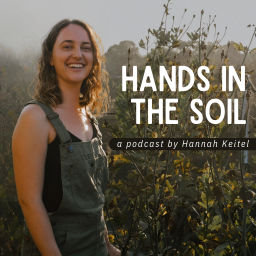
Welcome to Hands in the Soil, the podcast that dives deep into all things food, farming, and our intricate connection to the planet. We’re shining the spotlight on all those who work closely with the Earth – from farmers and ranchers, backyard gardeners and forestry workers, to indigenous seed keepers, waterway protectors and more. Together, we'll be uprooting the unseen, and learning from stewards at the frontlines of creating solutions to the existential threats we face in the era of climate change, food scarcity, and exploitation of our finite natural resources.
66. Reflections on Foundations in Land Stewardship
Foundations in Land Stewardship, the three-month farm school program I co-hosted with Cat Henning, just wrapped its inaugural cohort on August 1st. Though it’s impossible to fully capture the magic that unfolded throughout this program, this episode is my attempt to put words to what happened - for myself, for anyone who's been curious about the program, and for anyone who might want to create something like it in their own community.
Farm school went deep. Yes, we explored soil science and market streams and the mechanics of a viable farm business, but at the core of it, it was also necessary to explore identity, inner work, relationships, and the revelation that a farm is always a reflection of the person tending it. I learned a lot, and I'm excited to share some of that with you in this episode today.
Tune in to learn more about:
Why the program was built around farmer-teachers
How every farm is completely different, and every farm is a reflection of the person running it
The importance of knowing your strengths, owning your weaknesses, and building something that actually works for who you are
The power of bringing people onto farms that are alive, cared for, and stewarded with intention, and why that experience is healing in ways people don't expect
What it means to be a positive disturbance in a landscape, and how that shifts your whole orientation to the natural world
Why I believe you can't bring a big dream to life without first facing the parts of yourself that say it isn't possible
Why community is both the answer to food system change and the thing food most naturally creates
Sign Up for Farm School 2027
If you're interested in being part of the next cohort of Foundations in Land Stewardship, you can sign up to be notified when enrollment opens: www.handsinthesoil.farm/farmschool (https://www.handsinthesoil.farm/farmschool)
Connect with Hannah:
Instagram: @hannahkeitel (www.instagram.com/hannahkeitel)
7 Aug 2026
65. Know Your Fisher w/ Emily Soye Miller
In this episode of Hands in the Soil, we venture into new waters and explore the seafood industry. Our guest is Emily Soye Miller, seafood system educator, commercial fisheries consultant, and the managing force behind Fishful Future, a San Diego-based initiative for greater consumer awareness of local seafood that she ran from 2021 through 2025. Emily recently co-curated San Diego Seafood: Then & Now, a community cookbook that traces the history and future of San Diego's seafood culture.
Emily grew up recreationally fishing with her father in Southern California, processing squid bait at the kitchen table with her Korean immigrant mother, and navigating the early tension of what counts as "normal" food and for whom. That upbringing gave way to an ecology degree, a stint at a fisheries processor in Kodiak, Alaska, six years as a commercial fisheries observer on boats ranging from single-day trips to month-long offshore voyages, and eventually, a deep commitment to making local seafood legible, accessible, and culturally meaningful to everyday people.
Tune in to learn more about:
San Diego's history as the tuna capital of the world, and how dramatically things have changed since the post-WWII era
The Magnuson-Stevens Act and how US fisheries became some of the most well-managed in the world, and why that matters when people claim all commercial fishing is inherently harmful
The "graying of the fleet": why commercial fishing communities are aging out, shrinking, and struggling to attract the next generation
Why imports make it nearly impossible for small-scale artisanal US fishers to compete on price, and what that means for the future of local seafood
The seafood system as a "mysterious black box" and why most people have far less understanding of it than they do of agriculture
What responsible seafood consumerism actually looks like in San Diego
The gentrification of wild seafood, and why Emily refuses to call it a win if local seafood only ends up on luxury menus
How stewardship of the ocean arises naturally from place-based diets
Connect with Emily:
Website: fishfulfuture.com (fishfulfuture.com )
Instagram: @fishfulfuture (www.instagram.com/fishfulfuture)
TikTok: @fishful.future (https://www.tiktok.com/@fishful.future)
Connect with Hannah:
Instagram: @hannahkeitel (www.instagram.com/hannahkeitel)
21 Jul 2026
64. Lettuce Talk About the Diarrhea Outbreak
We’re back with a solo episode, because I couldn’t resist the topic. A Cyclospora parasite outbreak linked to iceberg lettuce is making headlines across the US, and while the CDC's warnings have left a lot of people wondering whether they can safely eat a salad, I want to set the record straight: this moment is less about contaminated lettuce and more about what happens when 40% of a country's salad comes from one company.
This is a short episode where I break down exactly how a parasite ends up on your lettuce, why consolidation makes outbreaks like this inevitable, and what you can actually do (starting today!) to step out of the most fragile parts of the food system.
Tune in to learn more about:
What Cyclospora is, how it spreads, and how a parasite that can only be transmitted through human feces ended up on grocery store lettuce
Why not all produce is affected, and why the blanket fear of fresh fruits and vegetables is misinformation
Who Taylor Farms is: over 40% of all salad kits sold in American grocery stores, plus ownership of Earthbound Organics, plus major growing and processing operations in Mexico and Canada
Why the scale that makes companies like Taylor Farms profitable is the exact same scale that makes outbreaks like this inevitable
The COVID parallel with distribution system failures and general systemic fragility.
Why small farms are structurally less likely to cause this kind of widespread harm, and more likely to be able to answer your questions directly
What food sovereignty actually looks like in practice: knowing your farmer, asking questions, growing something yourself if you can
Connect with Hannah:
Instagram: @hannahkeitel (https://www.instagram.com/hannahkeitel)
Reach and audience
Public platform figures. Ratings count people who left a rating, not total listeners.
Apple Podcasts (US)
5.0 / 5
15 ratings
Spotify
5.0 / 5
13 ratings
Podcast Authority Score: 40 / 100
A composite of feed quality, social presence, YouTube performance and engagement. Read the methodology.
Quality
60
Social presence
0
YouTube
0
Engagement
51
Host of Hands in the Soil?
Claim your podcast to manage its listing and keep your show details accurate.
Pod Engine is an independent podcast discovery and analytics service and is not affiliated with or endorsed by this podcast. Artwork and show content belong to their owners. Full legal notice.
Explore this show Podcast research with Pod Engine