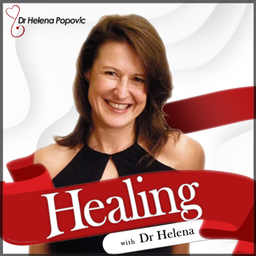
Healing with Dr Helena
Dr Helena Popovic
5.0from 7 ratings
- 26
- Episodes
- 7
- Ratings
- Daily
- Cadence
- 2026
- First episode
About Healing with Dr Helena
Welcome to my podcast, Healing with Dr Helena, where I challenge the limiting way we currently view disease, and offer a new paradigm for vibrant health and true healing. If modern medicine isn’t providing you with enough answers, and you want to come alive and thrive, rather than merely survive, this podcast is for you. It’s also for people who want to: - boost their brain to perform at their peak - avoid Alzheimer’s and other dementias - grow bolder rather than older - and live longer, stronger, healthier and happier.
- Publisher
- Dr Helena Popovic
- Category
- health & fitness
- Language
- en
- Explicit
- No
- First episode
- 7 Apr 2026
- Latest episode
- 4 Oct 2026
Latest episodes
26 episodes in the feed.
4 Oct 2026
Visualise to actualise your healing (EP22)
Today’s Brain Booster is: Visualise to actualise your healing. Have you ever imagined something so vividly that your body responded as if it were real? You imagine your child falling off their bike, and your heart skips a beat.You picture success, and your posture lifts. You visualise biting into a lemon, and your lips pucker. Nothing has happened, but your brain activates the same neural circuits that it does when you’re having the experience in real life. Brain scans show that your motor cortex, planning networks, and co-ordination pathways are all active when you visualise moving. How is this relevant to healing? Several studies on stroke patients found that when the person repeatedly visualised moving a paralysed limb, they improved their ability to function, reach, and use the affected limb. The same goes for people unable to move because of chronic pain. When they visualised, they actualised healing. * * * * * Today’s Health Headline is: Pain is your friend, not your foe. There’s an extremely rare genetic condition called Congenital Insensitivity to Pain (CIP), in which a person is born completely unable to feel physical pain. At first glance, it sounds like a super power. ‘Go on, punch me in the face! Bring on the school bully because there’s nothing they can do to hurt me!’ However, it’s actually a life-threatening disorder, because you can have a massive wound on your back and be bleeding to death, and not be aware of it. People with CIP have a genetic mutation that blocks their ability to send an electrical signal to their brain to alert it to harm or damage. This translates into a life of unnoticed severe injuries, silent infections — such as appendicitis — and unrecognised trauma of all kinds. The consequence is that very few people with CIP survive to adulthood. Modern medical monitoring is slowly improving this, but it’s a treacherous way to live. * * * * * What’s Missing From Modern Medicine is prescribing visualisation instead of sedation. The exception, of course, is having surgery. Obviously you need to be put to sleep for an invasive procedure. But a lot of painkillers — especially opioid medications — can make you feel sluggish or sleepy, and they’re highly addictive. Medicines like codeine, oxycodone, morphine and tramadol affect the nervous system, slow down brain activity, and cause drowsiness. They’re great for severe acute physical pain, but inappropriate for chronic pain. I’m also using the word ‘sedation’ as a metaphor for simply trying to eliminate pain without treating the underlying cause. By not exploring the psychological and emotional factors that perpetuate pain, we are sedating ourselves from experiencing a more fulfilling, meaningful, and truly joyful life. This episode explores the specific details of effective visualisation to retrain your brain to release chronic pain. * * * * * Today’s Whether Report answers the question: I’d like to know whether a bigger brain means a smarter brain? The short answer is no. Brain size relates more to body size. Whales and elephants have huge brains but they’re not the smartest animals. Albert Einstein had a smaller-than-average brain. Intelligence depends on how WELL your brain cells connect, not on how big your brain is. By intelligence, I’m referring to the nine different intelligences proposed by philosopher Dr Howard Gardner: Word smart Number smart Picture smart Body smart Music smart People smart Self smart Nature smart Life smart No matter how good we get at all the ‘smarts’, our brain won’t grow out of our skull! * * * * * Please subscribe to my podcast so that you don’t miss an episode, and email your whether questions to: podcast@drhelenapopovic.com (mailto:podcast@drhelenapopovic.com) For resources and references visit: https://drhelenapopovic.com/podcast/ (https://drhelenapopovic.com/podcast/)
27 Sept 2026
Pain can be modified by your mind (EP21)
Today’s Brain Booster is: Calm your fear, and pain will disappear. Last week I did a deep dive into pain, and the key points were that there are two types of pain, classified by their cause: Physical pain — caused by being punched in the nose (or some other kind of injury). Neuroplastic pain — caused by an over-protective brain circuit. There’s no physical damage, no broken nose, and no pulled muscle, but your brain generates pain because it thinks you’re under some kind of threat. Following on from this, I’m going to answer some important whether questions from Peter. How do I know whether my pain is physical or neuroplastic? Last week you provided a comprehensive list of conditions — such as fibromyalgia, tension headaches and IBS — that were classified as neuroplastic, because there was no physical damage to a person’s muscles or head. This I can understand. But you also gave chronic neck, shoulder and back pain as examples of neuroplastic pain. I’ve had chronic lower back pain for more than one year, and an MRI scan showed that I have disc degeneration, as well as a bulging disc. I also get intermittent shoulder pain, but no one can find a cause. Is my shoulder pain neuroplastic, or could the doctors be missing something? I’d also like to know whether the principles of curing neuroplastic pain, could also reduce my back pain? The majority of adults who are completely pain-free have what LOOK like severe structural issues on their MRI scans. These are famously referred to as ‘normal abnormalities’. In other words, as we age, we all start to get grey hair, wrinkles, and disc degeneration. None of these cause pain. Grey hair does not cause pain. Wrinkles do not cause pain. And degenerative discs do NOT cause pain. The belief that disc degeneration and herniation DO cause pain is one of the biggest misconceptions in modern medicine. A massive systematic review published in the American Journal of Neuroradiology highlighted that normal abnormalities on MRI scans are almost ubiquitous findings in healthy pain-free populations. Tune in to learn how to distinguish physical back pain from neuroplastic back pain. * * * * Today’s Health Headline is: Pain can be modified by our mind. The most famous example of acute neuroplastic pain is the case of a 29-year-old construction worker who jumped down onto a scaffolding plank and accidentally landed on a long sharp nail that was pointing upwards, and pierced right through his boot. The nail was so long (18 cm or 7 inches) that the tip of the nail could be seen poking out of the top of his heavy boot. The man was rushed to the emergency department of Leicester Royal Infirmary in the UK, and because he was in so much agony, he had to be sedated and given intravenous opioids so that the medical staff could cut the boot off his foot. When they did so, they were absolutely astounded to find that the nail had passed BETWEEN his toes and his foot was completely unscathed! There was zero injury to his foot. There wasn’t a drop of blood. When the man came out of the sedation and was told what had happened, his pain immediately vanished. Calm the fear, and pain will disappear. Intense pain can occur without physical injury or actual tissue trauma in any situation where our brain perceives or anticipates danger, be that physical or emotional danger. * * * * What’s Missing From Modern Medicine is recognising that calming fear can make pain disappear which is today’s Brain Booster, and also Step 3 of the 6-Step Process to retrain your brain to release chronic pain. Step 1 was Educate before you medicate Step 2 was — be Curious, not critical And Step 3 is Calm your fear, and pain will disappear. Feeling SAFE is absolutely fundamental to all healing. In Step 3, you’ll gather concrete evidence that there’s nothing to fear, and then use this evidence to self-soothe. Only when your brain is absolutely convinced that you’re safe, will it stop sending pain signals. Listen to this episode for the details.
20 Sept 2026
Retrain your brain to release chronic pain
Today’s Brain Booster is: Retrain your brain to release chronic pain. Since starting my podcast I’ve received a lot of questions about how to manage chronic pain, including back, neck and shoulder pain, migraines, fibromyalgia and RSI (repetitive strain injury). This is not surprising because chronic pain is one of the biggest public health challenges globally. Worldwide, 1 in 5 adults live with chronic pain. In Australia, 5.5 million adults have chronic pain, and in the US, it’s 50 million people. That’s a lot of people in a lot of pain. But do not fear, a solution is here! That’s what today’s podcast episode is about. Don’t believe anyone who tells you that nothing can be done for your chronic pain. When a health professional says ‘there’s nothing we can do’, what they mean is, there’s nothing THEY can do. But there’s plenty YOU can do. If you’ve had constant or intermittent pain for over three months, it’s highly likely you have what’s known as neuroplastic pain. This is pain generated by the brain in the absence of physical damage to any of your muscles, tissues or organs. What’s going on? In some cases, pain can become a habit. For example, you injured your back while moving furniture. You had physiotherapy for a month, and the injury has now healed. However, your brain got used to generating pain whenever you moved a certain way, and the circuit now keeps firing, even though your muscles have recovered. It’s like something in your brain is stuck on repeat. Another term for this is learned pain. The good news is that what is learned can be unlearned. In other cases, chronic pain is a manifestation of severe stress or anxiety — even if there was NO triggering injury. Pain can also result from suppressed emotions like anger, rage, resentment, or grief. If we don’t allow ourselves to feel our feelings, they will be expressed in our body — in many cases as chronic or relapsing pain. * * * * * Today’s Health Headline is: The purpose of pain is protection. The purpose of pain is to alert us to danger — be that physical, psychological, or emotional danger. Have you ever developed a headache when you’ve been snowed under at work? Or neck pain when you’ve felt pressured to meet a deadline? That’s neuroplastic pain arising from the threat of failure. No one suddenly hit you on the head with a hammer, or jarred your neck to cause a physical injury. Yes, you might also be dehydrated, and your posture might have contributed to the neck pain. But in the absence of a specific injury — more often than not — it’s the fear-inducing situation that precipitated the pain. Therefore, if the cause of pain is fear, the cure for pain is safety. What do you need to do, or say to yourself, to make yourself feel safe? * * * * * What’s Missing From Modern Medicine is recognising that chronic pain can be cured. An important step on the path to healing is to be curious, not critical, of your pain. When pain strikes or flares up, are you able to simply observe it? If it’s really excruciating, take whatever medications you usually use, and wait for a time when it isn’t unbearable. But if you can tolerate it, even for just a few seconds, can you simply put your attention on the pain, and survey it? Can you just be with it, and feel it, without judgement, resentment or anxiety? When you’re able to come to a neutral, watchful state, ask yourself the following 5 questions: Where exactly in my body is the pain? Is it in a well-defined spot, or does it cover a larger more diffuse area? Does it stay in one place, or does it move around? Is the pain dull, sharp, throbbing, burning, tingling or pulsating? What’s the quality of the sensation? Are there any accompanying symptoms such as dizziness, light headedness, fatigue, heaviness or nausea? By making peace with your pain, you calm your brain’s fear circuits, and start the process of healing. * * * * * Email whether questions to: podcast@drhelenapopovic.com (mailto:podcast@drhelenapopovic.com) References: https://drhelenapopovic.com/podcast/ (https://drhelenapopovic.com/podcast/)
Reach and audience
Public platform figures. Ratings count people who left a rating, not total listeners.
- Apple Podcasts (US)
- 5.0 / 5
- 6 ratings
- Spotify
- 5.0 / 5
- 1 ratings
Contact Healing with Dr Helena
- Guest appearances
- Books guests
Based on episode analysis; this does not confirm that the show is currently accepting guests.



Host of Healing with Dr Helena?
Claim your podcast to manage its listing and keep your show details accurate.
Pod Engine is an independent podcast discovery and analytics service and is not affiliated with or endorsed by this podcast. Artwork and show content belong to their owners. Full legal notice.
Explore this show
Podcast research with Pod Engine