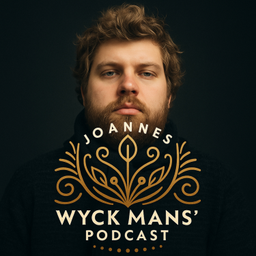
"Hi, I'm Joannes Wyckmans. Through the magic of text-to-speech, I bring this podcast to life, diving into complex topics and presenting them in an accessible format. Expect a journey across a vast array of subjects. Welcome aboard, and I hope you enjoy the ride."

Joannes Wyckmans Podcast
Claim This Podcastby Joannes J.A. Wyckmans
Podcast Overview
"Hi, I'm Joannes Wyckmans. Through the magic of text-to-speech, I bring this podcast to life, diving into complex topics and presenting them in an accessible format. Expect a journey across a vast array of subjects. Welcome aboard, and I hope you enjoy the ride."
Language
🇺🇲
Publishing Since
4/10/2025
1 verified contact email on file for Joannes Wyckmans Podcast
Pitch yourself as a guest, propose sponsorships, or reach out directly to the host.
Recent Episodes

June 7, 2026
An Analysis of Ernst Kaltenbrunner
<p>The Chieftain of Terror: An Analysis of Ernst Kaltenbrunner</p><p><br /></p><p>Executive Summary</p><p><br /></p><p>Ernst Kaltenbrunner (1903–1946) was the highest-ranking SS official to face justice at the International Military Tribunal in Nuremberg. As the successor to Reinhard Heydrich and the Chief of the Reich Security Main Office (RSHA), Kaltenbrunner controlled the most expansive machinery of state-sponsored terror in history, including the Gestapo, the SD, and the Criminal Police (Kripo).</p><p><br /></p><p>This document outlines his ascent from a provincial Austrian lawyer to a central figure in the Third Reich’s genocidal programs. Key takeaways include:</p><p><br /></p><p>* Supreme Authority of the RSHA: From January 1943 until the collapse of the Reich, Kaltenbrunner presided over the bureaucratic administration of the Holocaust, including the mass deportation of Hungarian Jews and the oversight of the concentration camp system.</p><p>* Ideological Commitment: Unlike opportunists who joined late, Kaltenbrunner was an early member of the Austrian Nazi underground, demonstrating a lifelong commitment to racial anti-Semitism and pan-German nationalism.</p><p>* The "Banality" of Evil: Historians and contemporaries describe him as a methodical bureaucrat who managed mass murder with industrial professionalism, often while consuming prodigious amounts of alcohol.</p><p>* Last-Ditch Survivalism: In the war's final months, he attempted to leverage his intelligence network to negotiate a separate peace with the Western Allies while simultaneously enforcing a "compulsory optimism" through summary executions of "defeatist" German citizens.</p><p>* Judicial Reckoning: Despite a defense centered on total denial of knowledge and responsibility, Kaltenbrunner was convicted of war crimes and crimes against humanity. He was executed by hanging on October 16, 1946.</p><p><br /></p><p><br /></p><p>--------------------------------------------------------------------------------</p><p><br /></p><p><br /></p><p>Early Life and Political Radicalization</p><p><br /></p><p>Born on October 4, 1903, in Ried im Innkreis, Upper Austria, Kaltenbrunner was raised in a traditional, middle-class Catholic household. His father was a respected lawyer, a profession Ernst would later adopt.</p><p><br /></p><p>Formative Influences</p><p><br /></p><p>* Geography: Kaltenbrunner grew up in Linz, the same city where Adolf Hitler spent his youth. The nationalist sentiment pervasive in this industrial city shaped his early worldview.</p><p>* Fraternity Culture: At the Graz University of Technology, Kaltenbrunner became a leader in German nationalist fraternities. He acquired vivid "dueling scars" (Schmisse) on both cheeks during academic fencing matches. These scars, combined with his 6'4" height and broad build, gave him a physically intimidating presence that he used to project dominance throughout his career.</p><p>* Ideological Foundations: His university years embedded a belief in German racial superiority, virulent anti-Semitism, and the conviction that violence was a legitimate political tool.</p><p><br /></p><p>Early Party Involvement</p><p><br /></p><p>Kaltenbrunner was a "True Believer" who joined the movement when it was still a minor, often illegal force in Austria:</p><p><br /></p><p>* NSDAP Membership: Joined in 1930 (Party No. 300,79).</p><p>* SS Membership: Joined in 1931 (SS No. 13,039).</p><p>* Underground Activity: During the period when the Austrian Nazi Party was banned (1933–1938), he organized clandestine SS cells in Upper Austria, serving as a primary link between the Austrian movement and Himmler’s apparatus in Munich. He was arrested twice by Austrian authorities for plotting against the state, experiences that hardened his radicalization.</p>

June 2, 2026
Political Ponerology: The Clinical Anatomy of Evil
<p>This episode introduces <strong>Andrew Łobaczewski’s</strong> work on <strong>political ponerology</strong>, a scientific framework dedicated to analyzing the origins and spread of <strong>macrosocial evil</strong>. The author argues that large-scale historical tragedies are not merely accidents of ideology but are driven by <strong>pathological individuals</strong>, particularly those with <strong>essential psychopathy</strong>, who infiltrate and hijack social structures. By shifting the study of evil from a theological or moralistic perspective to a <strong>clinical and psychological</strong> one, the text provides a roadmap for identifying how "pathocracies" form when societies lose their immunity to psychological deviance. This multidisciplinary overview explains that understanding the <strong>biological and psychological causes</strong> of such phenomena is essential for protecting modern civilization from systemic collapse. Ultimately, the source serves as both a <strong>survival guide</strong> and a scientific synthesis, aiming to provide humanity with the objective tools needed to diagnose and counteract the "terror of history."</p>

May 25, 2026
The Realism Gap: Why the Dutch Government Fails to Deliver
<p><strong>Analysis of Governmental Performance and Executive StagnationExecutive Summary</strong>The following briefing document synthesizes the findings and insights presented by the Netherlands Court of Audit (Algemene Rekenkamer) regarding the state of Dutch governance in 2025. The central conclusion is that the Netherlands has reached a state of stagnation, where the government systematically fails to deliver on its promises across nearly all critical policy areas, including housing, nitrogen, taxes, and security.Key takeaways include:</p><ul><ul><li><strong>The "Static State":</strong> Despite global acceleration, the Netherlands is "standing still," failing to meet both short-term targets and long-term strategic goals.</li></ul><ul><li><strong>Breach of Financial Standards:</strong> For the first time in decades, the government has exceeded the legal 1% error margin for financial regularity, specifically regarding financial "commitments" (verplichtingen), largely driven by irregularities in Defense procurement.</li></ul><ul><li><strong>The Execution Gap:</strong> A profound divide exists between academic policy-making at core ministries and the practical realities of execution. This is exacerbated by a culture of protecting ministers rather than addressing systemic flaws.</li></ul><ul><li><strong>Obsolescence:</strong> Governance is hindered by "stone-age" ICT systems (some dating to 1982) and an outdated "cash-based" accounting system that treats national finances like a student budget rather than a professional investment portfolio.</li></ul><ul><li><strong>Call for Realism:</strong> The Court of Audit, alongside the Council of State and the National Ombudsman, advocates for a "realistic government" that only promises what it can actually execute.</li></ul></ul><p></p>
964 total episodes available
Similar Podcasts
Discover related shows you might enjoy
Deep-dive analytics for Joannes Wyckmans Podcast
Frequently asked questions
Have a different question and can't find the answer you're looking for? Reach out to our support team by sending us an email and we'll get back to you as soon as we can.
- What is Joannes Wyckmans Podcast?
- How often does this podcast release new episodes?
This podcast updates daily.
- Where can I listen to this podcast?
This podcast is available on 4 platforms including Apple Podcasts, Spotify, and more. You can also use the RSS feed directly.
- Does this podcast accept guests?
No, this podcast does not typically feature guests.
Legal Disclaimer
Pod Engine is not affiliated with, endorsed by, or officially connected with any of the podcasts displayed on this platform. We operate independently as a podcast discovery and analytics service.
All podcast artwork, thumbnails, and content displayed on this page are the property of their respective owners and are protected by applicable copyright laws. This includes, but is not limited to, podcast cover art, episode artwork, show descriptions, episode titles, transcripts, audio snippets, and any other content originating from the podcast creators or their licensors.
We display this content under fair use principles and/or implied license for the purpose of podcast discovery, information, and commentary. We make no claim of ownership over any podcast content, artwork, or related materials shown on this platform. All trademarks, service marks, and trade names are the property of their respective owners.
While we strive to ensure all content usage is properly authorized, if you are a rights holder and believe your content is being used inappropriately or without proper authorization, please contact us immediately at hey@podengine.ai for prompt review and appropriate action, which may include content removal or proper attribution.
By accessing and using this platform, you acknowledge and agree to respect all applicable copyright laws and intellectual property rights of content owners. Any unauthorized reproduction, distribution, or commercial use of the content displayed on this platform is strictly prohibited.