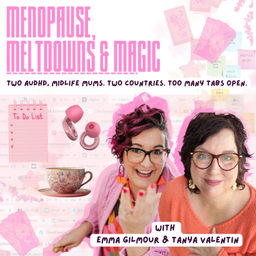
Menopause, Meltdowns & Magic - Two AuDHD, midlife mums. Two countries. Too many tabs open.
Tanya Valentin and Emma Gilmour
- 16
- Episodes
- Weekly
- Cadence
- 2026
- First episode
About Menopause, Meltdowns & Magic - Two AuDHD, midlife mums. Two countries. Too many tabs open.
Join Tanya Valentin (NZ neuro-affirming family coach) and Emma Gilmour (AUS alcohol-free & neurodivergent women’s coach) for honest, heart-led chats about being late-diagnosed AuDHD, perimenopausal, parenting teens in burnout, and trying not to lose ourselves (again). We cover masking, menopause, motherhood, identity, friendship, grief, and the messy magic of raising neurodivergent kids. This is a podcast for every mum who’s ever felt like she’s doing it wrong, too much, or not enough. Expect laughter, raw honesty, a little swearing, and a whole lot of validation.
- Publisher
- Tanya Valentin and Emma Gilmour
- Category
- kids & family
- Language
- en
- Explicit
- No
- First episode
- 10 Feb 2026
- Latest episode
- 2 Oct 2026
Latest episodes
16 episodes in the feed.
2 Oct 2026
Needing Space and Still Loving People with Alice Bramhill
What if needing space does not mean you love people any less? In this episode, Tanya and Emma sit down with Alice Bramhill, a registered mental health nurse, interpersonal psychotherapist and neurodivergent coach, to talk about relationships, retreat and the quiet courage of knowing yourself. Alice’s first book had only just been released, and it opened a conversation that wandered through grief, friendship, family culture and the pressure to be an “acceptable human”. Along the way, you may find some gentle permission. Permission to retreat when the world feelstoo loud. Permission to follow your own interests rather than someone else’s idea of a social life. Permission to let your children, and yourself, take space without it meaning anything is wrong. We close, as always, with a little magic.This week it arrives as a newborn calf, a small black cat hiding in plain sight, and a son who tells his mum she has done apretty good job.You may find this conversation helpful if: You have ever wondered whether needing timealone says something about how much you care You are in the in-between of a world that has shrunk and are wondering if that is allowed You feel the friendships built around your masked self fading, and you are unsure what comes next You are raising children and hoping they grow up knowing that space is something they never have to apologise for Who is Alice Bramhill? Alice is a registered mental health nurse, interpersonal psychotherapist and neurodivergent specialist coach based in the UK. She began nursing at sixteen, trained in interpersonal psychotherapy through the NHS, and left her full time NHS post in 2018 after her own burnout and as her children came out of school. She went on to complete an art degree, returned to therapy, and opened her private practice four years ago. Alice is also a parent of neurodivergent children, a gardener, a reader and the keeper of two dogs and a cat who recently adopted the family. Her first book, I Need My Space (But I Like You Too!), was published this week, and her second is already written and due next year.A line to carry with you: “Mixing less is often the medicine. It isn’t the same medicine for everybody.” Alice BramhillResources mentioned in the show:The book: I Need My Space (But I Like YouToo!): A Neurodivergent Guide to All Types of Relationships by Alice Bramhill, published by Jessica Kingsley Publishers. Alice’s book page (https://www.alicebramhill.co.uk/ineedmyspacethebook) or the publisher’s page (https://us.jkp.com/products/i-need-my-space-but-i-like-you-too). Book availability: Alice shared that the publisher expects copies for New Zealand and Australia to arrive in December, and that it can also be ordered online in the meantime. Alice’s website: alicebramhill.co.uk (https://www.alicebramhill.co.uk). Alice’s Substack: A community for deep feelers and big hearted people, where Alice writes about neurodivergent lifeand relationships. Interpersonal psychotherapy: The attachment and social theory based talking therapy Alice trained in, which treats relationships as central to how we feel. Extra Support The Great Aussie Alcohol Experiment with Emma Live from 1 October, 30 days, small group coaching, 25spots only. Join → (https://www.hoperisingcoaching.com/the_great_aussie_alcohol_experiment) Tanya's free 10-Day Tiny Anchors Journey A gentle, guided starting point for parents wanting asmall, doable anchor in the day to day of burnout recovery. Start the journey → (https://tanyavalentin.co/ta)
25 Sept 2026
When School Is Not Working: Unschooling, Burnout and Trust With Guest Melissa Crockett-Joyoue
Some children cannot learn at school, and some parents are left holding that truth while everyone around them has an opinion about it. In this conversation, Tanya and Emma sit down with Melissa Crockett-Joyoue, a Māori, late-diagnosed AuDHD mama of two unschooled neurodivergent children. Melissa is also the co-founder of the Unschooling Summit and the founder of Weave ND, an online membership community that supports neurodivergent unschooling families, with a focus on capacity building and connection for the parents. Melissa shares how her family arrived at unschooling out of crisis rather than choice, and what she has come to understand about learning, trust and nervous systems alongthe way. Together they explore what unschooling actually is, why so many parents feel an unravelling when they step away from a schoolish way of seeing the world, and what learning can look like during burnout when it may not look like learning at all. There is honest talk about grief, masking, friendship and the quiet work of caring for your own nervous system so that you can hold your child’s. If your child is in burnout and you are wondering whether they are falling behind, this conversation may offer some breathing room. You may find it supportive to listen for: Unschooling as child led, parent supported learning that rests on trust and relationship Why learning during burnout may begin with emotions, connection and environment Ways to notice the learning already happening in special interests and gaming The many pathways into further study later, when a young person knows what motivates them Masking, people pleasing and the cost school can carry for some neurodivergent children The grief parents carry, and why your own nervous system capacity matters Melissa Crockett-Joyoue lives in Aotearoa (New Zealand), is Māori and a late diagnosed AuDHD māmā of two unschooled neurodivergent children. Melissa is the founder of Weave ND, an online membership community dedicated to creating connection and building capacity of the parents in neurodivergent unschooling families. She's passionate about advocating for unschooling as an enriching and potentially life-changing path for families, especially those with neurodivergent kids. This lead her to co-found the international online 'The Unschooling Summit' with Esther Jones, which has reached over 11,000 families from 60+ countries over the last two years. https://weave-community.mn.co/ (https://weave-community.mn.co/) https://www.instagram.com/weave.nd.unschooling (https://www.instagram.com/weave.nd.unschooling) Offers & further support FREE 3-Day Alcohol Reset with Emma 22-24 September, 7:30pm AEST (replays available). Ajudgement-free space to learn tools for a take it or leave it relationship withalcohol. Register → (https://www.hoperisingcoaching.com/3-day-reset) The Great Aussie Alcohol Experiment with Emma Live from 1 October, 30 days, small group coaching, 25spots only. Join → (https://www.hoperisingcoaching.com/the_great_aussie_alcohol_experiment) Tanya's free 10-Day Tiny Anchors Journey A gentle, guided starting point for parents wanting asmall, doable anchor in the day to day of burnout recovery. Start the journey → (https://tanyavalentin.co/ta)
16 Sept 2026
Neurodivergent Marriages and Partnerships
Tanya and Emma sit down for an honest, unscripted conversation about what happens to a marriage or partnership when one or both parents are neurodivergent, and when a child moves into burnout. They talk about co-regulation, the invisible load carried by the primary caregiver, the grief of an imagined future that never arrived, and why so many parents feel trapped between their own safety and their family's survival. It is a tender, sometimes raw episode, and one both hosts say could easily have run for hours.In this episode The long middle of a neurodivergent marriage - Tanya reflects on her own thirty-year marriage, marriedat twenty with no idea either of them was neurodivergent, a hard decade of not knowing if they would stay together, and the slow, ongoing work of rediscovering the relationship as two neurodivergent people. One partner usually leads, the other catches up (or doesn't) - Parenting differently is heavily conditioned against. Often one partner takes the lead in learning new, more neuroaffirming ways and becomes the primary caregiver during a child's burnout, while the other defaults to managing finances and logistics, a split that can breed resentment and feel like judgment rather than support. Co-regulation quietly shifts from partner to child - Many neurodivergent couples unconsciously co-regulate each other, often without realising it's a foundation of the relationship. When children arrive, that co regulation frequently shifts onto them instead, leaving the partnership without the thing that was holding it steady. Financial dependency and fawning history can trap people in unsafe places - Stepping back from career to caregiver comes with a real cost: less financial independence, less agency, and more vulnerability,especially layered on top of a fawning, people-pleasing history. Both hosts hear from women, especially in school can't and PDA communities, who stay in relationships that aren't safe or fulfilling because there's no financial way out. The exhausting performance of the 'perfect parent' is a safety response - Pinterest parties, working-mother guilt, and the pressure to look like you have it all together aren't vanity. Tanya and Emma name these as nervous system safety responses to a deep fear of being seen asfaulty, and talk about the grief underneath it all for the imagined future and community that didn't turn out as hoped. It's especially hard for dads to be vulnerable or ask for help - Cultural conditioning tells men to toughen up and solve things themselves, therapy carries cost and stigma, and shame often sits underneath anger or control when a father feels powerless to fix his child'sstruggles. For Tanya, the biggest turning point in her marriage was her husband seeking outside support and the two of them doing the Tuning into Teens course together. Mentioned in this episodeUntamed by Glennon Doyle — referenced for the 'your house is your drawbridge' concept Tuning into Teens — the parenting course Tanya and her husband completed together Practical Magic 2 — the film Tanya's magic moment references Offers & further support FREE 3-Day Alcohol Reset with Emma 22-24 September, 7:30pm AEST (replays available). Ajudgement-free space to learn tools for a take it or leave it relationship withalcohol. Register → (https://www.hoperisingcoaching.com/3-day-reset) The Great Aussie Alcohol Experiment with Emma Live from 1 October, 30 days, small group coaching, 25spots only. Join → (https://www.hoperisingcoaching.com/the_great_aussie_alcohol_experiment) Tanya's free 10-Day Tiny Anchors Journey A gentle, guided starting point for parents wanting asmall, doable anchor in the day to day of burnout recovery. Start the journey → (https://tanyavalentin.co/ta)
7 Sept 2026
Rupture and Repair: Healing the Cracks in Our Relationships
Most of us grew up believing that a good relationship never has disagreements, conflict, or angry words. In this episode, Tanya and Emma sit with the opposite idea: that rupture is inevitable, and the real skill we were never taught is repair. Together they trace how their families of origin handled conflict (mostly by not handling it at all), why saying sorry to your own children can feel like breaking a generational rule, and how becoming the first generation to actually apologise reshapes the relationship on both sides. The conversation moves from parenting into perimenopause, masking and unmasking, and the friendships and family ties that do not survive us becoming more honest about our needs. It closes with a set of practical strategies for the relationships we cannot walk away from and a reminder that a relationship which can survive rupture and repair is stronger for it.In This Episode Why rupture and repair is the topic, and how it kept showing up everywhere this week Growing up where adults had the final say and feelings were not up for discussion The myth that parents must know everything and never make mistakes Being the first generation in the family to say sorry to their children, and meaning it The shame wired into asking for what you need: “don't be so needy” A therapist's reframe: would you take offence if your own child told you that you hurt them? What it looked like when their children, post-burnout, told them everything that had hurt ADHD, executive functioning, and the “why can't you just do the thing” spiral How it took their children collapsing into burnout for the pattern to become visible Why the absence of repair hurts more than the original rupture Being judged as a parent by how “well-behaved” your children are in public Practical strategies for hard family visits: time-boxing, radical acceptance, and taking breaks Glennon Doyle's Untamed and the “leave your fear at the door” family boundary Naming family culture rules in advance, including no commentary on bodies Fawning, courage, and finding the words in the moment The core ingredient of repair: holding two truths (multiplicity) at once. Resources & Mentions Untamed by Glennon Doyle — referenced for the “leave your fear at the door” boundary with visitors Magic Moments (Glimmers) Tanya - Ordering dinner-plate-sized dahlia bulbs and getting anticipatory joy from the wait Emma - Buying a trans and LGBTIQ+ ally pin that says “you are safe with me” If you are a parent of a neurodivergent child in burnout and you would like something to hold you while you hold everyone else, download the free 10 Tiny Anchors Journey (https://tanyavalentin.co/ta) If you are a woman who is questioning your relationship with alcohol, explore Emma's membership: https://www.hoperisingcoaching.com/bethelighthouse (https://www.hoperisingcoaching.com/bethelighthouse)
26 Aug 2026
Insight Isn’t Immunity: Understanding, Feeling, and the Parts of Us Still Learning to Trust Ourselves
This week Tanya sits down with Emma for a wandering,honest conversation about the gap between understanding something and actually feeling it. They talk about why knowing the “why” behind a meltdown, a trigger, or a parenting mistake doesn’t stop it from hurting, and how intellectualising can quietly become another way of bypassing our own nervous systems. From attachment wounds and trauma responses to theparticular grief of realising the harm done before a late autism diagnosis, this one goes deep. They also share the small, unfussy things that help them come back to themselves: dancing badly in the kitchen, talking to trees, and letting a feeling last its real ninety seconds instead of the story we build around it. In this episode Why insight and understanding don’t immunise us from hurt, grief, or overwhelm How intellectualising can be a trauma response and a nervous-system safety blanket Attachment patterns that show up when someone we love pulls away The particular shame of harm done before a late autism diagnosis Finding neurodivergent-affirming therapists, and why it’s worth vetting every one Tools for actually feeling a feeling: titration, pendulation, and the real ninety seconds What grounds each of them — dancing, nature, and safe anchors Magic momentsEmma - A slow, sweet morning cuddled up with her daughter Daisy — mucking about in bed together instead of jumping straight into the routine Tanya - Listening to Brené Brown talk about wearing two watches— one for chronos time and one that belonged to her grandmother— which sent Tanya looking for her own grandmother’s watch, and the memories that came withfinding it. Resources mentioned Big Magic by Elizabeth Gilbert Trauma and Recovery by Judith Herman Gabor Maté’s work on trauma and addiction Francis Weller’s work on grief, including the gates of grief and grief for the unloved self Adult Children of Emotionally Immature Parents by Lindsay C. Gibson An article referenced as “the piece by Lindsay” — Lindsey Mackereth's Substack (https://substack.com/@lindseymackereth) Kristy Forbes’s (https://substack.com/@kristyforbes) Substack If you are a parent of a neurodivergent child in burnout and you would like something to hold you while you hold everyone else, download the free 10 Tiny Anchors Journey (https://tanyavalentin.co/ta) If you are a woman who is questioning your relationship with alcohol, explore Emma's membership: https://www.hoperisingcoaching.com/bethelighthouse (https://www.hoperisingcoaching.com/bethelighthouse)
19 Aug 2026
When Trauma and Neurodivergence Get Tangled Together
In this episode, Tanya sits down with Emma for a conversation that goes right to the heart of a question so many parents in this community carry quietly: "Is it trauma, or is it neurodivergence?" Together they trace how the two get woven into each other from childhood, why masking costs so much more than it looks like from the outside, and what it means to try toparent differently while still learning the language yourself. This one is honest, a little raw in places, and full of the kind of recognition that makes you feel less alone. Grab a cup of tea before you press play. What we chat about in this episode: Why so many professionals label neurodivergent kids as traumatised, and thefear that stirs up in parents who did nothing wrong The ongoing debate of “is it trauma or is it neurodivergence,” and why Tanya and Emma see it as a false choice. A working definition of complex trauma: a heart that gets broken a million times and has to be put back together. What masking really costs, and how it gets layered into every part of a person rather than sitting on top like a persona. Why trauma is relational and situational, not an inevitable part of being neurodivergent. Power, compliance and why children who question the rules are so often met with cruelty. Situational mutism, freeze mode, and the lifelong echoes of being pushed to “just get the words out” The research linking autism itself to PTSD and complex PTSD, and the relief of realising “it's not just me” Why unmasking isn't always safe, and why that's allowed to stay true rather than be fixed. The reality of advocating for your child within systems that start treating you as the problem. Resources and mentionsSonny Jane Wise — the post on trauma and neurodivergence that sparked this conversation (https://www.instagram.com/livedexperienceeducator/) Lindsay's checklist on autism, stimming and CPTSD markers, mentioned as a helpful resource for parents and autistic adults (https://lindseymackereth.substack.com/p/autism-or-complex-ptsd-a-5-page-exploration?r=2mp9n9&utm_medium=ios&utm_id=97760_v0_s00_e0_tv4&triedRedirect=true&fbclid=PARlRTSATx7sJwZG9mAmZkaWQWUMsNLgaTxuGAqwkUv-m8EkdcskVvGGV4dG4DYWVtAjEwAHNydGMGYXBwX2lkDzEyNDAyNDU3NDI4NzQxNAABp02_V7mst5CrFFQx1hWcGfgT2cAejDJPVtDgiXxhk4zHFUPqfmyctYP-fiSp_aem_K6yrvVS9_GyjCQrMkZ_Weg) The research paper on trauma and autistic people referenced around the 18–20 minute mark. (https://www.ptsduk.org/link-between-autism-and-ptsd/) The book on emotionally immature parents that Emma mentioned (https://www.amazon.com.au/s?k=emotionally+immature+parents&language=en_AU&adgrpid=151358131841&hvadid=653529002869&hvdev=c&hvlocphy=9119078&hvnetw=g&hvqmt=e&hvrand=1894533586325755933&hvtargid=kwd-300895980201&hydadcr=7676_448032&mcid=79dbb5e5d10530a690a63a6ed4e58412&tag=nztxtgostdde-22&ref=pd_sl_4sscwpntqo_e) “Our hearts get broken a million times, and we have to put them back together. That's complex trauma.” If this episode landed for you, Tanya and Emma would love to hear where. Come share your own experience, your questions, or just tell them it's not just you. This is how we slowly build a world where more of us get to feel less alone in it. If you are a parent of a neurodivergent child in burnout and you would like something to hold you while you hold everyone else, download the free 10 Tiny Anchors Journey (https://tanyavalentin.co/ta) If you are a woman who is questioning your relationship with alcohol, get with Emma's membership: https://www.hoperisingcoaching.com/bethelighthouse (https://www.hoperisingcoaching.com/bethelighthouse)
1 Jun 2026
Why Fairness Matters So Much: Justice, PDA and the Nervous System
Why do some people seem able to let things go while others feel deeply affected by unfairness, injustice, or double standards? In this episode of Meltdowns, Menopause and Magic, Tanya and Emma explore the powerful relationship between neurodivergence, fairness, social justice, and nervous system activation. Together, they unpack why many Autistic and PDA individuals experience injustice not simply as an idea, but as a whole-body experience. They discuss how fairness shows up in childhood, schools, workplaces, families, and society more broadly, and why experiences of being misunderstood, excluded, or othered can leave lasting impacts. The conversation also explores the emotional labour of caring deeply about the world around us, how social justice can become intertwined with our own experiences of belonging, and what we can do when the weight of unfairness feels overwhelming. In this episode, we chat about: • Why fairness and justice can feel so important for many Autistic and PDA people. • The difference between noticing injustice and experiencing it as nervous system activation. • How schools, workplaces, and social systems can unintentionally create feelings of inequity. • Why many neurodivergent children struggle when rules are applied inconsistently. • The connection between fairness, belonging, masking, and childhood experiences of being misunderstood. • How experiences of exclusion can shape our responses to injustice as adults. • The emotional impact of witnessing discrimination and systemic inequities. • Supporting children who are highly affected by unfairness and social issues. • The challenge of staying informed without becoming overwhelmed. • Practical strategies for managing nervous system activation when feelings of injustice arise. If this conversation resonated with you, we'd love to hear your thoughts. What role does fairness play in your life or your child's experience? Follow along for more conversations about neurodivergence, parenting, menopause, identity, nervous systems, and the magic that can be found in unexpected places. Podcast: Meltdowns, Menopause and Magic Hosts:Tanya Valentin & Emma Gilmour If you are a woman questioning your relationship with alcohol, join Emma's 5 Day Alcohol Reset: https://www.hoperisingcoaching.com/fivedayreset (https://www.hoperisingcoaching.com/fivedayreset%20)A 5-day self-paced break from alcohol - to learn the tools to make alcohol a small and irrelevant part oftheir lives. If you are a parent of a child or teen in burnout needing support, join Tanya's Parent Community: From Burnout to Balance (https://tanyavalentin.co/parent-community/)
22 May 2026
When Support Hurts: Burnout, Belonging and Trusting Ourselves Again
In this episode of Menopause, Meltdowns and Magic, Tanya and Emma explore a complicated topic for many neurodivergent families: What happens when the “support” being offered actually causes more harm? Together, they unpack the long middle of burnout recovery, that messy, uncertain stage where things may appear to be improving on the surface, while nervous systems are still overwhelmed underneath. This conversation explores: Why the wrong support can prolong burnout. How even “good” support can become overwhelming during deep nervous system exhaustion. The pressure parents feel to accept therapies, interventions, and professional advice. Medical-model thinking versus relational and nervous-system-informed approaches. The grief, guilt and vulnerability of learning to trust ourselves again as parents. Why body autonomy and consent matter deeply for neurodivergent children. The difference between fitting in and true belonging. How compliance-based systems can disconnect children from themselves. The hidden trauma many parents carry while advocating for their children. This episode also touches on masking, chronic fatigue, accommodations in schools, interdependence versus independence, and the powerful ripple effects of cycle-breaking parenting. As always, the conversation weaves between personal stories, deep reflection, humour, nervous system wisdom, and moments of everyday magic.Resources & References Mentioned Dr. Emmi Pikler and respectful caregiving. Amanda Diekman and Low Demand Parenting. Brené Brown’s work on belonging versus fitting in. Internal Family Systems and No Bad Parts by Richard Schwartz. Peter Levine and nervous system trauma work. Podcast: Meltdowns, Menopause and Magic Hosts: Tanya Valentin & Emma Gilmour If you are a woman questioning your relationship with alcohol, join Emma's 5 Day Alcohol Reset: https://www.hoperisingcoaching.com/fivedayreset (https://www.hoperisingcoaching.com/fivedayreset ) A 5-day self-paced break from alcohol - to learn the tools to make alcohol a small and irrelevant part of their lives. If you are a parent of a child or teen in burnout needing support, join Tanya's Parent Community: From Burnout to Balance (https://tanyavalentin.co/parent-community/)
12 May 2026
What Matters Most: Pressure, Parenting, and Repair
In this deeply honest episode of Menopause, Meltdowns and Magic, Tanya and Emma explore the invisible pressure many parents carry to keep pushing through, even when their nervous systems, relationships, and families are asking for something gentler. Together, they unpack the cultural conditioning around productivity, perfectionism, people pleasing, and “good parenting,” and how these pressures can quietly shape the way we relate to ourselves and our children, especially during burnout recovery. This conversation moves through grief, masking, autonomy, relational safety, repair, fawning, self-compassion, and the emotional labour of parenting neurodivergent children. Tanya and Emma reflect on how burnout recovery can feel confusing when children begin to emerge from shutdown, and how easy it is to unconsciously compare them to who they were before burnout. This episode is a gentle reminder that healing is not linear, parenting is deeply human, and repair is always possible. In this episode, Tanya and Emma discuss: How productivity culture teaches us to keep pushing through exhaustion. Why parents can unconsciously place pressure on children emerging from burnout. The grief of letting go of who our children were before burnout. The connection between burnout, masking, perfectionism, and people pleasing. Why many coping behaviours are rooted in nervous system safety, not manipulation. How childhood experiences shape hypervigilance and fawning responses. The emotional impact of believing our children are a reflection of our worth. Why repair can create deeper and more authentic relationships. The difference between guilt and shame in parenting. Why self-compassion may matter even more than self-care. How relational safety allows children to advocate, unmask, and speak honestly. The importance of sitting beside difficult emotions instead of rushing to fix them.Resources & References Mentioned The Book of Awakening by Mark Nepo. Tuning Into Kids / Tuning Into Teens emotion coaching framework. Conversations around masking, relational safety, burnout, and nervous system care. Podcast: Meltdowns, Menopause and Magic Hosts: Tanya Valentin & Emma Gilmour If you are a woman questioning your relationship with alcohol, join Emma's 5 Day Alcohol Reset: https://www.hoperisingcoaching.com/fivedayreset (https://www.hoperisingcoaching.com/fivedayreset ) A 5-day self-paced break from alcohol - to learn the tools to make alcohol a small and irrelevant part of their lives. If you are a parent of a child or teen in burnout needing support, join Tanya's Parent Community: From Burnout to Balance (https://tanyavalentin.co/parent-community/)
28 Apr 2026
The Hidden Struggles of Neurodivergent Friendships
Friendship can feel complicated, especially for neurodivergent women navigating masking, burnout, grief, and identity shifts. In this deeply honest conversation, we explore how our experiences of friendship have been shaped over time—from early moments of exclusion and heartbreak, to high-masking personas, to the quiet unravelling that often comes with burnout, sobriety, or late diagnosis. We talk about what happens when your world becomes smaller, when your capacity changes, and when the people around you don’t quite meet you where you are. And we gently name the grief that lives underneath it all—the friendships that didn’t hold, the community that didn’t show up, and the longing to be truly seen. This episode is a soft place to land if you’ve ever felt like you don’t quite “fit” in friendship, or if connection has felt confusing, one-sided, or out of reach. You are not alone in this. In this episode, we explore: Why friendships can feel especially complex for neurodivergent women How early friendship experiences can shape masking and identity The impact of high masking and performing “acceptability” in relationships Friendship breakups and the deep, often unspoken grief they carry How alcohol, achievement, or caregiving roles can become forms of masking The shift that happens when masking drops (through burnout, diagnosis, or sobriety) Why some friendships feel “hollow” or difficult to sustain over time The emotional labour of being the one who maintains connection The experience of “disappearing” from friendships during burnout or crisis Why many neurodivergent people prefer depth over small talk Object permanence and “out of sight, out of mind” in friendships The difference between neurotypical and neurodivergent social expectations How parenting a child in burnout or crisis can reshape your identity and relationships The loneliness of experiences that others don’t understand (e.g. mental health crises vs. physical illness) The role of cultural narratives like “just world theory” in how people respond to hardship Grief as a central, often missing piece in friendship and community The importance of being witnessed, rather than fixed or judged What it feels like to find safe, attuned connection with other neurodivergent people A gentle reflection:Where have you felt like you had to “perform” in order to belong? What kind of friendship feels safe and sustainable for you now—not who you used to be, but who you are today? You are welcome to share your lived experience of this in the comments. Podcast: Meltdowns, Menopause and Magic Hosts: Tanya Valentin & Emma Gilmour If you are a woman questioning your relationship with alcohol, join Emma's 5 Day Alcohol Reset: https://www.hoperisingcoaching.com/fivedayreset (https://www.hoperisingcoaching.com/fivedayreset ) A 5-day self-paced break from alcohol - to learn the tools to make alcohol a small and irrelevant part of their lives. If you are a parent of a child or teen in burnout needing support, join Tanya's Parent Community: From Burnout to Balance (https://tanyavalentin.co/parent-community/)
21 Apr 2026
Supporting Trans and Gender Diverse Children with Chris McAllister
In this heartfelt and deeply human conversation, we are joined by comedian and content creator Chris McAllister, The Trans Comedian, who shares his journey of gender exploration, identity, and finding joy through humour. Together, we explore what it means to support trans and gender diverse children in a world that can feel both affirming and challenging. This episode gently weaves together lived experience, parenting reflections, and moments of lightness—offering reassurance that there is no single “right way” to navigate this path. This is a conversation about safety, belonging, and the power of being seen. Chris’s journey of discovering his identity and the role of gender euphoria How humour can be a powerful tool for healing, connection, and advocacy The reality of growing up outside gender norms—and the impact of bullying Why representation matters (and how it can change a child’s sense of possibility) The story behind Chris’s viral “I Can Tell” campaign and its ripple effect of kindness The difference between dysphoria and euphoria—and why this matters for understanding trans experience How parents can support their child when they begin exploring gender The importance of community, safe spaces, and finding “your people” Letting go of fear-based narratives and making space for possibility and joy You don’t need to have all the answers—presence and openness matter most Supporting your child’s identity can be as simple (and powerful) as using their name and pronouns Exploration is a natural part of childhood—gender is no different Creating a home where your child feels safe to be themselves can become a protective anchor, even when the outside world feels hard Connection, not perfection, is what helps families find their way forward This episode softly challenges the idea that a trans identity automatically means a life of struggle. Instead, it invites a more nuanced and hopeful perspective—one where joy, humour, and thriving are also part of the story. It also gently highlights something many parents carry quietly: the fear that they might “get it wrong.” If that’s you, this conversation is here to remind you that trying, learning, and staying connected matter far more than getting everything right. Connect with Chris on Instagram: https://www.instagram.com/thetranscomedian/ (https://www.instagram.com/thetranscomedian/) Podcast: Meltdowns, Menopause and Magic Hosts: Tanya Valentin & Emma Gilmour If you are a woman questioning your relationship with alcohol, join Emma's 5 Day Alcohol Reset: https://www.hoperisingcoaching.com/fivedayreset (https://www.hoperisingcoaching.com/fivedayreset ) A 5-day self-paced break from alcohol - to learn the tools to make alcohol a small and irrelevant part of their lives. If you are a parent of a child or teen in burnout needing support, join Tanya's Parent Community: From Burnout to Balance (https://tanyavalentin.co/parent-community/)
30 Mar 2026
When Self-Help Harms: Rethinking Growth, Safety, and Healing
In this honest and layered conversation, we explore the often-unquestioned world of self-help, personal development, and “growth” culture, and gently ask: What happens when the very tools meant to help us… actually harm us? Drawing from our own lived experiences as coaches, parents, and neurodivergent women, we unpack the complexity of healing spaces that can feel both transformative and unsafe at the same time. This episode invites you to step out of rigid self-improvement narratives and into something softer, more human, and more attuned. The hidden harm in some personal development spaces How power dynamics and lack of consent can show up in “growth” environments Why neurodivergent and trauma-affected individuals may be especially vulnerable The pressure of “always improving” and how it disconnects us from our humanity The impact of productivity culture on parents, especially those supporting children in burnout Why common self-help language (like resilience, self-sabotage, and inner critic) can be harmful Reframing behaviours as nervous system responses, not personal failings The difference between co-regulation and codependency How cultural conditioning shapes our relationship with rest, worth, and safety The importance of holding multiple truths — compassion for our past and space for our own experience If you are a neurodivergent person or a parent of a neurodivergent child or a child in burnout, this conversation may land deeply. So much of what we’ve been taught about success, behaviour, and growth doesn’t account for nervous systems, trauma, or capacity. And when we try to apply those frameworks to our children (and ourselves), it can create shame, fear, and disconnection. You are not doing it wrong. You are navigating something complex — with the tools you were given. If something in this episode didn’t sit right… or felt uncomfortable… or quietly resonated… You are allowed to trust that. You don’t need to override yourself to grow. You don’t need to push through something that doesn’t feel safe. There is another way. Podcast: Meltdowns, Menopause and Magic Hosts: Tanya Valentin & Emma Gilmour If you are a parent of a child or teen in burnout needing support, join Tanya's Parent Community: From Burnout to Balance (https://tanyavalentin.co/parent-community/) If you are a woman questioning your relationship with alcohol, join Emma's Be The Lighthouse Membership (https://www.hoperisingcoaching.com/bethelighthouse)
23 Mar 2026
When Lived Experience Is Dismissed: Autism, Masking & Why This Conversation Matters
In this episode, Tanya and Emma gently unpack a recent and controversial article by Uta Frith, which has stirred deep conversation within the neurodivergent community. Together, we explore what happens when lived experience is questioned… When progress feels like it’s being pushed backwards… And when already-marginalised voices—especially late-diagnosed women—are dismissed once again. This is not just a conversation about autism. It’s a conversation about power, voice, identity, and what it means to trust ourselves in a world that often asks us not to. What We Explore in This Episode: The Impact of Narrow Definitions of Autism How early diagnostic frameworks shaped our current understanding Why expanding the lens of autism matters The harm that can come when the spectrum is described as “too broad” What masking actually is (and why it exists) How masking connects to burnout, especially in children and parents Why dismissing masking invalidates lived experience—and delays support The concerning timing of these narratives alongside funding cuts How public discourse can influence access to support Why this conversation is bigger than one article The reality behind diagnosis (it’s not a “trend”) Misdiagnosis, internalised shame, and years of confusion The deep relief and self-understanding that can come with diagnosis Moving from self-blame to self-understanding How diagnosis can support compassion, not limitation The ripple effect this has on parenting, relationships, and identity The emotional weight of being dismissed (again) The intersection of gender, disability, and systemic bias Why this moment feels activating for so many We acknowledge that this conversation may feel tender, especially if you’ve experienced dismissal, misdiagnosis, or long periods of not being seen. You are invited to: Pause if you need to Come back when you feel resourced Tend to yourself with care and compassion You are not alone in this. Transcript (https://assets.cdn.filesafe.space/0SltjgYAk7U78VhOfBbE/media/69c0b324f516437b62488d18.txt) Next Episode: Next week, Tanya and Emma explore how productivity culture and the self-help industry can add to burnout and cause real harm to neurodivergent humans. Podcast: Meltdowns, Menopause and Magic Hosts: Tanya Valentin & Emma Gilmour If you are a parent of a child or teen in burnout needing support, join Tanya's Parent Community: From Burnout to Balance (https://tanyavalentin.co/parent-community/) If you are a woman questioning your relationship with alcohol, join Emma's Be The Lighthouse Membership (https://www.hoperisingcoaching.com/bethelighthouse)
16 Mar 2026
Polyvagal Theory, Nervous Systems, and the Debate Happening Online
In this episode, Tanya Valentin and Emma Gilmour explore the conversation currently unfolding in the wellness and neuroscience communities around polyvagal theory and recent critiques of the model. Polyvagal theory, originally proposed by Stephen Porges, has become a widely used framework in therapy, coaching, and neurodivergent spaces for understanding how the nervous system responds to safety and threat. Recently, a critique led by researcher Paul Grossman and colleagues sparked headlines suggesting that aspects of the theory may be incorrect or overstated. Rather than jumping into polarised takes, Tanya and Emma slow the conversation down. Together they explore what the debate actually means, what parts of the science are well supported, and why the framework has still been profoundly helpful for many people — especially those navigating trauma, burnout, and neurodivergent experiences. Most importantly, they reflect on the deeper question: How do we hold scientific nuance while still honouring lived experience? • What polyvagal theory is and why it became so influential • Why the recent critique of the theory has caused so much debate • What parts of the theory are still well supported by evidence • Why nervous system frameworks have helped many people move away from shame-based behaviour models • How understanding safety responses can transform parenting and self-compassion • Why regulation does not mean being calm all the time • The difference between burnout, shutdown, and depression • Why lived experience must remain central when interpreting psychological theories • The importance of small moments of safety rather than forcing “perfect” self-care Share your thoughts or your own “magic moment” from the week in the comments or on social media. If you enjoyed this episode, please follow, rate, and share the podcast so more parents navigating burnout, neurodivergence, and midlife transitions can find this community. Download Transcript (https://assets.cdn.filesafe.space/0SltjgYAk7U78VhOfBbE/media/69b776bf269d654b7394cf5d.txt) Next Episode: Next week, Tanya and Emma explore the debate sparked by a recent article questioning the autism spectrum model and what it might mean for autistic and AuDHD communities. Podcast: Meltdowns, Menopause and Magic Hosts: Tanya Valentin & Emma Gilmour If you are a parent of a child or teen in burnout needing support, join Tanya's Parent Community: From Burnout to Balance (https://tanyavalentin.co/parent-community/) If you are a woman questioning your relationship with alcohol, join Emma's Be The Lighthouse Membership (https://www.hoperisingcoaching.com/bethelighthouse)
9 Mar 2026
Midlife Momentum, Neurodivergence & Doing Life Your Own Way with Lisa Corduff
In this very first episode of Meltdowns, Menopause and Magic, Tanya and Emma sit down with author, coach and long-time entrepreneur Lisa Corduff for a deeply honest conversation about midlife, neurodivergence, grief, identity, and the pressure to live life “the right way.” Emma shares the story of how joining one of Lisa's programs years ago helped Emma shift from shame and perfectionism into a different relationship with time, productivity and self-acceptance. From there, the conversation unfolds into something many women will recognise: the tension between societal expectations and the reality of living with an ADHD or neurodivergent brain. Together they explore: Why the pressure to be productive can push women toward burnout Learning to trust your instincts instead of external “rules” for success The grief, identity shifts and self-questioning that often come in midlife How neurodivergent women often build businesses and lives differently Why rest, novelty and fun can be powerful strategies for momentum The freedom that comes from letting go of perfection and doing things your own way Lisa also reflects on navigating grief after losing her husband, the long road back to energy and creativity, and how she’s rebuilding momentum in her life in a way that honours her brain, her family and her capacity. This episode is full of laughter, honesty and those moments of recognition that remind us we’re not alone. ✨ At the end of the conversation, Tanya, Emma and Lisa share their recent “magic moments” — small glimpses of joy that help anchor us in the midst of complex lives. If you’ve ever felt like you’re doing life differently… or wondered if maybe the rules were never written for you in the first place — this conversation will feel like sitting at the kitchen table with friends who truly get it. Download Transcript (https://assets.cdn.filesafe.space/0SltjgYAk7U78VhOfBbE/media/69adf4f380d359781a6722bd.txt) Find out more about Lisa's Second Wind (https://lisacorduff.com/secondwind/?utm_source=ONTRAPORT-email-broadcast&utm_medium=ONTRAPORT-email-broadcast&utm_term=000+Action+webinar&utm_content=Your+replay%21+Plus....&utm_campaign=05032026) Program. Find out more about Emma's Lighthouse Membership (https://www.hoperisingcoaching.com/bethelighthouse) Find out more about Tanya's From Burnout to Balance Membership (https://tanyavalentin.co/parent-community/)
10 Feb 2026
Meet Emma and Tanya
Welcome to Menopause, Meltdowns and Magic. In this first episode, Emma Gilmour and Tanya Valentin introduce themselves and share what this podcast is really about — the conversations we’re having, the stories we’re telling, and what you can expect from this space. If you are a midlife mother raising a neurodivergent child, there’s a strong chance you’ll feel right at home here. You’re so welcome.
Contact Menopause, Meltdowns & Magic - Two AuDHD, midlife mums. Two countries. Too many tabs open.
- Guest appearances
- Books guests
Based on episode analysis; this does not confirm that the show is currently accepting guests.



Host of Menopause, Meltdowns & Magic - Two AuDHD, midlife mums. Two countries. Too many tabs open.?
Claim your podcast to manage its listing and keep your show details accurate.
Pod Engine is an independent podcast discovery and analytics service and is not affiliated with or endorsed by this podcast. Artwork and show content belong to their owners. Full legal notice.
Explore this show
Podcast research with Pod Engine