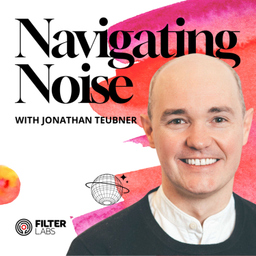
Navigating Noise is a weekly interview show about how critical decisions get made when the data behind them breaks down. Hosts Jonathan Teubner, founder of AI intelligence company FilterLabs, and Erol Yayboke, former Pentagon deputy chief of staff, talk with analysts, operators, and decision-makers working in intelligence and information operations. Each episode asks one question: how do you know what's actually happening in places that are hard to see? Season 2 covers the data supply chain behind info ops, the analyst under pressure, and the future of the craft.
Why Influence Operations Still Can't Prove They Work, with Carrick Longley @ ZenithFlow
For two decades, the information operations community has sold activity. Messages disseminated, impressions served, reach and click rates. Carrick Longley spent his career inside that business and came to a blunt conclusion: almost nobody can point to a single decision that changed.
Longley is the founder and CEO of ZenithFlow and a former Marine Corps major who spent years in signals intelligence, electronic warfare, and information operations planning before moving into industry. He holds a PhD in Information Sciences from the Naval Postgraduate School, where his dissertation examined how he and a small team pushed a field data collection tool through a change-resistant Department of Defense. He is also a vendor in this space, and he asked to be held to the same standard he holds everyone else to.
Erol takes him up on it. The conversation runs from baselines and attribution to why counter-narratives can amplify the thing they're meant to counter, why the risk of inaction almost never makes it into a decision brief, and what it would take for defense contracts to pay for outcomes instead of hours.
In this episode:
- Why the adage that it's easier to drop a bomb than to send a message still holds
- How stacked selection bias makes most social data useless for measurement
- The case for judging every operation, kinetic or not, by its cognitive effect
- Why information professionals have never had a real training range, and what Range is meant to fix
- What outcome-based contracting would require from both sides of the table
- How a self-taught engineer with a ham radio license built a 21-person company that ships the same day a customer asks
Subscribe to Navigating Noise for new episodes every week.
Available on YouTube, Spotify, and Apple Podcasts.
Timestamps:
00:00 Intro
01:23 A true or false to start
02:32 The 244-page dissertation almost nobody has read
06:01 Two decades of selling activity instead of outcomes
07:38 Impressions, reach, click rates, and what they miss
10:32 Define the objective first
11:39 Stacked selection bias in social data
14:03 The risk of inaction nobody briefs
14:52 When a counter-narrative amplifies what it counters
17:37 Every action has a cognitive effect
19:34 Information forces never had a training range
22:26 Building Range
24:44 Inside the synthetic environment
26:29 Where the name ZenithFlow came from
29:49 Teaching himself to code in order to teach it
31:53 From one engineer to twenty-one people
35:15 Operational context as the real moat
38:36 Paying for outcomes instead of hours
42:21 The billboard question
1 Sept 2026
How to Turn a Noisy Internet Into Actionable Signals for Irregular Warfare (with Jonathan and Erol)
One of these founders spent his twenties reading Augustine of Hippo in the original Latin, watching how a theologian made sense of an empire falling apart. The other spent his career in Ramadi, South Sudan and Anbar, then wrote about how Augustus Caesar built an empire using the oldest propaganda machine in history. They run the same company. This episode is the story of why that's not a coincidence.
Erol Yayboke and Jonathan Teubner co-host Navigating Noise and co-build Filter Labs, where the bet is simple and strange: the way information moves through a community is just as real a form of power as ships, bombs or currency, and almost nobody is reading it well. To open Season 2, they answer listener questions about the company's origin, their sharpest disagreement, and what they each learned approaching the same problem from opposite ends of history.
Along the way: a rooftop promise that became a two-week deadline, a defense of "boring policy," a critique of airport-book intellectualism in tech, and the data frustration that started in a house in Iraq.
In this episode:
• Why a book on Augustine of Hippo and a piece on Augustus Caesar point at the same idea about power
• How Filter Labs actually started in 2022, the night Putin cut off Western social media
• The "founder hubris" moment: promising a demo before telling the co-founder
• Why Jonathan thinks much of tech's "big ideas" culture is faux intellectualism
• The data mistake Erol watched the US make in Ramadi, and what he'd fix
• Why religious and "arcane" language is real power that policymakers keep ignoring
• What Season 2 is really about, and the serious voices you won't see on cable news
Subscribe to Navigating Noise so you don't miss Season 2.
Listen on YouTube, Spotify and Apple Podcasts.
25 Aug 2026
The Influence Operation That Never Sent a Single Message | Stephen Hunnewell
Navigating Noise is a weekly interview show about how the world's most critical decisions get made, and what happens when the data behind them breaks down. Hosts Jonathan Teubner and Erol Yayboke talk to the people working at the edge of intelligence, influence, and strategic competition.
Stephen Hunnewell is a Senior Principal within MITRE's Strategic Non-Kinetic Effects Mission Center, where he focuses on strategic influence and economic statecraft. Before MITRE, he served two tours in Afghanistan, first as an infantry officer, then as a civil affairs officer in the Pech River Valley, one of the deadliest stretches of the war.
In this episode, Stephen reconstructs an operation the Army called Crop Diversification, one that got left out of the definitive book on the valley: a program that paid Afghan farmers to stop growing the dense, unmanaged cornfields the Taliban used for cover and ambush positions. He points out partway through that he never once said the word "psyop." Jonathan presses him on what "influence" actually means once you strip away messaging, and the two get into why the discipline keeps sliding back into silos inside the U.S. system that's supposed to run it.
In this episode:
Operation Crop Diversification: paying Afghan farmers to stop growing the cornfields the Taliban ambushed from
How he got through the entire story without once saying the word psyop
Money as a weapon system, and what economic statecraft looked like before anyone called it that
Night letters, and why Taliban retaliation against villagers became the measure of effectiveness
Why influence became a dirty word inside the system that runs on it
What the OSS had that the US has never rebuilt, and why nobody wants to be the propaganda czar
How defense and influence work went from unfundable to fashionable
Subscribe to Navigating Noise for new episodes every week. Watch on YouTube, or listen on Spotify and Apple Podcasts.
Who has been a guest on Navigating Noise
Names identified in recent episode analyses. Showing up to five guests.
Chrissy Newton
Rorry Daniels
Dr Jennifer Sciubba
Dmitry Shishkin
Reach and audience
Public platform figures. Ratings count people who left a rating, not total listeners.
Apple Podcasts (US)
5.0 / 5
2 ratings
Podcast Authority Score: 19 / 100
A composite of feed quality, social presence, YouTube performance and engagement. Read the methodology.
Quality
25
Social presence
0
YouTube
0
Engagement
32
Host of Navigating Noise?
Claim your podcast to manage its listing and keep your show details accurate.
Pod Engine is an independent podcast discovery and analytics service and is not affiliated with or endorsed by this podcast. Artwork and show content belong to their owners. Full legal notice.
Explore this show Podcast research with Pod Engine