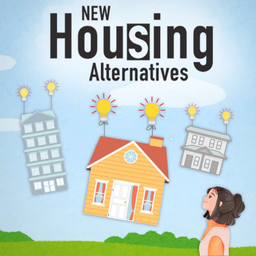
New Housing Alternatives
New Housing Alternatives Grant
5.0from 2 ratings
- 13
- Episodes
- 2
- Ratings
- Monthly
- Cadence
- 2025
- First episode
About New Housing Alternatives
What if the solutions to Canada’s housing crisis are already out there, just hidden in plain sight? New Housing Alternatives Podcast digs deeper to uncover what really works in solving the affordability issue. Despite dominant narratives claiming our housing crisis can be solved by simply building more market-rate supply, nearly half of Canadian households can’t afford average rents today. The crisis is deeper than a numbers game; it’s about who we’re building for, who gets left out, and what kind of communities we want to live in. Join hosts Ren Thomas and Cherise Burda as they explore real solutions to this once-in-a-generation housing crisis and cut through the noise on Canada’s housing affordability crisis to spotlight real solutions that already exist, and the people making them happen. New Housing Alternatives is made possible with the support of a Social Sciences and Humanities Research Council of Canada (SSHRC) Partnership Grant, a partnership that is co-directed by Alan Walks and Susannah Bunce and based at the University of Toronto. In this series, we talk to the people doing the work: nonprofit and co-operative developers, community organizers, and researchers reimagining housing not as a commodity, but as a human right. These are the underdogs creating affordable homes against the odds, proving it’s possible to build housing for people, not profit. You’ll hear from: -Ground-breaking developers creating alternative models of co-ownership and co-ops -Policy experts who challenge the supply-only narrative -Economists and data experts unpack how affordability vanishes, and how to bring it back -Community leaders who are preserving existing homes and building new ones in ways that centre dignity and access Whether you're a policymaker, housing advocate, or simply someone trying to make rent, this podcast brings you stories and insights that show a different future is not only possible, it’s already being built.
- Publisher
- New Housing Alternatives Grant
- Category
- news · science
- Language
- en
- Explicit
- No
- First episode
- 2 Oct 2025
- Latest episode
- 18 Sept 2026
Latest episodes
13 episodes in the feed.
18 Sept 2026
Beyond NIMBY: Humanizing Affordable Housing
In this episode of New Housing Alternatives, hosts Cherise Burda and Dr. Ren Thomas speak with Anne Gordon-Tighe, strategist at Y Station, a communications and research firm that works with governments, non‑profits, and housing providers. Anne explains how Y Station bridges the gap between quantitative public opinion research and qualitative public engagement, helping clients navigate contentious conversations around new affordable and supportive housing. Anne traces Y Station’s origins and name back to “Y stations” in the Second World War—radio towers that picked up signals and relayed them to code‑breakers at Bletchley Park. She uses this metaphor to describe how Y Station gathers signals from surveys, stakeholder interviews, and public meetings to give clients a holistic view of the “public conversation” around housing. For many non‑profit providers stepping into development for the first time, this support is critical: they are already stretched thin operating shelters and services, and often lack in‑house capacity to manage complex engagement and communications requirements tied to land sales and development approvals. The conversation then turns to the myths, fears, and human rights questions that surface when new affordable housing is proposed. Anne outlines common community concerns about property values, crime, and the loss of existing uses like parks, and contrasts these with neutral or supportive residents who simply want information. She describes Y Station’s approach to balancing radical transparency—including around contentious elements like harm reduction services—with a firm commitment to tenants’ rights. As she puts it, we don’t get to decide who our current neighbours have over as guests or what medications they take, and the same standard should apply to residents of affordable and supportive housing. From there, Cherise and Ren dig into what makes engagement effective—and why it often starts too late. Anne shares examples of humanizing strategies, including inviting prospective tenants into design workshops and using stories and data from existing sites to counter NIMBY narratives. She emphasizes the importance of proactive, non‑project‑based conversations led by municipal and community leaders, rather than placing the full burden on housing providers once a specific development is already on the table. The episode closes by contrasting the evolving approach of larger cities like Edmonton with the political dynamics of smaller municipalities, and by highlighting tools like good neighbour agreements, ongoing relationship‑building, and better data collection as ways to set both projects and future residents up for long‑term success. Key Takeaways Bridging research and engagement creates better housing conversations. Non‑profit housing providers face steep capacity and learning curves. Myths about affordable housing are persistent—but can be challenged. Tenants’ human rights must anchor engagement practices. Project‑based engagement starts too late and hardens opposition. Municipal leadership and good data can de‑risk housing debates. Good neighbour agreements and ongoing relationships matter. Chapters 00:00 – Intro: New Housing Alternatives and this episode’s focus 00:20 – Introducing guest: strategist and facilitator Anne Gordon Tai 00:43 – What Y Station does: bridging research and public engagement 02:04 – The WWII “Y stations” origin story behind the firm’s name 03:13 – Quantitative research vs. qualitative engagement—and why they’re siloed 04:38 – How Y Station supports non‑profit affordable housing developers 06:53 – Common community concerns: property values, crime myths, and losing parks 08:45 – Human rights, tenant privacy, and what neighbours don’t get to decide 09:59 – Humanizing engagement: involving prospective tenants and sharing stories 12:31 – Urban vs. suburban/small‑town attitudes toward change and new housing 14:10 – Why project‑based engagement comes too late in the public conversation 15:47 – Who should lead broader housing education: elected officials and community leaders 16:50 – The role of municipalities vs. affordable housing providers in public engagement 18:28 – Using data (property values, 911 calls) to counter myths about affordable housing 20:00 – Good neighbour agreements and ongoing community relations 21:47 – How municipal politics differ between big cities and smaller communities 25:31 – Final reflections on public engagement as foundation for successful tenancies 26:27 – Episode wrap‑up, resources, and thanks to our guest New Housing Alternatives is made possible with the support of the Social Sciences and Humanities Research Council of Canada. Explore our Vision & Objectives, Research Clusters & Projects, and subscribe to our blog at: https://newhousingalternatives.ca/blog
14 Aug 2026
Bridging The Housing Gap
In this episode of New Housing Alternatives, hosts Cherise Burda and Dr. Ren Thomas speak with Alex Laidlaw, Director of Impact Investments at the Calgary Foundation, one of Canada’s largest community foundations. They explore how community foundations sit at the intersection of philanthropy, government funding, and non‑market housing—and how tools like grants and flexible loans can help close the financing gaps that keep desperately needed projects from getting built. Alex traces the Calgary Foundation’s roots back to the 1950s, when large estates were locked into obsolete causes like carriage maintenance charities, and explains how community foundations were created so local partners could continually redirect those funds toward evolving needs. Today, that endowment of over $1.6 billion supports a wide range of priorities—but food insecurity and affordable housing are increasingly emerging as fundamental pressures across Calgary and the Treaty 7 region. The conversation then turns to the Resolve campaign, a collaborative, time‑bound effort by nine housing agencies that set out to raise $120 million for permanent supportive housing. Alex explains what made Resolve unusual in the philanthropic world: instead of competing campaigns chasing the same donors, organizations pooled their asks, coordinated messaging, and treated housing as a shared civic project. Even though the campaign ultimately raised just under $80 million, it was enough—paired with public funding and financing—to bring all of the planned projects to fruition. From there, Cherise and Ren dig into the broader role of philanthropic capital in the housing system: not as a replacement for government, but as one critical slice of the capital stack. Alex highlights the importance of using donations to build organizational capacity, fund feasibility work, and take early‑stage risks that public programs are often too rigid or slow to support. He also describes Calgary Foundation’s impact investing program, which uses short‑term, flexible “bridge” loans so non‑profits can acquire land and move projects forward while they wait on federal, provincial, and municipal grants. Throughout, Alex reflects on the current transition from CMHC programs to Build Canada Homes, and how well‑intentioned policy changes can create uncertainty on the ground that stalls non‑market developers already working at the edge of their capacity. The episode closes with a look beyond Calgary, as Alex points to more than 200 community foundations across Canada—from large urban institutions to smaller players like the Comox Valley Community Foundation—and invites listeners to see local community foundations as powerful, grounded partners in housing solutions. Key Takeaways Community foundations keep philanthropy aligned with current needs. Community foundations were created to unlock estate gifts tied to outdated purposes and redirect them toward evolving local priorities; today, they manage pooled endowments that can respond to issues like housing, food insecurity, and mental health as they emerge. Housing and food insecurity are cross‑cutting pressures. Across Calgary’s charitable sector, organizations are seeing food insecurity and affordable housing as fundamental barriers to stability—issues that touch everything from social services to health and cultural programming. Collaborative campaigns can reshape donor behaviour. The Resolve campaign showed how nine agencies fundraising together for a shared housing goal could reduce competition, simplify the donor landscape, and position housing as a unified, city‑wide priority rather than a fragmented set of projects. Philanthropy is a catalytic slice of the capital stack. Donations rarely cover full project costs, but they can play a decisive role by funding feasibility studies, early staff capacity, and non‑bricks‑and‑mortar elements that don’t fit neatly into government funding programs yet are crucial to getting housing built. Impact investing can bridge timing gaps in funding. Through loans rather than grants, Calgary Foundation helps organizations acquire land and undertake pre‑development work while they wait on slower public funding decisions—then recycles those repayments into future projects, multiplying the impact of endowed capital. Local foundations are national infrastructure for housing solutions. With more than 200 community foundations across Canada, there is likely one in or near most communities; their local knowledge and long‑term relationships position them to convene partners, identify gaps, and support context‑specific approaches to non‑market housing. Chapters: 00:00 – Intro: New Housing Alternatives and this episode’s focus 00:20 – Introducing guest: impact investor and fundraiser Alex Laidlaw 01:41 – The origin story of the Calgary Foundation 03:51 – From broad philanthropy to recognizing housing as a core need 04:21 – Food insecurity, housing, and basic needs across the sector 05:47 – Is this focus on housing new for community foundations? 07:24 – Alex’s path into housing and the Resolve campaign 07:49 – What made Resolve unique: nine housing agencies, one campaign 10:19 – Pooled philanthropy and the role of donors in capital projects 12:19 – Can campaigns like Resolve be sustained over time? 12:36 – Time‑bound collaboration and the challenge of ongoing capacity 14:00 – How community foundations relate to government funding 14:37 – Philanthropy as one slice of the housing capital stack 16:00 – Early‑stage risks, feasibility work, and building capacity 18:08 – Impact investing 101: Calgary Foundation’s loan program 18:40 – Timing gaps, land acquisition, and flexible bridge financing 19:54 – Build Canada Homes, CMHC, and the cost of uncertainty 21:20 – Why slow decisions and program shifts can stall local projects 21:56 – How listeners can find and engage local community foundations 22:30 – Examples from Calgary and the Comox Valley Community Foundation 24:05 – Closing reflections on local knowledge and housing solutions 24:37 – Episode wrap‑up and thanks to our guest New Housing Alternatives is made possible with the support of the Social Sciences and Humanities Research Council of Canada. Explore our Vision & Objectives, Research Clusters & Projects, and subscribe to our blog at: https://newhousingalternatives.ca/blog (https://newhousingalternatives.ca/blog)
17 Jul 2026
From Tongs to Trusts: Mutual Aid in Toronto's Chinatown
In this episode of New Housing Alternatives, hosts Cherise Burda and Dr. Ren Thomas speak with Chiyi Tam, urban planner, anti‑displacement organizer, and Managing Director & co‑founder of the Toronto Chinatown Land Trust. They explore how Chinatowns function as complex social and economic ecosystems, and how the community land trust (CLT) model can help protect housing, small businesses, and cultural spaces in the face of intense displacement pressures. Chiyi traces a lineage from historic tongs—diasporic clan and hometown associations that pooled funds to buy property, house workers, and offer near-interest-free loans—to today’s community land trusts in Toronto’s West Chinatown, Boston, and Los Angeles. She explains why conventional planning tools and “housing‑only” funding streams don’t fit a neighbourhood where people often live, work, and socialize in the same spaces, and shares how the Toronto Chinatown Land Trust is partnering with a tong to redevelop an ancestral hall at 217 Augusta into seniors’ housing and community space. Key Takeaways Chinatown is an ecosystem, not a single project. Rather than one organization “representing” Chinatown, the neighbourhood is sustained by overlapping networks of kung fu clubs, mahjong halls, family associations, tongs, BIAs, artists, and multiple levels of government, all tied together by relationships and mutual aid. Community land trusts are governance models, not one‑off housing fixes. CLTs are neighborhood‑wide, multi‑stakeholder real estate cooperatives that permanently steward land and buildings for community benefit, resisting the extraction of profit from private property—even when projects focus on housing. Housing, work, and culture are inseparable in Chinatown. From people sleeping behind laundries to nail salons in condo units, everyday life in Chinatown ignores the rigid separations of residential, commercial, and cultural uses that shape zoning, policy, and funding silos. Holistic solutions are essential. Tongs were proto‑CLTs rooted in mutual aid. Historically, tongs bought property together, ran internal lending systems, and helped members survive racist labour regimes and exclusionary housing markets—functioning as democratically controlled, member‑based land stewards long before the term “community land trust” existed. A succession crisis threatens deeply affordable housing. As 80- and 90‑year‑old tong leaders retire and pass away, many are selling off properties that have quietly housed low‑income seniors and bachelors for as little as $100/month, putting irreplaceable affordability and cultural spaces at risk. Partnerships can unlock new models of community ownership. By partnering with the Hainan Association of Ontario on the redevelopment of its clubhouse, the Toronto Chinatown Land Trust is piloting a model where younger generations step in as development partners and long‑term stewards—supporting seniors’ housing, cultural practice, and community control of land. Chapters: 00:00 – Intro: New Housing Alternatives and this episode’s focus 00:28 – Why look beyond “broken housing” narratives? 00:46 – Introducing guest: urban planner and organizer Chiyi Tam 02:00 – What is a community land trust, really? Governance vs. “housing solution” 04:19 – From Kensington Market to Chinatown: what makes this CLT different? 04:55 – Why zoning silos don’t fit how people live and work in Chinatown 09:17 – Painting a picture of mixed homes, businesses, and third spaces 10:02 – The Chinatown ecosystem: Cooperation between Chinatown and many stakeholders 11:05 – Kung fu clubs, mahjong halls, tongs, BIAs, and elected offices 14:06 – Balancing culture, heritage, and staying focused on land stewardship 16:44 – Walking tour reflections and the question: what are tongs? 17:20 – Tongs 101: global Chinese mutual aid and association halls 19:20 – Railways, burial traditions, and the birth of Chinatowns 21:55 – Karaoke fundraisers, fictitious kin, and buying property together 23:55 – Tongs as proto–community land trusts and social finance systems 25:44 – The succession crisis and losing $100/month rooms 26:43 – “Now I want to buy a tong building”: urgency and opportunity 27:04 – Has the recent market downturn helped? 27:31 – Why land is still expensive, and owners still need “full market value” 28:45 – First big project: redeveloping 217 Augusta with the Hainan Association 29:20 – Seniors’ housing, cultural space, and being first in North America 30:49 – Closing thoughts on optimism and community‑led land governance 31:20 – How to learn more and get involved: ChinatownLandTrust.ca 32:21 – Episode wrap‑up, research links, and credits 33:02 – Disclaimer: diversity of views within the partnership and funder New Housing Alternatives is made possible with the support of the Social Sciences and Humanities Research Council of Canada. Explore our Vision & Objectives, Research Clusters & Projects, and subscribe to our blog at: https://newhousingalternatives.ca/blog
19 Jun 2026
Transit, Timber, and Co-Ops
In this episode of New Housing Alternatives, hosts Cherise Burda and Dr. Ren Thomas speak with Graeme Hussey, President of Nesting Ground and Director of Affordable Housing at Windmill Developments. They explore how a sustainability‑focused private developer is partnering with non‑profits and co‑ops to deliver low‑carbon, mixed‑income housing, using the One Planet Living framework to make affordability and sustainability core requirements rather than trade‑offs. Graeme walks through flagship projects like the Kennedy Station co‑op community at 2444 Eglinton East, a nine‑storey mass‑timber building at 230 Royal York, and a 400‑unit, transit‑oriented mass‑timber development at 1460 Riverside Drive in Ottawa. He also breaks down the policy tools needed to scale this work—predictable low‑cost financing, municipal fee and tax relief, and federal support for offsite and prefab construction to unlock more climate‑aligned non‑market housing. Key Takeaways Mixed market and non‑market housing is becoming the new normal. With high costs and declining affordability, many viable projects now blend market units with deeply affordable or co‑op homes in the same buildings, backed by partnerships and layered incentives. Scale matters for non‑profit housing. It can take similar effort to build 20 units as 200; organizations like Nesting Ground aim to tackle the housing crisis by doing fewer, larger, multi‑hundred‑unit projects, often in multiple municipalities. Sustainability is no longer optional. For long‑term non‑profit owners, energy efficiency, low operating costs, and low‑carbon materials (like mass timber) are central to both climate goals and affordability over the building’s life. Modern methods of construction (MMC) and offsite building are key enablers. Prefab and offsite construction can deliver faster, better‑quality, more energy‑efficient buildings, and align well with federal priorities such as Build Canada Homes—if policy and funding de‑risk this sector. Policy levers need to align across governments. Federal low‑cost loans, provincial support, and municipal waivers of fees and property taxes can dramatically change the math for non‑profit and co‑op projects, shifting resources from hard costs into deeper affordability. Partnerships are the backbone of innovation. From co‑ops at Kennedy Station to mass‑timber towers in Ottawa, collaboration between private developers, non‑profits, community housing providers, and governments is crucial for delivering both affordability and climate action at scale. Chapters: 00:00 – Intro & Episode Overview 00:37 – Why Focus on New Housing Alternatives? Models that Actually Work 01:39 – Introducing Graeme Hussey, Windmill Developments, and Nesting Ground 02:30 – What Makes Windmill Different as a Private Developer? 02:57 – Dockside Green, Zibi, and 25 Years of Sustainable Development 04:48 – One Planet Living: A Framework for Affordability and Sustainability 05:07 – Partnering with Non‑Profits to Deliver Affordable Housing 07:28 – Why Mix Market and Non‑Market Housing in the Same Projects? 09:34 – Nesting Ground’s Mission: Scaling Non‑Profit Housing Across Cities 09:58 – Why Small Projects Take the Same Effort as Large Ones 12:27 – Housing and Climate: How MMC and Offsite Construction Fit In 13:07 – From Energy Efficiency to Embodied Carbon and Mass Timber 15:16 – 230 Royal York: Ontario’s Tallest Residential Mass‑Timber Building 16:48 – Inside the Kennedy Station Co‑op Project at 2444 Eglinton East 17:31 – Co‑ops, Mixed Income Models, and Zero‑Carbon Design 20:00 – Three Things Policymakers Need to Understand About Financing 20:18 – No Magic Bullet: Why Every Sector Has a Role 21:08 – Predictable Low‑Cost Financing and the Scale of Investment Needed 22:20 – Municipal Tools: Development Charges and Property Taxes 24:36 – Federal Leadership, Build Canada Homes, and the Prefab Sector 27:16 – 1460 Riverside Drive: A 400‑Unit Mass‑Timber TOD in Ottawa 28:35 – What It Means to See Your Projects Built on the Ground 30:53 – Timelines, Construction Speed, and Mass Timber vs. Concrete 31:39 – Collaboration, Replication, and Competing to Build the “Coolest” Projects 32:40 – Closing Reflections, Optimism, and Credits New Housing Alternatives is made possible with the support of the Social Sciences and Humanities Research Council of Canada. Explore our Vision & Objectives, Research Clusters & Projects, and subscribe to our blog at: https://newhousingalternatives.ca/blog
22 May 2026
From Tree to Home: Local Passive Panels, Prefab Housing, and Distributed Manufacturing
In this episode of New Housing Alternatives, hosts Cherise Burda and Dr. Ren Thomas speak with Melinda Zytaruk, CEO of Tooketree Passive Homes, a social enterprise that factory‑produces low‑carbon, high‑performance building panels. Together, they explore how offsite construction can deliver faster, more affordable, and climate‑resilient housing—while also creating safer, more stable local jobs. Melinda explains how panelized construction works, from sourcing Ontario wood and recycled cellulose to assembling precision panels in a controlled factory environment and partnering with builders on-site. She challenges dominant narratives about “industrialized” modular housing—like the idea that big, robot‑filled factories are the answer—and instead makes the case for a distributed network of small and medium panel producers embedded in local communities. They also unpack how federal initiatives like Build Canada Homes and “modern methods of construction” can support (or constrain) this ecosystem, why integrated design and early collaboration matter more for cost than any single technology, and how offsite construction can align with non‑market housing, co‑ops, and land trusts to deliver long‑term affordability and climate resilience. Key Takeaways Offsite construction is about people, not robots. Successful modular and panelized housing companies rely on skilled workers and collaborative teams—not vast, automated warehouses—creating safer, more accessible jobs (including for people traditionally excluded from construction). Factory‑built panels can be both low‑carbon and cost‑competitive. By integrating design early, reducing waste, and standardizing processes (while still customizing each building enclosure), panel producers can deliver Passive House–level performance without necessarily increasing as‑built costs. Local supply chains strengthen both climate and community outcomes. Tooketree’s panels use Ontario wood, recycled cellulose, and wood fibre insulation from Quebec, adding value to regional forestry and manufacturing while reducing emissions and supporting local economies. Distributed manufacturing builds resilience. A network of small, community‑based factories across Canada can share work, smooth demand, and avoid the vulnerability of “picking a few big winners” that may fail or face delays. Policy and finance must recognize pre‑construction and cash‑flow realities. Programs like Build Canada Homes can unlock capacity if they fund early design and collaborative planning, and address the “chicken‑and‑egg” problem of paying for materials and fabrication before panels arrive on site—especially for non‑profits, co‑ops, and land trusts. Chapters: 00:00 – Intro & Episode Overview 00:37 – Why Prefab and Offsite Construction for Housing? 01:56 – Introducing Melinda Zytaruk & Tooketree Passive Homes 02:38 – Trade Show Pitch: Building Faster, More Affordable, and Low‑Carbon 03:48 – Why Build Panels Indoors? Jobs, Safety, and Work‑Life Balance 05:17 – What Offsite Construction Really Looks Like (Not a Warehouse of Robots) 07:16 – Custom Panels, Shop Drawings, and Design Flexibility 08:39 – From Single‑Family Homes to Co‑ops and Non‑Market Housing 09:55 – Acting as Project Integrator and Design‑Assist Partner 10:44 – High‑Performance Goals: Passive House, Net Zero, and Low‑Carbon Enclosures 11:17 – Social Enterprise Values and Scaling Up to Multi‑Unit Housing 12:32 – Long‑Term Affordability and Operating Costs 13:22 – Is Offsite Construction Too Good to Be True? Costs, Myths, and Evidence 14:47 – Why Collaboration and Integrated Design Drive Cost More Than Technology 15:52 – Certifications: CSA, Passive House, and Net Zero Builders 16:23 – Sourcing Ontario Wood, Recycled Cellulose, and High‑Performance Membranes 18:06 – Supply Chain Vulnerabilities and Local Supplier Relationships 19:05 – From Tree to Home: Forest Jobs, Value‑Added Manufacturing, and Assembly 19:45 – Training Builders and GCs to Assemble Panels on Site 20:26 – How Offsite Construction Expands (Not Replaces) Local Construction Jobs 21:01 – What Policies Support Distributed Panel Producers? 21:40 – Build Canada Homes, Insurance, and Climate‑Resilient Housing 23:10 – The Need for Pre‑Construction Funding and Early‑Stage Design Support 24:18 – Cash Flow, Deposits, and the Modular “Chicken‑and‑Egg” Problem 26:00 – Industrialization vs. a Diverse, Distributed Offsite Ecosystem 26:27 – Why Small and Medium Local Factories Make the Sector More Resilient 27:29 – Collaboration Over Cut‑Throat Competition in a Housing and Health Crisis 28:43 – Centring Community, Well‑Being, and Human Rights in How We Build 29:49 – Closing Reflections, Optimism, and Credits Learn more about the Tooketree Passive Homes here: https://www.tooketree.com/ New Housing Alternatives is made possible with the support of the Social Sciences and Humanities Research Council of Canada. Explore our Vision & Objectives and Research Clusters & Projects, and subscribe to our blog at the link below: https://newhousingalternatives.ca/blog (https://newhousingalternatives.ca/blog)
17 Apr 2026
Community Land Trusts and the Future of Kensington Market
In this episode of New Housing Alternatives, hosts Cherise Burda and Dr. Ren Thomas speak with Dominique Russell, writer, activist, teacher, and co‑director of the Kensington Market Community Land Trust (KMCLT). Together, they explore how community land trusts (CLTs) use collective ownership, organizing, and mutual aid to fight displacement and preserve deeply affordable housing and commercial spaces in Toronto’s Kensington Market. Drawing on a decade of neighborhood organizing—from stopping a proposed Walmart to acquiring three mixed‑use buildings—Dominique explains how CLTs decommodify land, center community power, and reimagine what “ownership” can look like. She discusses funding tools like Toronto’s Multi‑Unit Residential Acquisition (MURA) program and community bonds, and reflects on how CLTs across Canada are increasingly grounding their work in decolonization, land back, and social justice. Key Takeaways Community land trusts (CLTs) decommodify land and housing: CLTs are democratically controlled, neighborhood‑based nonprofits that acquire and hold land for community benefit, prioritizing security of tenure and affordable homes and commercial spaces over market returns. Organizing comes before funding: KMCLT’s story shows that successful acquisition and financing (through tools like Toronto’s MURA program and community bonds) only become possible after deep community organizing, knowing your neighbors, and building a shared, representative vision for the neighborhood. CLTs are part of a broader movement for decolonization and social justice: KMCLT and other members of the Canadian Network of Community Land Trusts are increasingly centring land back, decolonization, and racial justice—redefining community ownership as mutual aid, local power, and long‑term resistance to displacement and gentrification. Chapters: 00:00 – Intro & Episode Overview 00:39 – Introducing Dominique Russell & Kensington Market CLT 01:25 – What Is a Community Land Trust? CLTs vs. Nonprofit Housing 04:13 – Why Kensington? Neighbourhood Preservation and Mission 04:39 – KMCLT’s Buildings on Kensington and Spadina 07:30 – From Anti‑Walmart Campaign to Community Land Trust 10:54 – Organizing Before Funding: Building a Representative CLT 11:04 – Acquisition, MURA, and Protecting Vulnerable Rental Housing 14:23 – Community Bonds and Financing Community Ownership 16:40 – Community Support, Short‑Term Rentals, and Displacement 19:24 – Advice for Communities Wanting to Start a CLT 21:20 – Future of KMCLT: Leadership Transition and Decolonizing Practice 23:30 – Relationship to Chinatown and Business Ecology 26:25 – Love of Place as the Emotional Core of CLT Work 28:58 – Local Organizing and the Wider CLT Movement 29:45 – Reflections & Key Lessons from Kensington Market 30:18 – Outro, Show Notes, and Credits Learn more about the Kensington Market Community Land Trust here: https://kmclt.ca/ New Housing Alternatives is made possible with the support of the Social Sciences and Humanities Research Council of Canada. Explore our Vision & Objectives and Research Clusters & Projects, and subscribe to our blog at the link below: https://newhousingalternatives.ca/blog (https://newhousingalternatives.ca/blog)
20 Mar 2026
The Co-operative Comeback
In this episode of New Housing Alternatives, hosts Cherise Burda and Ren Thomas speak with Tim Ross, CEO of the Co-operative Housing Federation of Canada (CHF Canada), about why co‑operative housing is one of Canada’s most promising – and underused – tools for tackling the housing crisis. Tim explains what housing co‑ops are, how they differ from other forms of non‑market housing, and why they offer stability, community, and long-term affordability in ways that market housing often cannot. Drawing on decades of sector experience and recent federal policy wins, Tim walks us through the renewed momentum behind co‑ops: the National Housing Strategy, the $1.5 billion Co-op Housing Development Program, new partnerships with municipalities and the private sector, and landmark projects like the major new co‑op at Toronto’s Eglinton Crosstown site. He also unpacks the practical challenges of growing the sector – from capital repairs in aging co-ops to governance capacity among member‑volunteers – and what it will take to scale co-operative housing across Canada. Key Takeaways Co-op housing is democratic, community‑centred, and non‑speculative. Members govern through elected boards and collective decision‑making, giving them real power over their housing in ways most nonprofit and private rental models do not. Co-ops provide security of tenure and long-term affordability. Because they are nonprofit and not traded on speculative markets, co-ops shield members from demovictions, renovictions, and extreme rent hikes. Co-ops house diverse, mixed‑income communities. They intentionally combine low-income households (often with rent supplements) with seniors, families, students, newcomers, and workers in one stable community. Policy is finally catching up after decades of neglect. Following years of federal withdrawal from non‑market housing, the National Housing Strategy and CHF Canada’s advocacy have secured $1.5B for new co-op development, $500M in rental assistance, and new sector support. Co-op rents increasingly outpace the market—in a good way. CHF Canada’s research shows co-op housing charges were already $150–$200/month below comparable private rents and, by 2021, the gap had widened to $400–$500/month, generating major long-term savings for members. Chapters: 00:00 – Intro & Episode Overview 00:21 – Introducing Tim Ross & CHF Canada 02:10 – What Is Co-op Housing? Governance, Tenure & Community 04:45 – Why Don’t We See More Co-ops? Policy Gaps & “Tortoise vs. Hare” Development 07:30 – Who Lives in Co-ops? Mixed-Income Models & Diverse Households 11:20 – Member Governance, Volunteer Roles & Capacity Challenges 14:30 – Aging Co-ops, Capital Planning & Renewal Needs 15:52 – Can Co-ops Grow? Financing Tools & the Co-op Housing Development Program 18:25 – Public Land, Federal Programs & Scaling New Co-op Supply 21:15 – Private Sector Partnerships & the Eglinton Crosstown Co-op Project 21:37 – Affordability: How Co-op Rents Compare to Market Rents Over Time 23:57 – Public Opinion, Polling Results & Cross‑Partisan Support for Co-ops 27:01 – Where to Learn More: CHF Canada Resources & Getting Involved 27:43 – Outro & Credits Learn more about CHF Canada and co-operative housing development on their website and social channels, including their “build” section for organizations interested in starting or expanding co-ops: https://chfcanada.coop/build/why-build/ New Housing Alternatives is made possible with the support of the Social Sciences and Humanities Research Council of Canada. Explore our Vision & Objectives and Research Clusters & Projects, and subscribe to our blog at the link below: https://newhousingalternatives.ca/blog/ (https://newhousingalternatives.ca/blog/)
21 Feb 2026
Racialized Evictions and AI in the Rental Housing System
In this episode of New Housing Alternatives, hosts Cherise Burda and Ren Thomas speak with Dr. Nemoy Lewis about how race, transit investment, and financialized landlords intersect to drive evictions in Toronto’s rental housing market, and how emerging uses of AI risk making things worse. Drawing on years of research into evictions, multifamily acquisitions, and transit-oriented development, Dr. Lewis shows that Toronto’s eviction crisis is not random. Instead, eviction filings are highly concentrated in Black renter–majority neighborhoods, particularly in the northwest quadrant of the city and along new transit corridors. Key Takeaways Evictions in Toronto are not random: they form a predictable, racialized geography of harm, with Black renter–majority neighborhoods facing eviction rates up to five to seven times the city average. Even when controlling for income, Black renters, including middle‑income households, experience disproportionately high eviction filings, showing eviction is a structural, not individual, problem. The northwest quadrant of Toronto and communities like North Albion (Rexdale), Chalkfarm, Jane and Finch, and Little Jamaica are among the hardest hit, especially around new transit investments. Financialized and corporate landlords drive most evictions: about 80–85% of filings occur in the primary rental market, and eviction is often used as a business strategy to “reposition” properties and attract higher‑income tenants. Large-scale transit projects trigger waves of multifamily acquisitions in historically disinvested, racialized neighborhoods, followed by spikes in eviction filings. AI tools are increasingly used in rent setting and tenant screening, potentially enabling collusion, removing human discretion, and embedding racial bias into housing decisions. Strengthening competition law, recognizing housing as a social good, and adopting vacancy control (tying rent control to the unit, not the tenancy) are key policy directions to disincentivize eviction-driven profit strategies and better protect renters. Chapters: 00:00 – Intro & Episode Overview 00:37 – Introducing Dr. Nimoy Lewis 02:06 – Research Goals & Eviction Patterns 05:18 – Beyond Downtown: Northwest Toronto Focus 08:44 – Who Is Being Evicted and Why 14:12 – Transit Investment & Property Repositioning 19:40 – AI, Rent Setting, and Tenant Screening 23:26 – Policy Responses & Vacancy Control 26:26 – Where to Learn More About the Research 27:53 – Outro & Credits Learn more about Nemoy Lewis Here. (https://www.torontomu.ca/school-of-urban-and-regional-planning/about/people/faculty/nemoy-lewis/) New Housing Alternatives is made possible with the support of the Social Sciences and Humanities Research Council of Canada. Explore our Vision & Objectives and Research Clusters & Projects, and subscribe to our blog at the link below: https://newhousingalternatives.ca/blog/ (https://newhousingalternatives.ca/blog/)
16 Jan 2026
The Tenant Class
In this episode of the New Housing Alternatives podcast, hosts Cherise Burda and Ren Thomas are joined by Ricardo Tranjan, senior researcher at the Canadian Centre for Policy Alternatives and author of "The Tenant Class." Together, they explore the evolving landscape of tenant rights, the growing influence of corporate landlords, and the urgent need for tenant-focused research and organizing to confront Canada’s affordability crisis. The conversation provides deep insight into power dynamics, policy history, and the challenges and opportunities faced by tenants and their advocates. Learning Objectives: Understand the historical context of tenant rights and rent control in Canada, and how regulations have weakened over time. Recognize the shift from local, “mom and pop” landlords to corporate landlords and real estate investment trusts (REITs). Analyze how global capital impacts housing affordability and the market’s power dynamics. Differentiate between research about tenants and research for tenants, and why this distinction matters. Reflect on the constant and persistent challenges facing tenant organizers and the importance of direct resource allocation. Identify effective strategies for building power among grassroots tenant organizations. Key Takeaways: Tenant protections in Canada have been historically limited and weakened, despite the worsening affordability crisis. The influx of global capital and the rise of large corporate landlords have fundamentally changed the rental landscape, intensifying power imbalances. Effective advocacy for tenants requires not just studying their challenges, but supporting organizing efforts and shifting resources into tenant movements. Grassroots tenant organizers face persistent threats, including rent increases, eviction, and predatory landlord practices—often with few resources. Building lasting power for tenant movements requires civil society and academic sectors to re-channel time, funding, and research toward direct support and organizing. Regulatory interventions to control capital and prioritize tenant protections are essential for meaningful change. Chapters: 00:00 – Introduction: Hosts, guest, and episode overview 02:00 – The history of tenant rights and rent control in Canada 05:00 – The emergence of corporate landlords and the power shift in housing 08:00 – Global capital’s influence on the rental market 11:00 – Distinguishing research about tenants from research for tenants 14:00 – Persistent challenges and the realities of grassroots tenant organizing 17:00 – The need for resource redirection and building power in tenant organizing 20:00 – Action items, resources, and closing remarks New Housing Alternatives is made possible with the support of the Social Sciences and Humanities Research Council of Canada. Explore our Vision & Objectives and Research Clusters & Projects, and subscribe to our blog at the link below: https://newhousingalternatives.ca/blog/ (https://newhousingalternatives.ca/blog/)
19 Dec 2025
Preserving Low‑Rent Housing
In this episode of New Housing Alternatives, hosts Cherise Burda and Ren Thomas speak with housing policy expert Steve Pomeroy about Canada’s rapid loss of affordable rental housing, often cited as 11 affordable units lost for every 1 built, with even higher ratios in cities like Ottawa and Waterloo. We cover: What it actually means to “lose” an affordable unit (demolition vs. rent inflation) How population growth, immigration, and homeownership barriers are driving rental demand The role of rent control and vacancy decontrol in accelerating rent hikes The growing impact of financialization and large‑scale investors Why non‑profit acquisitions, Rental Protection Funds, and rent benefits are key tools to preserve and expand non‑market housing The conversation digs into policy options for protecting existing low‑rent units, improving the viability of the non‑market sector, and designing smarter, more efficient affordability supports. New Housing Alternatives is made possible with the support of the Social Sciences and Humanities Research Council of Canada. Explore our Vision & Objectives and Research Clusters & Projects, and subscribe to our blog at the link below: https://newhousingalternatives.ca/blog/ (https://newhousingalternatives.ca/blog/)
21 Nov 2025
Nonprofit Housing Solutions
In this episode of the New Housing Alternatives podcast, hosts Cherise Berda and Ren Thomas are joined by Jill Atkey, CEO of the BC NonProfit Housing Association, to explore the critical role of nonprofit and cooperative housing in addressing Canada’s affordability crisis. Through a policy and advocacy lens, the conversation unpacks the history, challenges, and opportunities facing the sector, with a special focus on British Columbia’s unique approach and recent federal initiatives. Learning Objectives: Understand the historical context of affordable housing in Canada, including the impact of federal disinvestment in the 1990s. Identify the structure and scale of nonprofit and cooperative housing in BC and how it compares nationally. Examine the benefits of cross-sector collaboration among nonprofit, cooperative, and Indigenous housing organizations. Analyze the significance of new funding mechanisms like the BC Rental Protection Fund and the Canada Rental Protection Fund. Discuss the potential of the Build Canada Homes program and the evolving role of government in supporting nonprofit housing growth. Reflect on the long-term benefits of nonprofit and co-op housing for affordability, security, and sector resilience. Key Takeaways: Nonprofit and cooperative housing organizations are essential partners in delivering affordable housing, especially in BC where provincial investment has been strong. Collaboration across the nonprofit, co-op, and Indigenous housing sectors amplifies advocacy and education efforts, making it easier for governments to respond. New funding programs at the provincial and federal levels are enabling nonprofits to acquire and preserve affordable housing, preventing financialization and rent spikes. The Build Canada Homes program signals a renewed federal interest in supporting nonprofit housing, with a focus on flexibility, long-term planning, and portfolio growth. Nonprofit and co-op housing models offer long-term affordability and security, leveraging assets for sector growth and reducing reliance on government ownership. Chapters: 00:00 – Introduction: Hosts, guest, and episode overview 02:00 – The history of affordable housing policy in Canada 05:00 – The structure and scale of nonprofit housing in BC 08:00 – Provincial investment and the growth of nonprofit housing 11:00 – Collaboration: Nonprofit, co-op, and Indigenous housing organizations 14:00 – The BC Rental Protection Fund and its impact 17:00 – National implications: The Canada Rental Protection Fund 20:00 – The Build Canada Homes program and future directions 23:00 – Long-term benefits of nonprofit and co-op housing 25:00 – Resources, further learning, and closing remarks New Housing Alternatives is made possible with the support of the New Housing Alternatives grant (https://newhousingalternatives.ca/), led by Alan Walks and Susannah Bunce, based at the University of Toronto. Explore our Vision & Objectives (https://newhousingalternatives.ca/#vision) and Research Clusters & Projects (https://newhousingalternatives.ca/#research), and subscribe to our blog at the link below: https://newhousingalternatives.ca/blog/ (https://newhousingalternatives.ca/blog/)
17 Oct 2025
Defining Affordable Housing
Dive into the complexities of affordable housing in Canada with this episode, which unpacks the terminology, challenges, and policy debates shaping the nation’s housing landscape. Through expert interviews and data-driven discussion, listeners will gain a foundational understanding of what “affordable housing” really means, why definitions matter, and how different models and government roles impact the availability and accessibility of homes. This episode is ideal for anyone interested in public policy, urban planning, or the future of housing in Canada. Learning Objectives: Understand the various definitions of "affordable housing" and why clarity matters. Distinguish between market, non-market, community, and social housing. Explore the current landscape of housing supply in Canada and the mismatch with actual needs. Examine the critical role of federal involvement in addressing the housing crisis. Identify actionable policy recommendations for improving housing affordability and supply. Key Discussion Points: The ambiguity of "affordable housing" and its implications for policy and public understanding. The evolution of terminology: from social housing to community and non-market housing. The motivations and business models behind market vs. non-market housing providers. Data on what types of homes are being built in Canada and who they serve. The importance of specifying targets for community/non-market housing within broader supply goals. The economic and social costs of inaction on affordable housing and homelessness. Recommendations for federal leadership, nonprofit engagement, and coordinated action. Takeaways: "Affordable" is a relative term; policy must focus on affordability for those most in need. Non-market and community housing play a unique, essential role in long-term affordability. Federal leadership and targeted funding are crucial to reversing the decline in affordable housing stock. A healthy housing system requires a full range of options, not just more units. Chapters: 0:00:06 – Introduction and Host Backgrounds 0:00:27 – The Problem with "Affordable Housing": Definitions and Confusion 0:02:22 – Ray Sullivan on Income-Based Affordability and Policy Implications 0:04:04 – Political Platforms and the Use of "Affordable" in Canada 0:05:44 – Market, Non-Market, Community, and Social Housing: Terminology and Evolution 0:08:12 – Private vs. Nonprofit Motivations in Housing Development 0:11:09 – Current Housing Supply: What’s Being Built and Who It Serves (Alex Flynn) 0:13:39 – The Mismatch Between Housing Supply and Actual Need 0:15:42 – The Role of Federal Government and the Shrinking Share of Non-Market Housing 0:18:52 – Policy Recommendations: Targets, Funding, and Federal Leadership 0:20:14 – The Importance of Nonprofit Providers and Federal Lands 0:22:28 – Conclusion and Resources for Further Learning New Housing Alternatives is made possible with the support of the New Housing Alternatives grant (https://newhousingalternatives.ca/), led by Alan Walks and Susannah Bunce, based at the University of Toronto. Explore our Vision & Objectives (https://newhousingalternatives.ca/#vision) and Research Clusters & Projects (https://newhousingalternatives.ca/#research), and subscribe to our blog at the link below: https://newhousingalternatives.ca/blog/ (https://newhousingalternatives.ca/blog/)
2 Oct 2025
New Housing Alternatives TRAILER
Reach and audience
Public platform figures. Ratings count people who left a rating, not total listeners.
- Spotify
- 5.0 / 5
- 2 ratings
Contact New Housing Alternatives
- Guest appearances
- Books guests
Based on episode analysis; this does not confirm that the show is currently accepting guests.
Shows with a similar audience




Host of New Housing Alternatives?
Claim your podcast to manage its listing and keep your show details accurate.
Pod Engine is an independent podcast discovery and analytics service and is not affiliated with or endorsed by this podcast. Artwork and show content belong to their owners. Full legal notice.
Explore this show
Podcast research with Pod Engine