- 15
- Episodes
- 14
- Ratings
- 2025
- First episode
About Office Therapy
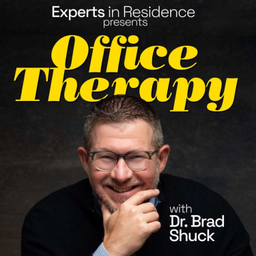
Pull up a chair. Pour a bourbon or grab a coffee—whatever helps you slow down. This is Office Therapy with Dr. Brad Shuck, professor, researcher, and believer that work should be a place where people feel seen. Each week, Brad unpacks leadership, trust, burnout, and belonging with honest insight and research-backed reflection to help you build a healthier, more human workplace. Work doesn’t have to be toxic—it just has to start with a conversation.
- Publisher
- Brad Shuck
- Category
- business
- Language
- en
- Explicit
- No
- First episode
- 18 Oct 2025
- Latest episode
- 10 Jun 2026
Latest episodes
15 episodes in the feed.
10 Jun 2026
Why human skills matter more — not less — in an age of AI.
Sitting in a crowded airport, surrounded by people connected to every device imaginable, one thought wouldn't go away: we've never been more connected to information, and never more disconnected from each other. This episode of Office Therapy sits with that tension. As AI makes answers easy and information abundant, connection is becoming scarce — and scarcity makes it valuable. Drawing on years of engagement research and the story of a highly capable leader whose team was struggling, we unpack a simple but uncomfortable truth: people don't follow information. They follow connection. They give their best where they feel seen, safe, and like they belong. Empathy. Trust. Presence. Listening. The things that can't be automated, outsourced, or generated with a prompt. If you lead a team, the question worth reflecting on isn't how much information people are receiving — it's how connected they feel. If this resonated, share it, subscribe, and tell us what to explore next.
8 May 2026
When Your Boss Is Less Engaged Than You Are
Everyone's talking about the Gallup 2026 headline — global engagement at 20%. Almost no one is talking about the finding that matters more: manager engagement has fallen 9 points in three years, wiping out nearly half a decade of gains. Female managers dropped 7. Managers under 35 dropped 5. And for the first time in Gallup's tracking history, managers are now less engaged than the individual contributors they lead. In this episode of Office Therapy, Dr. Brad Shuck breaks down why this is a structural signal, not a people problem — and why the billion-dollar cost of manager disengagement is the product of a measurement error most organizations can actually fix. The difference between satisfaction and engagement. Why training is the wrong response. And four small, no-budget shifts you can make this week to start changing the conditions on your own team — starting with your calendar.
22 Apr 2026
I'm not burned out. I'm designed-out.
"I'm not burned out. I'm designed-out." That's what a top operator told her CPO at 10:47 PM on a Tuesday. And Dr. Brad Shuck can't stop thinking about it. In this episode of Office Therapy, Brad unpacks why the burnout conversation is missing the point in 2026. Drawing on new Berkeley research showing AI intensifies work instead of reducing it, and Gallup's April 2026 finding that manager engagement has collapsed to 22%, Brad makes the case that what leaders are calling a people problem is actually a design problem. You'll hear: Why "task expansion" is the hidden cost of your AI rollout The brutal math behind today's average manager carrying 12 direct reports Why compassion without systems burns out your best leaders Three moves to fix it: the Compassion Load Index, an emotional routing table, and Strategic Slowness If your highest performers are quietly becoming your highest flight risks, this one's for you.
17 Mar 2026
The Leadership Power of Pause
In today’s fast-moving workplaces, urgency has quietly become the default setting. Calendars fill up, meetings stack back-to-back, and leaders move from decision to decision without a moment to breathe. But what if the constant rush is actually making our organizations less effective? In this episode of Office Therapy, we explore the hidden cost of urgency culture and why speed doesn’t always lead to better leadership. Drawing on research in employee engagement and leadership, Dr. Brad Shuck reflects on the importance of creating space to think, listen, and reflect in a world that rewards constant motion. When leaders lose the time to pause, leadership can slowly turn into reaction. Decisions become faster, but not necessarily wiser. And the deeper conversations that build trust, engagement, and meaning at work begin to disappear. The most effective leaders understand a powerful paradox: sometimes the fastest way forward is to slow down. This episode invites you to reclaim a small but powerful leadership skill—the courage to pause long enough to think clearly, ask better questions, and create the space where engagement and insight can grow.
6 Mar 2026
Staying Human in an Age of More
In this episode of Office Therapy, Dr. Brad Shuck explores the hidden cost of efficiency in the age of AI. What happens when the tools designed to save us time don’t actually give time back—but instead intensify the pace of work? Through a deeply human reflection on burnout, task expansion, and the pressure to never fall behind, this episode unpacks why getting more done can still leave us feeling more depleted. Dr. Shuck invites listeners to consider the difference between engagement and well-being, and why protecting margin, redefining quality, and prioritizing human connection may be more important now than ever. This conversation is not really about AI. It is about work, time, and what it means to stay human in systems that keep asking for more. Grounded in themes central to Dr. Shuck’s research on employee engagement and well-being, this episode offers a thoughtful reminder: just because you can fill every open moment doesn’t mean you should.
29 Jan 2026
The Activity Paradox: Why Hard Work Isn’t Always Healthy
Luis works hard—18,000 steps by lunch, steel-toed boots, freight runs on a spotless warehouse floor. But his doctor tells him to “exercise more.” That contradiction? It’s not just frustrating. It’s the activity paradox. In this episode of Office Therapy, Dr. Brad Shuck unpacks why physically demanding jobs don’t always protect our health the way leisure-time exercise does. Drawing on the latest research and real-life stories, Brad explores how work culture, recovery, control, and purpose all shape our bodies—down to the cellular level. We’ll dive into: Why job-based movement often fails to deliver health benefits What breaks, recovery, and micro-adjustments can really do How organizational design—not willpower—is the key to better health The powerful role of culture in our physiological well-being This isn’t just about steps—it’s about how we live at work. 🎧 Tune in to learn how we can redesign work for real health—and why culture isn’t fluff; it’s physiology.
15 Jan 2026
2026 Predictions to help you hit the ground running
Pull up a chair—this episode is a calm, evidence-shaped walk into 2026. We start by naming the weight so many are carrying at work right now, then map five trends leaders can use today—not science fiction, not hype, just practical moves you can put into motion. In this conversation, I share why: Culture & recognition will move from “nice to have” to boardroom-level strategy. Whole-person health becomes an operating model, not a perk. AI shifts from fear to fearless multiplier—freeing up capacity and revealing leadership. Belonging and psychological safety power performance (people don’t disengage from purpose). Constant skilling becomes the new loyalty—organizations must become learning systems. You’ll leave with four simple prompts to try this week: tie one people program to one business result; give 30% of a workflow’s busywork to AI (with guardrails); schedule a 90-minute learning sprint; and ask, “Who’s shrinking?”—then fix the environment so they can expand. The future isn’t far away—it’s here, just unevenly distributed. Let’s build readiness with clarity, not certainty, and design work that sustains people and performance. If this episode resonated with you, share it, subscribe, and drop a comment to suggest what we should explore next.
23 Dec 2025
Creating Ownership Cultures: The Small Behaviors That Change Everything
Ownership Is Contagious (Not the Job-Description Kind) We toss around “empowerment,” but ownership is different—it’s the lived, felt belief that “this work matters, and I shape it.” In this episode, I share Maria’s story: a bottleneck, a simple question, and six words that changed everything—“Why don’t you go ahead and try?” We’ll translate that moment into a practical playbook: clarity as kindness, trust in micro-signals, and shared wins that make contribution visible. You’ll leave with two 48-hour experiments to help your team move from passive compliance to active contribution—and to raise real accountability without tightening control. Try this today • Write a 3-line brief: Outcome / Guardrails / Decision Rights • Delegate a visible decision and say, “If it goes sideways, I’ve got your back.”
8 Dec 2025
Micro-Restoration: Small Rituals, Big Renewal
Winter in Kentucky, a crackling fire, and a simple invitation: slow down. In this episode of Office Therapy, Dr. Brad Shuck explores the quiet power of renewal—micro-restoration. Not sabbaticals or grand gestures, but small, human, repeatable acts leaders can use to reset in the flow of work. Through three short stories and a practical menu (the 90-second reset, the 3-breath meeting open, the micro-walk, and the permission slip), Brad shows how intentional pauses reduce burnout, restore presence, and make better decisions possible. You’ll hear why well-timed micro-breaks are research-backed, how modeling rest shifts culture, and you’ll end with a brief guided reset you can use today. The goal isn’t to be tireless—it’s to be renewable.
28 Nov 2025
Self-Forgiveness Is a Leadership Skill (The Repair Loop)
This week, we talk about forgiveness—especially the hard, practical work of forgiving ourselves after a miss. I share a story about “Jennifer,” a senior leader who owned a decision publicly but kept replaying it privately, and how that quiet self-blame began to drain confidence, slow decisions, and dim her team’s energy. We unpack why self-forgiveness isn’t a soft pass; it’s accountable, repeatable, and central to psychological safety. You’ll learn a compact five-step “Repair Loop” leaders can use in real time: name the miss, own responsibility, repair what you can, recommit to a guiding principle, and then release and return. We also close with two reflection questions to help you move from self-attack to self-respect—so you can lead with clarity, presence, and humanity. What you’ll learn: Why self-forgiveness is accountability, not avoidance How unseen self-blame erodes confidence and psychological safety A five-step Repair Loop you can use on any Tuesday afternoon The ripple effects of forgiving leadership on trust, morale, and innovation Two journal prompts to turn insight into action
20 Nov 2025
The Cost of Carrying It All: Why Leaders Are Tired (and What to Do About It)
In this deeply resonant episode of Office Therapy, Dr. Brad Shuck unpacks a growing, unspoken truth: many leaders aren’t burnt out from lack of care—but from carrying too much, too often, alone. Drawing from lived experience and decades of research on engagement and leadership, Brad explores the shift from heroic compassion to sustainable systems of care. You’ll meet Maya, a leader whose story mirrors so many, and walk away with a practical playbook to redistribute emotional load, build safety into rituals, and protect the people who make workplaces work. This episode is an invitation—to pause, to reflect, and to design something better.
14 Nov 2025
The Moment People Feel Like Owners
What happens when leaders stop treating pay as a cost and start treating it as an invitation to ownership? Inspired by recent headlines about Walmart’s shift toward equity-based compensation, Brad explores why the real story isn’t the number—it’s the philosophy. Through research, reflection, and a powerful story about a frontline leader named Maria, this episode unpacks how trust, agency, and shared investment change the way people show up at work. Listeners will walk away with five practical ways to foster ownership on any team—no matter the budget—and a reflective question to carry into the week.
4 Nov 2025
When Culture Feels Off
When the culture’s pulse fades, meetings look fine on paper but feel lifeless in the room. In this episode, Dr. Brad Shuck names the quiet signs of a flatlined workplace—polite agreement, safe ideas, and no real spark—and explains why this isn’t a strategy problem, it’s a connection problem. Drawing on leadership research and real-world observation, he explores how curiosity, psychological safety, and human-centered leadership restore energy, and why nostalgia for “the way we worked” won’t bring it back. You’ll learn how to read the room, notice where energy rises and falls, and use one brave question—“How are you, and what do we need to talk about?”—to bring people back into conversation and care.
28 Oct 2025
Leading With Hope
Welcome to Office Therapy with Dr. Brad Shuck — a space to slow down, reflect, and reconnect with what matters most at work and in life. In this episode, Brad explores what it really means to lead with hope in a time when so many are feeling the weight of uncertainty and exhaustion. Drawing on the research of psychologist C.R. Snyder and insights from Harvard Business Review, he unpacks the structure of hope — goals, pathways, and agency — and how each plays a role in building resilience, trust, and meaning in the workplace. Hope, Brad reminds us, isn’t naïve optimism. It’s courage in motion — the quiet belief that our efforts today can make tomorrow a little better. Through reflection and practical examples, he shows how small acts of recognition, gratitude, and purpose can turn a ripple of hope into a wave of renewal across teams and organizations. Because when leaders choose hope, they don’t just inspire — they create the conditions for people to thrive. If this episode resonated with you, share it, subscribe, and drop a comment to suggest what we should explore next.
18 Oct 2025
Welcome To Office Therapy
Pull up a chair. Pour a bourbon or grab a coffee — whatever helps you slow down. In this first episode of Office Therapy, Dr. Brad Shuck invites you to pause the chaos and take a look at what’s really going on behind the office door — leadership, engagement, trust, burnout, belonging, and the human side of work. After decades studying why some people thrive while others struggle, Brad shares why work doesn’t have to be toxic, leadership doesn’t have to be lonely, and culture doesn’t have to be complicated. It just has to start with a conversation.
Reach and audience
Public platform figures. Ratings count people who left a rating, not total listeners.
- Apple Podcasts (US)
- 5.0 / 5
- 14 ratings
Contact Office Therapy
- Guest appearances
- Does not typically book guests
Based on episode analysis; this does not confirm that the show is currently accepting guests.
Host of Office Therapy?
Claim your podcast to manage its listing and keep your show details accurate.
Pod Engine is an independent podcast discovery and analytics service and is not affiliated with or endorsed by this podcast. Artwork and show content belong to their owners. Full legal notice.
Explore this show
Podcast research with Pod Engine