
A Podcast on Antebellum America (ca.1812 - ca.1845) hosted by Daniel N. Gullotta and sponsored by Andrew Jackson's Hermitage.
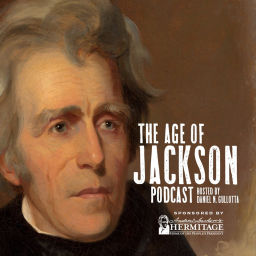
The Age of Jackson Podcast
Claim This Podcastby Daniel Gullotta
4.6(273 reviews)
151 episodes
Updated Inactive
Accepts GuestsHas SponsorsLocation 🇺🇸
Podcast Overview
A Podcast on Antebellum America (ca.1812 - ca.1845) hosted by Daniel N. Gullotta and sponsored by Andrew Jackson's Hermitage.
Language
🇺🇲
Publishing Since
1/19/2018
1 verified contact email on file for The Age of Jackson Podcast
Pitch yourself as a guest, propose sponsorships, or reach out directly to the host.
Recent Episodes
March 11, 2022
149 The Tormented Rise of Abolition in Andrew Jackson's America with J.D. Dickey
The 1830s were the most violent time in American history outside of war. Men battled each other in the streets in ethnic and religious conflicts, gangs of party henchmen rioted at the ballot box, and assault and murder were common enough as to seem unremarkable. The president who presided over the era, Andrew Jackson, was himself a duelist and carried lead in his body from previous gunfights. It all made for such a volatile atmosphere that a young Abraham Lincoln said “outrages committed by mobs form the every-day news of the times.”<br /><br />The principal targets of mob violence were abolitionists and black citizens, who had begun to question the foundation of the U.S. economy — chattel slavery — and demand an end to it. Led by figures like William Lloyd Garrison and James Forten, the anti-slavery movement grew from a small band of committed activists to a growing social force that attracted new followers in the hundreds, and enemies in the thousands. Even in the North, abolitionists faced almost unimaginable hatred, with newspaper publishers, businessmen with a stake in the slave trade, and politicians of all stripes demanding they be suppressed, silenced or even executed.<br /><br />Carrying bricks and torches, guns and knives, mobs created pandemonium, and forced the abolition movement to answer key questions as it began to grow: Could nonviolence work in the face of arson and attempted murder? Could its leaders stick together long enough to build a movement with staying power, or would they turn on each other first? And could it survive to last through the decade, and inspire a new generation of activists to fight for the cause? <br /><br />J.D. Dickey reveals the stories of these Black and white men and women persevered against such threats to demand that all citizens be given the chance for freedom and liberty embodied in the Declaration of Independence. Their sacrifices and strategies would set a precedent for the social movements to follow, and lead the nation toward war and emancipation, in the most turbulent era of our republic of violence.<br />-<br />J. D. Dickey is the New York Times bestselling author of Empire of Mud, a history of the troubled rise of Washington, D.C., in the nineteenth century, Rising in Flames: Sherman’s March and the Fight for a New Nation and American Demagogue, both published by Pegasus Books.
March 4, 2022
148 William Hunter, A British Soldier's Son Who Became an Early American with Eugene A. Procknow
In June 1798, President John Adams signed the now infamous Alien & Sedition Acts to suppress political dissent. Facing imminent personal risks, a gutsy Kentucky newspaper editor ran the first editorial denouncing the law's attempt to stifle the freedom of the press. Almost immediately, government lawyers recommended his arrest and prosecution.That editor was William Hunter, amazingly, the son of a British soldier. During the American Revolution, he accompanied his father on a campaign to fight the American Rebels. Witnessing first-hand the terrors of combat and twice experiencing capture, Hunter wrote the only surviving account written by a child of a British soldier during the American Revolution. Previously unknown, the journal is one of the most important document discoveries in recent years.Remarkably immigrating to an enemy country, Hunter started the second newspaper west of the Alleghenies in Pennsylvania. Moving to Kentucky's capital, Hunter spoke his mind as a newspaper editor, took entrepreneurial risks, and helped start educational and civic institutions. Particularly compelling, Hunter overcame two major personal setbacks that tarnished his character and left him bankrupt. Each time, he tenaciously persevered and regained prominent stature.Later, Hunter became an elected Kentucky representative, a staunch Andrew Jackson supporter, and moved to Washington, DC, to root out fraud and waste in his administration. Beyond the well-known founders, William Hunter represents a previously underappreciated community leader who made essential contributions to developing democratic and civic institutions in Early America.
February 11, 2022
147 John Leland: A Jeffersonian Baptist in Early America with Eric C. Smith
John Leland (1754-1841) was one of the most influential and entertaining religious figures in early America. As an itinerant revivalist, he demonstrated an uncanny ability to connect with a popular audience, and contributed to the rise of a "democratized" Christianity in America. A tireless activist for the rights of conscience, Leland also waged a decades-long war for disestablishment, first in Virginia and then in New England. Leland advocated for full religious freedom for all-not merely Baptists and Protestants-and reportedly negotiated a deal with James Madison to include a Bill of Rights in the Constitution. Leland developed a reputation for being "mad for politics" in early America, delivering political orations, publishing tracts, and mobilizing New England's Baptists on behalf of the Jeffersonian Republicans. He crowned his political activity by famously delivering a 1,200-pound cheese to Thomas Jefferson's White House. <br /><br />Leland also stood among eighteenth-century Virginia's most powerful anti-slavery advocates, and convinced one wealthy planter to emancipate over 400 of his slaves. Though among the most popular Baptists in America, Leland's fierce individualism and personal eccentricity often placed him at odds with other Baptist leaders. He refused ordination, abstained from the Lord's Supper, and violently opposed the rise of Baptist denominationalism. In the first-ever biography of Leland, Eric C. Smith recounts the story of this pivotal figure from American Religious History, whose long and eventful life provides a unique window into the remarkable transformations that swept American society from 1760 to 1840.<br />-<br />Eric C. Smith is the Senior Pastor of Sharon Baptist Church in Savannah, Tennessee, and a historian of American Baptists and early American religion. He is also the author of Oliver Hart and the Rise of Baptist America (OUP, 2020) and Order & Ardor: The Revival Spirituality of Oliver Hart and the Regular Baptists of Eighteenth-Century South Carolina (USC Press, 2018). He and his wife, Candace, have three children.
151 total episodes available
Similar Podcasts
Discover related shows you might enjoy

Amarica's Constitution
Akhil Reed Amar

Lectures in History
C-SPAN

For the Ages: A History Podcast
The New York Historical

Listening to America
Listening to America

Ben Franklin's World
Liz Covart

Stay Tuned with Preet
Preet Bharara

Matter of Opinion
New York Times Opinion

Conversations with Tyler
Mercatus Center at George Mason University

The Ezra Klein Show
New York Times Opinion
The World in Time / Lapham’s Quarterly
Lapham’s Quarterly

Booknotes+
C-SPAN

History Unplugged Podcast
History Unplugged

Strict Scrutiny
Strict Scrutiny

Serious Trouble
Josh Barro and Ken White

Pod Save America
Pod Save America
Deep-dive analytics for The Age of Jackson Podcast
Frequently asked questions
Have a different question and can't find the answer you're looking for? Reach out to our support team by sending us an email and we'll get back to you as soon as we can.
- What is The Age of Jackson Podcast?
- How often does this podcast release new episodes?
This podcast updates inactive.
- Where can I listen to this podcast?
This podcast is available on 2 platforms including Apple Podcasts, Spotify, and more. You can also use the RSS feed directly.
- Does this podcast accept guests?
Yes, this podcast regularly features guests.
Legal Disclaimer
Pod Engine is not affiliated with, endorsed by, or officially connected with any of the podcasts displayed on this platform. We operate independently as a podcast discovery and analytics service.
All podcast artwork, thumbnails, and content displayed on this page are the property of their respective owners and are protected by applicable copyright laws. This includes, but is not limited to, podcast cover art, episode artwork, show descriptions, episode titles, transcripts, audio snippets, and any other content originating from the podcast creators or their licensors.
We display this content under fair use principles and/or implied license for the purpose of podcast discovery, information, and commentary. We make no claim of ownership over any podcast content, artwork, or related materials shown on this platform. All trademarks, service marks, and trade names are the property of their respective owners.
While we strive to ensure all content usage is properly authorized, if you are a rights holder and believe your content is being used inappropriately or without proper authorization, please contact us immediately at hey@podengine.ai for prompt review and appropriate action, which may include content removal or proper attribution.
By accessing and using this platform, you acknowledge and agree to respect all applicable copyright laws and intellectual property rights of content owners. Any unauthorized reproduction, distribution, or commercial use of the content displayed on this platform is strictly prohibited.