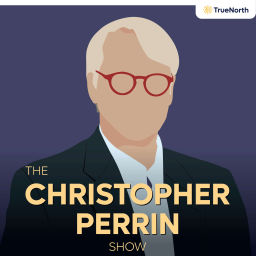
Podcast thumbnail for The Christopher Perrin Show

The Christopher Perrin Show

Claim This Podcast

by Christopher Perrin

5.0(12 reviews)
61 episodes
Updated Bi-weekly
Accepts GuestsHas SponsorsLocation 🇺🇸
61

Podcast Authority

Beta
GoodBased on show quality, social media presence, reviews, charts, and more
Pod Engine
Quality88
Social0
YouTube0
Engagement85

Podcast Overview

Dr. Christopher Perrin has been a leader in the renewal of classical education in the United States for 25 years. In this podcast, he traces the renewal of the American paideia exploring the recent history of the American renaissance in light of the 2500 years that have preceded it. Christopher is the founding CEO of Classical Academic Press and the founder of ClassicalU.com. The Christopher Perrin Show is part of the TrueNorth.fm podcast network.

Language

🇺🇲

Publishing Since

4/8/2022

Unlock The Full Podcast Authority Score Report

See how your podcast performs across key metrics

61

Podcast Authority

Beta
GoodBased on show quality, social media presence, reviews, charts, and more
Pod Engine
Quality88
Social0
YouTube0
Engagement85
8
Excellent Areas
1
Good Performance
10
Growth Opportunities
excellent
Episode Length
37 minutes
Performing excellently!
good
iTunes Tags
7.6/10

Recommendations available

Unlock the full report to see detailed tips

needs improvement
Publishing Consistency
Every 24 days

Recommendations available

Unlock the full report to see detailed tips

+16 More Metrics

Unlock comprehensive insights including:

  • • YouTube presence analysis
  • • Social media reach metrics
  • • RSS compliance scoring
  • • Podcast 2.0 features
  • • Technical standards
What's Included in Your Full Report

Detailed Analytics

  • Complete breakdown of all 19 authority metrics
  • Personalized recommendations for each metric
  • Industry benchmarks and comparisons
  • Technical RSS feed analysis and compliance scoring

Growth Strategies

  • Step-by-step action plans for improvement
  • Quick wins to boost your score immediately
  • Pro tips from successful podcasters
Get your free podcast insights report

See how your show performs across every key metric

Instant delivery
No spam
Attract Better Guests

High authority scores make your podcast more attractive to industry leaders and influencers who want to appear on credible shows.

Secure Sponsorships

Sponsors look for podcasts with proven authority and engagement. Your score demonstrates your podcast's value to potential partners.

Grow Your Audience

Understanding your strengths and weaknesses helps you make data-driven decisions to expand your listener base effectively.

1 verified contact email on file for The Christopher Perrin Show

Pitch yourself as a guest, propose sponsorships, or reach out directly to the host.

Recent Episodes

Episode thumbnail for Episode 61: Hildegard College: Restoring Polymathy and Redemptive Entrepreneurship

May 27, 2026

Episode 61: Hildegard College: Restoring Polymathy and Redemptive Entrepreneurship

Christopher Perrin interviews Dr. Matthew J. Smith, founder of Hildegard College, about restoring polymathy and redemptive entrepreneurship in education.

Episode thumbnail for Episode 60: A Living Tradition: Classical Education Without Nostalgia

April 22, 2026

Episode 60: A Living Tradition: Classical Education Without Nostalgia

<p><b>Description </b></p><p>Christopher Perrin welcomes Dr. John Mark Reynolds for a extensive conversation about the renewal of classical education—and why the term classical often confuses more than it clarifies. Reynolds shares how family life, great teachers, and deep reading (especially C. S. Lewis and Plato) shaped his intellectual and spiritual journey, eventually drawing him into the classical Christian education movement. Together they explore how classical education is not nostalgia or narrow Greco-Roman elitism, but a living tradition rooted in wonder, dialectic, and a “great conversation” that has always been broader than the modern West. The conversation turns to virtue formation and liberal education, arguing that education should prepare students not only for work, but for judgment, sacrifice, and even death. Perrin and Reynolds also address how the classical movement can avoid becoming a guru-driven ideology, how it must remain open to science and modern technological change, and why false dichotomies distort educational debates. The episode closes with Reynolds’ vision for St. Constantine School, a K–16 “grown backward” model that integrates tutorial-style liberal arts education with practical formation for diverse vocations.</p><p><b>Episode Outline</b></p><ul><li>Why the question “What is classical education?” is harder than it sounds (and why it matters for renewal)</li><li>The paradox of learning: the more you know, the more you know you don’t know </li><li>Reynolds’ early formation: pastoral family life, reading, and learning to “get to the bottom” of ideas</li><li>Influential teachers and the life of wonder: Plato, the Socratic habit, and learning as lifelong pursuit</li><li>Returning to Christian faith and integrating faith with the life of the mind</li><li>Why the word “classical” can mislead: the tradition is global, multi-ethnic, and not limited to Greco-Roman texts</li><li>Classical education as the “great conversation”: local cultures rooted in mother tongue, connected to a shared metaphysical reality</li><li>The liberal arts, virtue, and human freedom: what education once aimed at (and what modern credentialing often replaces)</li><li>Education as preparation to live well—and to die well: Plato, Scripture, and the moral seriousness of formation</li><li>Avoiding two dangers in the renewal: guruism and ideological “compounds”</li><li>Science, technology, and modernity: why classical education must have room for Newton (and for contemporary scientific callings)</li><li>St. Constantine’s model: tutorial liberal arts, K–16 integration, dual enrollment, and forming “souls fit for paradise”</li><li>Where to learn more: St. Constantine’s website and ongoing work</li></ul><p><b>Key Topics &amp; Takeaways</b></p><ul><li><strong>Classical education is bigger than the word “classical.”</strong> The tradition is not inherently ethnocentric; its sources and conversations span regions and cultures, including the Near East and Africa.</li><li><strong>Wonder and dialectic are central.</strong> Reynolds frames classical learning as rooted in Socratic inquiry and a habit of getting to the bottom of things.</li><li><strong>Liberal education aims at freedom and virtue.</strong> True liberty includes self-governance, responsibility, gratitude, and service—virtues modern schooling often thins into mere credentialing.</li><li><strong>Education should prepare students for ultimate realities.</strong> The conversation repeatedly returns to the claim that the one certainty is death, and education should form people who can face it with moral seriousness.</li><li><strong>The renewal must remain humble.</strong> Classical education collapses when it becomes guru-centric, novelty-driven, or triumphalist.</li><li><strong>Classical education must remain intellectually modern.</strong> A classical school should have room for mathematics, science, engineering, and technological prudence—not a nostalgic retreat from modernity.</li><li><strong>Multiple models are needed.</strong> St. Constantine is presented as one viable “iteration,” not the only faithful expression of classical education.</li><li><strong>Formation serves many vocations.</strong> Reynolds argues that tutorial-style liberal arts can prepare nurses, engineers, builders, and citizens—not only professors and “cocktail party” intellectuals.</li></ul><p><b>Questions &amp; Discussion</b></p><ul><li><strong>What do you mean when you say “classical education” in your own context?<br></strong>List the assumptions you hear most often (elitist, Greco-Roman-only, anti-science, ethnocentric). Draft a two-sentence explanation that highlights both aims (virtue/wisdom) and methods(dialectic/great books/literacy).</li><li><strong>How should liberal education form freedom and virtue today?<br></strong>Contrast “credentialing” with “formation.” Where does your institution drift toward one over the other? What habits would actually train self-governance (attention, honesty, courage, sacrifice) in students?</li><li><strong>What does it mean to prepare students to die well?<br></strong>Discuss whether your curriculum implicitly prepares students for comfort and success more than moral endurance. Name one text, practice, or tradition that could restore seriousness about mortality, judgment, and ultimate goods.</li><li><strong>How can classical education avoid becoming an ideology or “compound”?<br></strong>Identify warning signs of guruism (one name, one method, one “true” model). List practices that keep a school porous and humble (plural models, peer critique, historical study, spiritual disciplines).</li><li><strong>What do you think of a K–16 approach to classical formation?<br></strong>Discuss potential strengths (continuity, tutorial culture, cost efficiency, coherent formation). Discuss potential risks (scale, resource demands, insularity). What would be a realistic “next step” in your context?</li></ul><p><b>Suggested Reading &amp; Resources</b></p><ul><li><a href="https://classicalacademicpress.com/collections/classical-education/products/the-liberal-arts-tradition-a-philosophy-of-classical-christian-education">The Liberal Arts Tradition</a> by Kevin Clark, DLS, and Ravi Scott Jain</li><li><a href="https://amzn.to/41GNURP">The Space Trilogy</a> by C. S. Lewis</li><li><a href="https://www.saintconstantine.org/">Saint Constantine School</a> </li><li><a href="https://classicalu.com/">ClassicalU</a></li><li>ClassicalU Course: <a href="https://classicalu.com/course/c50f0740-c9b3-441f-bffc-66b55fda3571?from=%2Fcourse-finder">The Liberal Arts Tradition</a></li><li>ClassicalU Course: <a href="https://classicalu.com/course/360ebb23-f045-4819-9836-2e9dd15be8eb?from=%2Fcourse-finder%3Fpage%3D5">Classical Education History and Introduction</a></li><li>ClassicalU Course: <a href="https://classicalu.com/course/9051465e-496f-4926-af7b-42deadedb1d8">Introduction to Classical Education</a></li><li>ClassicalU Course: <a href="https://classicalu.com/course/91c61af2-1fc6-40d9-a68f-813d509f0293?from=%2Fcourse-finder%3Fpage%3D2">Teaching Science Classically: 10 Essential Principles</a></li></ul><p><br></p>

Episode thumbnail for Episode 59: American Education: What It Was and Can Be Again

April 15, 2026

Episode 59: American Education: What It Was and Can Be Again

<p><b>Description </b></p><p>Recorded at the <a href="https://classicaleducationsymposium.org/">2026 Great Hearts National Symposium</a> on February 25, 2026, this edited episode features Christopher Perrin’s keynote speech exploring the history, meaning, and renewal of classical education, asking a foundational question: what exactly are we trying to recover? Drawing from sources as diverse as Augustine, Herodotus, Tocqueville, and C.S. Lewis, he traces the transmission of the liberal arts from ancient Greece and Rome through Christendom and into early America. Along the way, Perrin reflects on the gradual fragmentation of this tradition in the modern era, illustrated through the story of the Adams family and the rise of progressive education. </p><p>Perrin challenges educators to embrace the humility at the heart of true learning—that the more we know, the more we recognize our ignorance—and to see themselves as perpetual students. The episode also highlights the remarkable resurgence of classical education today, describing it as a reawakening of seeds long buried but now beginning to flourish. Perrin emphasizes that education is not merely a science or technique, but the transmission of a living tradition aimed at forming wisdom, virtue, and love. Listeners will come away with a renewed sense of purpose, encouraged to tend the “fire” of learning and to participate faithfully in handing down a rich inheritance to the next generation.</p><p>Special thanks to the <a href="https://institute.greatheartsamerica.org/">Great Hearts Institute</a>. </p><p><b>Episode Outline</b></p><ul><li>Why the question “What is classical education?” is harder than it sounds (and why it matters for renewal)</li><li>The paradox of learning: the more you know, the more you know you don’t know </li><li>“Begin with the end”: death, wisdom, and the purpose of education </li><li>Tradition as “handing down”: language, culture, and education as inheritance </li><li>Athens and Rome: Greek paideia, Roman educatio, and the liberal arts as a transmitted curriculum</li><li>The Church and Christendom: incorporating Greco-Roman learning, theology as “queen,” and widening access</li><li>England to early America: grammar schools, Boston Latin, Harvard, and the rise of popular literacy </li><li>The Adams family as an educational case study: formation, thinning, and the modern fracture </li><li>Progressive education: what changed, what was gained, and why education can’t be reduced to a quantitative science</li><li>The modern renewal: early schools (1979–1981), today’s ecosystem, and the need for teacher formation at scale</li><li>Final exhortation: preserve humility, avoid pride, resist false dichotomies, and tend the “fire” of wonder in schools</li></ul><p><b>Key Topics &amp; Takeaways</b></p><ul><li>Classical education is a tradition before it is a “renewal.” A renewal only makes sense if we can name what is being renewed.</li><li>Teachers must be perpetual students. The classical teacher models humility—seeking wisdom while resisting the pretense of having arrived.</li><li>Education is measured by ultimate aims. Human life is fleeting; education gains its meaning from what it prepares us for—virtue, wisdom, piety, and a life rightly ordered.</li><li>Tradition is unavoidable. Even rejecting tradition requires using language and capacities that were first handed down as a tradition.</li><li>The liberal arts are an inheritance with a genealogy. From Greek and Roman culture through Christian adaptation, the arts endure because they correspond to human nature.</li><li>Modern fragmentation reshaped education’s purpose. When technology and “force” become central categories, education shifts from transmitting culture to preparing for flux.</li><li>Progressive vs. classical is not a simple binary. Many educational “heresies” are partial truths held out of balance (false dichotomies distort practice).</li><li>The renewal must be sustained by love, not mere critique. A movement fueled only by opposition cannot endure—formation requires positive vision and shared goods.</li><li>Classical education belongs to humanity. It is deeply shaped by Christianity, but not owned exclusively by Christians; it welcomes seekers and strangers.</li></ul><p><b>Questions &amp; Discussion</b></p><ul><li><strong>Why do you think “classical education” is so difficult to define clearly?<br></strong>Name what you most often hear from parents or colleagues when they ask what “classical” means. Try writing a two-sentence definition that includes both aim (why) and means (how), then compare with others.</li><li><strong>How does the “perpetual student” posture change the way you teach?<br></strong>Where are you tempted to project certainty or expertise instead of wonder and humility? Identify one practice that would help your faculty model learning (shared reading, teacher seminar, public “I don’t know yet”).</li><li><strong>What is education for when you “begin with the end” (mortality in view)?<br></strong>How does remembering death sharpen what matters in curriculum and school culture? If you had to prioritize one outcome—wisdom, virtue, piety, civic responsibility—what would you choose and why?</li><li><strong>What can we learn from the Adams family arc—formation to fracture?<br></strong>In your own experience, where do you see education becoming “garments that no longer fit”? Does your school respond by adapting the form—or by recovering the measure of the human person?</li><li><strong>What kind of “renewal energy” actually sustains a school long-term?<br></strong>Where does your community rely on critique of modern schooling rather than a positive vision? Identify one “beauty practice” (music, poetry, liturgy, feast, shared reading) that could rekindle joy and friendship.</li></ul><p><b>Suggested Reading &amp; Resources</b></p><ul><li><a href="https://classicalacademicpress.com/collections/classical-education/products/the-liberal-arts-tradition-a-philosophy-of-classical-christian-education">The Liberal Arts Tradition</a> by Kevin Clark, DLS, and Ravi Scott Jain</li><li><a href="https://classicalacademicpress.com/collections/classical-education/products/an-introduction-to-classical-education-a-guide-for-parents">An Introduction to Classical Education: A Guide for Parents</a> by Christopher A. Perrin, MDiv, PhD</li><li><a href="https://classicalacademicpress.com/collections/humanitas">Humanitas</a></li><li><a href="https://openlibrary.org/books/OL20148163M/An_essay_toward_a_history_of_education?utm_source=chatgpt.com">An Essay Toward Education</a> by W. H. H. Kane</li><li><a href="https://amzn.to/4vxUacg">From Dawn to Decadence</a> by Jacques Barzun </li><li><a href="https://amzn.to/4muZsRC">Democracy in America</a> by Alexis de Tocqueville </li><li><a href="https://amzn.to/4sB9Ngm">The Education of Henry Adams </a>by Henry Adams</li><li><a href="https://archive.org/details/valueclassics00westgoog?utm_source=chatgpt.com">The Value of the Classics</a> by Andrew West (ed.)</li><li><a href="https://amzn.to/4eqEUaK">Address to Young Men on Reading Greek Literature</a> by Basil of Caesarea</li><li><a href="https://institute.greatheartsamerica.org/">Great Hearts Institute  </a></li><li><a href="https://classicalacademicpress.com/">Classical Academic Press</a></li><li><a href="https://classicalu.com/">ClassicalU</a></li><li>ClassicalU Course: <a href="https://classicalu.com/course/c50f0740-c9b3-441f-bffc-66b55fda3571?from=%2Fcourse-finder">The Liberal Arts Tradition</a></li><li>ClassicalU Course: <a href="https://classicalu.com/course/360ebb23-f045-4819-9836-2e9dd15be8eb?from=%2Fcourse-finder%3Fpage%3D5">Classical Education History and Introduction</a></li><li>ClassicalU Course: <a href="..."></a></li></ul>

61 total episodes available with 1 transcripts

Recent guests on The Christopher Perrin Show

Guests from recent episodes — sign up to see every guest that has ever appeared on this show.

Matthew J Smith

Guest

Dr Angel Parham

Guest

Deep-dive analytics for The Christopher Perrin Show

Frequently asked questions

Have a different question and can't find the answer you're looking for? Reach out to our support team by sending us an email and we'll get back to you as soon as we can.

What is The Christopher Perrin Show?

Dr. Christopher Perrin has been a leader in the renewal of classical education in the United States for 25 years. In this podcast, he traces the renewal of the American paideia exploring the recent history of the American renaissance in light of the 2500 years that have preceded it. Christopher is the founding CEO of Classical Academic Press and the founder of ClassicalU.com. The Christopher Perrin Show is part of the TrueNorth.fm podcast network.

How often does this podcast release new episodes?

This podcast updates bi-weekly.

Where can I listen to this podcast?

This podcast is available on 10 platforms including Apple Podcasts, Spotify, and more. You can also use the RSS feed directly.

Does this podcast accept guests?

Yes, this podcast regularly features guests.

Legal Disclaimer

Pod Engine is not affiliated with, endorsed by, or officially connected with any of the podcasts displayed on this platform. We operate independently as a podcast discovery and analytics service.

All podcast artwork, thumbnails, and content displayed on this page are the property of their respective owners and are protected by applicable copyright laws. This includes, but is not limited to, podcast cover art, episode artwork, show descriptions, episode titles, transcripts, audio snippets, and any other content originating from the podcast creators or their licensors.

We display this content under fair use principles and/or implied license for the purpose of podcast discovery, information, and commentary. We make no claim of ownership over any podcast content, artwork, or related materials shown on this platform. All trademarks, service marks, and trade names are the property of their respective owners.

While we strive to ensure all content usage is properly authorized, if you are a rights holder and believe your content is being used inappropriately or without proper authorization, please contact us immediately at hey@podengine.ai for prompt review and appropriate action, which may include content removal or proper attribution.

By accessing and using this platform, you acknowledge and agree to respect all applicable copyright laws and intellectual property rights of content owners. Any unauthorized reproduction, distribution, or commercial use of the content displayed on this platform is strictly prohibited.