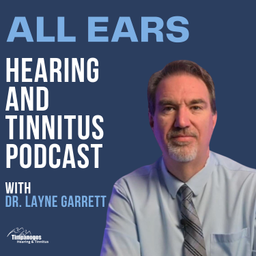
Welcome to *All Ears*, the podcast where Dr. Layne Garrett — audiologist, tinnitus specialist, and founder of Timpanogos Hearing & Tinnitus — helps you take charge of your hearing health.
Each episode dives into practical advice, cutting-edge treatments, and expert insights on hearing loss, tinnitus, hearing aids, and beyond.
Whether you're struggling with that constant ringing, curious about the latest devices, or just want to hear life's moments more clearly, Dr. Garrett is here to guide you with compassion, science, and solutions.
Tune in, turn up the volume, and discover how to reclaim the sounds that matter most.
v]]\A new study looked at hearing loss and frailty — a geriatric measure of how much health reserve a person has left — in more than 2,600 adults over 65. Worse hearing was linked to meaningfully higher frailty scores overall, but that link nearly disappeared among people who used hearing aids.
Dr. Layne Garrett, Au.D., breaks down what the research actually found, what it can't prove, and why fitting verification matters even though this particular study never measured it. Drawing on more than two decades treating tinnitus and complex hearing loss, Dr. Garrett explains why every evaluation at Timpanogos Hearing and Tinnitus includes real ear measurement — confirming exactly how much sound reaches the eardrum, rather than relying on a software prediction alone.
This episode also walks through a patient story: a 78-year-old who'd quietly stopped going to his weekly cribbage game, and what changed after a properly verified fitting.
Timpanogos Hearing and Tinnitus is a medical-model practice, not a transactional retailer — built around thorough, function-first care.
Learning Center — https://utahhearingaids.com/learning-center
13 Oct 2026
Is a Tinnitus Cure Coming? The Real Research
Tinnitus research headlines rarely survive the trip from a clinical trial to your feed intact — patient counts shift, disease-specific results get generalized, and animal data gets described like it's already helping people. In this episode, Dr. Layne Garrett, Au.D., breaks down four treatments actually in the tinnitus research pipeline — AC102, Auricle, and two Gateway Biotechnology programs — along with where ebselen (SPI-1005) and TMS actually stand today. He also covers the treatment already sitting on the shelf: Lenire, FDA De Novo approved since March 2023, still underused by patients who've never heard of it.
Dr. Garrett has spent over two decades specializing in tinnitus and complex hearing loss at Timpanogos Hearing & Tinnitus, a medical-model practice built around Real Ear Measurement verification on every fitting and a full-time Lenire program. If you're trying to sort real relief from research that's still years away, this episode walks through what's actually proven, what's promising, and what's already available.
9 Oct 2026
ReSound Sensia: An Audiologist's Early Impressions
For years, the hard problem in hearing aids wasn't noise — it was judgment. At a crowded table, the voice you want and the voice you don't can arrive at the same volume, and the device has to guess which one matters. ReSound's new Sensia claims to make that guess better. In this first look, Dr. Layne Garrett, Au.D., explains the "loud vs. important" problem in plain language and breaks down how Sensia attacks it: an AcoustIQ classifier that reads the room, a binaural beam that works across both ears toward whoever you're facing, and a deep neural network that strips competing voices rather than just background hum. He weighs the evidence carefully — an independent German lab (Hörzentrum Oldenburg) finding better audibility of the person you face, against ReSound's own 88% classifier-accuracy figure — and shares the real patient signal that caught his attention: someone who stopped needing to touch the app at all. He's also candid about what's unproven: a quiet office is not the test, a Friday-night football game is. And he explains why none of this smart processing helps unless the fitting is verified in your ear with Real Ear Measurement. If you struggle in restaurants, church, or family gatherings, or you already wear ReSound and manage your programs manually, this is a straight, early read from the fitting chair.
Learning Center — https://utahhearingaids.com/learning-center
Inside a recent episode
Why Hearing Aids Don't Work for Some People
Published 17 Jul 2026 · Transcript excerpt
[…] I can hear doc, I just can't understand what people are saying. Maybe you've said it, maybe someone in your family has. It's clinically meaningful because it tells me the ears are getting sound, but somewhere between the cochlea and the brain, the signal is getting distorted in ways that make more volume, not fix it. A review published in Trends in Neuroscience put it plainly. Hearing loss doesn't just reduce sensitivity to sound. It causes complex distortions in how the brain processes sound, distortions that amplification alone can't correct. The cochlea isn't just a microphone, it's doing intricate signal processing. […]
Pod Engine is an independent podcast discovery and analytics service and is not affiliated with or endorsed by this podcast. Artwork and show content belong to their owners. Full legal notice.
Explore this show Podcast research with Pod Engine