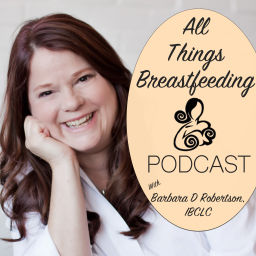
Podcast thumbnail for All Things Breastfeeding Podcast

All Things Breastfeeding Podcast

Claim This Podcast

by Barbara D. Robertson, IBCLC; Barbara Demske RN, BSN

4.7(69 reviews)
123 episodes
Updated Daily
Accepts GuestsHas SponsorsLocation 🇺🇸

Podcast Overview

A Comprehensive, Professional Service for All of Your Breastfeeding Needs / Ann Arbor, MI

Language

🇺🇲

Publishing Since

3/4/2015

1 verified contact email on file for All Things Breastfeeding Podcast

Pitch yourself as a guest, propose sponsorships, or reach out directly to the host.

Recent Episodes

Episode thumbnail for All Things Breastfeeding Episode 110: Using Research in Clinical Practice

April 27, 2026

All Things Breastfeeding Episode 110: Using Research in Clinical Practice

<p>From Barbara Robertson and Nancy Mohrbacher:</p> <p>Using new research in clinical practice? How do we do this? When is it time to let go of our old ways of doing things and incorporate new information? These are some of the questions Nancy and Barbara discuss in this episode of All Things Breastfeeding. Sometimes, incorporating new research in clinical practice is easy. It can be an &#8220;ah-ha&#8221; moment. Nancy had this when she learned about Suzanne Colson&#8217;s research on releasing babies&#8217; reflexes to stimulate breastfeeding. She knew Suzanne&#8217;s description was true and immediately began incorporating Suzanne&#8217;s ideas into her practice. Barbara had this type of moment when she read Nancy&#8217;s article, &#8220;The Magic Number.&#8221;</p> <p>On the other hand, we can also suffer from confirmation bias. We may want to believe that we can use human milk for longer than the current recommendations (see article below), so we are happy when a study suggests this might be true. On the other hand, it can take 17 years or longer for research to become clinical practice. When should we wait? When is it time to change? Some clear guidance both Nancy and Barbara use is: &#8220;Will it be harmful?&#8221; It does not harm anyone to start playing around with latch and positioning, or adding extra milk removals, for someone struggling with milk supply.</p> <p>Take a listen to learn more about Nancy&#8217;s and Barbara&#8217;s thoughts on this subject. Enjoy!</p> <p>Resources:</p> <ul class="wp-block-list"> <li>Colson SD, Meek JH, Hawdon JM. Optimal positions for the release of primitive neonatal reflexes stimulating breastfeeding. Early Hum Dev. 2008 Jul;84(7):441-9. doi: 10.1016/j.earlhumdev.2007.12.003. Epub 2008 Feb 19. PMID: 18243594.: <a href="https://pubmed.ncbi.nlm.nih.gov/18243594/" target="_blank" rel="noreferrer noopener">https://pubmed.ncbi.nlm.nih.gov/18243594/</a></li> <li>Anders, L. A., Mesite Frem, J., &amp; McCoy, T. P. (2025). Flange size matters: A comparative pilot study of the Flange FITSTM guide versus traditional sizing methods. Journal of Human Lactation, 41(1), 54-64. <a href="https://pubmed.ncbi.nlm.nih.gov/39614713/" target="_blank" rel="noreferrer noopener">https://pubmed.ncbi.nlm.nih.gov/39614713/</a></li> <li>Mohrbacher, N. (2011). The Magic Number and Long-Term Milk Production. Clinical Lactation 2(1), 15-18. <a href="https://lactalearning.com/wp-content/uploads/2025/07/MohrbacherMagicNumber2011.pdf" target="_blank" rel="noreferrer noopener">https://lactalearning.com/wp-content/uploads/2025/07/MohrbacherMagicNumber2011.pdf</a></li> <li>All Things Breastfeeding Episode 108: Tongue Tie Update: <a href="https://lactalearning.com/tongue-tie-update/" target="_blank" rel="noreferrer noopener">https://lactalearning.com/tongue-tie-update/</a></li> <li>Scharff, A. Z., Sedlacek, L., de Oliveira Mekonnen, A., Liolios, I., Ritter, S., Fuchs, F., &amp; Happle, C. (2026). Leftover Infant Milk After Bottle Feeding: Parental Practices and Microbiological Findings. medRxiv, 2026-02. <a href="https://www.medrxiv.org/content/10.64898/2026.02.13.26346179v1" target="_blank" rel="noreferrer noopener">https://www.medrxiv.org/content/10.64898/2026.02.13.26346179v1</a></li> </ul> <p></p> <p>The post <a href="https://bfcaa.com/all-things-breastfeeding-episode-110-using-research-in-clinical-practice/">All Things Breastfeeding Episode 110: Using Research in Clinical Practice</a> appeared first on <a href="https://bfcaa.com">The Breastfeeding Center of Ann Arbor</a>.</p>

Episode thumbnail for All Things Breastfeeding Episode 109: 2nd Night Syndrome?

March 30, 2026

All Things Breastfeeding Episode 109: 2nd Night Syndrome?

<p>From Barbara Robertson</p> <p>What is 2nd Night Syndrome? 2nd-night syndrome is a common feature of newborn behavior. It typically occurs on the 2nd night after birth, when the baby&#8217;s behavior shifts from sleepiness to greater wakefulness, often asking to nurse frequently. Our colleague, Jan Barger, has discussed this. In her description of this she says, &#8220;All of a sudden, your little one discovers that he’s no longer back in the warmth and comfort – though a bit crowded – womb where he has spent the last 9 months – and it is SCARY out here!&#8221; No wonder babies are upset!&#8221; Correct! Infants are upset, but our takeaway message to families is that this is normal and your baby is fine. And, happily, there are things you can do that may help.</p> <div class="wp-block-image"> <figure class="alignright"><img decoding="async" src="https://lactalearning.com/wp-content/uploads/2026/03/AmeliaHerstein-194x300.jpg" alt="2nd night syndrome" class="wp-image-5596"/></figure> </div> <p>What does 2nd Night Syndrome look like? The key sign of this is that the baby wants to be held continually and nursed frequently. This is expected behavior. The baby is shifting from being fed through the umbilical cord and held constantly in the womb, to now needing to eat themselves and realizing they are not always being held. People often classify this behavior as &#8220;fussy&#8221; or &#8220;starving&#8221;. Suzanne Colson discussed infants needing to transition from the womb to the world. The baby was warm, fed, and cuddled 24/7 in the womb, and in Western society, we tend to try to put the baby down, away from us, to sleep. As the baby becomes more alert, they instinctively know this isn&#8217;t where they belong. They are safest in their birthing parent&#8217;s arm, right next to their food source for easy access. The baby may appear more wakeful, irritable, and cry more frequently. They want to cluster-feed, nursing for long periods of time and/or in short, frequent bursts, especially in the evening or at night. Again, they seek constant contact and to be held.</p> <p>What are the theories as to why Second Night Syndrome is happening? To begin with, as mentioned, there is a significant environmental adjustment for infants. They go from a warm, cozy, noisy, dark womb to the world where noise, light, and temperature are inconsistent and often unpleasant. This change can be overwhelming for a baby. Babies in the womb are also being fed constantly, so the idea of being hungry is new as well. Their stomachs are tiny and expect frequent, small feeds. Frequent feeds also stimulate the parent&#8217;s milk supply, progressing from colostrum to transitional milk to mature milk. A review of research on secretory activation found that frequent milk removals are precisely what is needed at this point. The baby&#8217;s intake needs are going to increase over the next few days from about 0.5 oz (15 mLs) per feed to about 2-3 oz per feed in the next week. By frequently removing milk, the baby signals to the parent&#8217;s body that it is time for secretory activation, leading to a full milk supply. A fascinating study found that, among exclusive pumpers, the number of milk removals was critical for reaching and maintaining this stage. If the parent did not maintain frequent milk feedings, they would move out of secretory activation.</p> <p>Why does it happen in the evening and at night? One theory is that the surrounding environment is loud and chaotic during the day. If the family remains in the hospital, many staff members are in and out of the room throughout the day. It is usually bright. There are often many visitors, especially if it is the first baby.&nbsp; All of this can cause the baby to feign sleep, thereby appearing calm. Once the chaos subsides, the lights are dimmed, and the baby &#8220;wakes&#8221; up, ready for interaction and feeding.</p> <p>What can be done about Second Night Syndrome? In many ways, this increased behavior in the baby is the parent&#8217;s first opportunity to set the tone for the relationship. The parent has a choice: give the baby what they need at this moment, or fight it. Note that I used the word &#8220;need,&#8221; not &#8220;want.&#8221; The first stage of human development, according to Erik Erikson, is trust vs mistrust. Will the parent be present for the baby, or prioritize their own needs (or societal expectations) over the baby&#8217;s needs? What does the baby want? The bottom line is they want to be close to their parent. They want to be held skin-to-skin constantly. Skin-to-skin contact soothes the baby and helps them regulate their body. Make sure the baby doesn&#8217;t have mittens on. One of my interns once said that babies &#8220;see&#8221; with their hands. They also want access to their food source (the breast/chest) as often and as long as they feel they need to access it. After the baby feeds, gently shift so that the parent and the baby are comfortable. If you try to put the baby down somewhere, they will most likely wake again. If the baby is to be moved, the family should wait until the baby is in a deep (REM) sleep. The baby begins in light sleep, and if moved, they will wake. Keep in mind that infants move in and out of REM sleep more quickly than adults, approximately every 30 minutes. We encourage the parent to rest as much as possible during the day. The adage &#8220;sleep when the baby sleeps&#8221; is no joke in the early weeks.</p> <p>Ensuring the family has as much support as possible greatly helps, so the parents&#8217; only primary job is to meet the baby&#8217;s needs. Getting family and friends involved is a great idea. Hiring a doula for the first week or two can be a good solution. Remember, too, during the day, keep things calm, dark, and quiet so the baby doesn&#8217;t feel the need to play possum. Using calming techniques can also be effective. Rocking, walking, shushing, and letting the baby suck are great ideas.</p> <p>Again, Second Night Syndrome (SNS) is a normal developmental hurdle, not an illness. The baby isn&#8217;t starving, and there is nothing wrong with the baby. The baby intuitively knows that the safest place for them to be is at or near the breast/chest. This intense need is very temporary. The sooner the family learns how to meet their baby&#8217;s particular needs, the sooner this tends to pass.&nbsp;</p> <p>The post <a href="https://bfcaa.com/all-things-breastfeeding-episode-109-2nd-night-syndrome/">All Things Breastfeeding Episode 109: 2nd Night Syndrome?</a> appeared first on <a href="https://bfcaa.com">The Breastfeeding Center of Ann Arbor</a>.</p>

Episode thumbnail for All Things Breastfeeding Episode 108: Tongue Tie Update

March 3, 2026

All Things Breastfeeding Episode 108: Tongue Tie Update

<p>A tongue tie update? Barbara and Nancy discuss a <a href="https://pubmed.ncbi.nlm.nih.gov/41380726/">2026 research study on tongue ties by Raol et al</a>. and a commentary response in this episode of All Things Breastfeeding. One of the goals of LactaLearning is to provide recent studies that have the potential to impact clinical lactation practices. The debate over whether tongue ties are being over- or under-treated has been ongoing for several years. After reviewing the latest research on tongue ties for the upcoming edition (this edition is still at least a year away from being released), the research conclusion seems to be that there are absolutely cases where a tongue tie release appeared to be critical for an infant to be able to nurse effectively and/or without pain for the parent. On the other hand, it appears that more babies are undergoing this procedure, even though this may not have been the core issue.</p> <div class="wp-block-image"> <figure class="alignright"><img decoding="async" src="https://lactalearning.com/wp-content/uploads/2026/03/Andre-Matin-del-300x169.jpg" alt="tongue tie update" class="wp-image-5534"/></figure> </div> <p>The Raol study looked at 476 infants and found &#8220;<strong>Conclusions:</strong> Although ankyloglossia may affect breastfeeding experiences, ankyloglossia alone does not appear to affect breastfeeding maintenance or infant weight gain. Improving breastfeeding outcomes should include multidisciplinary management to focus on all potential causes and not only ankyloglossia.&#8221; What was so different about this recent study?&nbsp; &#8220;Their study is unique in that none of the infants had a frenotomy or other surgical treatment of their ankyloglossia, and exclusive breastfeeding was assessed at 2–4 weeks, 3 months, and 6 months after delivery. Surprisingly, there were no differences in rates of exclusive breastfeeding at any time point, including at 6 months (82.3% [no ankyloglossia] vs 73.5% [assessed with ankyloglossia]; P?=?.25), and no differences in infant growth velocity at any time point.&#8221; <a href="https://publications.aap.org/pediatrics/article-abstract/157/1/e2025073238/205746/Untreated-Ankyloglossia-A-Broader-Perspective?redirectedFrom=fulltext">Dr. Ann Will and Dr. Lydia Furman</a> reported.</p> <p>What was also unique was that, instead of releasing the tongues, they provided great lactation support and were grounded in a community that valued breastfeeding. Could this be enough for many babies?</p> <p>There are flaws to the study as well. One issue was the way the authors identified tongue ties. It is not clear how many of the babies had more serious ties.</p> <p>Again, this is food for thought.</p> <p>If you work with breastfeeding/chestfeeding families and are passionate about lactation support, or you want to turn your passion for nursing into professional practice, visit<a href="https://lactalearning.com"> LactaLearning.com</a> and consider following us on social media!</p> <p><a href="https://www.instagram.com/lacta.learning/">Instagram</a> @lacta.learning</p> <p><a href="https://www.facebook.com/profile.php?id=100081793430834">Facebook</a> LactaLearning</p> <p>Raol, N., Silamkoti, B., Syed, S. M., Hosek, K., Theetla, P., &amp; Madireddy, A. (2026). Ankyloglossia, breastfeeding, and infant weight gain: a mixed-methods study. Pediatrics, 157(1), e2024070531.<br>Witt, A., &amp; Furman, L. (2026). Untreated Ankyloglossia: A Broader Perspective. Pediatrics, 157(1), e2025073238.<br><a href="https://pmc.ncbi.nlm.nih.gov/articles/PMC4484383/">Bristol Tongue Assessment Tool</a><br><a href="https://www.abramofono.com.br/wp-content/uploads/2012/02/Lingual-Frenulum-Protocol-with-scores-for-infants-IJOM-2012.pdf">Martinelli Tongue Tie Assessment</a> Lingual Frenulum Protocol for Infants<br>Thomas, K., Kliff, S., &amp; Silver-Greenberg, J. (2023). Inside the booming business of cutting babies’ tongues. New York Times, 18.<br>LeFort, Y., Evans, A., Livingstone, V., Douglas, P., Dahlquist, N., Donnelly, B., Leeper, K., Harley, E., Lappin, S., and Academy of Breastfeeding Medicine. (2021). Academy of breastfeeding medicine position statement on ankyloglossia in breastfeeding dyads. Breastfeeding Medicine, 16(4), 278-281. <a href="https://www.nytimes.com/2023/12/18/health/tongue-tie-release-breastfeeding.html">https://www.nytimes.com/2023/12/18/health/tongue-tie-release-breastfeeding.html</a></p> <p>Responses to the above article:</p> <figure class="wp-block-embed"><div class="wp-block-embed__wrapper"> https://www.liebertpub.com/doi/10.1089/bfm.2024.29263.editorial </div></figure> <figure class="wp-block-embed"><div class="wp-block-embed__wrapper"> https://www.thestewartcenterforoptimalhealth.com/2024/03/17/breaking-down-the-nyt-article-inside-the-booming-business-of-cutting-babies-tongues </div></figure> <p>The post <a href="https://bfcaa.com/all-things-breastfeeding-episode-108-tongue-tie-update/">All Things Breastfeeding Episode 108: Tongue Tie Update</a> appeared first on <a href="https://bfcaa.com">The Breastfeeding Center of Ann Arbor</a>.</p>

123 total episodes available with 1 transcripts

Deep-dive analytics for All Things Breastfeeding Podcast

Frequently asked questions

Have a different question and can't find the answer you're looking for? Reach out to our support team by sending us an email and we'll get back to you as soon as we can.

What is All Things Breastfeeding Podcast?

A Comprehensive, Professional Service for All of Your Breastfeeding Needs / Ann Arbor, MI

How often does this podcast release new episodes?

This podcast updates daily.

Where can I listen to this podcast?

This podcast is available on 9 platforms including Apple Podcasts, Spotify, and more. You can also use the RSS feed directly.

Does this podcast accept guests?

No, this podcast does not typically feature guests.

Legal Disclaimer

Pod Engine is not affiliated with, endorsed by, or officially connected with any of the podcasts displayed on this platform. We operate independently as a podcast discovery and analytics service.

All podcast artwork, thumbnails, and content displayed on this page are the property of their respective owners and are protected by applicable copyright laws. This includes, but is not limited to, podcast cover art, episode artwork, show descriptions, episode titles, transcripts, audio snippets, and any other content originating from the podcast creators or their licensors.

We display this content under fair use principles and/or implied license for the purpose of podcast discovery, information, and commentary. We make no claim of ownership over any podcast content, artwork, or related materials shown on this platform. All trademarks, service marks, and trade names are the property of their respective owners.

While we strive to ensure all content usage is properly authorized, if you are a rights holder and believe your content is being used inappropriately or without proper authorization, please contact us immediately at hey@podengine.ai for prompt review and appropriate action, which may include content removal or proper attribution.

By accessing and using this platform, you acknowledge and agree to respect all applicable copyright laws and intellectual property rights of content owners. Any unauthorized reproduction, distribution, or commercial use of the content displayed on this platform is strictly prohibited.