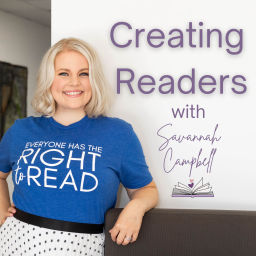
Join Savannah Campbell, a certified reading specialist and passionate advocate for the Science of Reading, as she shares her journey from traditional teaching methods to transformative, evidence-based practices. Savannah brings you the latest research, practical strategies, and actionable insights to help educators refine their craft and empower their students to become confident, lifelong readers. Whether you’re a seasoned teacher or new to the field, ”Creating Readers” is your go-to resource for making meaningful progress in literacy education—without the overwhelm. Grab a seat, and let’s create readers together!
Host Savannah Campbell explores why teachers should adapt reading programs rather than follow them rigidly, emphasizing teacher expertise over curriculum fidelity.
13 May 2026
#29 When Do We Stop Using Decodables? (And What Comes Next)
Last week, we talked all about what decodables are with Brooke Vitali.This week, we’re tackling the question everyone is quietly wondering…When do we actually stop using them?
In this episode, I walk you through how to think about decodables as a tool (not the goal), what signals students are ready to move on, and what instruction should look like after decodables.
Spoiler: it’s not going back to leveled texts.
🔑 Key Takeaways
🔧 Decodables are a tool—nothing more, nothing less They exist to give students practice with phonics skills that have already been explicitly taught.
🎯 They are NOT the end goal The goal is not to get good at reading decodables: the goal is to read and understand any text.
🧠 Word recognition and comprehension develop separately (at first): Decodables support word recognition. Authentic text builds language comprehension. Both matter.
🔄 We don’t move on based on “levels”: Guided reading levels are not grounded in research and shouldn’t drive instructional decisions.
📚 The real signal: multisyllabic words: When students can decode and encode multisyllabic words, that’s your cue to begin transitioning away from decodables.
🌍 What comes next: authentic text + knowledge building: Shift to thematic text sets that build vocabulary and background knowledge—not leveled systems.
If you’ve ever found yourself trying to understand when to move away from decodables and what’s next, this episode is for you!
Links Mentioned:
Blog on Decoding Multisyllabic Words
Link to Dry Erase Notecards*
*As an Amazon affiliate, I may earn a small commission, at no charge to you, on any items purchased through my link.
29 Apr 2026
#28 Decodables Done Right: Story, Scope, and What Actually Matters with Brooke Vitale
In this episode, I’m joined by Brooke Vitale, founder of Charge Mommy Books and a former editor at major publishing houses like Penguin and Disney. Brooke has published over 100 books and brings a unique perspective to the world of decodables, blending strong storytelling with research-aligned phonics practices.
We dig into what decodables are actually for, how they should (and shouldn’t) be used, and what it really takes to create texts that both support decoding and feel like real stories.
🔑 Key Takeaways
📖 Decodables are a tool, not the curriculum: Their job is to provide practice with taught phonics skills, not replace explicit instruction.
🔤 Phonics control matters, but so does story: A decodable should still have have a story that makes sense. If it’s just words on a page, we’re missing the point.
🧠 Comprehension still belongs in decodables: Even simple tasks, like matching a sentence to a picture, require meaning-making and should be part of the experience.
⚠️ Biggest (non-mistake) mistake--not reading the book first: You can’t anticipate student breakdowns if you don’t know what’s coming.
✍️ Writing decodables is harder than it looks Brooke shares her process, starting with word lists, building a story, then revising for phonics control.
🔗 Connect with Brooke
Website: https://www.chargemommybooks.com
Instagram & Facebook: @chargemommybooks
Available on Amazon*
*As an Amazon affiliate, I may earn a small commission on any purchase made through my link, at no additional cost to you.
Inside a recent episode
#30 Stop Following Textbooks With Fidelity!
Published 28 May 2026 · Transcript excerpt
[…] Publishers, their job is to create a product that works for thousands of schools, different states, different mandates, different philosophies, different rubrics to be part of the accepted core curriculum for your state. And because of that, they can't simply follow the science. […]
Pod Engine is an independent podcast discovery and analytics service and is not affiliated with or endorsed by this podcast. Artwork and show content belong to their owners. Full legal notice.
Explore this show Podcast research with Pod Engine